 FlashBoards Learn
- Learn
- Directing & Staging
- Blocking
Directing & Staging · Film language
Blocking
Also called: staging, blocking a scene, actor blocking
Blocking is the planned choreography of actors and camera in a scene: where each person stands, when they move, how close they get and where the lens sits while it happens. Good blocking lets movement carry the story, so the audience reads power, tension and relationships before a line is spoken.
- What it does
- Turns positions and moves into meaning: who dominates, who is isolated, who is closing in, and when the balance shifts.
- Use it when
- Any scene with two or more people, and any scene where a move, an entrance or an exit changes the situation.
- Watch out
- Moves without a motivation look staged; moves that ignore the camera give the editor nothing to cut.
- Try this prompt
Wide shot, 24mm, eye level: a woman stands in a kitchen doorway, a man sits at the table in the foreground with his back half to her, a teenager at the sink watches both
What is blocking in film?
Blocking answers three questions for every moment of a scene: where is everyone, where are they going, and where is the camera when they get there. The word comes from theater; film kept it and added the lens, so every position has to work for a frame as well as for a room.
A blocked scene is a chain of positions linked by moves. An actor starts at the window, crosses to the table, sits, stands when the news arrives. Each stop is a mark, usually tape on the floor, and hitting a mark every take keeps the actor in focus, in the light and in the frame the operator expects.
Blocking has two halves:
- Actor blocking: distance between people, who stands and who sits, who faces whom, who turns away, who enters and who leaves.
- Camera blocking: where the camera stands for each part of that choreography, what lens it carries, and whether it moves with the actors or lets them move through a fixed frame.
Blocking is part of mise-en-scène, the whole arrangement in front of the camera, but it is the only part that moves.
Why does blocking matter? What movement tells the viewer
Two people a meter apart are in a different relationship than the same two people five meters apart, and a scene that changes that distance changes the relationship without a word.
Power and status. Standing over someone who is seated still works. An interrogation plays differently when the suspect is the only seated person in a room of standing officers; if the suspect stands up halfway through, the audience feels the balance shift before the dialogue admits it.
Alliance and isolation. Characters who share a side of the frame, a bench or a table read as a unit; a character alone across open floor reads as the outsider. Moving one person from one group to the other is a plot point you can see.
Where to look. When one person crosses while the others hold still, the audience watches the mover. That is how blocking works with directing the viewer's eye in a crowded wide.
Revealing and hiding. A body steps in front of another, a character walks away into shadow, a door opens on someone who was listening. Timing a reveal to a move gives it weight without a cut.
The classics show it frame by frame. In Citizen Kane (1941), Orson Welles and cinematographer Gregg Toland stage the signing away of young Kane's future with the adults in front and the boy visible through the window behind them, playing in the snow: one deep frame holds the decision and the person it will affect. Kurosawa's Seven Samurai (1954) arranges its men in staggered planes so the whole group reads in a single wide. Hitchcock's Rope (1948) builds the film from long unbroken takes in which the actors' moves bring the right face to camera at the right moment. Steven Spielberg is known for playing dialogue in long moving masters whose blocking forms two-shots and singles that would normally need cuts.
How to block a scene: a working method
A working order, from paper to floor:
1. Find the beats. Break the scene into its turns: the news lands, the lie is exposed, someone gives up. Each beat is a candidate for a move. If nothing changes, nobody needs to move.
2. Give every move a reason. People move to get something: a drink, the door, distance, closeness. Motivated moves look natural; moves invented for the camera look like choreography. This is where blocking meets directing actors: the move should come out of intention, not out of your diagram.
3. Draw the floor plan. A top-down sketch with circles for actors, arrows for moves, numbered positions and camera setups is the fastest way to see the scene before shooting.
4. Rehearse, then adjust. Actors will find better paths than you drew. Keep what is alive, then fix positions with tape. The usual set rhythm is block, light, rehearse, shoot.
5. Block for the lens, not the room. A move that looks big in the room can read as nothing on a 100mm lens, while one step toward a 24mm lens can double the size of a face. Wide lenses (18–32mm on Super 35) exaggerate moves toward or away from camera; long lenses (75mm and up) compress depth, so lateral moves read better. Keep the path inside the depth of field or plan the focus pulls with the first AC.
6. Light the positions. Once marks are set, the gaffer knows where faces will be. An actor 30 cm off a mark can step out of the key or into a flag's shadow.
7. Check the cut before you shoot. Ask which setups see each key reaction, which moves must match across angles, and where the 180-degree rule line sits when people cross.
Common blocking patterns and what they say
Most scenes are built from a handful of arrangements.
The triangle
Three people at the corners of a triangle, often one closer to the lens. Every face stays visible in one wide, and the camera gets a clean three-shot plus natural over-the-shoulders along each side. When one person steps out of the triangle, the scene has a visible turn.
Standing and seated
Height is status. One seated and others standing reads as a hearing or an examination; a relaxed seated figure facing a fidgeting standing one reads the other way. Rising from a chair is one of the strongest moves you can give an actor.
The barrier
A desk, a table, a pane of glass between two people. The barrier holds them apart, so walking around it to the other person's side becomes a statement.
Depth staging
Instead of spreading actors across the frame, stack them along the lens axis: one in the foreground, one mid-frame, one deep. Two actions play in one frame, a reaction stays on screen while someone else talks, and a static wide carries the information of several cuts. It is the directing side of depth layering.
Entrances, exits and crosses
Where a character enters and which way they cross sets their screen direction. Entering toward the lens is confrontational; entering deep and staying small is tentative.
The walk and the tableau
At one extreme, the walk-and-talk, with the camera traveling alongside on a dolly or a Steadicam. At the other, the tableau, where nobody moves and the arrangement of bodies alone carries the frame.
Blocking the camera: the oner versus coverage
Once the actors are blocked, there are two broad ways to film them, and the choice shapes the blocking itself.
Coverage-first. Actors move, then settle into positions that are easy to cover: a wide master shot of the whole scene, then mediums, singles and over-the-shoulder shots of each settled position. Moves happen mainly in the master. The editor gets control over pace and performance; the risk is continuity, such as a glass lifted on a different word in the single.
The oner. Actors and camera are choreographed together into one long take in which the frame keeps re-forming: a wide becomes a two-shot as one actor steps in, a single appears when another turns toward the lens, a reaction plays deep in the frame. Rehearsal time goes up, lighting must work for every position, focus pulls multiply, and the editor has few options. The payoff is a scene the audience lives through in real time.
Many directors mix the two: a moving master for the scene's big changes, plus a few singles held back for the moment the performance needs to be read up close. The standard setups are covered in our guide to coverage.
Blocking vs. mise-en-scène vs. coverage
The three terms overlap because they describe parts of the same scene.
- Mise-en-scène is everything placed in front of the camera and how it sits in the frame: set, props, costume, light, and the actors' positions and movement. It is the broadest term, often used to discuss a finished film's style.
- Blocking is the moving part of mise-en-scène: the planned positions and moves of actors, and the camera positions tied to them. It is a working term, used in prep and on set.
- Coverage is the set of shots recorded to capture that blocking. It belongs to the camera and the edit rather than the staging.
A quick test: the lamp and the wallpaper are mise-en-scène; when she crosses to the window is blocking; how many angles you need to cut that cross is coverage. The wider craft of placing and moving people lives in our directing and staging hub.
Blocking in motion
8 clipsBlocking only fully shows up in motion. In these clips, watch who moves while the others hold still, where each move stops, and how the distance between people changes the relationship before anyone says a word.
How to create a blocking with AI
4 promptsImage and video models place people wherever they like unless the prompt gives them the floor plan. Write blocking the way you would draw it: who is in front, who is deep, who stands and who sits, which way each one faces, where the camera is. The recipes stage a kitchen confrontation with Nano Banana 2 Lite, try a second staging in depth with GPT Image 2.5, and play the move from recipe 1's frame with MiniMax H3 Max Turbo. Keep the floor sketch, stills and clip side by side on one FlashBoards board. The fourth prompt re-shoots a real film shot from a text description alone, and the original plays next to the result so you can compare.
Cinematic film still, wide shot, 24mm lens, camera at eye level in the corner of a small kitchen at night, deep focus. Foreground left: a man in his fifties with a thick gray mustache, round wire glasses and a brown corduroy jacket sits at a wooden table, turned half away from the door, both hands around a mug. Background right: a woman in her forties with short copper-red hair and a long green wool coat stands in the open doorway, one hand on the door frame, looking at him. Middle distance, center: a lanky teenage boy with a shaved head and a gray hoodie leans against the sink, arms folded, watching both. One warm pendant lamp over the table, cold blue hallway light behind the woman, 35mm film grain.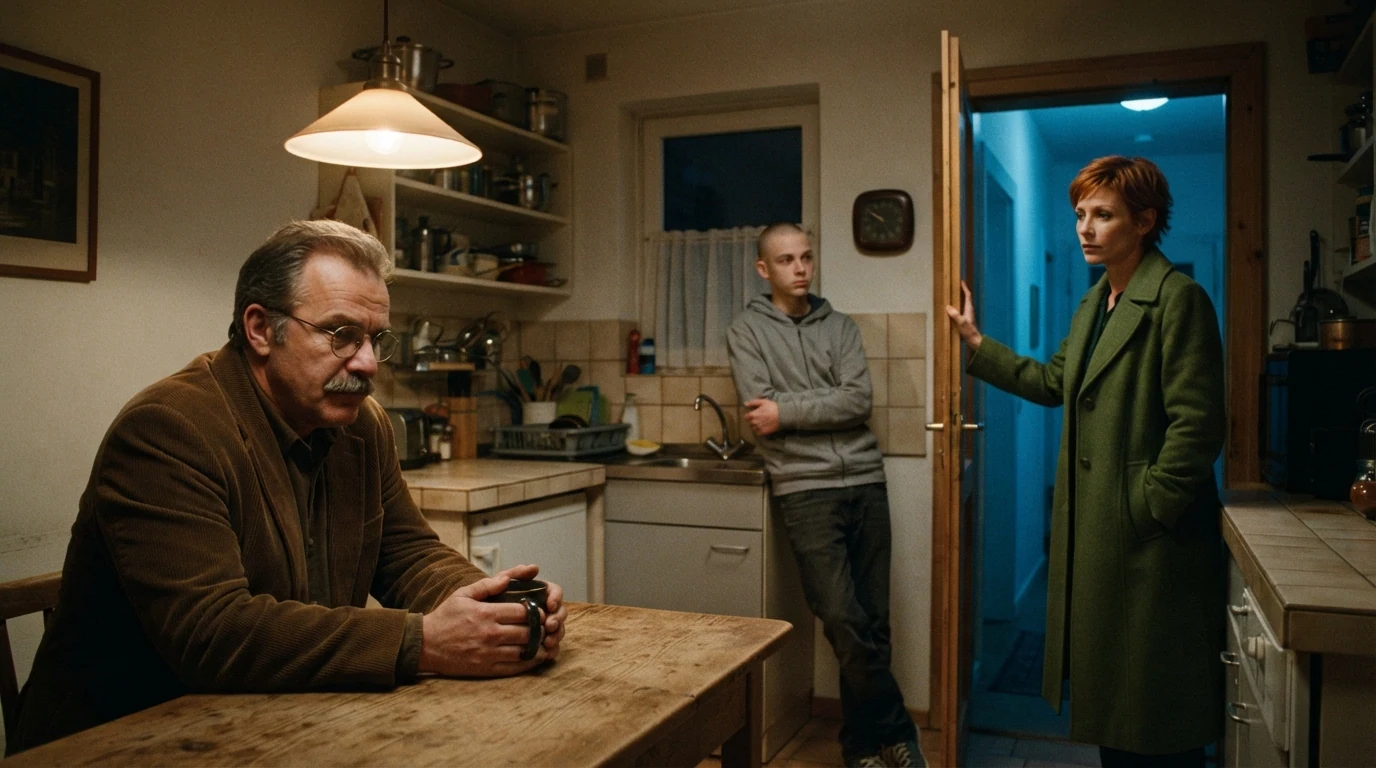
The prompt is a floor plan in words: foreground left, middle distance, center and background right put three people on three planes, while sits, stands in the open doorway and leans against the sink give three heights. Turned half away and looking at him fix the eyelines. 24mm and deep focus keep everyone sharp.
Open FlashBoardsCinematic film still, widescreen, 32mm lens, camera at seated head height at one end of a long narrow night-train carriage, staging in depth along the aisle. Extreme foreground right, soft and large: the shoulder and profile of a young woman with tight black braids and a mustard scarf, seated by the window, looking down the aisle. Middle of the aisle, sharp: a heavy-set man in his sixties with a white goatee and a navy conductor's uniform walks toward camera, ticket punch in hand. Far end of the carriage, small: a thin man in a black raincoat rises from his seat and looks back at the conductor. Warm overhead strip lights, dark windows, subtle film grain.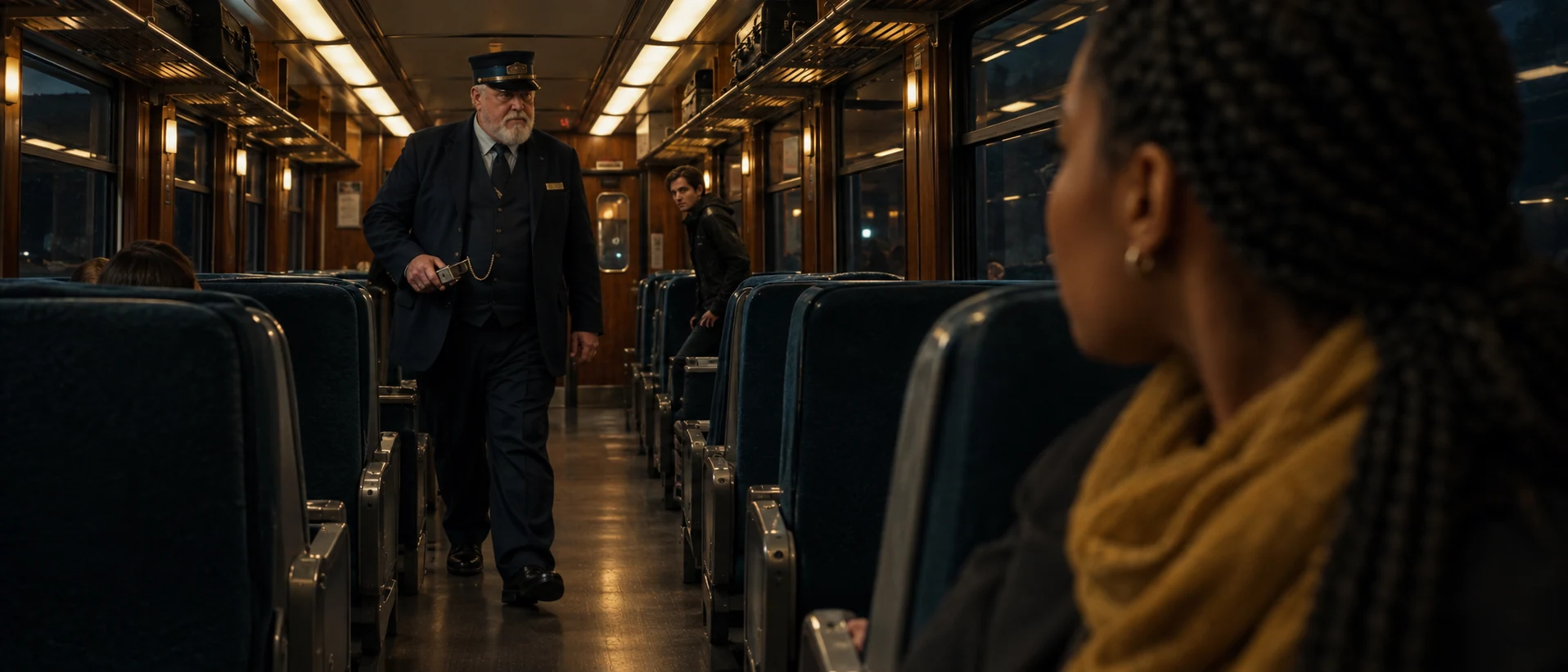
Here the tension runs along the lens axis instead of across the frame. Extreme foreground, middle of the aisle and far end build three planes; walks toward camera and rises … looks back set two converging moves. Soft and large tells the model where focus falls, and 21:9 keeps the eye traveling down the aisle.
Open FlashBoardsCamera: locked-off wide at eye level, then a very slow push toward the table in the final moments. Action: The woman in the green coat lets go of the door frame and immediately walks across the kitchen toward the table, steady and unhurried. As she passes the sink, the teenage boy unfolds his arms and turns his head to follow her. She stops at the table opposite the man, pulls out the chair and stays standing with both hands on its back. The man sets the mug down and slowly looks up at her.Lets go of the door frame and immediately walks starts the move on the first frame, so the model animates the blocking instead of creeping in on a still. The path has clear stops: doorway, sink, table. Stays standing keeps her above the seated man at the end, which is the point of the move.
Open FlashBoards{
"output": "Full-screen live-action scene from Men in Black II (2002), from its very first frame: one continuous locked-off wide shot, no cuts. Early-2000s 35mm, a steel-gray agents' locker room deep inside a sleek headquarters: perforated gray metal lockers along the left wall, a back wall of large round frosted panels glowing bright white, dark gray carpet, one low steel bench on the left, a single pale gray swan-shaped swivel chair standing alone right of centre. Cool desaturated blue-gray palette, the glowing circles are the main light and throw the right-hand figures into near silhouette, light film grain.",
"characters": {
"S1": {
"name": "Kay, played by Tommy Lee Jones",
"look": "lean man in his late fifties, weathered face, short graying hair, black suit, white shirt, black tie, wristwatch on his left wrist",
"voice": "dry, low Texas drawl, unhurried"
},
"S2": {
"name": "Jay, played by Will Smith",
"look": "slim man in his early thirties, close-cut dark hair, crisp white shirt with the sleeves down, thin black tie, black trousers, jacket off",
"voice": "quick, a little sulky"
},
"S3": {
"name": "a stocky bearded agent with no lines",
"look": "heavy-set man in his forties, dark swept-back hair, short dark beard, black suit, black shoes",
"voice": "silence: he never speaks"
}
},
"shots": [
{
"shot": 1,
"camera": "static, locked-off wide from a low tripod at seated-chest height, slight low angle, 28mm feel, deep focus, the frame never moves: S1 and S2 on the bench in the left third, open carpet in the middle, the lone swan chair in the right-centre mid-ground",
"action": [
"BEGINNING: alive from the first frame, S1 sits on the left end of the bench leaning forward, forearms on his thighs, his screen-right hand on his knee, head turned to screen right toward S2's face; S2 sits close on his right, hands resting on his knees, head turned to screen left toward S1; S3 is striding into frame from the right edge in the near foreground, big and dark against the glowing wall, walking away from camera and to the left toward the swan chair.",
"THEN: S3 walks deeper across the carpet with his back half to camera, reaches the swan chair and turns to screen left so that he faces the bench in profile; S2's head swings to screen right to watch him arrive while S1 keeps his eyes on S2.",
"THEN: S3 bends at the waist and lowers himself slowly into the swan chair, one hand reaching for the armrest; S2 lifts his screen-right hand from his knee in a small open-palm shrug, still glancing at S3.",
"THEN: S2 turns his head back to screen left toward S1; S1 has not moved.",
"END: S3 sits settled in the swan chair in profile facing screen left toward the pair, hands on his thighs, several meters of empty carpet between him and the bench; S1 and S2 stay close together on the bench on the left, the frame split into the pair and the man alone."
],
"dialogue": [
{
"speaker": "S1",
"on_screen": true,
"when": "early in the shot, while S3 is still walking in",
"delivery": "dry, teasing, head turned to S2",
"line": "<d>[English] Still sulking?</d>"
},
{
"speaker": "S2",
"on_screen": true,
"when": "right after, as S3 reaches the chair",
"delivery": "flat denial",
"line": "<d>[English] No.</d>"
},
{
"speaker": "S1",
"on_screen": true,
"when": "immediately after S2's denial",
"delivery": "unconvinced",
"line": "<d>[English] Yeah.</d>"
},
{
"speaker": "S1",
"on_screen": true,
"when": "as S3 sits down, to the end of the shot",
"delivery": "gruff, almost kind",
"line": "<d>[English] Hell, you miss her.</d>"
}
]
}
],
"sound": {
"ambience": "low air-conditioning hum of a sealed room, S3's leather-soled footsteps on the carpet, the swivel chair creaking as he sits",
"speech": "exactly these spoken phrases, each said once, in this order",
"never_spoken": "no narration and no voice-over: the descriptions, performance notes and step words of this prompt are never spoken aloud",
"music": "a film score under the scene, always below the voices: soft muted strings with a slow, wistful low woodwind line",
"subtitles": "none"
}
}Remakes the locked-off wide in Men in Black II (2002) where a bearded agent crosses the locker room and sits alone facing Kay and Jay, keeping the static low wide, the entrance from the right foreground, the dialogue and the empty carpet between them.
The prompt is structured JSON: Kay and Jay by name on the bench, the lone swan chair, one path for the third man with clear stops (enter, reach the chair, turn, sit facing the pair) and the lines verbatim from the film. The camera never moves, so the distance he chooses is the whole statement.
Open FlashBoardsCommon mistakes
- Everyone in a row. Models line people up facing the lens like a group photo. Name a plane and a facing direction for each person.
- Same height for all. Without sits, stands or leans, every figure comes out standing and the status disappears.
- Eyelines to camera. Say who each person looks at (looking at him, watching both).
- Soft backgrounds. A pleasant blur hides the person deep in the room. Ask for deep focus and a wider lens.
- Drift instead of blocking. A mood-only video prompt gets a slow push on a frozen scene. Start the move in the first sentence and give one path with clear stops.
- Walk-ons. Mentioning a hallway or crowd can add new people. Describe only who is already in the start frame.
Keep the reference frames, prompts and every generated take side by side — images and video in one canvas.
FAQ
5 questionsWhat does blocking mean in film?
Blocking is the planned movement and positioning of actors and camera within a scene. The director decides where each character stands, when they move, how close they get and where the camera sits for each part of the action. Good blocking makes movement carry meaning and gives the editor shots that cut together.
How do you block a scene?
Break the scene into beats and give each beat a motivated move. Sketch a top-down floor plan with actor positions, arrows for moves and camera setups. Walk the scene with the actors, keep what feels natural, then tape marks on the floor. Light the marked positions, rehearse on camera, and make sure every key reaction is covered before you shoot.
What is the difference between blocking and staging?
In practice they mean nearly the same thing. Staging is the broader word for arranging actors in a space, while blocking is the working set term for the specific marks and moves, tied to camera positions and rehearsed until they repeat.
What is a blocking rehearsal?
A blocking rehearsal is the first run of a scene on set, done by the director and actors while key crew watch. It fixes where people move and stop. Afterward the crew tapes marks, the cinematographer plans light and camera for those spots, and stand-ins take over while the set is lit. The usual order is block, light, rehearse, shoot.
Why is blocking important in film?
Blocking tells the audience what dialogue does not: who holds power, who is isolated, who is closing in, when a relationship changes. It steers the eye in a wide frame and sets a scene's rhythm. It also decides whether the scene can be edited, because shots only cut together when actors hit the same marks and moves in every take.
Related terms
5- Mise-en-ScèneFilm History & Theory
Mise-en-scène is everything placed and arranged in front of the camera — setting, props, costume, makeup, lighting, and the actors' positions and movement — and how it is composed in the frame to create meaning.
- CoverageDirecting & Staging
Coverage is the full set of shots filmed for one scene — master, singles, over-the-shoulders, inserts, reactions — that gives the editor choices of pace, emphasis and performance.
- Master ShotDirecting & Staging
A master shot records an entire scene in one continuous take, usually wide enough to hold every actor, and serves as the backbone the rest of the coverage is cut into.
- Depth LayeringComposition & Framing
Depth layering builds a shot in distinct planes — foreground, midground and background — each holding something meaningful, so the flat screen gains volume and several actions or ideas can be read at once.
- Screen DirectionComposition & Framing
Screen direction is the left-to-right or right-to-left way characters move and look across the frame; keeping it consistent between shots tells the audience where people are heading and who is chasing whom.
Further reading
Steven D. Katz, Film Directing Shot by Shot: Visualizing from Concept to Screen (Michael Wiese Productions). David Bordwell, Figures Traced in Light: On Cinematic Staging (University of California Press). Alexander Mackendrick, On Film-making (Faber and Faber).