 FlashBoards Learn
Editing · Film language
Montage
Also called: montage sequence, training montage, Soviet montage
A montage is a sequence of short shots, usually carried by music, that compresses time or builds one idea — weeks of training, a marriage, a city waking up — into a minute or two. Instead of showing events in full, it shows their highlights and lets the audience fill the gaps.
- What it does
- Compresses days, months or years into a minute and shows change the story needs but cannot afford to play in real time.
- Use it when
- A character must visibly progress (skill, love, ruin, success) and the steps matter less than the arc.
- Watch out
- A string of pretty shots with no before and after is a music video, not a montage; every sequence needs a start state and an end state.
- Try this prompt
training montage beat, fictional young boxer with a copper braid sprinting up wet concrete stairs at dawn, low angle, 35mm, breath steaming, sodium lamps
What is a montage in film?
In English-language filmmaking, a montage (or montage sequence) is a self-contained run of brief shots that summarizes action across time or space. A boxer goes from wheezing on the stairs to sprinting up them; a couple meets, marries and grows old. The shots are usually cut to a song or a score cue, with little or no synchronous dialogue, and the whole thing lasts from thirty seconds to a few minutes.
The word causes confusion because it has two meanings. In French and Russian, montage simply means film editing — the whole craft of putting shots together. In English it narrowed to this specific device. And in film theory, Soviet montage names a 1920s school that treated the cut itself as the source of meaning. This article covers the last two separately.
What makes a montage different from ordinary scene editing:
- Time is openly compressed. Continuity editing hides the gaps between shots; a montage announces them. Each cut may skip an hour or a year. It is the most direct tool for showing the passage of time.
- Shots are units of an argument, not of a scene. Each image stands for many similar moments — one sit-up stands for a thousand.
- Music replaces the scene's own sound. The track gives the fragments a shared rhythm and an emotional line.
- There is an arc. A good montage starts in one state and ends in another. The last shot is a payoff, often held longer than the rest.
Structurally, a montage is one sequence bridging two scenes that play in real time.
What is Soviet montage theory?
In the 1920s a group of Soviet filmmakers — Lev Kuleshov, Sergei Eisenstein, Vsevolod Pudovkin and Dziga Vertov — argued that cinema's power lives in the cut, not in the individual shot. Kuleshov's workshop showed that viewers read the same face differently depending on the image placed next to it, the result now known as the Kuleshov effect.
Eisenstein pushed hardest. For him a cut was a collision: shot A plus shot B produces an idea contained in neither, much as two characters combine into a new word. In Strike (1925) he cuts the massacre of workers against the slaughter of a bull; the audience draws the comparison. In Battleship Potemkin (1925) the Odessa Steps sequence fragments one event into dozens of angles — boots, faces, a runaway pram — stretching and shattering real time rather than compressing it. That is the key difference from the Hollywood sense: Soviet montage is about meaning through juxtaposition, not about summarizing weeks of story.
Eisenstein described several methods, from the plainest to the most abstract:
- Metric — cuts at fixed lengths, regardless of content, to set a pulse.
- Rhythmic — cut lengths follow movement inside the frame.
- Tonal — shots grouped by their emotional tone: light, shape, texture.
- Overtonal — the combined effect of the first three over a whole passage.
- Intellectual — images combined to express an abstract idea, as in the bull and the workers.
Vertov's Man with a Movie Camera (1929) applied the same thinking to a city: a day of work and leisure built from hundreds of fragments, with no plot at all. That "city symphony" line runs through Koyaanisqatsi (1982).
In the 1930s Hollywood hired montage specialists such as Slavko Vorkapich to build short transition sequences — spinning headlines, falling calendar pages. The collision theory was traded for a practical job: get the story from here to there, fast.
Why filmmakers use a montage sequence
A montage solves a structural problem: the story needs a change that takes months, and the film has ninety seconds for it.
Compressing a process. The training montage is the familiar case, but the same logic serves building a house, planning a heist, studying for an exam or rising in a criminal empire, like the "Push It to the Limit" run in Scarface (1983).
Summarizing a relationship. The "Married Life" sequence in Up (2009) covers decades of a marriage in about four wordless minutes scored by Michael Giacchino. It works because it repeats motifs — the savings jar, the tie, the hill — and changes them each time, so the audience tracks time and loss at once.
Showing decline. In Citizen Kane (1941) a series of breakfast-table scenes, linked by whip pans, shows a marriage cooling over years: the table gets longer, the talk shorter, until the couple read rival newspapers. In Requiem for a Dream (2000) a repeated set of fast, sound-stamped extreme close-ups — pills, dilating pupils — makes the ritual of addiction feel mechanical.
Releasing emotion that has been held back. The ending of Cinema Paradiso (1988) is a montage of kisses a priest once cut out of the films. The images belong to other movies; the meaning comes entirely from what the audience knows about the man watching them.
The cost is intimacy. A montage keeps the viewer at a distance from any single moment, so it rarely carries a turning point. The decision to train belongs in a scene; the training itself goes in the montage; the fight it prepares for is a scene again. Montage also changes the pace of a film sharply, which is why editors often place one where the story needs a lift after a heavy dialogue stretch.
What makes a good training montage?
The training montage became a genre of its own after Rocky (1976): Rocky's early-morning runs through Philadelphia, cut to Bill Conti's "Gonna Fly Now," end on the steps of the Philadelphia Museum of Art with his arms in the air — the same steps that left him winded and doubled over earlier in the film. Rocky IV (1985) turned it into a cross-cut duel, alternating his farmhouse training in the snow with his rival's high-tech lab. Mulan (1998) staged it as a song, "I'll Make a Man Out of You," where the recruits fail a task at the start and the hero solves it at the end.
The pattern behind the ones that work:
- Show the failure first. The opening beats establish what the character cannot do: the dropped weight, the missed punch, the arrow nobody can retrieve.
- Repeat one test. Return to the same exercise two or three times so progress is measurable on screen.
- Change the conditions. Rain, night, snow, a crowd joining the run — the world escalates with the character.
- Pay off with a shot that echoes the first failure. Same angle, same place, opposite result. The payoff shot is usually the longest in the sequence.
- Cut to the music's structure. Build through verses, save the widest and most heroic images for the final chorus.
Audiences know these steps before they happen. That familiarity lets you skip setup, but it also makes a lazy training montage feel like a cliché instantly.
How to shoot and cut a montage
A montage is written in the edit but won or lost in planning. Treat it as its own short film with a beginning, middle and end.
Write the arc in one line. "She can't run a mile; by winter she runs the harbor wall at dawn." Everything you shoot should serve that before and after.
Budget the shots. A 90-second music cue typically holds 20–40 shots at 2–4 seconds each; a fast-cutting climax may drop to half a second per shot. Shoot about twice as many beats as you plan to use. Beats are cheap to cover and costly to reshoot.
Cover each beat in several sizes. For every action, get a wide for geography, a medium for effort and an insert shot for detail: the taped knuckles, the stopwatch, the calendar. Inserts are the glue; they let you cut anywhere without continuity problems.
Plan a visual progression. Change light, weather and wardrobe across beats so time reads instantly: first-light blue to noon white to golden hour, bare trees to leaves. Keep one element constant — a location, a prop, a framing — so the change registers against it.
Design the transitions. Hard cuts on the beat feel energetic; a dissolve between beats feels reflective and says "time is passing." A match cut — the same gesture in two different years — is the most elegant bridge montage has.
Pick the music early. Temp the montage to the real track, or at least the same tempo, before the shoot, and time key actions to musical phrases. A 120 BPM song gives a beat every half second; cutting every two or four beats keeps the sequence locked to it.
Give it a button. End on a held shot that lands the change — the fighter at the top of the stairs, the finished boat, the empty chair. Without it, the montage just stops.
On set, work from a list of beats rather than scenes, with a small crew, a light handheld or gimbal rig and lenses around 25–85mm.
Montage vs. cross-cutting
Both cut rapidly between different images, and they are often combined, but they do different jobs.
- Cross-cutting alternates between two or more lines of action happening at roughly the same time in different places. Its engine is simultaneity and suspense: will the rescue arrive before the train?
- A montage summarizes one line of action across a long span of time. Its engine is compression: we skip the months and see the change.
The baptism in The Godfather (1972) is the classic hybrid. It cross-cuts Michael at the font with the killings of rival family heads, and because the church organ and the liturgy carry across every location, it plays like a montage — one idea, Michael's double oath, built from fragments.
A quick test: if you could reorder the shots within each strand without breaking the story, you have a montage. If each shot depends on the one before it in the same strand — a fuse burning shorter — you are cross-cutting.
Montage in motion
7 clipsA montage only exists in motion, so watch the cuts rather than any single frame. Notice how short each shot is, what repeats from one fragment to the next, and the one idea the pieces add up to: a ritual, a preparation, a city, a career.
How to create a montage with AI
4 promptsAI will not cut a montage for you, but it is the fastest way to previsualize one: generate each beat as a frame, animate the ones that need motion, and lay them out in order to check the arc before anyone shoots. On a FlashBoards board the reference frames, every take and the beat list sit side by side, so you can see whether the first and last shots really rhyme. The fourth prompt re-shoots a real film shot from a text description alone, and the original plays next to the result so you can compare.
Opening beat of a training montage: a fictional young boxer, a woman in her late twenties with shaved sides, a short copper braid and a thin scar through her left eyebrow, grey hooded sweatshirt and taped hands, sprinting up a long flight of wet concrete stairs in a harbor town at dawn, camera low on the steps looking up at her, 35mm lens, blue first light with orange sodium lamps still on, her breath steaming, rain-dark walls on both sides, gritty 1970s film grain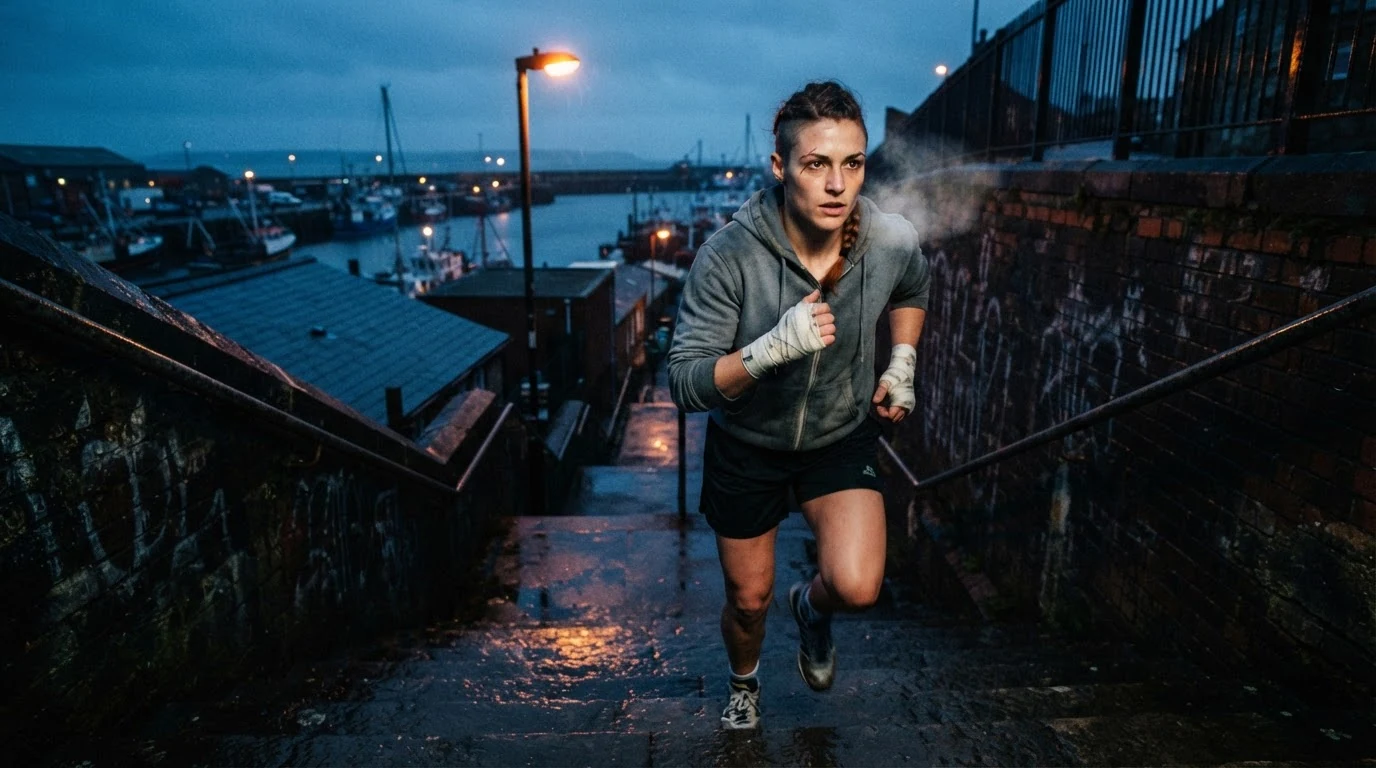
"Opening beat" plus the struggle cues set the start state of the arc. The scar, braid and taped hands make her clearly fictional and easy to repeat word for word in later beats. "Camera low on the steps looking up" and "35mm" give the heroic stair shot; dawn with the lamps still on stamps the time of day, which the montage will change.
Open FlashBoardsNine-panel storyboard sheet for a wordless relationship montage, three rows of three frames with thin white gutters, the same fictional couple in every panel: a tall man with a gap in his front teeth and a sandy beard, a short woman with a black bob and a red knitted scarf. Panels in order: meeting on a ferry deck, painting a small blue boat together, dancing in a kitchen, carrying a crib up narrow stairs, arguing by a rainy window, repainting the boat with a child, both grey-haired on the ferry deck, the man alone on the deck, the scarf tied to the boat's mast. Same ferry deck framing in panels 1, 7 and 8, warm film color, cinematic 35mm look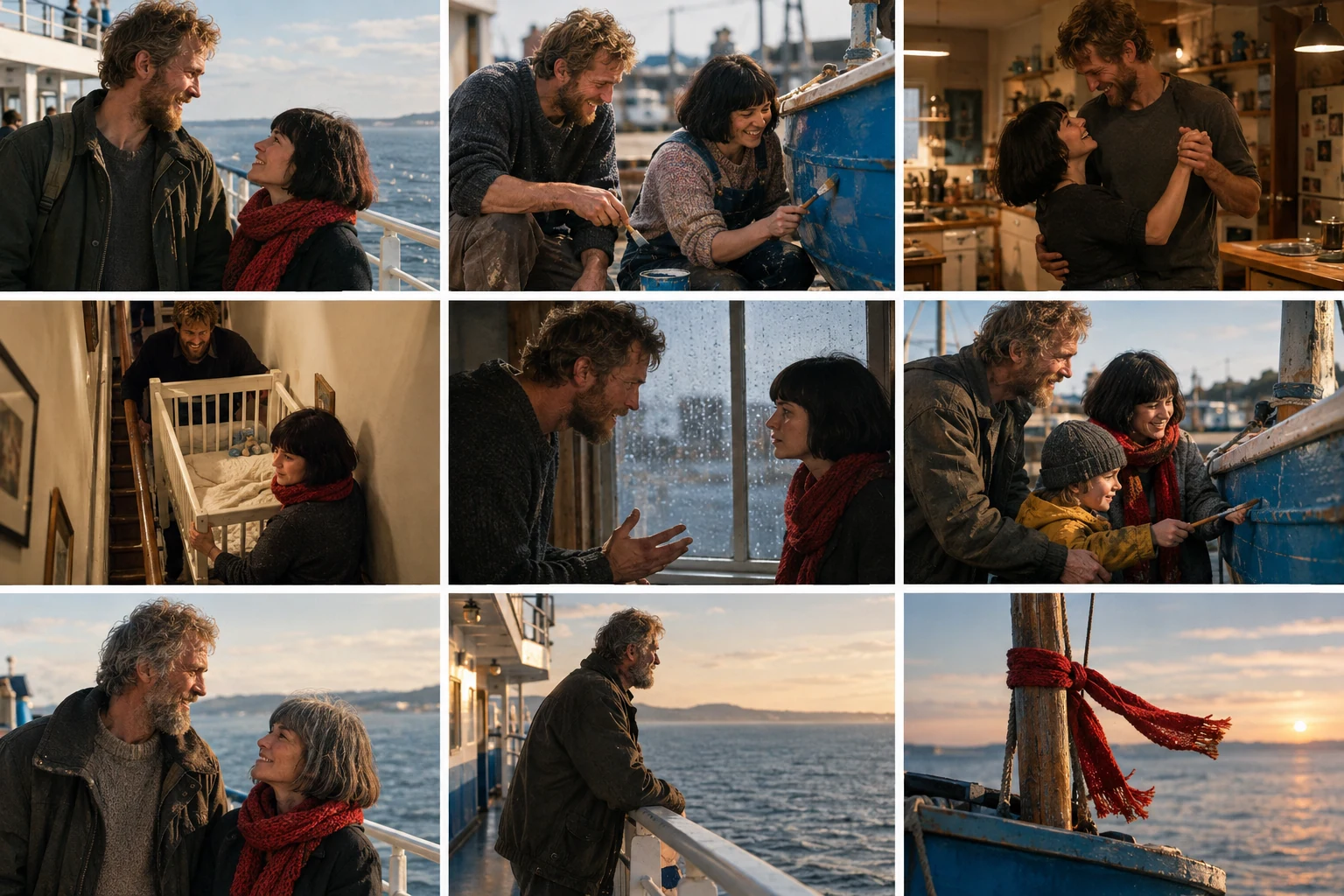
A storyboard grid lets one generation hold the whole arc, so you can judge the sequence, not just a frame. Repeating "the same ferry deck framing" in three panels builds the motif that makes a life montage work; the scarf and the boat are recurring props that change meaning across time. Numbering the panels in order keeps the model from shuffling the story.
Open FlashBoardsCamera: handheld, low on the steps, backing up the stairs at her running speed and keeping her framed from the knees up. Action: She is already sprinting, arms pumping, breath steaming. Halfway up her foot slips on a wet step and she catches herself with one taped hand on the concrete. She pushes off and keeps climbing, jaw set, then slows near the top, bent forward and breathing hard.The first sentence of the action puts her in full motion, so the clip is alive from frame one instead of drifting in on a still. The slip is the failure the montage needs at the start. You will use two or three seconds in the cut; a complete action gives the editor choices.
Open FlashBoards{
"output": "Full-screen live-action musical drama from Les Misérables (2012) from its very first frame: seven locked-off shots joined by six hard cuts, a montage of a poor Paris street in winter, each shot a different corner of the same misery. 1830s Paris, overcast flat daylight, cold rain and slush on cobbles, desaturated blue-green palette with muddy browns, soft 35mm film grain.",
"characters": {
"S1": {
"name": "the Beggars' Chorus, the poor of Paris",
"look": "never seen singing: only the ragged townspeople of the shots, in worn wool coats, caps and shawls",
"voice": "a rough unison chorus of men and women, sung, low and weary"
}
},
"shots": [
{
"shot": 1,
"camera": "locked-off, eye level, wide, from inside a dark doorway, the black doorframe down the left edge, the rain-grey street bright through the opening at top left",
"action": [
"BEGINNING: alive from the first frame, a man in a torn grey-brown coat and cap, left of centre, bent forward, steps backward toward screen left, gripping the legs of a limp body.",
"THEN: a bald old man sitting on the floor at right, face lit, lifts the body's shoulders with both hands, looking up-left at the other man.",
"END: the body hangs between them, a foot off the wet floor."
],
"dialogue": [],
"voice": "silence: nobody speaks in this shot, no voice at all"
},
{
"shot": 2,
"cut_at": "00:01.293",
"camera": "locked-off, eye level, medium wide, under a sagging canvas awning, blurred round loaves in the near lower left foreground",
"action": [
"BEGINNING: behind a market stall, a woman in a blue bodice and a white cap, centre left, stands with head bowed, two women and a bald man in shawls beside her.",
"END: nobody moves; they stare down at the empty stall."
],
"dialogue": [],
"voice": "silence: nobody speaks in this shot, no voice at all"
},
{
"shot": 3,
"cut_at": "00:02.169",
"camera": "locked-off, eye level, wide, a grey street in falling rain",
"action": [
"BEGINNING: a wooden handcart heaped with round golden loaves stands right of centre, a man in a long dark coat standing still at left.",
"END: the cart rolls slowly toward screen left, dark-coated figures walking beside it."
],
"dialogue": [],
"voice": "silence: nobody speaks in this shot, no voice at all"
},
{
"shot": 4,
"cut_at": "00:03.003",
"camera": "locked-off, eye level, medium wide, straight on through vertical rusted iron bars filling the frame",
"action": [
"BEGINNING: behind the bars at left, a bearded man in a battered cap holds a small girl in a pale blue dress; thin children stand beside them, a man in a cap at far right.",
"END: they stay still, looking out through the bars."
],
"dialogue": [
{
"speaker": "S1",
"on_screen": false,
"when": "right at the cut to this shot",
"delivery": "a ragged off-screen chorus of men and women sings in unison, low and weary, on the beat of the score; nobody in frame moves their lips",
"line": "<d>[English] At the end of the day <scenetrans></d>"
}
]
},
{
"shot": 5,
"cut_at": "00:03.837",
"camera": "locked-off, eye level, wide, a high soot-dark brick wall with torn pale posters filling the frame",
"action": [
"BEGINNING: two ragged figures huddle small at the foot of the wall, bottom left: one bent with face in hands at the far left, one in a blue cap at left of centre.",
"END: the one in the blue cap blows into cupped hands."
],
"dialogue": [
{
"speaker": "S1",
"on_screen": false,
"when": "carried straight over the cut, the same sung line",
"delivery": "the same off-screen chorus, sung on the beat; nobody in frame moves their lips",
"line": "<d>[English] <scenetrans> you're another <scenetrans></d>"
}
]
},
{
"shot": 6,
"cut_at": "00:04.463",
"camera": "locked-off, eye level, medium, a whitewashed brick wall behind her",
"action": [
"BEGINNING: a young woman with frizzy auburn hair piled up, mustard shawl over a torn pale bodice, sits against the wall at left of centre.",
"END: she keeps her head turned toward screen right, eyes down, mouth closed."
],
"dialogue": [
{
"speaker": "S1",
"on_screen": false,
"when": "carried straight over the cut, the same sung line",
"delivery": "the same off-screen chorus, sung on the beat; nobody in frame moves their lips",
"line": "<d>[English] <scenetrans> day <scenetrans></d>"
}
]
},
{
"shot": 7,
"cut_at": "00:05.047",
"camera": "locked-off, low, wide, from behind the crowd, a blurred dark shoulder in the near left foreground, pale fog ahead",
"action": [
"BEGINNING: backlit dark silhouettes shuffle away down the wet street into white fog.",
"END: a small child silhouette walks away among them in the lower centre."
],
"dialogue": [
{
"speaker": "S1",
"on_screen": false,
"when": "right after the cut, ending the sung line",
"delivery": "the same off-screen chorus, sung on the beat; nobody in frame moves their lips",
"line": "<d>[English] <scenetrans> older</d>"
}
]
}
],
"sound": {
"ambience": "cold rain on cobbles, cart wheels on wet stone, a low murmur of the crowd",
"speech": "exactly these sung words, one line of the chorus carried over the cuts, each fragment sung once, in this order",
"never_spoken": "no narration and no voice-over: the descriptions, performance notes and step words of this prompt are never spoken aloud",
"music": "a film score under the scene, always below the voices: a heavy low orchestral march with brooding strings and a slow pounding pulse",
"subtitles": "none"
}
}Remakes the street montage from Les Misérables (2012): the prompt keeps its seven locked-off shots in order, from the body dragged through a doorway to the crowd fading into fog, with the chorus line and cut times of the original.
A montage is many shots, so the prompt is structured JSON: each fragment gets its own camera, place and small action, and the cut_at values copied from the original are the only timing. The one sung line of the chorus is split across the cuts it runs over, so the voice binds the fragments while the locked-off frames stay still and the cuts do the work.
Common mistakes
- One frame, no arc. Models produce a single beautiful image; a montage needs a before and after. Prompt the opening beat and the payoff beat separately, with the same framing and opposite results.
- Character drift. The face and wardrobe change from beat to beat. Paste the same descriptor string (scar, braid, taped hands) into every prompt and keep the best frame on the board as reference.
- Everything in the same light. Without explicit time cues every beat looks like the same afternoon, and time stops passing. Name the hour, the weather and the season in each prompt.
- Asking a video model for the cuts. Prompts like "fast montage of training shots" produce a muddled single shot. Generate one shot per beat and cut them together in the edit, or spell out every shot and its cut time, as the fourth prompt does.
- Stock-photo motivation. "Inspiring athlete" returns clean, posed gym imagery. Ask for effort and wear: sweat, grime, chipped paint, torn tape.
Keep the reference frames, prompts and every generated take side by side — images and video in one canvas.
FAQ
5 questionsWhat is a montage in film?
A montage is a sequence of short shots, usually set to music, that condenses a long stretch of story time into a minute or two. It shows the highlights of a process — training, falling in love, building something, falling apart — and trusts the audience to fill in the rest. It starts in one state and ends in another, often with a longer payoff shot.
What is a training montage?
A training montage shows a character gaining a skill over weeks or months through a run of brief exercise shots cut to music. Rocky (1976) set the template: early failures, repeated tests, harsher conditions, and a final shot that echoes the first failure with the opposite result. It lets a film skip the tedium of practice while keeping the sense of effort.
What is Soviet montage?
Soviet montage is a 1920s film theory and practice developed by Kuleshov, Eisenstein, Pudovkin and Vertov. It holds that meaning is created by the collision of shots rather than contained in any single one. Eisenstein's Strike and Battleship Potemkin (both 1925) are the textbook examples, using contrasting images and fragmented action to produce ideas and emotion the individual shots lack.
How long should a montage be?
Most feature-film montages run 30 seconds to 3 minutes, usually the length of a music cue or a trimmed song. Beyond that the audience starts to miss scenes and dialogue. Shot length depends on the tempo: 2–4 seconds per shot for a reflective montage, a second or less for an energetic climax. Always end with a held payoff shot.
Is montage the same as editing?
In French and Russian, yes: montage is the ordinary word for editing. In English, montage means a specific kind of sequence that compresses time, while editing is the whole craft of selecting and ordering shots. Continuity editing hides the gaps between shots; a montage openly skips time between them, and that is the key difference.
Related terms
7- Film EditingEditing
Film editing is the selection and ordering of shots — where each one starts, ends and what follows it — to build continuity, rhythm and meaning out of the raw footage.
- Cross-CuttingEditing
Cross-cutting alternates between two or more lines of action happening in different places, usually at the same time, so each strand builds tension or meaning against the other.
- Passage of TimeStorytelling
Showing the passage of time means telling the audience that hours, seasons or years have gone by — through montage, dissolves, time-lapse, title cards, changing light or aging characters.
- JuxtapositionEditing
Juxtaposition places two contrasting images side by side — in one frame or across a cut — so their collision creates a meaning neither has alone.
- Kuleshov EffectEditing
The Kuleshov effect is the finding that viewers read the same neutral face differently depending on the shot cut next to it — food, a coffin, a child — so meaning comes from the edit, not the single shot.
- Fast CuttingEditing
Fast cutting strings together many very short shots in quick succession to create energy, chaos or overload — common in action, trailers and music videos.
- DissolveEditing
A dissolve blends one shot into the next: the first fades out while the second fades in over the same frames, briefly overlapping — often to mark passing time or link two ideas.
Further reading
Sergei Eisenstein, Film Form: Essays in Film Theory (1949). Karel Reisz and Gavin Millar, The Technique of Film Editing. Walter Murch, In the Blink of an Eye.