 FlashBoards Learn
Editing · Film language
Fast Cutting
Also called: quick cuts, rapid cutting, MTV-style editing
Fast cutting is an editing style that strings together many very short shots, often a second or less each, in quick succession. It raises the viewer's pulse: action feels faster, comedy lands harder, and at the extreme the audience is pushed into overload. It is standard in action films, trailers and music videos.
- What it does
- Packs many short shots into a few seconds so the scene feels faster, denser and more urgent than real time.
- Use it when
- You need energy, impact or chaos: a fight, a chase, a gearing-up sequence, a comic routine, a trailer build.
- Watch out
- Cut too fast with no anchor shot and the audience loses geography; speed without clarity reads as noise.
- Try this prompt
extreme close-up insert, tattooed hand snapping a steel carabiner shut, hard white work light, motion blur on fingers, 35mm film grain
What is fast cutting in film?
Fast cutting (also called quick cuts, rapid cutting or MTV-style editing) changes shots far more often than the audience needs to follow the action. Each shot carries one idea, then it is gone.
The yardstick is average shot length (ASL): scene length divided by the number of shots. Classical Hollywood features averaged roughly 8 to 11 seconds per shot; many contemporary action films run at 2 to 4 seconds, and single sequences drop under one. At 24 fps a 12-frame shot lasts half a second, about the shortest time a viewer can read an unfamiliar image.
Fast cutting is a choice of rhythm, so it belongs to pacing in the wider craft of film editing.
Why do filmmakers use quick cuts?
Energy. Each cut is a small jolt. Edgar Wright turns routines into comedy this way in Shaun of the Dead (2004) and Hot Fuzz (2007): getting dressed or gearing up becomes a burst of insert shots, each stamped with a sound effect.
Compression. Requiem for a Dream (2000) reduces each drug ritual to a rapid chain of extreme close-ups, so the habit plays as a mechanism.
Chaos. In The Bourne Ultimatum (2007), editor Christopher Rouse cut the handheld fights so fast that the viewer shares the confusion; he won the Oscar for editing. Whiplash (2014) cuts drum close-ups to the tempo, so the edit itself becomes the pressure.
Selling. A movie trailer accelerates its cuts toward the final beat, then stops dead on the title.
How to shoot and edit a fast-cut sequence
Fast cutting is planned on set, not rescued in the edit. A 20-second sequence at a 1-second ASL needs 20 usable shots.
- Cover every gesture from three or four positions: a wide for geography, a medium for the actor, tight inserts of hands, props and eyes.
- Overlap the action in every setup so the editor can cut on movement; the eye follows the move across the join.
- Keep an anchor. Return to the same wide or face every few cuts. That map separates exciting from confusing.
- Keep the point of interest in a similar screen position, because in a 10-frame shot nobody searches the frame.
- Choose the blur. A standard 180° shutter keeps natural motion blur; 45° to 90° gives crisp, staccato frames.
- Cut to sound. Lay music and hits first, vary lengths (8, 12, 6, 20 frames) and accelerate toward the climax.
Fast cutting vs. flash cut vs. jump cut
- Fast cutting is a rhythm: a whole sequence of short shots, each a different image.
- A flash cut is a single shot of a few frames dropped into normal-paced action: a memory, a threat, an image half seen.
- A jump cut joins two shots of the same subject from nearly the same angle, so time visibly skips.
A montage is defined by purpose, compressing time or building an idea. Many montages are fast-cut, but a fast-cut fight in continuous time is not a montage.
Fast Cutting in motion

9 clipsThese clips play fast cutting at real speed. Count the cuts, notice that each shot carries one gesture or image, and look for the anchor, a wide or a face, that keeps the rush readable.
How to create a fast cutting with AI
4 promptsA video model generates one continuous shot, so fast cutting still happens in the edit. Use AI to make the pieces, single-action inserts and a sheet of beats, then check the order on a FlashBoards board where references, takes and the cut list sit side by side. The fourth prompt re-shoots a real film shot from a text description alone, and the original plays next to the result so you can compare.
Extreme close-up insert shot: the hand of a fictional bike courier, a woman with a faded blue compass tattoo on the back of her hand and chipped black nail polish, snapping a steel carabiner shut onto a black canvas bag strap, fingers mid-motion with slight motion blur, workshop bench, hard white work light from the left, background out of focus, macro look, 35mm film grain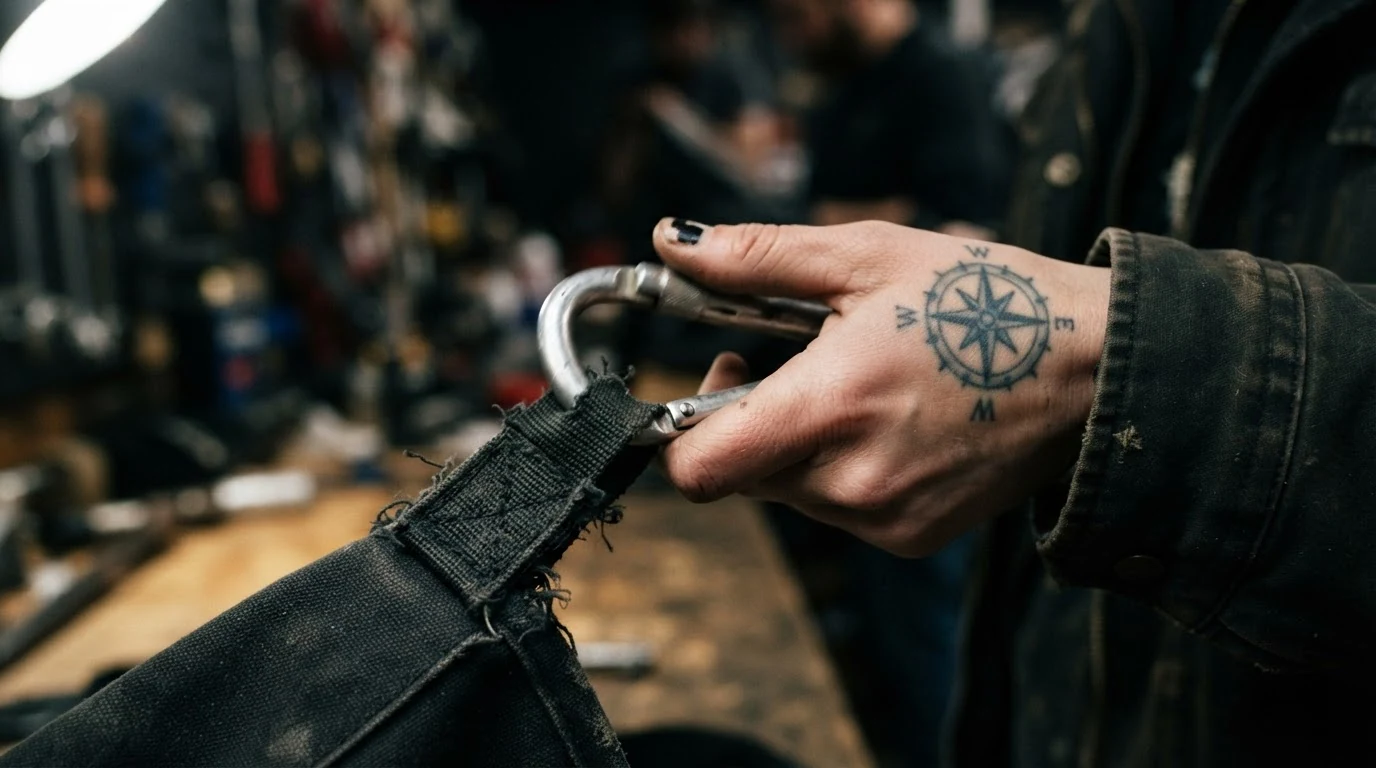
"Extreme close-up insert" plus one action gives a frame that reads in half a second, which a fast cut needs. "Mid-motion with slight motion blur" makes it feel lifted from a moving shot. The tattoo and nail polish keep the courier fictional and repeatable.
Open FlashBoardsNine-panel storyboard sheet, three rows of three with thin white gutters, extreme close-ups of the same fictional bike courier with a shaved head, a silver nostril ring and a blue compass tattoo on her hand. In order: jacket zipper pulled up, laces yanked tight, tape wrapped on a handlebar, her eye opening, chain dropped on a sprocket, carabiner snapped shut, door kicked open to daylight, rear wheel spinning, foot slamming onto a pedal. Same hard white light and teal-orange grade in every panel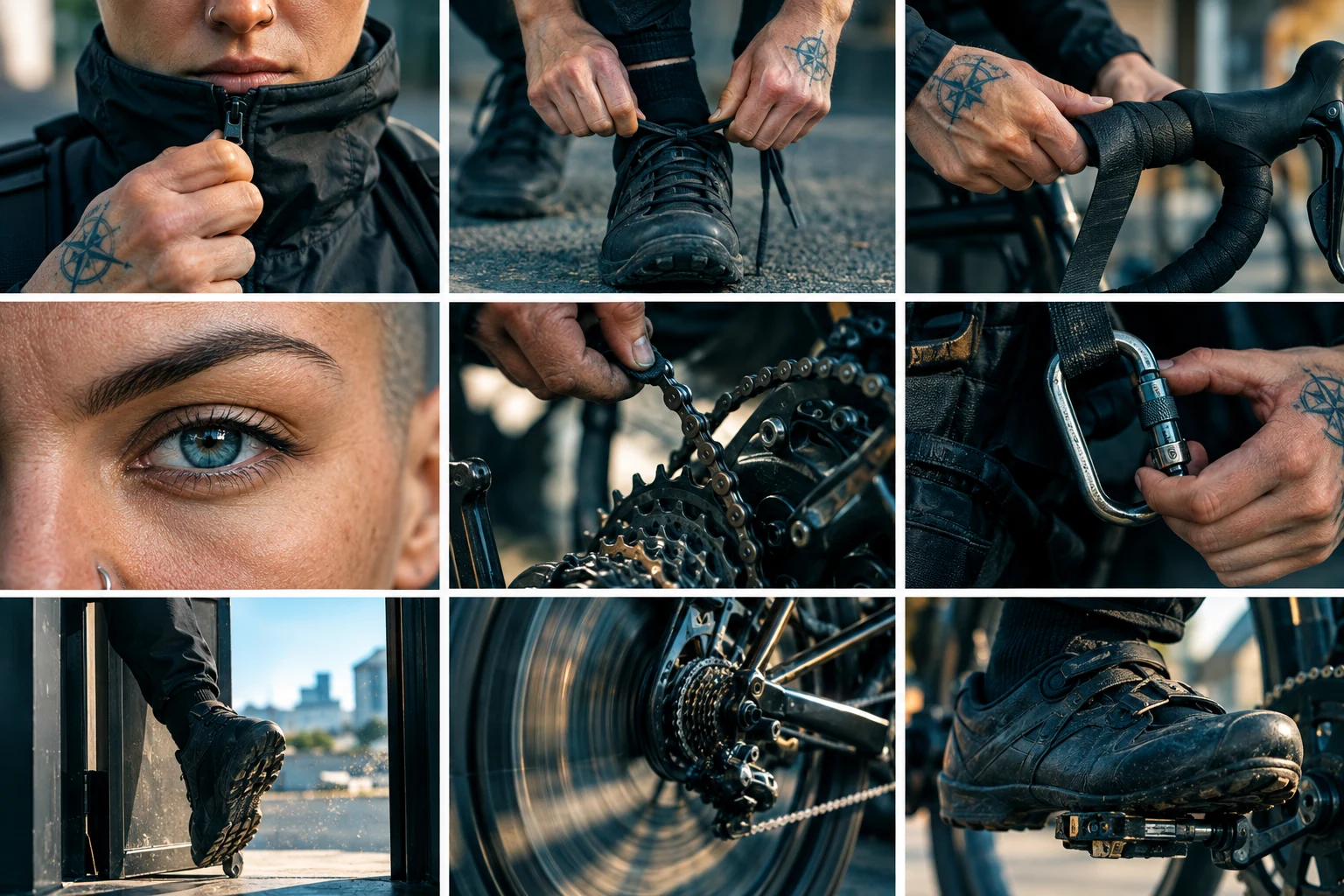
A grid holds the whole sequence, so you judge rhythm and variety, not one image. One verb per panel is how fast-cut inserts are written; the repeated light and grade keep the pieces cuttable.
Open FlashBoardsCamera: locked-off extreme close-up with slight handheld jitter, same framing throughout. Action: Her fingers are already moving fast and snap the carabiner shut. She yanks the strap tight in one hard pull, the canvas jerking upward. Her hand slaps flat on the bench, then whips out of frame to the right, leaving the strap swinging under the white work light.Starting mid-action keeps the clip alive from the first frame. Three distinct actions give three cut points: trim the clip into 8 to 15-frame pieces and intercut them with other inserts.
Open FlashBoards{
"output": "Full-screen live-action scene from The Chef, The Actor, The Scoundrel (2013), alive from its very first frame: twelve shots joined by eleven hard cuts, a fast-cut arming sequence where every shot is one grab or one gesture. 1940s China, a dim wooden hall with dark lattice screens, 35mm anamorphic grain, warm amber tungsten light with deep green shadows, saturated and smoky.",
"characters": {
"S1": {
"name": "man in the gray-green jacket (unnamed)",
"look": "pale gray-green quilted jacket, seen from the chest down, face above the frame",
"voice": "silent"
},
"S2": {
"name": "man in the felt hat (unnamed)",
"look": "wide-brim pale felt hat, brown leather vest over a patterned shirt, neckerchief",
"voice": "silent"
},
"S3": {
"name": "man in the cream tunic (unnamed)",
"look": "long cream-white cotton tunic tied with a black belt, short dark hair",
"voice": "silent"
},
"S4": {
"name": "man in the brocade collar (unnamed)",
"look": "shaved head, white jacket with a wide gold-embroidered brocade collar",
"voice": "silent"
}
},
"shots": [
{
"shot": 1,
"camera": "low angle at table height, wide lens, looking along a long wooden table; then a fast blurred whip pan to the right that ends looking across the table at S1",
"action": [
"BEGINNING: alive from the first frame, rifle stocks lie in the left foreground and a cartridge box in the centre; a long brass ammunition belt is dragged from the right side across the table, rattling over the wood.",
"THEN: the camera whips right in a smear of motion blur, the frame tipping.",
"THEN: S1 stands behind the table, centre frame, his face cut off by the top of the frame, and picks up a rifle with both hands.",
"END: he holds the rifle diagonally across his chest, muzzle toward the lower left, lattice screens and one small warm lamp behind him on the right."
],
"dialogue": [],
"voice": "silence: nobody speaks in this shot, no voice at all"
},
{
"shot": 2,
"cut_at": "00:02.000",
"camera": "close-up at waist height, S1's pale green sleeve entering from the left edge, a round embroidered emblem blurred behind",
"action": [
"BEGINNING: S1's left-side hand grips the rifle, which runs diagonally from the left down to the lower right.",
"THEN: his upper hand lifts off the rifle.",
"END: it yanks the bolt back hard."
],
"dialogue": [],
"voice": "silence: nobody speaks in this shot, no voice at all"
},
{
"shot": 3,
"cut_at": "00:02.750",
"camera": "medium shot, eye level, a pale blurred shoulder in the right foreground",
"action": [
"BEGINNING: S2 stands centre frame in front of a colourful patterned backdrop.",
"END: he whips a long curved sword horizontally across the frame, the blade a streak of light."
],
"dialogue": [],
"voice": "silence: nobody speaks in this shot, no voice at all"
},
{
"shot": 4,
"cut_at": "00:02.958",
"camera": "dark medium shot, fast handheld movement, lamp light streaking",
"action": [
"BEGINNING: a rifle swings across the top of the frame in a heavy motion blur.",
"END: S3 is centre frame in the dark, arms spread, turning toward the lens."
],
"dialogue": [],
"voice": "silence: nobody speaks in this shot, no voice at all"
},
{
"shot": 5,
"cut_at": "00:03.458",
"camera": "close-up on hands, shallow focus, S3's cream sleeve filling the right half",
"action": [
"BEGINNING: S3's hands reach to a rifle standing upright in a rack on the left.",
"END: they pull it down and out of the rack."
],
"dialogue": [],
"voice": "silence: nobody speaks in this shot, no voice at all"
},
{
"shot": 6,
"cut_at": "00:03.833",
"camera": "medium-full shot, frontal, S3 framed from the shoulders to the knees, wooden shelves behind",
"action": [
"BEGINNING: S3 swings the long rifle down across his body.",
"END: he holds it level at his black belt with both hands."
],
"dialogue": [],
"voice": "silence: nobody speaks in this shot, no voice at all"
},
{
"shot": 7,
"cut_at": "00:04.125",
"camera": "extreme close-up along a rifle lying horizontally, table height, a cream quilted sleeve in the right foreground",
"action": [
"BEGINNING: an open palm cradles the rifle from below, centre frame.",
"END: a hand on the right works the bolt forward with a snap."
],
"dialogue": [],
"voice": "silence: nobody speaks in this shot, no voice at all"
},
{
"shot": 8,
"cut_at": "00:04.667",
"camera": "top-down overhead of the whole table, locked-off",
"action": [
"BEGINNING: rifles, pistols, grenades, a round tin and a long ammunition belt lie spread on the wood.",
"THEN: hands reach in from the top-left corner, the left edge and the right edge.",
"END: they snatch weapons off the table one after another."
],
"dialogue": [],
"voice": "silence: nobody speaks in this shot, no voice at all"
},
{
"shot": 9,
"cut_at": "00:05.458",
"camera": "close-up at chest height, frontal",
"action": [
"BEGINNING: S3 holds a black pistol upright against his cream tunic.",
"END: his hand slides flat along its side."
],
"dialogue": [],
"voice": "silence: nobody speaks in this shot, no voice at all"
},
{
"shot": 10,
"cut_at": "00:05.833",
"camera": "over a blurred gray-green quilted shoulder in the left foreground, eye level",
"action": [
"BEGINNING: S3 strides toward the lens from centre-right.",
"END: he is close, arms at his sides, one hand starting to lift."
],
"dialogue": [],
"voice": "silence: nobody speaks in this shot, no voice at all"
},
{
"shot": 11,
"cut_at": "00:06.167",
"camera": "medium close-up, eye level, dark lattice screens behind, a blurred shoulder in the right foreground",
"action": [
"BEGINNING: S4 stands centre frame, facing the lens.",
"THEN: he flips a round black disc up in front of his face, covering it.",
"END: he lowers the disc to his chest again."
],
"dialogue": [],
"voice": "silence: nobody speaks in this shot, no voice at all"
},
{
"shot": 12,
"cut_at": "00:06.583",
"camera": "close-up, slightly low, red paper decoration blurred on the right",
"action": [
"BEGINNING: S3 bends his head down over a dark submachine gun with a flat round magazine, held upright.",
"END: he pulls it tight against his cheek."
],
"dialogue": [],
"voice": "silence: nobody speaks in this shot, no voice at all"
}
],
"sound": {
"ambience": "metallic clacks of bolts, the rattle of the ammunition belt dragged over wood, whooshes of fast swings, floorboards creaking",
"speech": "no words in this video; the only human sounds are breaths and movement",
"never_spoken": "no narration and no voice-over: the descriptions, performance notes and step words of this prompt are never spoken aloud",
"music": "a film score under the scene, always below the voices: pounding war drums and fast plucked strings on a driving pulse",
"subtitles": "none"
}
}This remakes the arming sequence from The Chef, The Actor, The Scoundrel (2013); the prompt keeps its twelve shots and cut times, the low table-level opening with its whip pan, the overhead grab and the silent, score-driven sound.
Each of the twelve shots gets its own entry with one grab or one gesture, and the original's cut times sit only in cut_at, so the model lands all eleven cuts within about a tenth of a second of the reference. Silence is stated per shot and the score is one line, so drums carry the pace, not invented voices.
Common mistakes
- Asking a video model for "rapid cuts" gives random scene jumps. Generate single shots and cut them yourself.
- Models default to medium shots; name one body part and one prop.
- Vague motion becomes a slow push-in. Put fast verbs ("snaps", "yanks", "whips") at the start of the action line.
- Takes drift in color and character. Repeat the same details and grade word for word, then compare takes side by side.
Keep the reference frames, prompts and every generated take side by side — images and video in one canvas.
FAQ
4 questionsWhat is fast cutting in film?
Fast cutting is an editing technique that joins many very short shots, often a second or less each, in quick succession. It makes a scene feel faster and more intense than real time and is common in action sequences, comic routines, trailers and music videos.
How short are shots in a fast-cut sequence?
There is no fixed rule, but fast-cut sequences often average one to two seconds per shot, and single shots can be 6 to 12 frames at 24 fps. About half a second is the shortest time a viewer can read an unfamiliar image, so the fastest cuts rely on simple, instantly legible shots.
What is MTV-style editing?
MTV-style editing is a nickname for fast cutting that spread from 1980s music videos into commercials and features. It favors very short shots cut on the musical beat, varied angles and stylized inserts. The term is often used critically, for films where quick cuts replace clear staging.
How do you use quick cuts without confusing the audience?
Keep an anchor shot, a wide or a key face, that returns every few cuts. Cut on movement so the eye carries across each join, keep the point of interest in a similar area of the frame, give every shot one clear action and vary shot lengths so the rhythm has contrast.
Related terms
4- Jump CutEditing
A jump cut joins two shots of the same subject from nearly the same angle, so time visibly skips forward and the cut itself becomes noticeable — used for energy, unease or elapsed time.
- Pacing in FilmEditing
Pacing is how fast a film feels to the viewer — set by shot length, how much happens per scene and how long the edit lets moments breathe.
- MontageEditing
A montage is a sequence of short shots, usually set to music, that compresses time or builds an idea — weeks of training, a relationship, a city waking up — in a minute or two.
- Movie TrailerEditing
A trailer is a 1–3 minute promotional cut of a film's best moments — usually a three-act mini-structure of setup, escalation and a button — built from picture, music and sound design to sell the film without spoiling it.
Further reading
David Bordwell, "Intensified Continuity: Visual Style in Contemporary American Film," Film Quarterly (2002). Walter Murch, In the Blink of an Eye. Karel Reisz and Gavin Millar, The Technique of Film Editing.