 FlashBoards Learn
- Learn
- Film Industry
- Blockbuster
Film Industry · Film language
Blockbuster
Also called: tentpole, summer blockbuster, event movie
A blockbuster is a big-budget film released on thousands of screens at once and marketed as an event, built to earn a huge box office in its opening weeks. The modern model of saturation release, national TV advertising and the summer event movie traces back to Jaws (1975) and Star Wars (1977).
- What it does
- Concentrates a studio's money, marketing and screens on one film designed to reach the widest possible audience at the same moment.
- Use it when
- Describing a tentpole release, planning a spectacle-driven project, or pitching an idea whose appeal fits in one image and one sentence.
- Watch out
- A blockbuster is defined by intent and scale, not by results: a film can be released as one and still flop, and a small film can become a hit without being one.
- Try this prompt
Extreme wide shot, a tiny lone figure on a dune facing a colossal half-buried starship at dawn, anamorphic, epic scale
What is a blockbuster?
In the industry, blockbuster describes how a film is made and sold, not only what it earns. It has a large production budget, a recognizable hook or brand, a wide release on as many screens as possible on the same day, and a marketing campaign loud enough to make the opening feel unmissable.
The word came from the World War II aerial bombs that could level a city block; the press borrowed it for shows and films with a similar impact. Studios today also say tentpole, a release that holds up the year's slate like a pole holds up a tent, or event movie. It is one of the core business ideas of the film industry.
How Jaws and Star Wars created the summer blockbuster
Earlier epics like The Ten Commandments (1956) and Ben-Hur (1959) opened as roadshow releases: a few prestige theaters, reserved seats, a slow rollout. Summer was a weak season.
Jaws (1975) flipped that. Universal opened Steven Spielberg's film in hundreds of theaters at once in June and backed it with national TV advertising. It became the highest-grossing film up to that time.
Star Wars (1977) completed the model by showing how much a hit could earn beyond the ticket window, through toys, merchandise and later chapters. Studios then built their calendars around summer and holiday tentpoles, and the franchise, the sequel and the shared universe grew from there.
What makes a film a blockbuster?
Most blockbusters share the same ingredients:
- A concept that sells in one sentence. A shark terrorizes a beach town. Simple hooks travel across countries and age groups.
- Spectacle you can see in the trailer. The film is built around money shots, often shown in premium formats like IMAX.
- Scale of release. Thousands of screens, openings in many territories at once, a date fixed years ahead.
- Marketing to match. Trailers, posters, brand tie-ins and paid media; film marketing for a tentpole can approach the cost of the film itself.
- A broad audience. The "four-quadrant" film plays to men and women, younger and older, often with a family-friendly rating.
The budget buys the spectacle; the wide opening protects it by earning most of the money before reviews and word of mouth catch up.
Why blockbusters are a high-risk bet
A tentpole needs an enormous box office just to break even, so one miss can hurt a studio's year: Heaven's Gate (1980) is still remembered for helping sink United Artists. Successful franchises work the other way, becoming a studio's cash cow that funds riskier films. That is why so many blockbusters are sequels, remakes and adaptations: familiar characters lower the risk of the opening weekend.
Planning a film at blockbuster scale
Blockbuster set pieces are planned long before shooting, with storyboards and previs so the crew, VFX vendors and marketing team work from the same images. In FlashBoards you can build that plan on one infinite board: reference frames from classic event films, generated key frames for each set piece, and notes on which images carry the pitch.
Blockbuster vs. sleeper hit
A blockbuster is designed to be big from day one: huge budget, maximum screens, a campaign that peaks on opening weekend, and front-loaded earnings. A sleeper hit arrives quietly and grows week by week through word of mouth; My Big Fat Greek Wedding (2002) kept adding theaters until it was one of the most profitable films of its year. A sleeper can outgross a blockbuster, but it becomes a hit rather than being released as one.
How to create a blockbuster with AI
3 promptsYou can't generate a box office, but you can generate the look a blockbuster sells: overwhelming scale with a tiny human figure in it. These recipes make a pitch key frame, a widescreen variation and a moving teaser shot. Keep them next to your reference frames on one FlashBoards board to compare takes side by side.
Extreme wide shot at dawn, epic science fiction key frame. A lone woman in her forties with a shaved head and a thin scar through her left eyebrow, wearing a rust-orange flight suit, stands on a dune crest in the lower left third, seen from behind. Below her, a derelict starship several kilometers long lies half-buried in the desert, its hull ribbed and weathered. Low golden sun behind the ship, dust haze, wide lens at dune height, deep focus, enormous scale.
Extreme wide shot, lower left third and several kilometers long set the size ratio that reads as blockbuster: a small, specific human against something vast. Dust haze separates the foreground from the far hull.
Open FlashBoardsAnamorphic widescreen frame, disaster epic. A lanky teenage boy with curly red hair and a yellow raincoat stands at the railing of a steel suspension bridge at dusk, small in the center of the frame. Beyond him, a wall of storm clouds taller than the city skyline rolls over a harbor, lit from inside by lightning. Wet asphalt reflects cyan and amber light, rain streaks, wide lens at eye level, horizontal lens flares.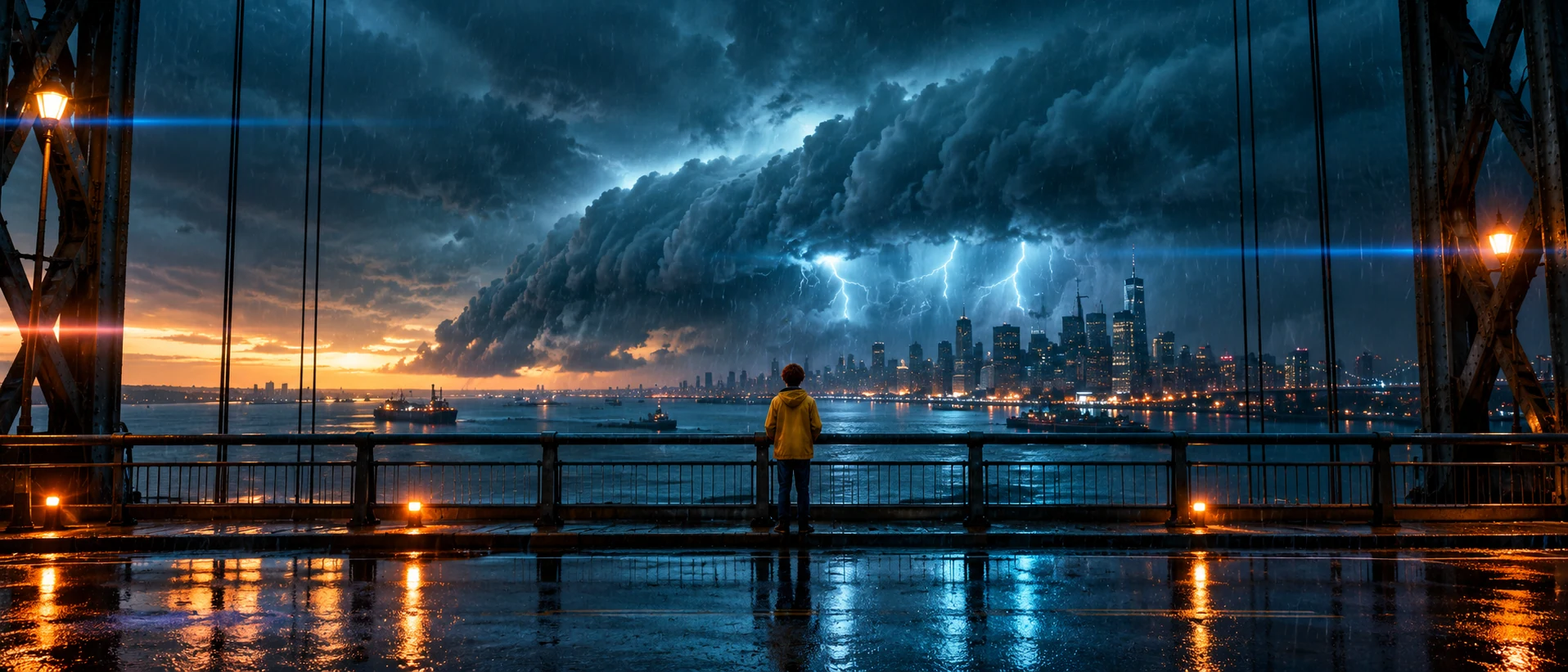
The 21:9 ratio and anamorphic widescreen give the letterboxed frame audiences link with event movies. Taller than the city skyline gives the model a known object to measure the threat against.
Open FlashBoardsCamera: starts behind the woman's shoulder on the dune crest and rises steadily upward and forward like a crane, ending on a high view of the full length of the starship. Action: wind is already blowing sand off the crest in thin streams. The woman starts walking down the slope toward the ship, her flight suit flapping. Dust drifts across the hull as the low sun flares along its ribbed edge.Wind and sand make the shot alive from the first frame. The rising crane plays the trailer-style reveal, person first, then scale, and everything named is already in recipe 1's frame, so nothing new gets invented.
Open FlashBoardsCommon mistakes
- Models shrink scale to something comfortable. Name a size (kilometers long, taller than the skyline) and add a human for comparison.
- A large centered hero turns the frame into a poster portrait. Keep the figure small, on a third.
- In video, an unstated move becomes a slow push-in on a still. Give the camera direction and motion from the start.
Keep the reference frames, prompts and every generated take side by side — images and video in one canvas.
FAQ
5 questionsWhat is a blockbuster movie?
A blockbuster movie is a big-budget film released widely and marketed as an event, designed to earn a very large box office, especially on opening weekend. The word also describes any huge commercial hit, but in the industry it usually means a planned tentpole with major spectacle, a simple hook, thousands of screens and a large advertising campaign.
What was the first summer blockbuster?
Jaws (1975) is usually called the first summer blockbuster. Universal released it in hundreds of theaters at once in June, backed by national television advertising, and it became the highest-grossing film up to that time. Its success, followed by Star Wars (1977), convinced studios that summer was the season for their biggest releases.
What does tentpole mean in film?
A tentpole is a big-budget release that a studio expects to support the rest of its slate financially, the way a pole holds up a tent. Tentpoles are usually franchise films, sequels or adaptations with built-in audiences, scheduled on key summer or holiday dates, and their earnings cover the studio's smaller films and misses.
Why is it called a blockbuster?
The word comes from heavy World War II aerial bombs nicknamed blockbusters because one could destroy a city block. Journalists applied it to shows and films with a similarly huge impact. After Jaws and Star Wars it came to mean the big-budget, widely released event film that studios still plan their calendars around.
What is the difference between a blockbuster and a sleeper hit?
A blockbuster is planned to be huge from the start, with a big budget, wide release and heavy marketing, and earns most of its money in the first weeks. A sleeper hit opens with modest expectations and little promotion, then grows through word of mouth. Both can succeed, but only the blockbuster was released as an event.
Related terms
4- Box OfficeFilm Industry
Box office is the money a film earns from theater ticket sales, reported by territory and period (opening weekend, domestic, worldwide); the studio keeps only a share, so a film needs roughly 2–2.5× its budget to break even.
- SequelStorytelling
A sequel continues an earlier story, following the same characters or world after the events of the first film.
- Money ShotFilm Industry
In filmmaking, the money shot is the spectacular image the audience paid to see — often the most expensive or difficult shot, used heavily in trailers (the Titanic's stern rising, a skyscraper-sized explosion).
- Film MarketingFilm Industry
Film marketing builds awareness and want-to-see before release — trailers, posters, taglines, press, festivals, social media and paid media (P&A) — targeted at the audience the film can realistically reach.
Further reading
Tom Shone, Blockbuster: How Hollywood Learned to Stop Worrying and Love the Summer (Free Press) · Peter Biskind, Easy Riders, Raging Bulls (Simon & Schuster)