 FlashBoards Learn
- Learn
- Film Industry
- Money Shot
Film Industry · Film language
Money Shot
Also called: hero shot, spectacle shot
A money shot is the spectacular image a film's audience pays to see: the biggest, most expensive or hardest shot in the picture, usually the one the trailer and poster are built around. Think of the Titanic stern rising vertically out of the sea, or a whole skyline going up in flames.
- What it does
- Delivers the payoff the marketing promised, in one image that proves where the budget went.
- Use it when
- Planning where a film's money, schedule and effort peak, and which frame will sell the project.
- Watch out
- Spectacle with no setup is just noise; the shot lands only if the story has made the audience wait for it.
- Try this prompt
Extreme wide shot, a colossal dam bursting at dusk, a tiny engineer on the catwalk in the foreground, epic scale
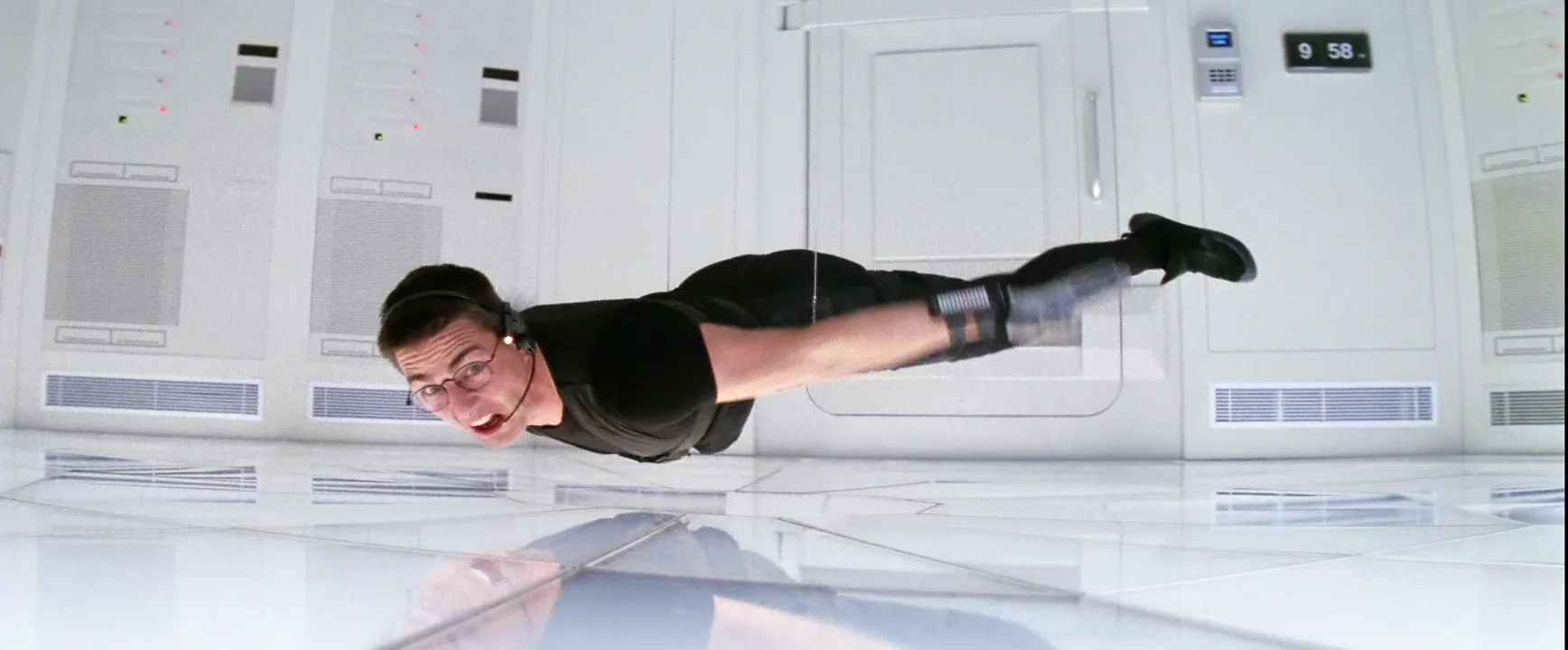
What is a money shot in film?
In the film industry, the money shot is the image that justifies the ticket. It is rarely the most important shot for the story; it is the one with the most visible value on screen: a crowd of thousands, a practical explosion, a stunt nobody else has done, a creature revealed in full daylight. Some people call it the hero shot or spectacle shot.
Canonical examples: the crane shot in Gone with the Wind (1939) that rises from Scarlett in the Atlanta rail yard until she is a speck among hundreds of wounded soldiers; the flying shots of Superman (1978), a film sold on the promise that you would believe a man can fly; the brachiosaurus reveal in Jurassic Park (1993); the stern rising into the night in Titanic (1997).
(The phrase also has a cruder adult-film meaning; in filmmaking talk it simply means the big payoff image.)
Why studios build films around it
A blockbuster is sold before anyone has seen it, and it is sold with images. The money shot ends up on the poster, the teaser and the final beat of the movie trailer.
Inside the film it works as a promise kept. The story builds anticipation (a monster glimpsed in pieces), and the money shot pays it off. Placed too early or with no emotional stake, it is expensive wallpaper.
It is also a budgeting decision. A low-budget film may have exactly one: a single day with a crane, one rented location, one stunt, protected in the schedule so everything else can stay modest. It is the most concentrated form of production value: the moment where the cost is meant to be seen.
How to plan and shoot a money shot
Give it scale the eye can measure. Put a small, recognizable human figure against the big thing and choose a frame wide enough to hold both: an extreme long shot on a 24–35mm lens, camera low so the event towers over the horizon.
Hold it. Money shots are usually cut longer than the surrounding coverage.
Shoot it once, with many cameras. A demolition, a car flip or a full-scale fire can't be reset, so productions roll several cameras at once: a wide master, a long lens compressing the action, a crash camera near the event, sometimes a high-speed camera for slow motion.
Decide practical or digital early. Practical effects often form the foreground layer, extended digitally behind.
Plan it visually. Put the frame on a storyboard and build the sequence backward from it: what the audience sees first, what is withheld, when the reveal comes. In FlashBoards you can pin reference frames from films you admire next to AI-generated versions of your own key image, then work out the setup shots around it on the same board.
Money shot vs. production value
Production value is a quality of the whole film: how rich every frame looks relative to its cost. The money shot is a single moment, the peak of that value. A lavish period drama can have high production value and no money shot at all, while a cheap film can have one strong money shot and little polish elsewhere. The producer's question is where the money shows most, and whether the story earns it.
Money Shot examples in film
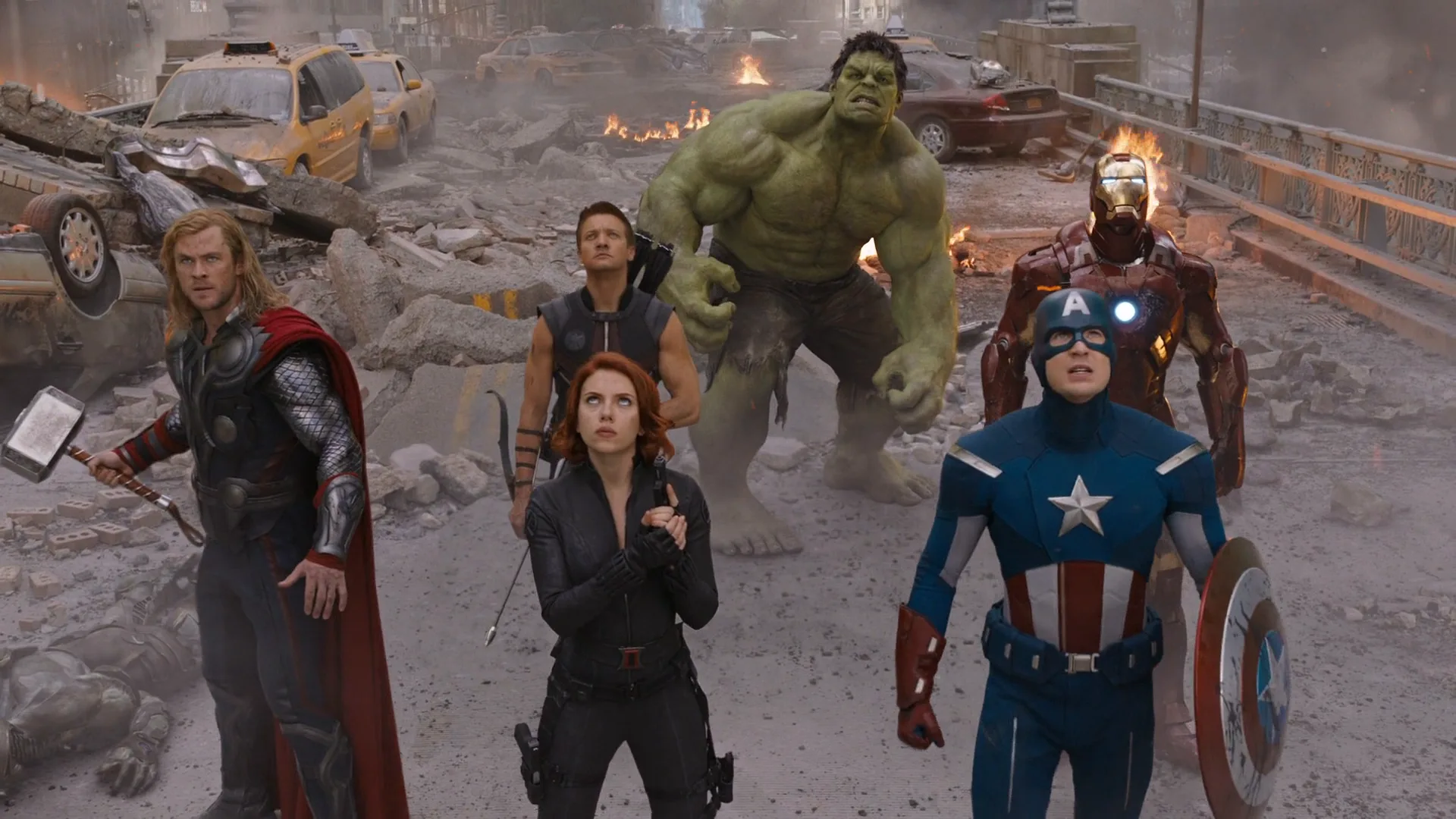
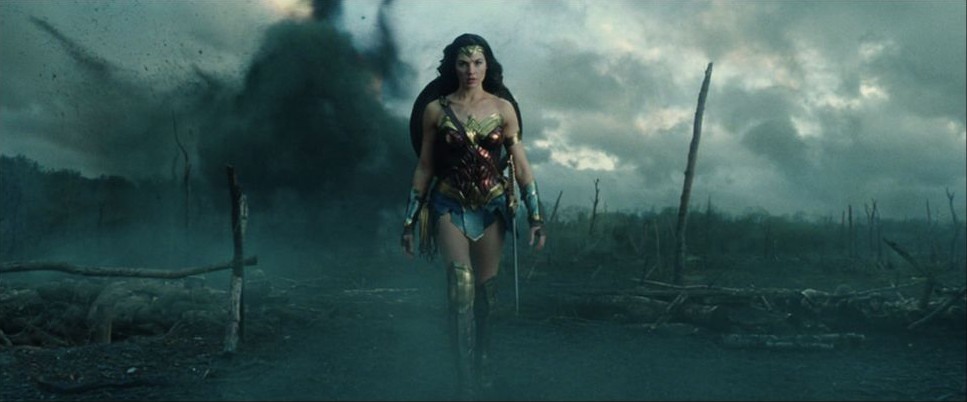
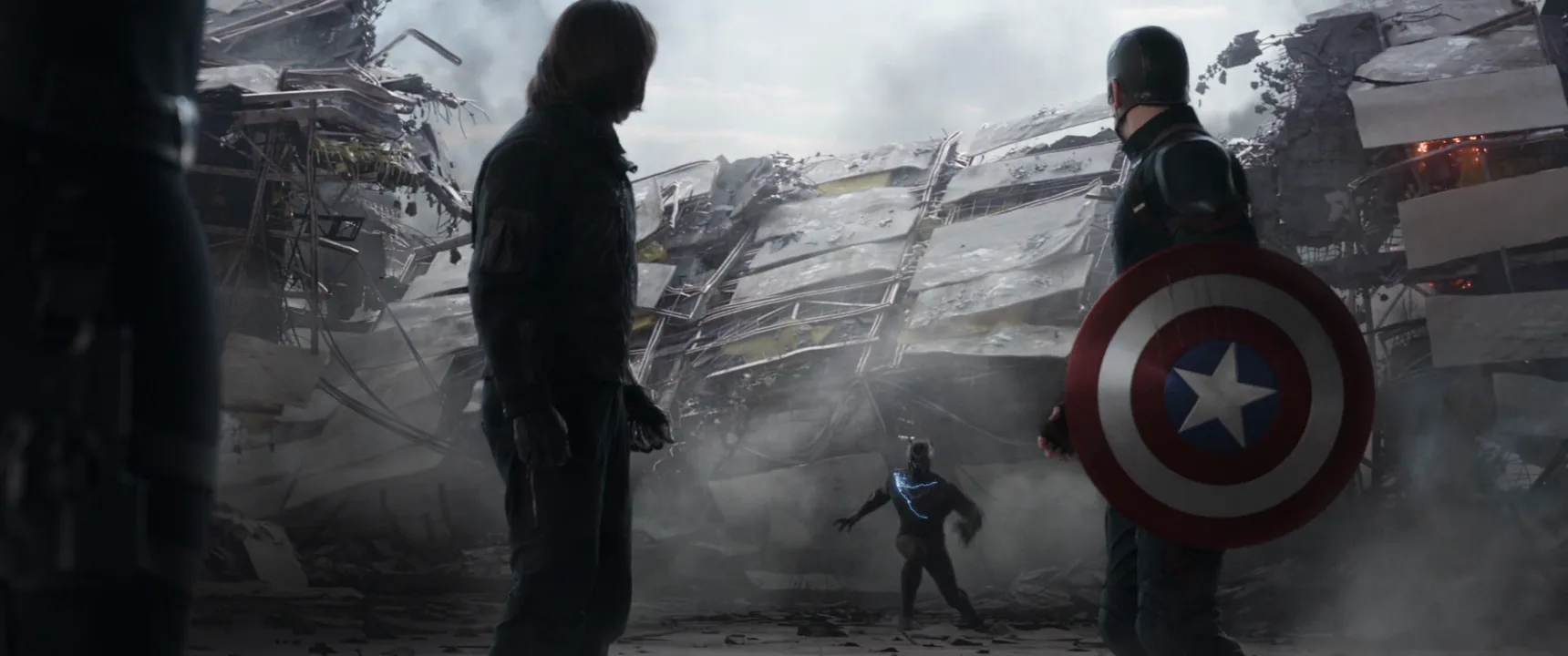
5 framesFrames built to be remembered: people set against scale, stunts and destruction.
How to create a money shot with AI
4 promptsA money shot is a single image, so it is easy to prototype with AI: a disaster key frame, a widescreen second take and a moving version for a pitch. Keep them next to your references on one FlashBoards board and compare takes side by side. The fourth prompt re-shoots a real film shot from a text description alone, and the original plays next to the result so you can compare.
Extreme wide shot at dusk, a colossal concrete dam bursting open in the center of the frame, white water exploding through a jagged breach into the valley below. In the lower right foreground, a small engineer in her fifties with close-cropped gray hair and a yellow hard hat grips the railing of a steel catwalk, seen from behind. Orange sky, spray mist, camera low at catwalk level, 24mm lens, deep focus, epic scale.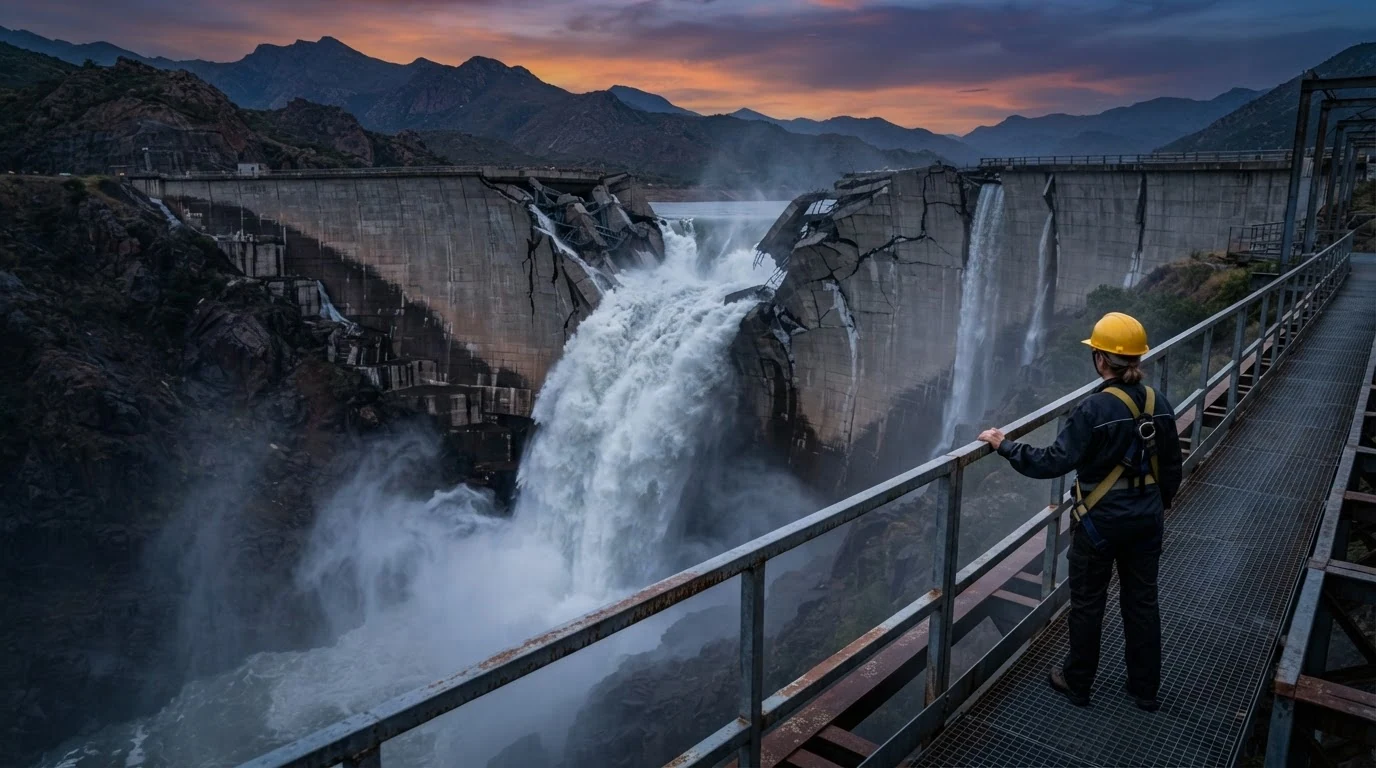
Extreme wide shot and small engineer in the lower right foreground set the size ratio that makes spectacle read; camera low at catwalk level puts the viewer on the structure.
Open FlashBoardsAnamorphic widescreen key frame, night. A huge ocean freighter capsizing in a storm, its bow rising steeply out of black water, deck lights still burning, containers sliding into the sea. In the left foreground, a bearded man in his thirties in an orange survival suit in a lifeboat, a red flare lighting his face and the rain. Low angle from the waterline, lightning behind the ship, heavy spray.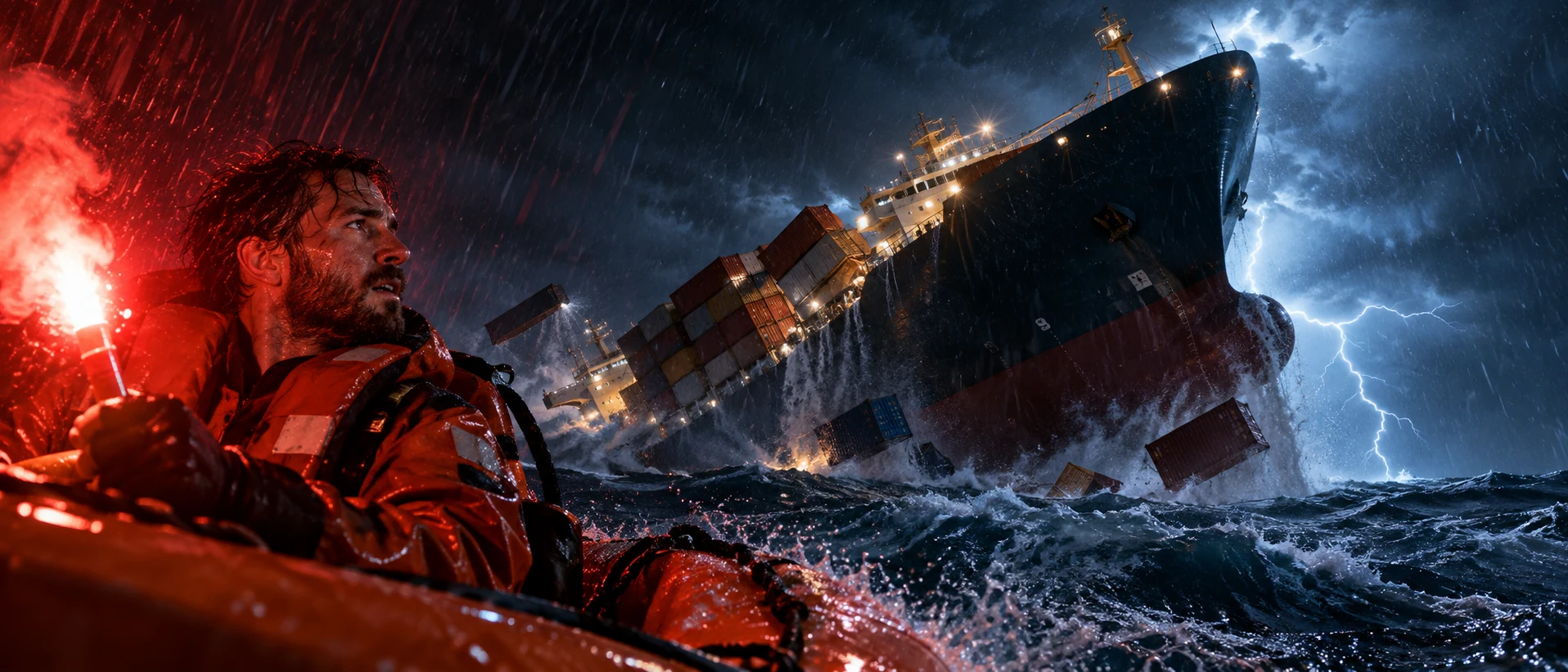
A new subject and a 21:9 frame test the same principle: one lit face against a giant event. Low angle from the waterline makes the bow tower.
Open FlashBoardsCamera: slow steady push forward toward the dam, low at catwalk level. Action: water is already blasting through the breach as the shot begins. Chunks of concrete break from the edges and fall into the torrent, and the opening widens. The engineer tightens her grip on the railing and takes one step back as spray blows across her. By the end the flood fills the lower valley, mist rising into the orange sky.Already blasting as the shot begins keeps the clip alive from the first frame; the engineer's step back gives a human reaction to measure the event by.
Open FlashBoards{
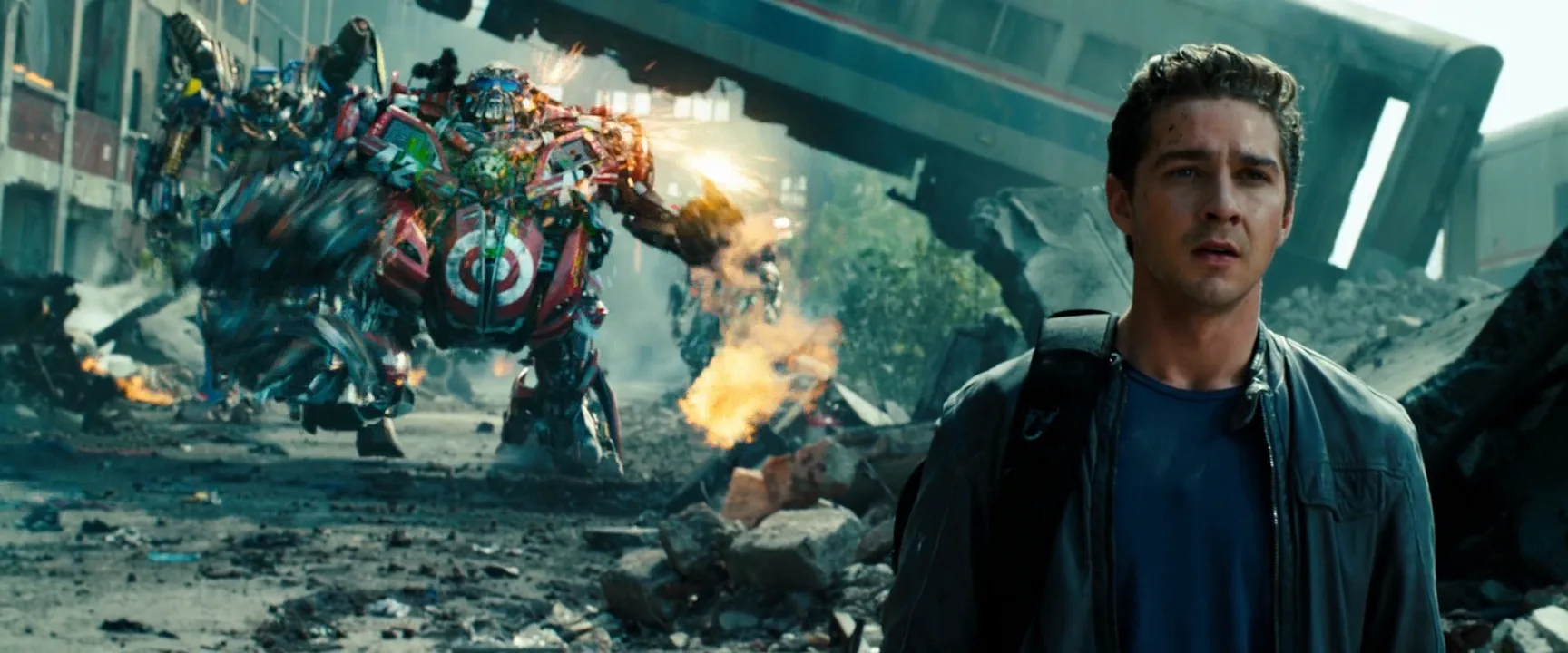
"output": "Full-screen live-action scene from Transformers: Dark of the Moon (2011), from its very first frame: one single continuous shot. Anamorphic 35mm blockbuster look, 2.39:1 scope frame, hazy bright daylight in a wrecked city street, teal-steel shadows against orange fire, dust and smoke hanging in the air, a derailed elevated train car slanting across the top of the frame.",
"characters": {
"S1": {
"name": "Sam Witwicky, played by Shia LaBeouf",
"look": "slim young man in his mid-twenties, short tousled dark-brown hair, soot smudges on his forehead, open dark charcoal zip jacket over a navy-blue T-shirt, a black backpack strap over his right shoulder",
"voice": "silent in this shot"
}
},
"shots": [
{
"shot": 1,
"camera": "slow steady dolly in toward S1, eye level, long anamorphic lens compressing the street behind him; starts as a medium shot with S1 in the right third from mid-chest up and the street open behind him on the left, ends as a medium close-up of his face and shoulders just right of center; focus stays on his face, the street behind him slightly soft",
"action": [
"BEGINNING: alive from the first frame, S1 stands still in the right third facing the camera, lips parted, eyes wide and fixed on a point just left of the lens; far behind him, left of center, a three-story walking robot of red and chrome armor plates with a red-and-white bullseye disc on its chest is already striding toward camera down the rubble-strewn street, a heavy arm cannon raised; a brick building on the far left, a tall jet of gas fire roaring up from the street just right of the robot, small fires in the rubble lower left.",
"THEN: the robot keeps walking toward camera and swings its arm cannon toward screen right; S1 breathes through his parted lips, shoulders still, his head never turning toward the street behind him.",
"THEN: the cannon fires, a green-and-orange muzzle flash bursting at the robot's shoulder; a shower of sparks hits the asphalt in the lower left and sprays across the street; a smaller blue robot strides out behind it on the left; S1's brows draw together and his mouth almost closes while his eyes stay on the same point.",
"END: the robot looms larger and closer behind S1 with more robots marching behind it, the gas fire flaring beside it; S1, now in medium close-up, stays frozen in awe and fear, lips parting again, both hands below the frame the whole time."
],
"voice": "silence: nobody speaks in this shot, no voice at all",
"dialogue": []
}
],
"sound": {
"ambience": "heavy metallic robot footfalls shaking the ground, the roar of the gas fire, one cannon blast and hissing sparks on asphalt, falling debris, distant sirens heard from far away",
"speech": "no words in this video; the only human sounds are breaths and movement",
"never_spoken": "no narration and no voice-over: the descriptions, performance notes and step words of this prompt are never spoken aloud",
"music": "a film score under the scene, always below the voices: a heavy, ominous brass-and-strings swell over pounding low drums",
"subtitles": "none"
}
}Remakes the slow dolly-in on Sam Witwicky (Shia LaBeouf) in Transformers: Dark of the Moon (2011), dir. Michael Bay, DP Amir Mokri, as a red-and-chrome robot strides through fire behind him: the face-versus-colossus staging, the push to a close-up and the cannon-fire beat, with no dialogue, as in the original.
The camera field fixes the slow dolly in from medium shot to close-up, while the action steps keep Sam's face frozen in the right third and let the robot stride toward camera and fire behind him, so the scale contrast plays out in one unbroken frame. Explicit silence and a single score line keep invented words off the soundtrack.
Common mistakes
- Models crop in on the event and lose scale. Name the shot size and put a small human figure in a specific corner.
- Disaster prompts drift to generic orange haze. Name materials: concrete, steel, containers, deck lights.
- In video, a big event can freeze. Say the motion is already underway and how it grows.
Keep the reference frames, prompts and every generated take side by side — images and video in one canvas.
FAQ
4 questionsWhat is a money shot in film?
The spectacular image an audience pays to see: the biggest, most expensive or most difficult shot in a film, often a stunt, a disaster or a creature reveal. Trailers and posters are built around it, and inside the film it pays off the anticipation the story has built, like the rising stern in Titanic.
Why is it called a money shot?
Because it is where the money shows. The shot usually takes a large share of the budget, schedule and effort, and it is the image that sells tickets. Producers use the phrase for the moment where the film's cost is meant to be visible on screen rather than hidden in the background.
Is a money shot the same as a hero shot?
Often, yes. In film a hero shot is a big, flattering image of the main character or key object, frequently low and wide, and it is often the money shot. The money shot is the broader idea: the payoff image the whole film is built to deliver, with the hero in it or not.
Can a low-budget film have a money shot?
Yes, and it matters more there. A small production can put most of its effort into one day: a rented crane, a single stunt, a practical fire. Everything else stays simple so that one image looks far bigger than the budget, and the payoff should come late, after the story has made the audience wait.
Related terms
5- Production ValueFilmmaking Process & Crew
Production value is how expensive and polished a film looks on screen — sets, locations, costumes, lighting, extras, effects — relative to what it actually cost.
- BlockbusterFilm Industry
A blockbuster is a big-budget, widely released film built to earn huge box office — the modern model of saturation release and summer event movies traces back to Jaws (1975) and Star Wars (1977).
- Practical EffectsPost-Production & VFX
Practical effects are created physically on set — animatronics, prosthetic makeup, miniatures, pyrotechnics, rain and wind machines — and captured by the camera rather than generated with CGI in post.
- Extreme Long ShotCamera Shots
An extreme long shot shows a vast space in which people are tiny or absent — landscapes, cityscapes, battlefields — so environment, scale and isolation matter more than any character.
- Movie TrailerEditing
A trailer is a 1–3 minute promotional cut of a film's best moments — usually a three-act mini-structure of setup, escalation and a button — built from picture, music and sound design to sell the film without spoiling it.
Further reading
Steven D. Katz, Film Directing Shot by Shot (Michael Wiese Productions, 1991), on planning and visualizing key sequences.