 FlashBoards Learn
Film Movements & Styles · Film language
Bayhem
Also called: Michael Bay style, Bay shot, hero shot 360
Bayhem is the nickname for Michael Bay's maximalist action style: low-angle hero shots with a circling camera, golden-hour skies, lens flares, massive practical explosions and rapid cutting that keeps every shot in motion. The result is deliberate sensory overload: the audience never gets a still, quiet frame.
- What it does
- Turns every beat into a poster moment: heroes loom against burning skies, and nothing on screen ever stops moving.
- Use it when
- Hero introductions, launches, chases, last stands and trailer beats where scale and adrenaline matter more than subtlety.
- Watch out
- Applied to every shot, it flattens into noise; the audience loses geography and the big moments stop feeling big.
- Try this prompt
low-angle hero shot at sunset, two fictional operatives rising into frame beside a black SUV, orange sky, anamorphic lens flare, smoke, 24mm at knee height
What is Bayhem?
Bayhem is the name fans and critics give to the look of Michael Bay's films, from Bad Boys (1995) and The Rock (1996) to Armageddon (1998), Pearl Harbor (2001), the Transformers series and Ambulance (2022). In the film movements and styles hub it is a personal style rather than a movement, but it has been copied so widely that it reads as default blockbuster grammar.
Bay came up directing commercials and music videos, and every frame is still built to sell:
- The Bay shot. Characters rise into a low-angle shot while the camera circles them in a fast arc shot, the sky wheeling behind their heads.
- Burning skies. Scenes staged at golden hour, graded toward orange skin and teal shadows.
- Long-lens layering. Flags, smoke or passing cars between camera and subject, compressed by a telephoto.
- Flares and haze. Anamorphic flares and smoke catch every light.
- Real fire. Big pyrotechnics shot in camera as practical effects.
- Relentless motion. Cameras on cranes, cars and drones, joined by fast cutting.
Why does Bayhem work on an audience?
Bayhem is built for the gut. The low angle and the circling move make ordinary actors look mythic; the sky turns a parking lot into a monument. The slow-motion walk toward camera of the drilling crew in Armageddon tells the viewer “these people matter” before a line of dialogue lands.
Constant movement and short shots keep adrenaline high, and layered foregrounds make a static setup feel crowded and dangerous. Real explosions help too: actors react to real heat, and debris has weight.
The cost is clarity. When every shot is a climax, geography and rhythm collapse. Spend Bayhem on the moment the hero commits or the building goes up, and let quieter coverage around it give those shots contrast.
How to shoot a Michael Bay style shot
The hero circle. Lens at knee or hip height, 21–35mm, close to the actors. Track around them on a circular dolly track or Steadicam, 90–180 degrees in a few seconds, as they rise from a crouch, so the backlight rotates behind their heads.
The layered long lens. Go to 200mm or longer and put something in front of the subject: a flag, a fence, a wall of light bars. Move the camera so the foreground slides across the frame.
Light and atmosphere. Shoot the big moments in the last hour of sun, into it, with smoke in the air. At night, aim bright sources at the lens and let anamorphic glass streak them.
Coverage. Run several cameras on every stunt, some at 48–120 fps for slow-motion inserts, so the edit can cut every half second.
Bayhem vs. maximalism
Bayhem is one branch of maximalism, the aesthetic of excess. Both pile on color, density and speed. Baz Luhrmann's maximalism is decorative and theatrical: the excess lives in costume, production design, music and collage editing. Bayhem's excess is kinetic: the camera, the fire, the vehicles and the scale. Luhrmann overloads the eye; Bay overloads the body.
Bayhem in motion
7 clipsBayhem is easier to see in motion than in a still. In every clip, watch for the same three habits: something sliding through the foreground, light aimed straight into the lens, and a camera or an edit that never stops moving.
How to create a bayhem with AI
4 promptsImage models default to eye-level, centered, clean frames. Bayhem comes from naming the height, the lens, the foreground layer and the light hitting the lens. In FlashBoards, pin these clips beside your takes on one board, build the start frame with Nano Banana 2 Lite, try a long-lens variation with GPT Image 2.5, then animate the circling move with MiniMax H3 Max Turbo. The fourth prompt re-shoots a real film shot from a text description alone, and the original plays next to the result so you can compare.
Low-angle hero shot at sunset, camera at knee height, 24mm lens looking up, horizon in the bottom quarter of the frame so the figures tower over the lens. Two fictional operatives beside a black SUV on an empty airfield: a woman in her late thirties with a shaved head, a thin white scar through her left eyebrow and an olive tactical jacket, and a man in his fifties with a gray braided beard and a crooked nose in a dark flight jacket. Behind them a wrecked truck burns, black smoke rising into an orange sky. The low sun sits just past her shoulder, throwing an anamorphic lens flare across the frame. Haze, teal shadows, film grain.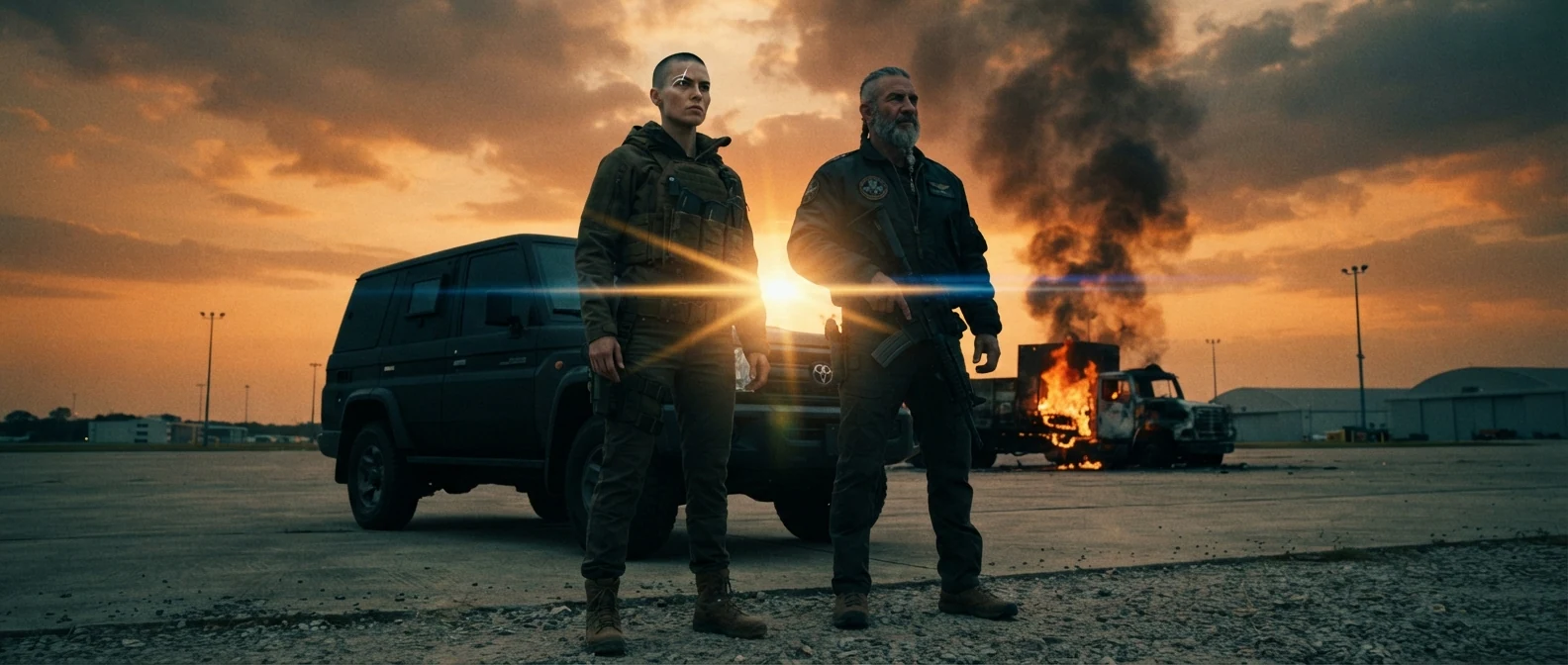
“Camera at knee height”, “looking up” and a horizon in the bottom quarter force the low angle models otherwise flatten. The sun “just past her shoulder” gives backlight and flare at once; the burning truck gives the video something to animate.
Open FlashBoardsTelephoto action still, 400mm lens, golden hour. An armored truck and three police cruisers with flashing light bars race down a desert highway toward camera, compressed into one dense stack. Heat haze. An out-of-focus American flag fills the left third of the foreground. A huge orange sun sits low behind the convoy, dust lit gold. Orange and teal grade, anamorphic widescreen.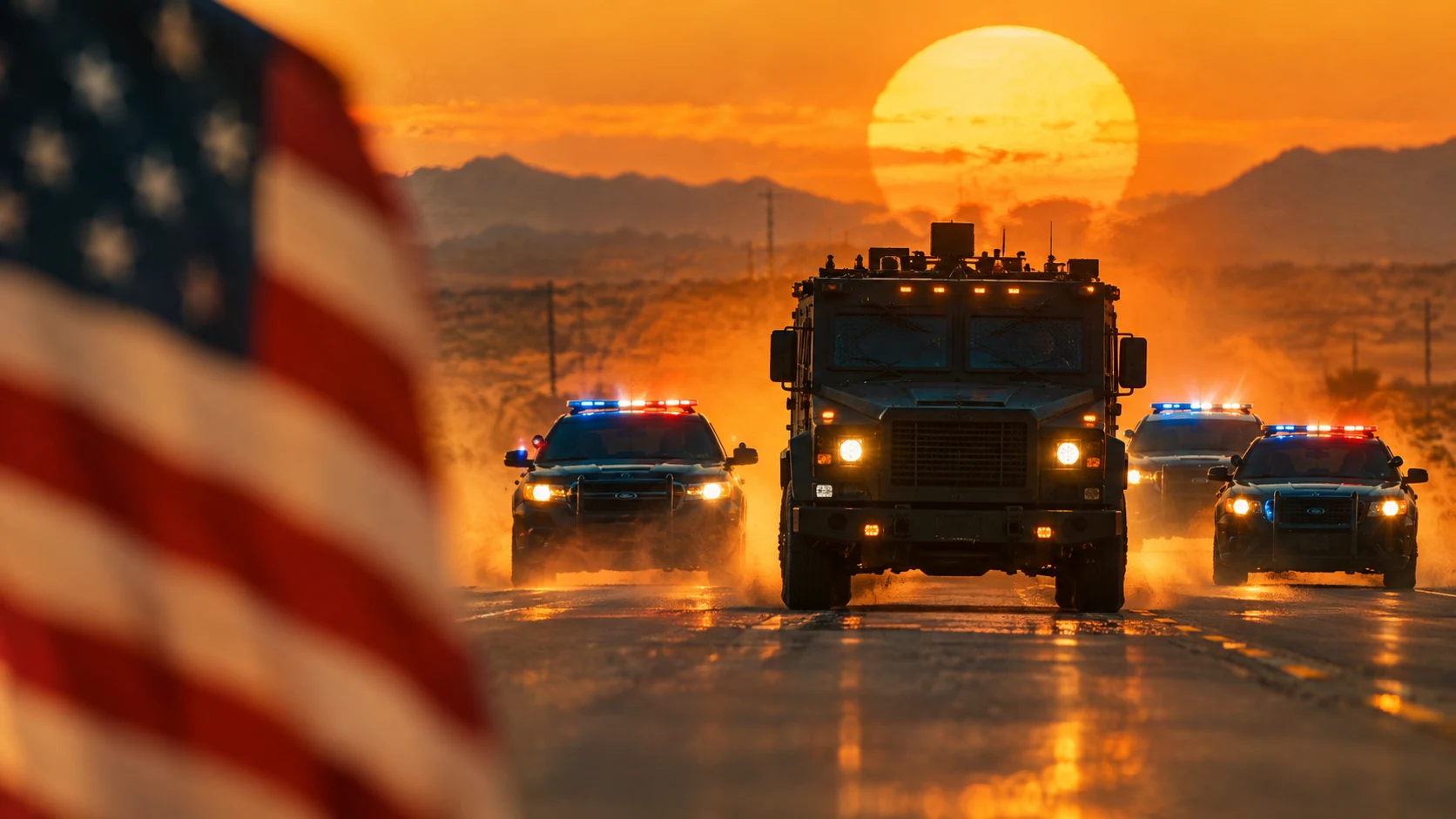
“400mm” and “compressed into one dense stack” create the long-lens layering; the soft flag is the foreground plane Bay keeps between camera and subject.
Open FlashBoardsCamera: from the first frame the camera arcs quickly around the two operatives at knee height, left to right about 120 degrees, looking up, ending on their profiles with the burning truck behind them. Action: the woman turns her head toward the fire as the move starts; the man steps up beside her; flames roll and black smoke billows into the orange sky while the sun flare sweeps across the lens.The arc starts at once, so the model doesn't settle into a slow push-in, and the prompt names only what is already in the frame, with a direction, angle and end point.
Open FlashBoards{
"output": "Full-screen live-action night scene from The Incredible Hulk (2008), alive from its very first frame: one continuous shot with no cuts. Glossy 2000s action-film 35mm look, anamorphic widescreen, deep black shadows, hot red and amber emergency light, cold blue-white streetlight, plumes of mist lit blue between old stone government buildings with warm-lit facades around a downtown plaza cordoned off by police.",
"characters": {
"S1": {
"name": "police officer, uncredited extra",
"look": "dark navy uniform and peaked cap, broad build",
"voice": "silence: never speaks"
},
"S2": {
"name": "second police officer, uncredited extra",
"look": "dark navy uniform and peaked cap, slightly shorter, standing face to face with S1",
"voice": "silence: never speaks"
},
"S3": {
"name": "soldiers, uncredited extras",
"look": "a small squad in olive camouflage fatigues and helmets, rifles held low, half in darkness",
"voice": "silence: never speak"
}
},
"shots": [
{
"shot": 1,
"camera": "long lens at car-roof height, the lens just above the roof of a parked police cruiser; the camera trucks slowly and steadily left for the whole shot, rising a touch, so the cruiser roof and its light bar slide across the foreground from left to right and leave the frame on the right; the background stays sharp, the light bar is soft and blazing",
"voice": "silence: nobody speaks in this shot, no voice at all",
"action": [
"BEGINNING: alive from the first frame, the curved white roof of the cruiser fills the lower half of the frame and its red-and-amber light bar blazes at left of centre; behind it, sharp, S1 and S2 stand face to face on the sidewalk at frame left, talking with small hand gestures; more cruisers with headlights and red-blue lights idle at the far end of the street, and a white sedan sits in the middle distance.",
"THEN: the light bar drifts to the centre of the frame and pulses red, amber and bright white; each white strobe throws a long horizontal lens flare across the frame; S1 steps back from S2 toward the near left edge of frame.",
"THEN: S1 turns and walks away from camera up the sidewalk at frame left, past a row of short dark bollards and a low police sawhorse barrier, while S2 drops out of view at the left edge; the light bar reaches the right third of the frame, strobing white, with a thin blue flare streak across the middle.",
"THEN: the cruiser roof slides out of the frame on the right, its last red glow smearing along the bottom right corner.",
"END: the street is open: S1 keeps walking away up the sidewalk at frame left, a dark olive military truck with its headlights on stands in the middle ground at centre, S3 stand beside it in the half-dark, one of them passing close to the lens at the far right edge; police lights glitter red and blue deep in the background under the blue-lit mist."
],
"dialogue": []
}
],
"sound": {
"ambience": "idling engines, the tick of the rotating light bar, bursts of police radio static with no words, a siren wailing far away across the city, boots on pavement",
"speech": "no words in this video; the only human sounds are breaths and movement",
"never_spoken": "no narration and no voice-over: the descriptions, performance notes and step words of this prompt are never spoken aloud",
"music": "a film score under the scene, always below the voices: low tense strings with a slow drum pulse building toward a military arrival",
"subtitles": "none"
}
}Remakes the light-bar shot from The Incredible Hulk (2008): the prompt carries over the slow truck left, the flaring roof light in the foreground, the officer walking off up the sidewalk and the reveal of the army truck and soldiers.
The corpus label “Truck left slow” sets the move, so the prompt has the cruiser roof slide out of frame on the right and uncover the street. The blazing light bar is the foreground layer, and naming the white strobe gives the flare a source. Nobody speaks in the original, so the prompt asks for silence and a low score.
Open FlashBoardsCommon mistakes
- Models level the camera: state “camera at knee height, looking up” and the lens.
- “Explosion” alone gives a cartoon fireball; describe the smoke, the fire and what is burning.
- No flare without a source: put the sun or lamp at the edge of the frame.
- A move without direction and end point becomes a push-in.
Keep the reference frames, prompts and every generated take side by side — images and video in one canvas.
FAQ
4 questionsWhat does Bayhem mean?
Bayhem blends “Bay” and “mayhem”: shorthand for Michael Bay's action style. It covers circling low-angle hero shots, sunset skies, lens flares, long-lens layered compositions, huge practical explosions and very fast editing. The word is used both admiringly and critically, and it now describes any action film that borrows the look.
What is the Michael Bay shot?
The Bay shot is a low-angle move where the camera circles characters as they rise into frame or turn toward the lens, the sky and backlight rotating behind them, often in slow motion at sunset. It turns a simple hero beat into something monumental and is widely imitated in action films and trailers.
Which films best show Michael Bay's directing style?
Bad Boys (1995) and The Rock (1996) established it, Armageddon (1998) pushed its heroic slow motion, Pearl Harbor (2001) carried it into a period war film, and the Transformers series added giant visual effects. Ambulance (2022) updated it with drones flying through a chase.
How do I get a Michael Bay look on a small budget?
Shoot at golden hour into the sun, put the camera low on a wide lens and arc it around your actor. Add smoke, put something in the foreground on a longer lens, and cut fast between angles. Replace big explosions with safe practical fire or a composited stock layer.
Related terms
5- Arc ShotCamera Movement
An arc shot moves the camera along a curved path around a subject, so the subject holds its place in the frame while the background revolves behind it — a way to heighten a climactic beat, bind two characters together or give a hero moment extra charge.
- Low-Angle ShotCamera Angles
A low-angle shot looks up at the subject from below eye level, making them loom larger against the ceiling or sky — used for power, menace or heroism, or to make a space feel monumental.
- Fast CuttingEditing
Fast cutting strings together many very short shots in quick succession to create energy, chaos or overload — common in action, trailers and music videos.
- Practical EffectsPost-Production & VFX
Practical effects are created physically on set — animatronics, prosthetic makeup, miniatures, pyrotechnics, rain and wind machines — and captured by the camera rather than generated with CGI in post.
- Golden HourLighting
Golden hour — which filmmakers call magic hour — is the short window after sunrise and before sunset when the low sun gives warm, soft, raking light and long shadows; crews often keep shooting into the blue twilight that follows.
Further reading
Tony Zhou, “Michael Bay – What is Bayhem?”, Every Frame a Painting (2014).