 FlashBoards Learn
- Learn
- Camera Movement
- Arc Shot
Camera Movement · Film language
Arc Shot
Also called: orbit shot, 360 shot, circular tracking shot, circle dolly
An arc shot moves the camera along a curved path around a subject while the lens stays pointed at them. The subject holds its place in the frame and the world revolves behind them, so the move reads as heightened attention: a decision, a kiss, a hero moment or a bond between characters.
- What it does
- Keeps the subject centered while the background sweeps behind them, so a still moment feels charged and three-dimensional.
- Use it when
- A character reaches a turning point, two people lock together, or a hero needs a moment the audience will remember.
- Watch out
- Arcs are loud; overuse turns every scene into a trailer, and a full circle shows the whole set, crew and lights included.
- Try this prompt
Camera arcs slowly 90 degrees around a woman on a rooftop at dusk, keeping her centered as the city skyline slides behind her
What is an arc shot?
An arc shot is a camera movement in which the camera travels along part of a circle with the subject at its center. Two things happen at once: the camera trucks sideways and it pans to keep the subject in frame. The subject barely moves in the frame, but we see them from a new side as the shot goes on, and the background slides past the other way.
The same move goes by several names. Orbit shot is the term most drone pilots and VFX artists use, and it describes exactly the same thing: the camera physically circles the subject. Circle dolly or circular tracking shot points to the gear, a dolly running on curved track. 360 shot or 360 arc is the full-circle version, where the camera comes back to where it started. It has nothing to do with footage from a 360-degree VR camera.
What separates an arc from its neighbors is the pivot point. A pan pivots on the camera itself, so the subject would slide out of frame. A camera roll rotates the image around the lens axis, so the horizon tips. In an arc the pivot is the subject. The farther the background sits from the subject, the faster it appears to rush past, which is why arcs feel so dimensional on a wide-angle lens in a deep space.
Why do filmmakers use arc shots?
Circling a person is the camera's way of saying this moment matters. In life we only walk around someone when we are studying them or can't take our eyes off them. A few jobs it does well:
- Raise the stakes of a single beat. A slow quarter arc around a character who is making up their mind stretches the moment without a cut. Arcs often sit right at a scene's climax for this reason.
- Bind two people together. Circling a couple or two rivals makes them the axis everything else turns around. The kiss in Vertigo (1958), where the camera seems to circle Scottie and Judy while the hotel room behind them turns into a place from his memory, is the classic version.
- Make a hero moment. The circling shot of the whole team standing back to back in The Avengers (2012) makes a group into a unit. Michael Bay built a signature out of low, slow arcs around heroes rising into frame; the clip from The Island below is one of them.
- Survey a group. The opening diner conversation in Reservoir Dogs (1992) circles behind the men at the table, catching faces and backs in turn.
- Reveal the space. An arc that starts on a face and swings behind the shoulder turns a close-up into a view of what the character sees.
- Unsettle. A fast arc, or one that keeps going past 360 degrees, makes the world feel unstable. The opening of Moonlight (2016) circles Juan on a Miami street.
The cost is that the audience always notices an arc, so save it for the beat that earns it.
How to shoot an arc shot
Gear. The cleanest arc comes from a dolly shot rig on curved track. Curved sections usually come as 45- or 90-degree pieces. The radius sets the look: at 1.5–2 m you are in a close-up world and the background whips past; at 4–6 m the move is statelier and you can hold a medium shot. Without track, a Steadicam shot or a gimbal operator can walk the circle, looser but free to follow moving actors. Drones have orbit modes. A low-budget trick is to put the camera and the actor on the same rotating platform: the background revolves while the actor stays locked in the frame.
Lens and distance. On a 24–35 mm lens close to the subject, the background sweeps dramatically and the arc feels immersive. On a telephoto lens from a long radius the background compresses into a slow-moving wall of color, good for romance. Keep the distance constant: if the radius drifts, the arc turns into a push-in or pull-out halfway through.
Height and speed. Most arcs run at eye or chest height. Drop the camera to hip height and look up for a hero arc. A quarter arc over 5–8 seconds reads as contemplative; a half circle in 2–3 seconds reads as action.
Blocking. Mark the actor's spot and eyelines. If they turn with the camera, the move disappears. For two actors, place the center of the circle between them. Remember that a large arc crosses the 180-degree rule line on camera. The next cut must match the side you end on.
Lighting and set. A full 360 sees every direction, so there is nowhere to put lamps, stands or crew. Light from overhead, hide sources in practicals, or keep the arc to 90–180 degrees and light from the side the camera never visits. Give the background layers (pillars, crowds, windows, trees); against a blank wall an arc looks like a slow pan.
Horizontal arc shot (X-axis arc)
The horizontal arc circles the subject at roughly the same height, swinging from one side of them to the other. Nearly all the clips on this page are horizontal arcs.
Decide where the arc starts and ends relative to the face. From front three-quarter to profile, the character turns away from us and toward their world. From behind the shoulder to the face, the arc is a reveal of the person. From the face to over the shoulder, it hands the audience the character's point of view. The size of the arc matters too: 30–45 degrees is a subtle drift, 90 degrees is a clear statement, and 180 degrees or more becomes an event in itself.
Horizontal arcs also work as seamless transitions. When the camera passes behind a pillar or a person's back at the midpoint, an editor can hide a cut there and continue the circle in another place or time.
Vertical arc shot (Y-axis arc)
A vertical arc swings the camera over or under the subject along a curve, shifting from a high angle to a low one (or back) while keeping the subject at the center. Where a crane shot mostly changes the camera's height, a vertical arc changes height and angle together so the lens keeps pointing at the same spot.
The classic use is a change of status. Starting high and looking down, then swinging down to a low angle looking up, turns someone who looked small into someone who looks powerful, without a cut. The reverse, from a low hero angle up to an overhead view, can deflate a character or show them alone in a big space. Vertical arcs need a crane, telescopic arm or drone. Many shots combine both axes: the camera circles around the subject while also rising or sinking, a diagonal orbit.
Arc spin: the fast 360
An arc spin is a fast, often full-circle orbit around the subject, so quick that the surroundings whirl past as if the world were spinning around the character. The subject stays sharp at the center while the background turns into horizontal streaks. It is common in music videos, fights and dance numbers.
Speed is what changes the meaning. A slow 360 is a study of a person; a fast one is a feeling, usually vertigo, exhilaration or losing control. Arc spins are usually shot on a gimbal with the operator running a tight circle, or on a rotating rig. Shoot at a higher frame rate if you might want to ramp the spin into slow motion at its peak.
The frozen cousin of the arc spin is the time slice effect, where an array of still cameras around the subject fires at one instant and the frames are played in sequence. The camera appears to orbit a moment that has stopped.
Arc shot vs. pan: what's the difference?
Both moves slide the background sideways across the frame. The difference is where the camera is.
- In a pan the camera stays in one place and swivels on its tripod head. Foreground and background slide at almost the same speed, and the subject is seen from the same side the whole time. If the subject doesn't move, a pan leaves them behind.
- In an arc the camera travels around the subject and swivels to keep them centered. The background moves much faster than the subject, and you see the subject from a new side at the end of the shot: front becomes profile, profile becomes back.
A quick test: watch the subject's face. If you see a different side of their head at the end than at the start, and the subject didn't turn, the camera arced. If you see the same side and the frame just slid off, it was a pan.
An arc also differs from a tracking shot: a tracking shot follows a subject through space, while an arc circles one that stays mostly in place. Travel versus attention.
Arc Shot in motion
10 clipsWatch the subject's face and the background together. In a true arc, the person stays near the same spot in the frame while we see them from a new side, and the background slides past much faster than they do.
How to create a arc shot with AI
3 promptsAn image model gives you the start frame: a centered subject with a deep background to circle past. The move belongs to the video model, and it reads as an arc only if we end on a new side of the subject. Nano Banana 2 Lite builds the start frame, GPT Image 2.5 tries an arc-spin still, and MiniMax H3 Max Turbo animates the first frame into a quarter orbit. Keep the film clips, stills and every take on one FlashBoards board so you can compare orbits side by side.
Cinematic film still, medium close-up, 35mm lens, camera at chest height, front three-quarter view: a woman in her thirties with a short platinum buzz cut, freckles and a small silver hoop in one ear, wearing an olive bomber jacket, stands still at the edge of a flat city rooftop at blue hour, centered in frame, looking past the lens. Behind her a rusty water tower, a line of warm string lights and a dense skyline of lit office windows receding into haze, a brick chimney close to the lens on the right edge of frame, light wind moving her collar, shallow depth of field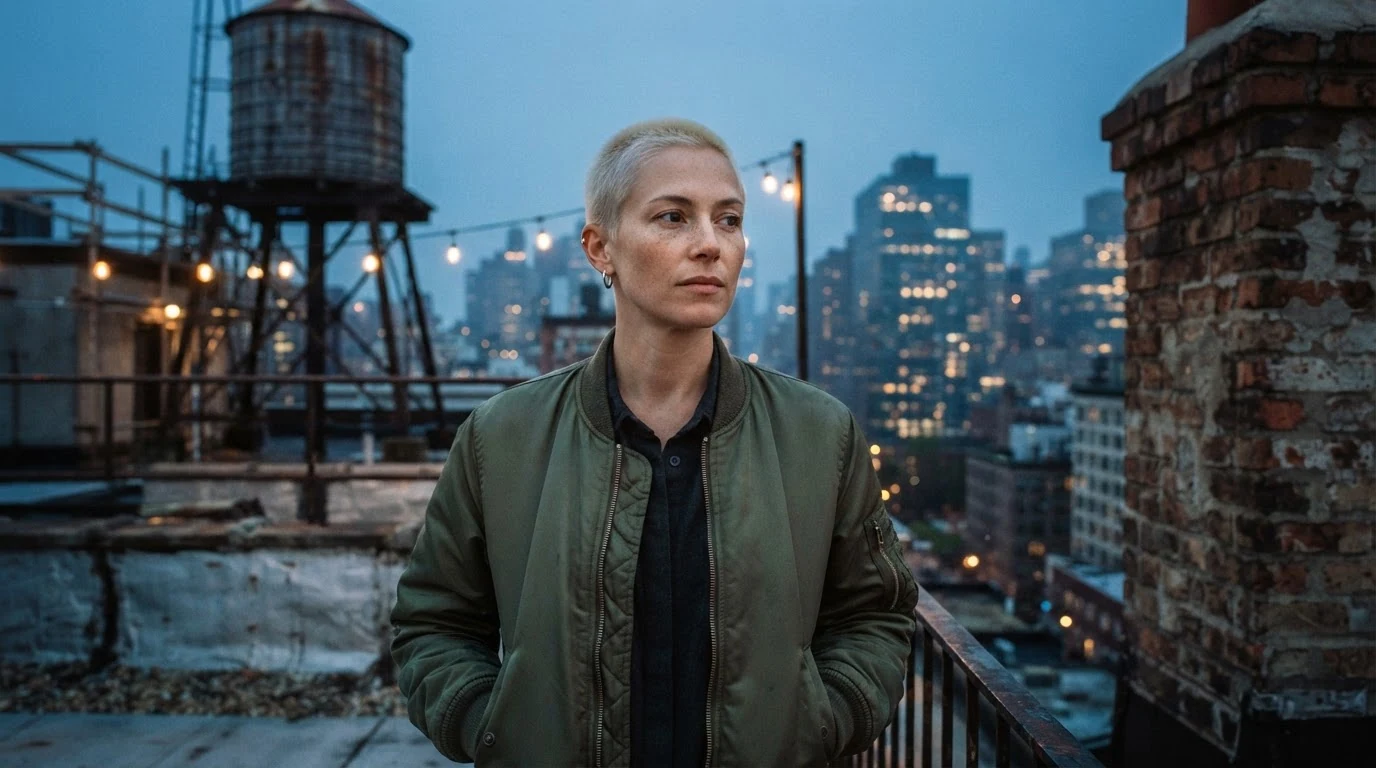
Centered in frame and front three-quarter view set the pivot and the starting side of the orbit. The layered background (water tower, string lights, skyline) gives the camera something to slide past, and the chimney close to the lens is the foreground that makes parallax visible.
Open FlashBoardsCinematic film still from a fast arc spin: a teenage boy with curly red hair, a gap in his front teeth and a yellow raincoat stands in the middle of a crowded night market, perfectly sharp and centered, head tilted back and laughing, arms spread wide. The camera orbits him at speed at shoulder height, so the food stalls, paper lanterns and passers-by behind him are smeared into long horizontal streaks of red, orange and white light. 28mm lens, wet ground reflecting the lanterns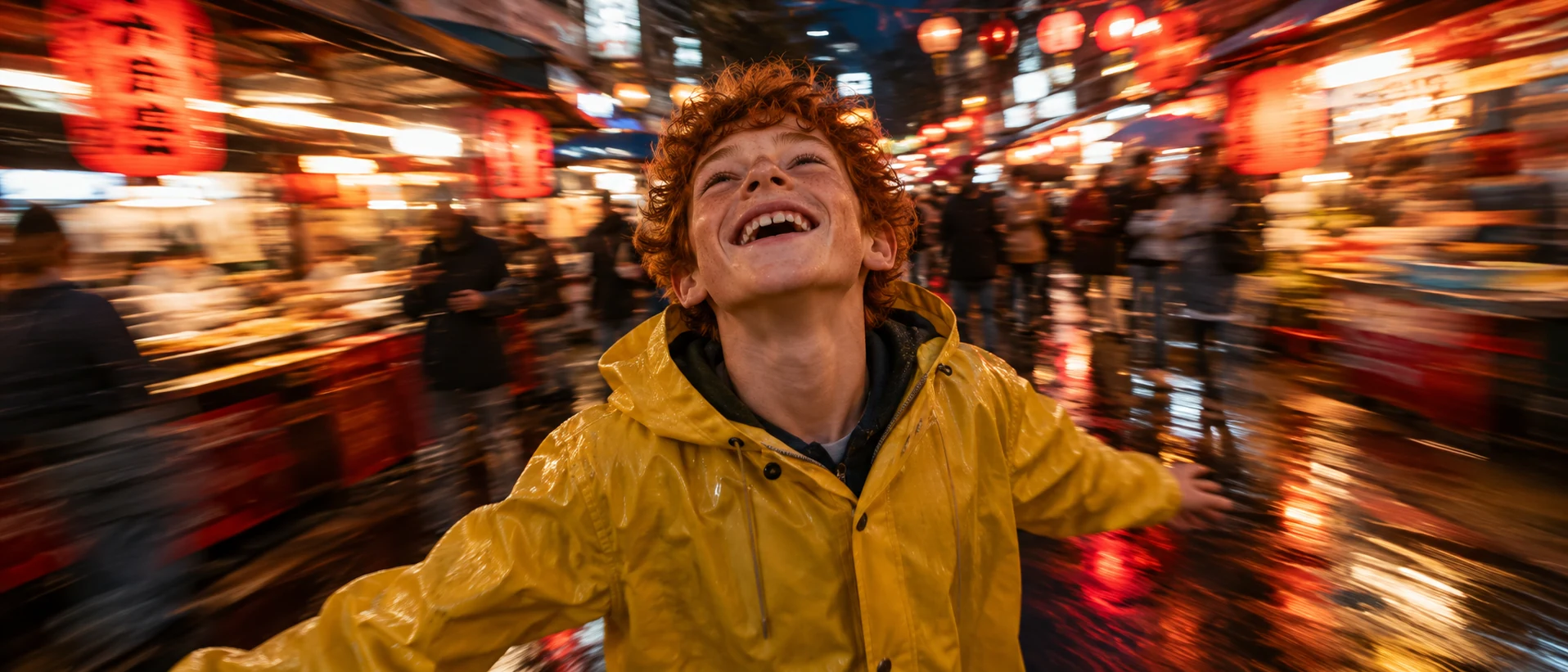
A still can't move, but it can show the result of a fast orbit: perfectly sharp and centered against long horizontal streaks is the visual signature of an arc spin. Naming the camera's orbit at shoulder height stops the model from blurring the boy too. Use it as a second take for a euphoric beat.
Open FlashBoardsCamera: a smooth, steady arc around the woman, traveling to the right on a circle at a constant distance of about two meters and panning to keep her centered in the frame. The camera moves about 90 degrees around her over the whole shot, from her front three-quarter view to her left profile, and eases to a stop. The brick chimney slides out of the right edge of the frame first, then the water tower and string lights sweep from right to left behind her and more of the lit skyline comes into view. Action: wind is already moving her collar and the string lights are swinging gently as the shot begins. In the middle she stays facing the city while the camera circles her, and she breathes out slowly. At the end she lifts her chin and looks out over the skyline, seen in profile against the lit windows.Arc around the woman, on a circle at a constant distance and panning to keep her centered describe the two parts of the move (truck plus pan) so the model doesn't settle for a simple pan. About 90 degrees and from her front three-quarter view to her left profile give an end point the model can hit. She stays facing the city stops her turning with the camera and cancelling the move.
Open FlashBoardsCommon mistakes
- A pan instead of an arc. The background slides but the subject is seen from the same side. Describe the change of view: from her front three-quarter view to her left profile, the camera travels on a circle around her.
- The subject spins, not the camera. The model turns the person on the spot. State that she stays facing the city and that the camera is the one moving.
- Invented surroundings. Past 90–120 degrees the model has to draw parts of the set it never saw, and they rarely match. Keep AI arcs to a quarter or half circle, and describe the whole surroundings in the start frame.
- Drift into a push-in. Without a stated distance, the orbit slowly closes in on the face. Add at a constant distance of about two meters.
- A frozen start. With only a camera move in the prompt, MiniMax H3 Max Turbo can hold still and then creep in. Start
Action:with something already moving: wind, lights, passers-by.
Keep the reference frames, prompts and every generated take side by side — images and video in one canvas.
FAQ
5 questionsWhat is an arc shot in film?
An arc shot is a camera move in which the camera travels along a curved path around a subject while staying pointed at them. The subject stays near the center of the frame and is seen from a gradually changing side, while the background sweeps past behind them. Directors use it to heighten a key moment or bind two characters together.
Is an orbit shot the same as an arc shot?
Yes. Orbit shot is simply another name for the same move: the camera physically circles the subject, which stays near the center of the frame while the background revolves. Drone pilots tend to say orbit; camera crews say arc or circle dolly. A full-circle version is usually called a 360 arc or 360 shot.
What is a 360 arc shot?
A 360 arc shot is an arc that goes all the way around the subject and returns to its starting point. Slow 360s study a character or a group; fast ones, often called arc spins, make the world whirl and suggest euphoria or panic. A full circle sees the whole set, so lights and crew must hide overhead or in practicals.
How do you do an arc shot without a dolly track?
Walk the circle with a gimbal or Steadicam, keeping the same distance from the subject and panning to hold them centered. Mark the floor with tape at a fixed radius so the operator stays on the curve. For exteriors, a drone's orbit mode does the same job. On a low budget, put the camera and actor on a shared rotating platform: the background turns while the actor stays locked in frame.
What is the difference between an arc shot and a tracking shot?
A tracking shot moves with a subject through space: following, leading or running beside them as they travel. An arc shot circles a subject that stays mostly in place, so the change is in the viewing angle, not the location. The two can overlap when the camera orbits a walking actor, but the intent differs: a tracking shot is about the journey, an arc is about focused attention.
Related terms
6- PanCamera Movement
A pan swivels the camera horizontally from a fixed position — left or right around its vertical axis — to follow action, connect two points in space or reveal a scene bit by bit.
- Camera RollCamera Movement
A camera roll rotates the camera around its own lens axis, so the horizon and the whole image turn inside the frame — from a slow lean to a full 360° barrel roll — to convey disorientation, a shift of power or a stylised transition.
- Tracking ShotCamera Movement
A tracking shot moves the camera through space with a moving subject — on a dolly, Steadicam, vehicle or drone — following, leading or flanking it so the audience travels with the action.
- Steadicam ShotCamera Movement
A Steadicam shot is filmed with a body-worn stabiliser — vest, spring-loaded arm and balanced sled — that lets the operator walk, run and climb stairs while the camera glides; it made long moving takes like Rocky's steps run and The Shining's corridors possible.
- Seamless TransitionEditing
A seamless transition hides the cut inside matching motion, a camera move, a dark object crossing the lens or a shared shape, so two shots play as one continuous action.
- Camera MovementCamera Movement
Camera movement is any change of the camera's position or direction during a shot — pans, tilts, dollies, cranes, handheld and more — used to guide attention, reveal space and set the emotional rhythm of a scene.
Further reading
Steven D. Katz, Film Directing Shot by Shot: Visualizing from Concept to Screen (Michael Wiese Productions). Blain Brown, Cinematography: Theory and Practice (Routledge).