 FlashBoards Learn
- Learn
- Film Movements & Styles
- Weirdcore
Film Movements & Styles · Film language
Weirdcore
Also called: weirdcore aesthetic
Weirdcore is an internet aesthetic built from unsettling amateur imagery: low-resolution photos, harsh flash glare, clumsy text overlays, staring eyes and cryptic phrases. Ordinary places and objects look slightly wrong, so the image feels like a half-remembered reality you cannot quite trust, closer to a strange memory than to a dream.
- What it does
- Turns a mundane place into a memory that feels corrupted: cheap, familiar and quietly wrong.
- Use it when
- A scene is a disturbed memory, a character losing track of reality, found media or an eerie title card.
- Watch out
- Clean, pretty rendering kills it; weirdcore needs bad texture: flash, compression, awkward text.
- Try this prompt
amateur flash photo of an empty carpeted hallway at night, blown-out walls, low-res JPEG blocks, white Arial caption 'you were here before'

What is weirdcore?
Weirdcore is a visual style that took shape on Tumblr, image boards and later TikTok in the late 2010s. Like most internet aesthetics in film movements and styles, it has no manifesto or founders, only images people remix and repost.
Its defining trait is texture, not subject. A weirdcore image looks made by an amateur with the wrong tools: a compact camera with the flash on, a webcam, an early 3D program, a phone photo resaved too many times. On top sits a clumsy caption in a default font, and eyes stare out of walls and skies.
That separates it from its softer sibling dreamcore: dreamcore is clean, pastel and glowing, weirdcore is deliberately bad-looking. The amateur finish and the text overlay make an image weirdcore.
The visual language of weirdcore
- Direct flash. Hard on-camera flash blows out the nearest surface and drops the rest into black.
- Low resolution. Blocky JPEG artifacts, visible pixels, digital zoom, webcam smear.
- Text overlays. White Arial or Comic Sans with an outline; short, lowercase, ambiguous phrases.
- Eyes. Single eyes or rows of them on objects that should not have any.
- Mundane places. Hallways, bedrooms, school gyms, backyards at night. Many overlap with liminal spaces, but weirdcore adds text, eyes and damage.
- Early CG and clip art. Low-poly shapes, default textures, colors too saturated or oddly washed out.
Restraint matters: the place stays ordinary and only one or two things are wrong.
Why does weirdcore feel so unsettling?
Weirdcore imitates the look of evidence. Flash snapshots, camcorder tapes and forum photos are how real life gets recorded, so a damaged amateur image reads as a document. Anything impossible in it feels found, not invented.
Film got there early. The nightmare sequence in Vertigo (1958) breaks Hitchcock's polished color with a floating head on flat graphic backgrounds. David Lynch shot Inland Empire (2006) on standard-definition digital video, and the smeared image makes ordinary rooms feel hostile. The VHS effect and the glitch effect supply much of this texture in post.
It is related to stylistic suck, but stylistic suck is cheap for a laugh; weirdcore is cheap for dread.
How to shoot a weirdcore look
Camera. Use the cheapest tool available: an old compact, a webcam, a phone's front camera. On a cinema camera, shoot clean and degrade in post.
Flash. Hard on-camera flash from 1–2 m in a dark interior, ambient 3–4 stops under. The nearest wall clips, the back of the room vanishes: single-source hard light, no fill.
Framing. Eye level or slightly high, a little crooked, 24–28mm equivalent.
Degrade. Scale down to 640×480 and back up, resave as low-quality JPEG twice, add a green or magenta cast.
Text and eyes. One short line in a default font, white with a black outline, and at most one eye element.
Weirdcore vs. dreamcore
| | Weirdcore | Dreamcore | |---|---|---| | Feeling | A memory that went wrong | A dream you would return to | | Texture | Low-res, compressed, flash glare | Clean, soft, glowing | | Color | Harsh or washed out | Pastel, lifted shadows | | Text | Common, clumsy, cryptic | Rare, gentle | | Eyes | Frequent, staring | Occasional |
Quick test: remove the text and sharpen the image. If it now looks ordinary, it was weirdcore.
Weirdcore in motion






6 clipsWatch for wrongness in motion: stiff early-3D figures that stare without blinking, faces that stretch or split into copies, and textures that look accidental. The loops feel like files found on an old hard drive.
How to create a weirdcore with AI
3 promptsImage models know the word weirdcore, but alone it drifts into polished horror art. Describe the amateur camera, the flash, the compression and the exact caption, and keep the place ordinary. On a FlashBoards board, keep reference loops next to your takes and animate the one that feels most wrong.
Amateur point-and-shoot flash photo of an empty carpeted upstairs hallway in an ordinary house at night, eye level, slightly crooked, 28mm. Harsh direct on-camera flash: the beige walls near the camera are blown out, the far end falls into black. A white door at the end stands half open onto darkness, one large eye drawn on it in black marker. Faded mauve carpet, a small framed picture hanging crooked on the left wall, a bare bulb on the ceiling. Low resolution, heavy JPEG compression blocks, greenish color cast. Lower third, centered text in white Arial with a thin black outline: "you were here before".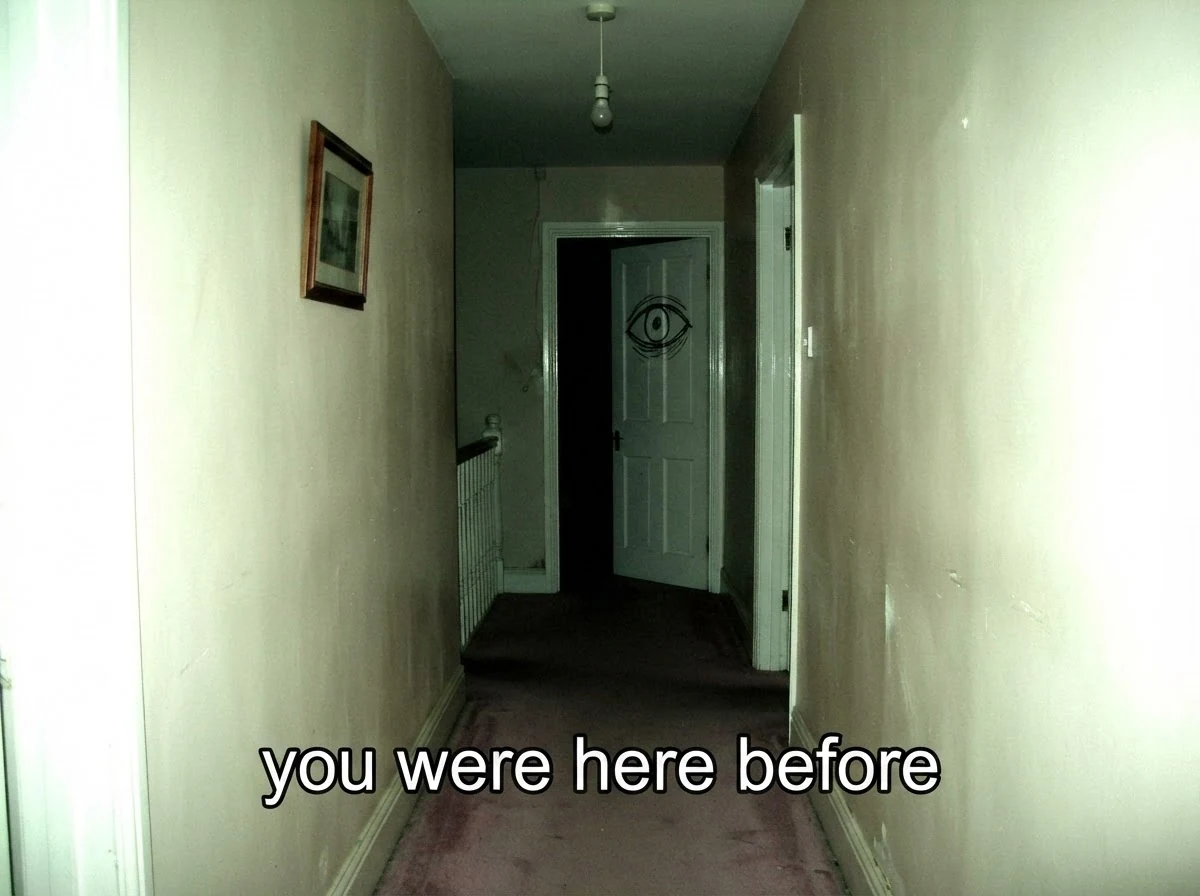
Point-and-shoot flash, blown out and falls into black build the flash falloff; JPEG compression blocks supply the damage. The marker eye and quoted caption are the weirdcore signals.
Open FlashBoardsLow-quality webcam still of a woman in her fifties with a cropped silver bob, round tortoiseshell glasses and a mustard cardigan, standing small in the middle of a drained indoor swimming pool, pale blue tiles, fluorescent tubes overhead. She faces the camera, arms at her sides. Flat greenish fluorescent light, soft digital blur, visible pixels, washed-out colors. Rows of small cartoon eyes printed on the tiled wall behind her. Top left, yellow Comic Sans text with a black drop shadow: "she knows this place".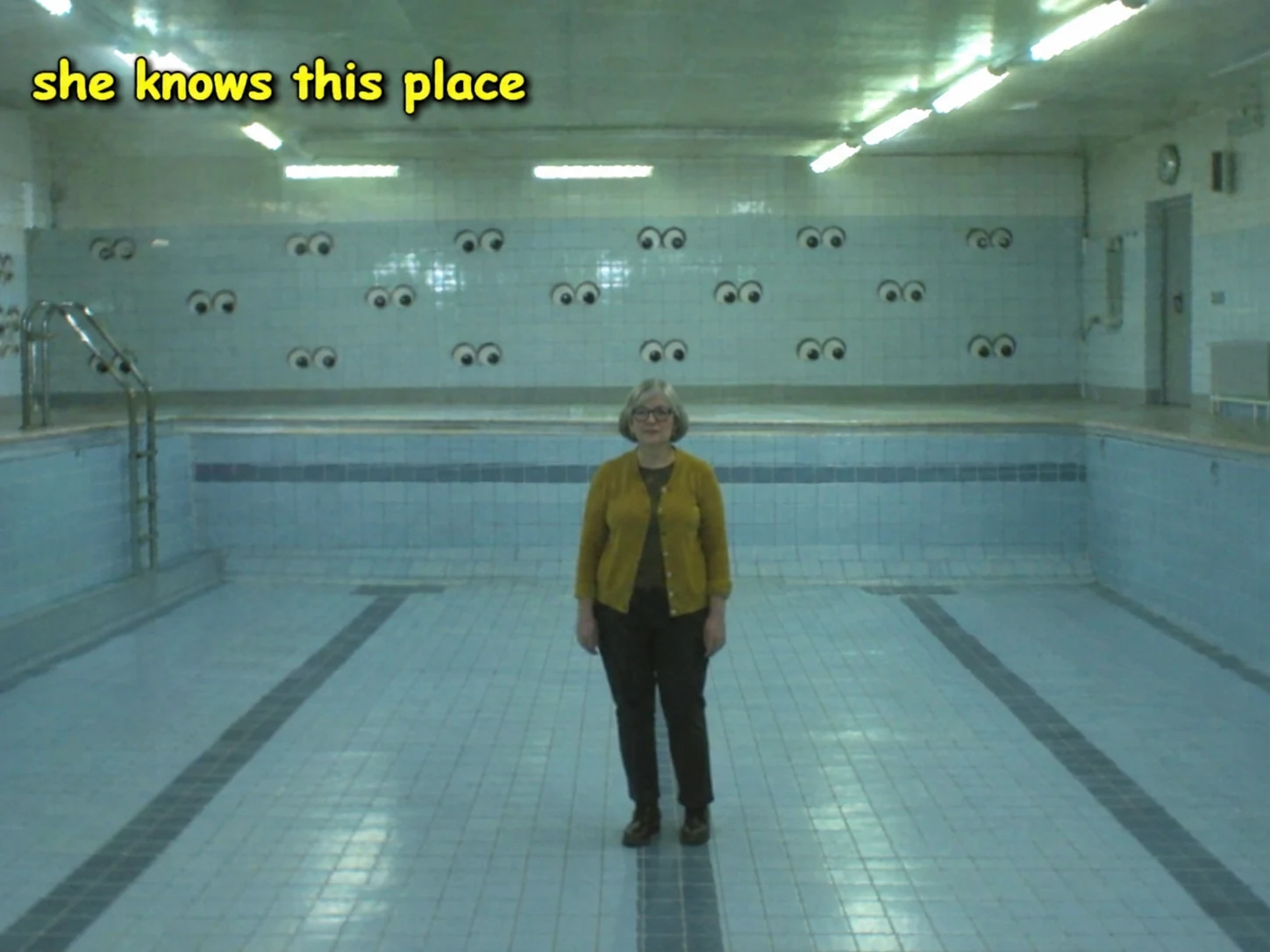
A second take swaps flash for webcam texture. The drained pool is a liminal location; the printed eyes and caption push it into weirdcore. Specific features keep the woman fictional.
Open FlashBoardsCamera: handheld, slow, slightly shaky creep forward down the hallway toward the half-open door, about one meter over the shot, framing staying crooked. Action: the bare ceiling bulb is already flickering, each flicker changing the brightness of the walls. The door drifts slowly further open onto darkness. The crooked picture swings slightly on its nail. The white caption stays fixed in the lower third.The flickering bulb starts motion at once, and everything that moves already exists in recipe 1's image. Saying the caption stays fixed helps the text survive.
Open FlashBoardsCommon mistakes
- Weirdcore alone brings polished creepy art. Name the device and its flaws: point-and-shoot flash, webcam still, JPEG compression.
- Models clean images up. Repeat the degradation words and use 4:3.
- Text comes out misspelled. Quote the exact words, name the font and color, keep it short.
- Too many eyes tips into horror; use one eye motif.
- In video, text warps. State that it stays fixed, or add it in the edit.
Keep the reference frames, prompts and every generated take side by side — images and video in one canvas.
FAQ
4 questionsWhat is the weirdcore aesthetic?
Weirdcore is an internet aesthetic of unsettling amateur images: low-resolution photos, harsh flash, compression artifacts, clumsy text in default fonts, staring eyes and cryptic phrases. It shows ordinary places, hallways, bedrooms, backyards, with one or two things slightly wrong, like a memory you are not sure happened.
What is the difference between weirdcore and dreamcore?
Both are surreal, nostalgic internet aesthetics. Dreamcore is clean, soft and pastel, with glowing light and gentle impossible details. Weirdcore is deliberately low quality: flash glare, pixelation, awkward text and staring eyes. Dreamcore feels like a pleasant dream; weirdcore feels like a corrupted memory.
Is weirdcore a horror aesthetic?
Not exactly. Weirdcore is uneasy rather than frightening and rarely shows monsters or gore. The discomfort comes from disorientation: a familiar place that looks wrong, a caption that seems to address you, eyes where none should be. Add darkness and violence and it becomes horror art.
How do I make weirdcore images with AI?
Describe the capture, not the genre: an amateur flash photo or webcam still, low resolution, JPEG compression, an ordinary place at night. Add one eye motif and a short quoted caption with a named system font and color. Generate several takes, compare them side by side and animate the most unsettling one.
Related terms
4- DreamcoreFilm Movements & Styles
Dreamcore is an internet-born surreal aesthetic that imitates the feel of dreams: pastel skies, empty playgrounds and hallways, soft glow, eyes and clouds in odd places — nostalgic and slightly unsettling.
- Liminal SpaceFilm Movements & Styles
A liminal space is a transitional place — hallway, empty mall, pool, stairwell, parking lot — shown deserted and out of its normal time, so it feels nostalgic, familiar and quietly eerie at once.
- Glitch EffectPost-Production & VFX
A glitch effect imitates digital or analog failure — tearing, pixel blocks, color-channel splits, frozen frames — to signal malfunction, a hacked feed or a character's breakdown.
- VHS EffectPost-Production & VFX
The VHS look recreates home-video tape: soft detail, bleeding color, tracking lines, noise and a date stamp — used for nostalgia, found footage or unease.
Further reading
Kyle Chayka, Filterworld (2024). Mark Fisher, The Weird and the Eerie (2016).