 FlashBoards Learn
- Learn
- Film Movements & Styles
- Liminal Space
Film Movements & Styles · Film language
Liminal Space
Also called: liminal spaces, liminal aesthetic, backrooms
A liminal space is a transitional place, such as a hallway, stairwell, empty mall, pool or parking garage, shown deserted and outside its normal hours. Because the viewer expects people and motion there, the emptiness reads as a pause in time: familiar, nostalgic and quietly eerie at once.
- What it does
- Turns an ordinary in-between place into a held breath: familiar, empty and slightly wrong.
- Use it when
- A character is between states, lost, waiting, or somewhere time seems to have stopped.
- Watch out
- Horror lighting, fog or a monster in the dark turns quiet unease into a cheap scare.
- Try this prompt
empty hotel corridor at 3 a.m., one-point perspective, flat fluorescent ceiling light, worn patterned carpet, 24mm, chest height, deserted, still
What is a liminal space?
Liminal comes from the Latin limen, a threshold. Anthropologists Arnold van Gennep and later Victor Turner used liminality for the middle stage of a rite of passage, when a person has left one status and not yet entered the next. A liminal space is the architectural version of that middle stage: a place built to be passed through, not stayed in. Corridors, stairwells, lobbies, waiting rooms, airport gates, motel walkways, parking decks, underpasses, empty classrooms in summer.
On its own, a hallway is just a hallway. It becomes a liminal space on screen when three things line up:
- Function. The place exists for transit or waiting, so we instinctively expect people moving through it.
- Absence. Nobody is there, or one small figure is, far away. The expected crowd is missing.
- Wrong time. A school at night, a mall before opening, a pool after closing, an office on a holiday. The place is out of its hours, so it feels out of time.
It is a type of space and a way of framing it, not a visual effect or filter. The idea spread online around 2019, when collections of anonymous photos of empty carpeted rooms, tiled pools and after-hours shops went viral under the label liminal spaces. Filmmakers had been using the same feeling for decades, which is why it now sits among film movements and styles as an aesthetic you can design on purpose. The anthropologist Marc Augé's idea of non-places (airports, motorways, supermarkets that nobody inhabits) is a close cousin, and there is even a word for the feeling of a usually busy place gone quiet: kenopsia.
Why do liminal spaces feel eerie, and why do filmmakers use them?
The unease comes from a gap between expectation and image. We have been in thousands of corridors and car parks, always with other people, noise and purpose. Remove all three and the brain keeps looking for what should be there. Nothing threatening appears, which is exactly the point: the tension has nowhere to discharge.
The other half of the feeling is nostalgia. The most shared liminal images are full of slightly dated materials: patterned hotel carpet, drop ceilings, beige wallpaper, 1990s mall fountains, pale blue pool tile. They look like places from childhood seen through a slightly faded photo, so the eeriness is mixed with longing. That blend is what separates the aesthetic from plain horror.
Filmmakers use it for specific jobs:
- Characters between states. A character who has quit, fled, grieved or not yet decided is often shown in a transit space. The Tokyo hotel of Lost in Translation (2003), seen mostly in sleepless night hours, holds two people suspended between lives.
- Dread without a threat. The Overlook's corridors in The Shining (1980) are frightening long before anything happens in them, because a huge hotel built for guests has none. The Hotel Earle's endless hallway in Barton Fink (1991) works the same way.

- Institutional unreality. Jacques Tati's Playtime (1967) builds a whole city of glass lobbies and waiting rooms where people drift like visitors. The TV series Severance (2022) turns bare white office corridors into a maze with no outside.
- Time slipping. David Lynch returns again and again to dim hallways and thresholds; in Lost Highway (1997) a corridor inside a house becomes a passage into something else.
The common thread is restraint. The space does the work, the camera lets it, and the atmosphere builds from what is missing.
How to shoot a liminal space
Location and set. Pick a place whose purpose is obvious at a glance: a corridor with numbered doors, a stairwell with a fire door, a mall concourse with shutters down. Shoot it out of hours, or dress it that way. In set design terms, favor repetition (identical doors, ceiling tiles, lights) and slightly dated, slightly worn surfaces over anything new or branded. Remove every clue that could explain the emptiness, such as a closed sign or crime tape.
Lens and height. An 18–28mm lens on full frame (a wide-angle lens) stretches a corridor and shrinks any figure in it. Keep the camera at chest or eye height, 1.3–1.6 m, and level: tilting up or down makes the frame dramatic, and liminal images are deliberately undramatic. Stop down to f/5.6–f/8 so the far wall is as sharp as the near one; nothing should be singled out.
Composition. Center the vanishing point. One-point perspective, symmetry and the lines of floors, ceilings and skirting boards act as leading lines that pull the eye to an empty end. Give most of the frame to negative space. If a person is in shot, keep them small, far away and turned from the lens.
Light. Use what the place would really have. Overhead fluorescent lighting or LED panels at 4000–4500K, with a touch of green, is the signature. Keep contrast low and exposure normal or a half stop over: no pools of darkness, no hard shafts, no colored gels unless the location has them. One flickering tube is enough event for a whole scene.
Movement and duration. A locked-off static shot held two or three beats longer than comfortable is the classic form. When you move, move slowly along the axis of the corridor, at walking pace or less, and keep the vanishing point centered.
Sound and grade. Room tone is half the effect: ventilation hum, a buzzing ballast, distant traffic, footsteps with too much reverb. In the grade, lift the blacks slightly, keep saturation modest and let the whites lean warm-yellow or cyan-green depending on the fixtures. A light VHS effect or camcorder texture pushes the image toward found-photo nostalgia.
The Backrooms and other liminal offshoots

The best-known branch is the Backrooms. It began with an anonymous 2019 image-board post of an empty office space: mono-yellow wallpaper, damp carpet, humming fluorescent ceiling panels, and doorways leading only to more of the same. Users wrote it up as a place you can "no-clip" into out of reality, and it grew into a sprawling collaborative fiction with numbered levels. Kane Parsons' found-footage YouTube series brought the look to moving images and made camcorder texture part of it.




The visual rules of the Backrooms aesthetic are narrow and easy to copy: monochrome walls, low ceilings, repeated fixtures, no windows, no furniture, a view that always turns another corner. Other spin-offs keep the logic and swap the materials. Poolrooms are endless white or pale blue tiled halls with still, shallow water and soft daylight from nowhere. Empty malls, closed playgrounds and night-time schools each have their own following.
For a filmmaker, the lesson is that the look depends on constraint: one material, one light source type, one repeating module, and no sign of anyone. Break any of those and the image becomes an ordinary empty room.
Liminal space vs. dreamcore
The two are often used interchangeably online, but they are different things. A liminal space is a real type of place photographed or filmed plainly: the realism is what makes it unsettling. Dreamcore is an internet aesthetic that imitates dreams: pastel skies, clouds and eyes in impossible places, soft glow, surreal edits, sometimes text. Dreamcore often borrows liminal locations, an empty hallway or playground, and then adds unreal elements.
| | Liminal space | Dreamcore | |---|---|---| | Core idea | Transitional place, empty, out of hours | Imitation of dream logic | | Realism | Plain, documentary, believable | Openly surreal and manipulated | | Light | Flat practical light, fluorescents | Soft glow, pastel haze, bloom | | Added elements | None: absence is the subject | Eyes, clouds, doors to sky, text | | Feeling | Uneasy nostalgia, held breath | Wistful, dreamy, sometimes creepy |
Weirdcore sits further out still: low-res amateur images with clumsy text overlays and cryptic phrases. A quick test: if you could walk into the frame tomorrow at 3 a.m. and see the same thing, it is liminal. If the frame could only exist in a dream or an edit, it is dreamcore or weirdcore.
Liminal Space in motion
11 clipsFive film clips show the real corridors, stations and stairwells, and the animated loops distill the online liminal look: repeated fixtures, one material, flat light and nobody there. Watch how slowly and evenly the camera moves, and how every corridor leads only to more of the same.

How to create a liminal space with AI
3 promptsImage models know the words liminal and backrooms, but on their own those words tend to produce generic horror. Describe the place, the hour, the light and the lens instead, and keep the frame plain. On a FlashBoards board you can pin reference loops next to your takes and compare them side by side before you animate the best one.
Wide shot of a long hotel corridor at 3 a.m., one-point perspective, camera centered at chest height, 24mm lens, deep focus. Worn maroon patterned carpet, cream walls, identical numbered doors receding on both sides, flat overhead fluorescent panels with a faint green cast, one panel near the far end slightly dimmer. Far down the corridor, small in frame, a tall woman with a shaved head in a mustard-yellow raincoat walks away from the camera. Deserted, quiet, low contrast, slightly faded 1990s color, realistic photo.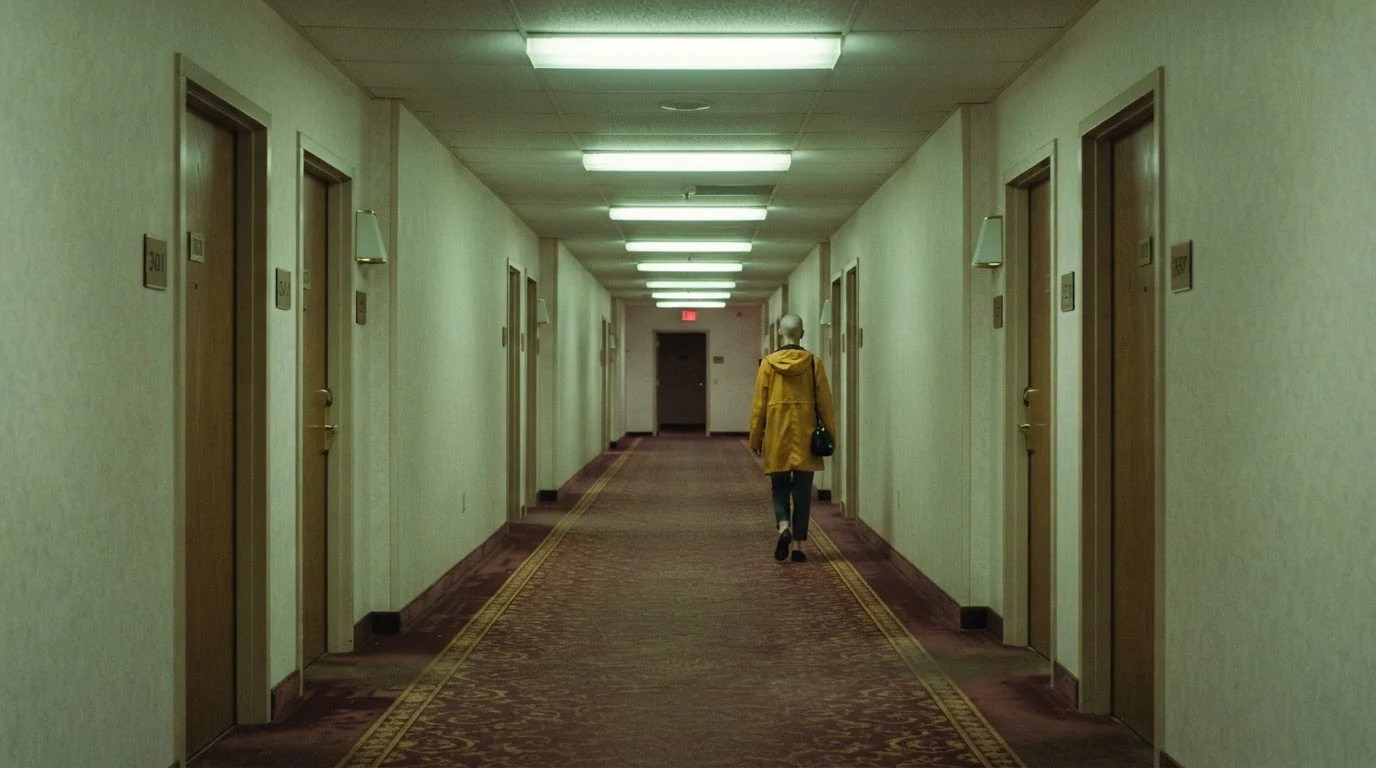
One-point perspective, centered and 24mm build the corridor geometry; flat overhead fluorescent and low contrast keep it undramatic. The dated carpet and faded 1990s color add the nostalgia, and a single small, specific figure walking away gives the video recipe motion without breaking the emptiness.
Open FlashBoardsAn empty two-level shopping mall at 6 a.m. before opening, wide eye-level shot from the center of the concourse, 28mm lens, symmetrical composition. Metal shutters pulled down over every shopfront, a still fountain with a tiled rim, potted palms, a silent escalator in the middle distance, glossy beige floor reflecting the lights. Grey dawn light from a long skylight mixed with rows of fluorescent tubes. Deserted, still, everything in sharp focus, muted pastel colors, documentary photograph.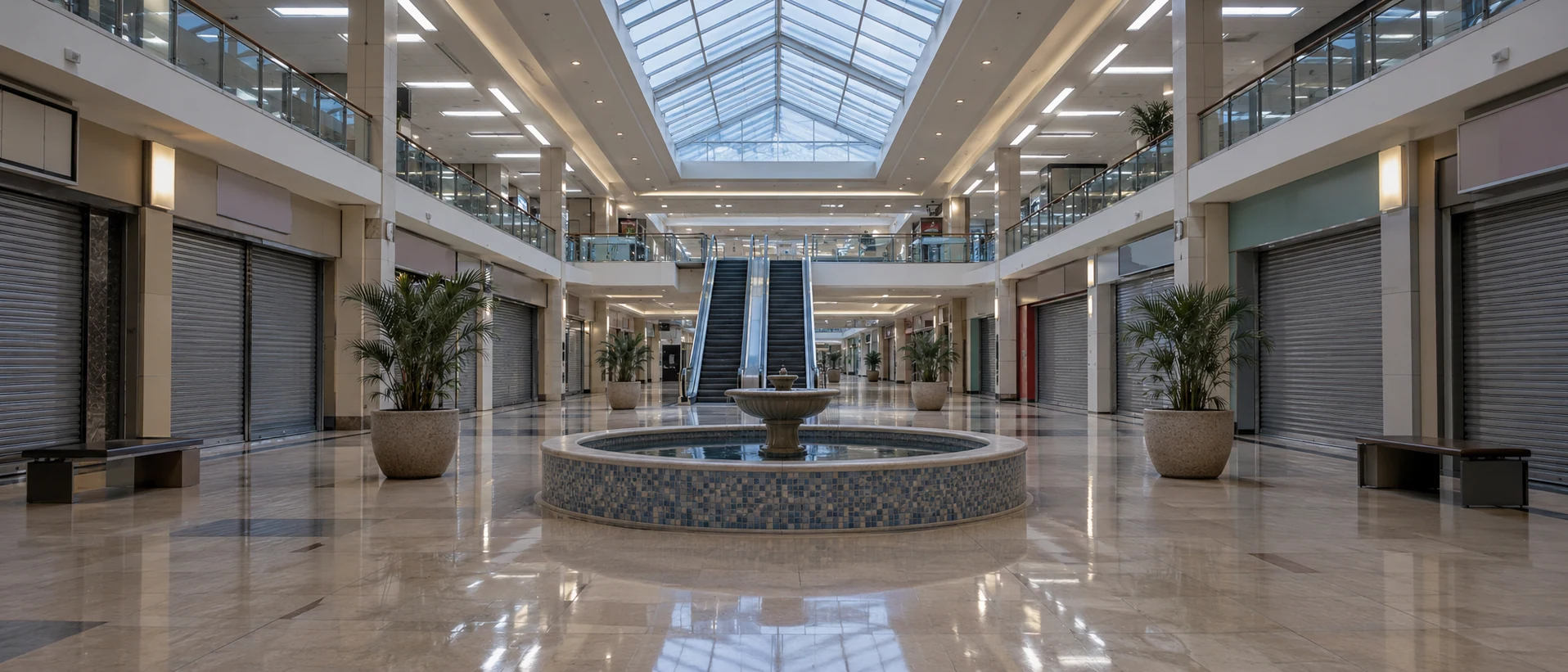
A different liminal type and a wider 21:9 frame. Before opening and shutters pulled down explain the emptiness as ordinary, not apocalyptic. The mixed dawn-and-fluorescent light and the glossy floor carry the after-hours mood; documentary photograph keeps the model from stylizing it.
Open FlashBoardsCamera: a slow, steady dolly forward down the exact center of the corridor at chest height, slower than walking pace, the vanishing point staying centered for the whole shot. Action: the woman in the mustard raincoat is already walking away at the far end of the corridor. The dim fluorescent panel near the end flickers twice. She keeps walking, turns right at the end of the corridor and disappears, leaving the corridor empty. The carpet, doors and lights stay the same.The walk and the flicker start in the first sentence, so the clip is alive from frame one. The move is slow and centered to keep the symmetry. Ending on the empty corridor is the liminal beat, and restating that the carpet, doors and lights stay the same discourages the model from inventing new features.
Open FlashBoardsCommon mistakes
- The word liminal alone often brings fog, red light or a creature. Describe flat, even, practical light and ordinary materials instead.
- Models love shallow depth of field and a moody key light. Say deep focus, everything sharp, low contrast to keep the frame documentary.
- Surfaces come out new and glossy. Add worn, slightly faded, 1990s or name dated materials (patterned carpet, drop ceiling, pale blue tile).
- Crowds creep in. In image prompts, deserted and empty, out of hours work better than listing what to leave out; in video, describe the scene positively and keep any figure small and specific.
- In video, a dark far end invites invented doorways or shapes. State what the end of the corridor holds, such as a closed white fire door or a right turn.
- Without a stated move the shot creeps in on the still. Give the dolly direction, speed and where it stays centered.
Keep the reference frames, prompts and every generated take side by side — images and video in one canvas.
FAQ
6 questionsWhat is a liminal space?
A liminal space is a transitional place, such as a hallway, stairwell, lobby, parking garage, empty mall or public pool, shown deserted and outside its normal hours. Because we expect people and movement there, the emptiness feels like a pause in time. The result is a mix of familiarity, nostalgia and quiet unease rather than outright fear.
Why do liminal spaces feel so creepy?
They break an expectation. Places built for crowds and transit look wrong without people, noise and purpose, so the mind keeps searching for what is missing. Nothing threatening appears, which keeps the tension unresolved. Dated materials and flat fluorescent light add a sense of childhood memory, making the unease feel personal and strangely nostalgic.
What is the Backrooms aesthetic?
The Backrooms aesthetic comes from a 2019 internet image of an empty office maze with yellow wallpaper, damp carpet and buzzing fluorescent ceiling panels. It grew into a collaborative fiction and a found-footage video style. Visually it is a strict version of the liminal look: one material, one light type, low ceilings, endless repetition and no people.
What are examples of liminal spaces in film?
Classic examples include the empty corridors of the Overlook Hotel in The Shining (1980), the Hotel Earle's hallway in Barton Fink (1991), the glass lobbies of Jacques Tati's Playtime (1967) and the white office corridors of the series Severance. David Lynch films such as Lost Highway (1997) use dim hallways as thresholds into another state of reality.
What is the difference between liminal space and dreamcore?
A liminal space is a real kind of place shown plainly, and its realism is what unsettles you. Dreamcore is an internet aesthetic that imitates dreams with pastel skies, eyes, clouds, glow and surreal edits. Dreamcore often uses liminal locations as a base, then adds impossible elements. If the scene could exist at 3 a.m. tomorrow, it is liminal.
How do you create a liminal space aesthetic in photos or video?
Choose a transit space and shoot it out of hours. Use a wide lens around 18–28mm at chest height, center the vanishing point and keep everything in focus. Rely on existing fluorescent or panel light with low contrast. Remove people or keep one small distant figure, hold static shots longer than feels comfortable, and let room tone carry the sound.
Related terms
5- DreamcoreFilm Movements & Styles
Dreamcore is an internet-born surreal aesthetic that imitates the feel of dreams: pastel skies, empty playgrounds and hallways, soft glow, eyes and clouds in odd places — nostalgic and slightly unsettling.
- WeirdcoreFilm Movements & Styles
Weirdcore is an internet aesthetic of unsettling amateur imagery — low-res photos, flash glare, clumsy text overlays, eyes and cryptic phrases — that feels like a half-remembered, slightly wrong reality.
- Negative SpaceComposition & Framing
Negative space is the empty area around a subject — sky, wall, darkness, water — deliberately left large so the subject feels isolated, small, lonely or expectant, and the eye settles on it.
- Leading LinesComposition & Framing
Leading lines are lines in the frame — roads, rails, corridors, fences, architecture, beams of light — that carry the viewer's gaze toward the subject or deeper into the space.
- SymmetryComposition & Framing
Symmetry arranges the frame so its left and right halves mirror each other around a central axis — architecture, props and actors in matched positions — creating order, formality and sometimes an uncanny, controlled world.
Further reading
Arnold van Gennep, The Rites of Passage (1909). Victor Turner, The Ritual Process (1969). Marc Augé, Non-Places: Introduction to an Anthropology of Supermodernity (1992).