 FlashBoards Learn
- Learn
- Film History & Theory
- Allegory of the Cave
Film History & Theory · Film language
Allegory of the Cave
Also called: Plato's cave, Plato's allegory
The allegory of the cave is Plato's image of prisoners who take shadows on a wall for reality until one of them escapes into daylight. In film it works twice: as a model of cinema itself, an audience in the dark watching projected light, and as a story template about leaving a manufactured world.
- What it does
- Turns a character's discovery that their world is fake into a physical journey from shadow to light.
- Use it when
- The story is about illusion, control or awakening, and you want the audience to feel the escape, not just hear it explained.
- Watch out
- The return matters as much as the exit; stopping at the reveal throws away half the idea.
- Try this prompt
Dark basement, a row of seated figures facing a concrete wall of flickering shadows, a bright doorway behind them, one young man turning toward the light
What is the allegory of the cave?
In Book VII of the Republic, Plato describes people chained since childhood inside a cave, facing a wall. Behind them burns a fire, and objects carried in front of it cast shadows on that wall. For the prisoners, the shadows are the world.
One prisoner is freed. The fire hurts his eyes, the climb out is painful, and daylight blinds him before he can see real things. Back in the cave, the others mock him.
Filmmakers return to it because it describes the situation of watching a movie, and because it is already a plot in four beats: captivity, release, ascent, return.
Why is the cave a metaphor for cinema?
A dark room, a light source behind the audience, figures moving on a flat surface, viewers who agree to treat them as real: cinema is the cave with better seats. In the 1970s the French theorist Jean-Louis Baudry built his account of the film "apparatus" around this comparison, one of the core ideas of film theory.
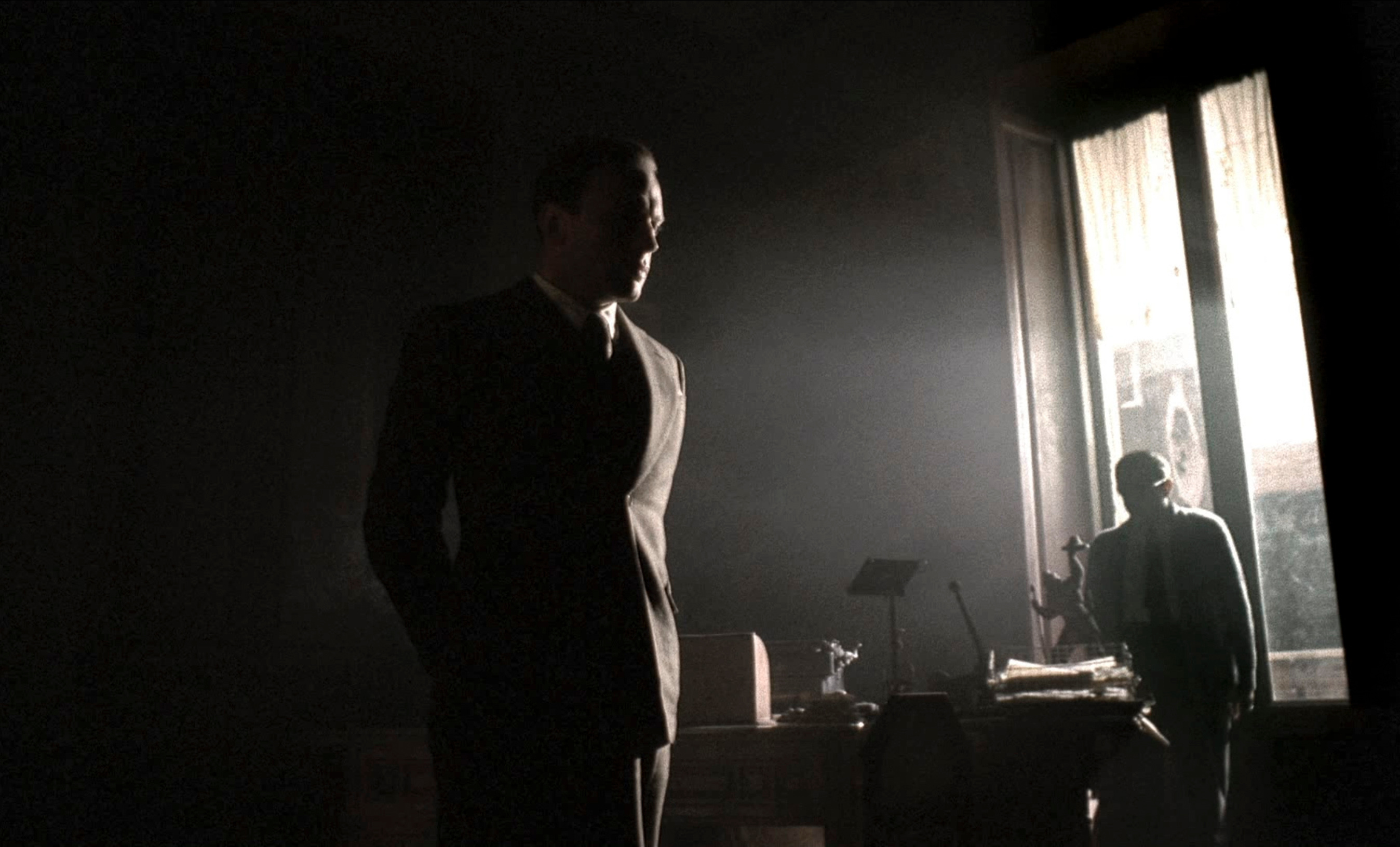
The comparison cuts both ways, cinema as a machine for dreams and for illusion, which is why films quoting the cave so often comment on screens and simulations, and why the device suits postmodern film. Bertolucci's The Conformist (1970) stages a conversation about the myth in a darkened study where window light turns the characters into shapes.
The cave as a story template: films that follow it
Most "escape the fake world" films map onto Plato's four beats.
- Captivity. A world with invisible walls: Truman's island town in The Truman Show (1998), the simulated city of The Matrix (1999), the sunless metropolis of Dark City (1998). The rules of worldbuilding are the chains.
- Release. A glitch, a stranger or a pill breaks the pattern.
- Ascent. The escape hurts: Neo's eyes ache because he has never used them, like the prisoner blinded by daylight.
- Return. The one who has seen the sun goes back and is not believed. Us (2019) inverts the cave, with doubles living underground.
Many of these belong to the dystopian film tradition, but The Lego Movie (2014) proves the pattern works in comedy too.
How to stage the allegory of the cave on screen
The cave is a lighting and design problem before it is a theme.
- Put the light behind the captives. One hard point source, a fire, projector or window, so their world plays out as cast shadows on the surface they face.
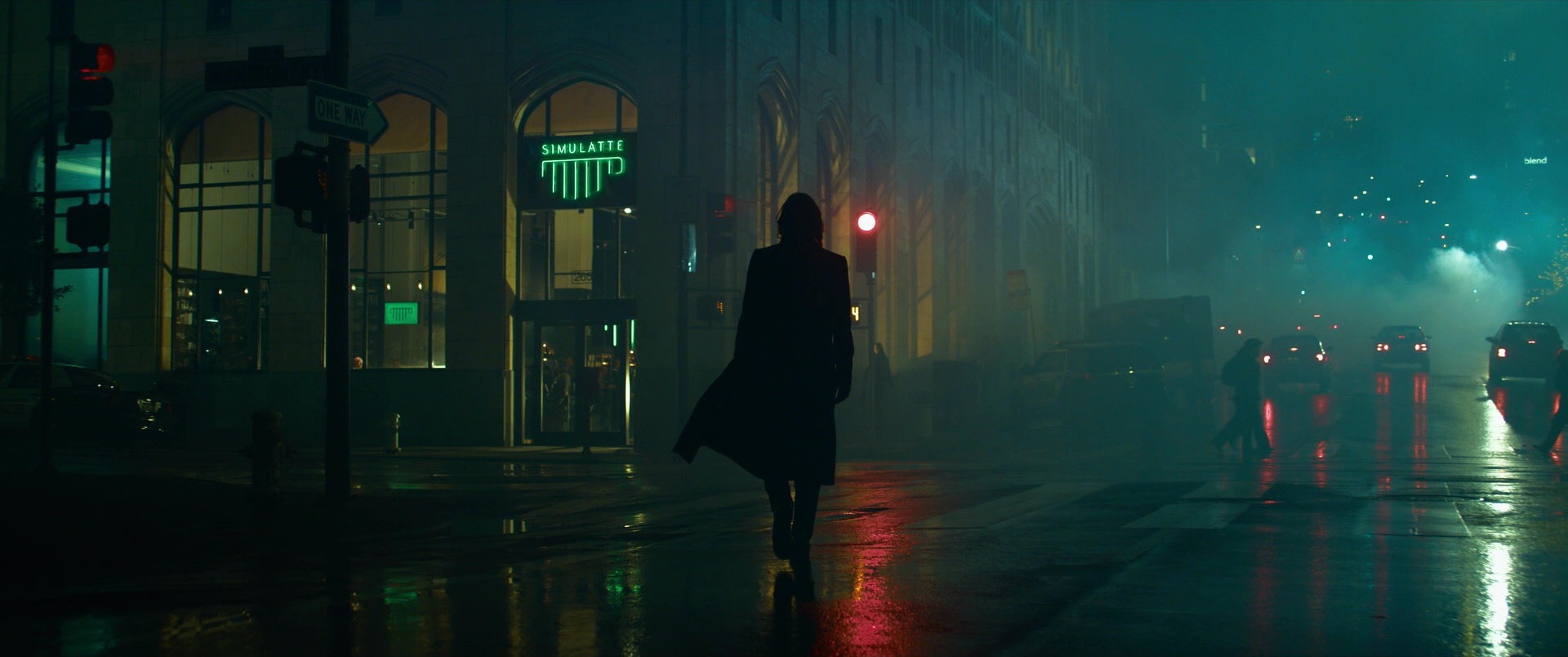
- Give the false world one visual rule. A tint, a too-perfect sky, a sun that never moves. The Matrix films push their simulated city toward green and teal.
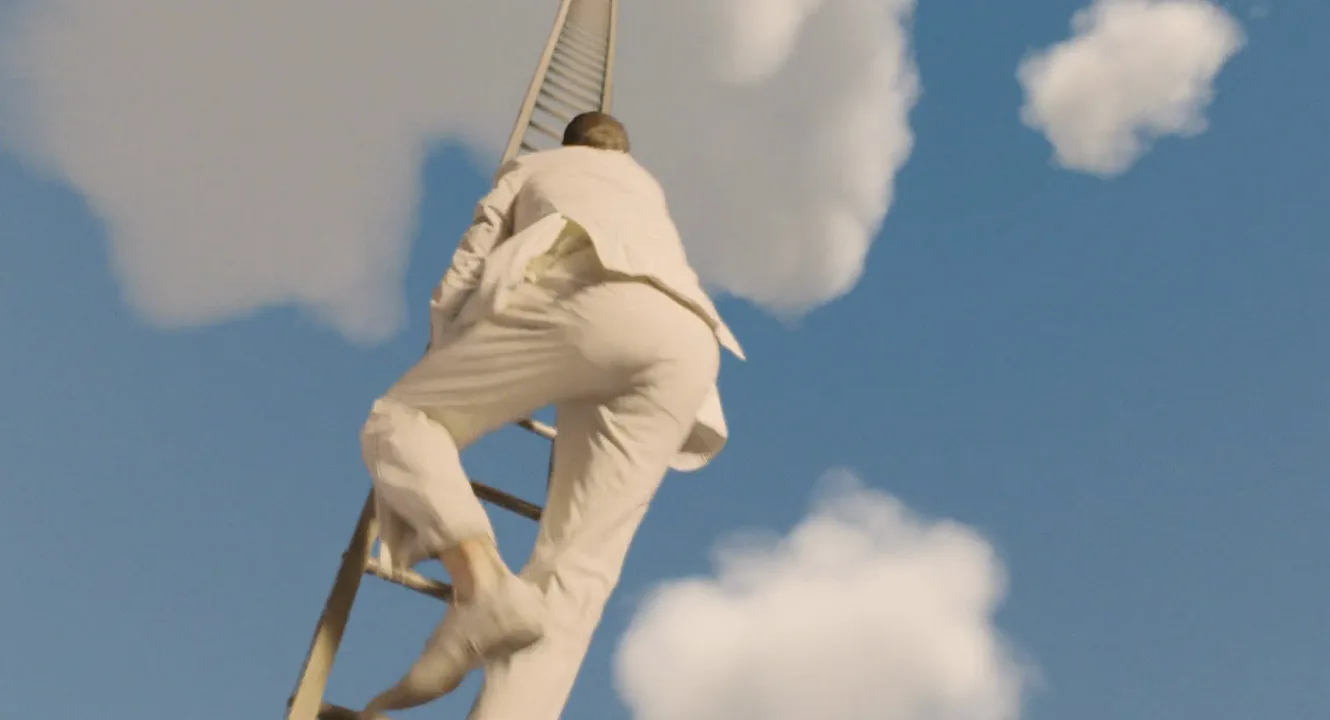
- Make the exit a physical threshold. Stairs, a ladder, a door in the horizon, framed from below.
- Let the light hurt. Overexpose the first shot outside by a stop or two and let it settle.
- Play the return. Bring the character back into the old palette, which now looks wrong.
On a FlashBoards board, put false-world tests in one column, real-world tests in the next and the threshold shot between them.
Allegory of the cave vs. allegory in general
An allegory is any story whose whole system stands for something else, like a farm for a revolution. The cave is one specific allegory about one subject: the gap between appearance and reality and the cost of crossing it. A twist about a simulated world can borrow its structure without being allegorical at all. And it is more than a silhouette on a wall: the cave is the whole arrangement of viewer, light and screen, plus the way out.
Allegory of the Cave examples in film
4 framesFilms that borrow the cave make its parts visible: a light behind the characters, a false sky, a way out.
How to create a allegory of the cave with AI
4 promptsModels love atmosphere and forget where the light comes from. Build the start frame with Nano Banana 2 Lite, try a modern false world with GPT Image 2.5, animate it with MiniMax H3 Max Turbo, and compare takes on one FlashBoards board. The fourth prompt re-shoots a real film shot from a text description alone, and the original plays next to the result so you can compare.
Wide shot from behind six people seated on a long wooden bench in a dark concrete basement, all facing a bare gray wall. A bright projector light behind them throws large sharp shadows of moving shapes onto the wall. At the end of the bench a thin young man with a shaved head and a long scar across his chin turns back toward the light, squinting. Hard backlight, dust in the beam, 28mm lens, film still.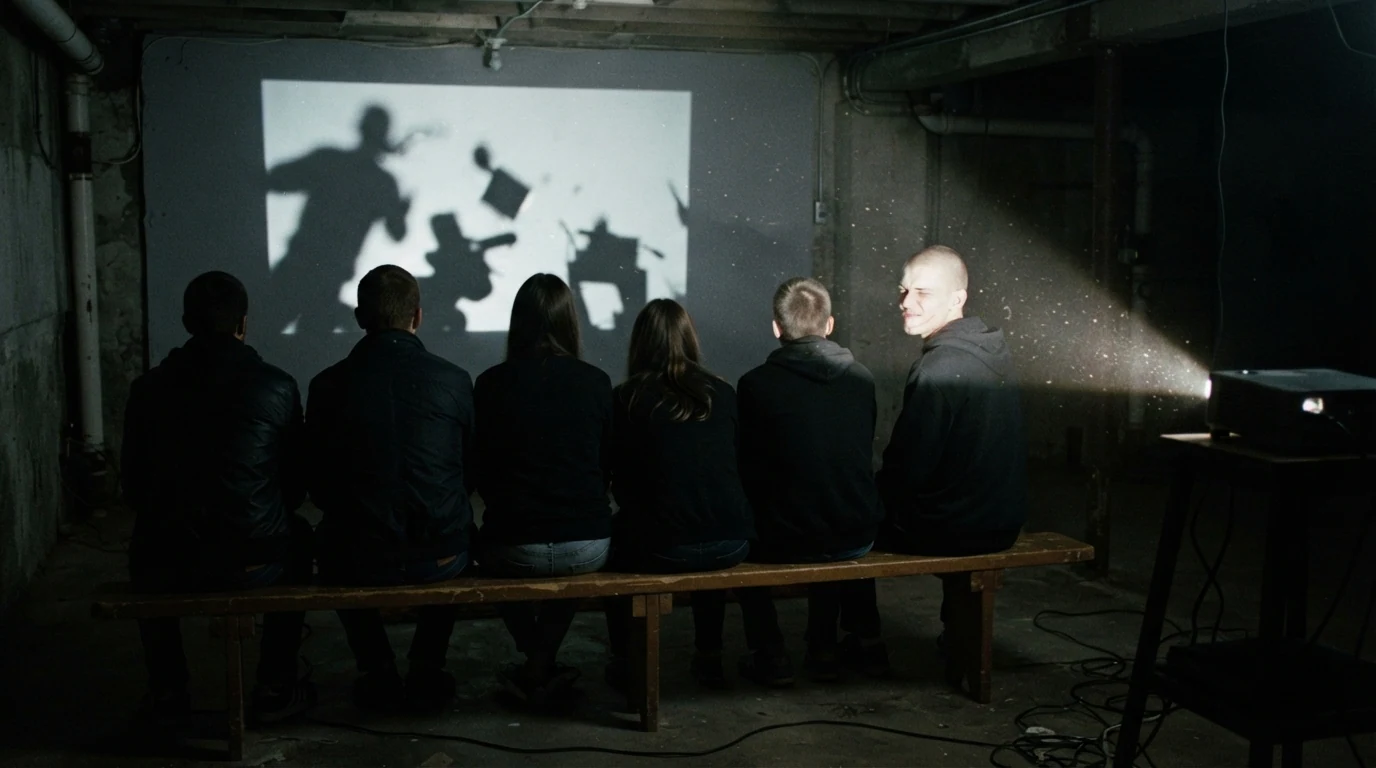
From behind and facing a bare wall set up Plato's geometry; projector light behind them places the source. The man turning back toward the light is the release.
Open FlashBoardsWide shot of a perfect pastel suburban street under a flawless blue sky with identical white clouds. At the end of the street the sky is a painted wall with a small open door, pure white daylight pouring out. A woman with curly gray hair, round glasses and a yellow raincoat stands at the door, one hand on the frame. Low camera, 24mm lens, crisp midday light, film still.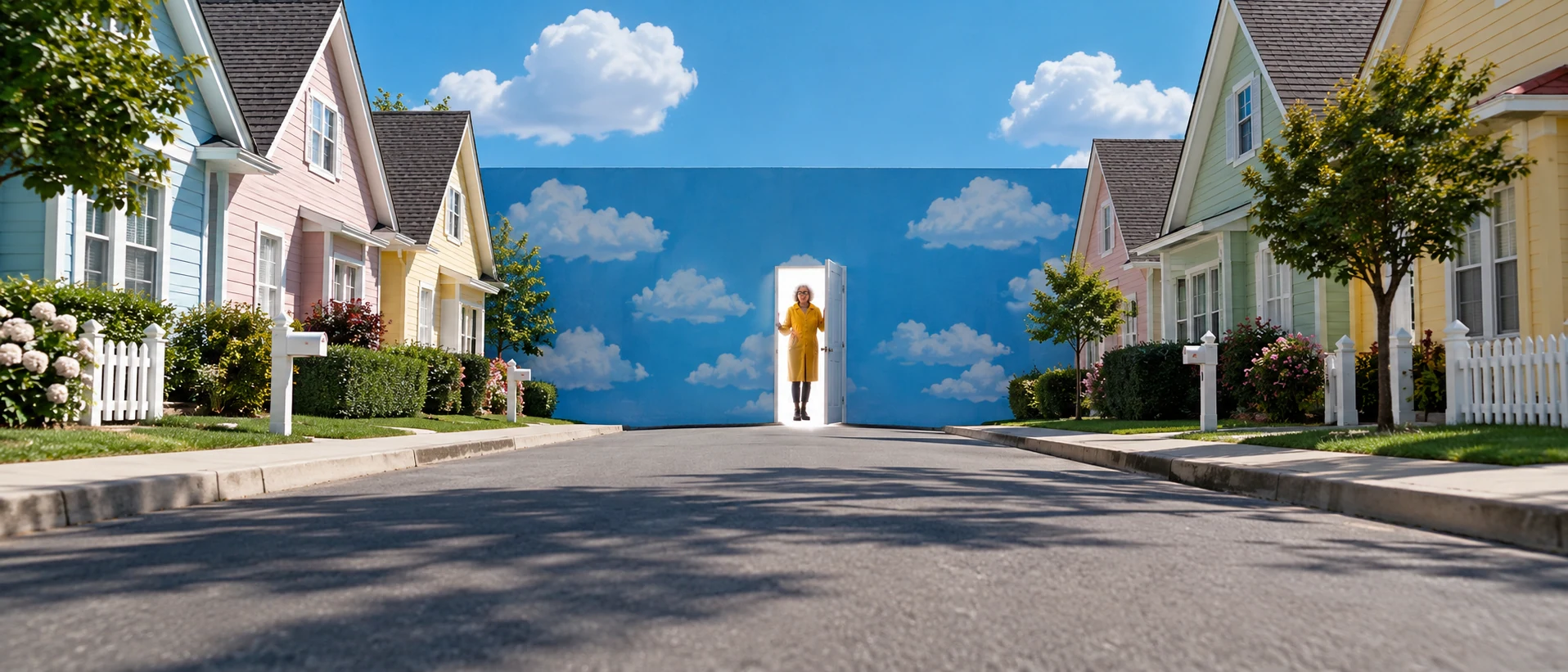
The sky is a painted wall makes the false world's limit physical, and daylight pouring out keeps the real world brighter than the fake one.
Open FlashBoardsCamera: a slow, steady push in toward the young man at the end of the bench, ending in a medium shot. Action: The shadows on the wall are already flickering. The young man keeps turning toward the light, raises a hand to shield his eyes, then stands up while the others keep staring at the wall. His own shadow rises onto the wall.Already flickering keeps the frame alive; his own shadow rises starts the escape inside the image of captivity.
Open FlashBoards{
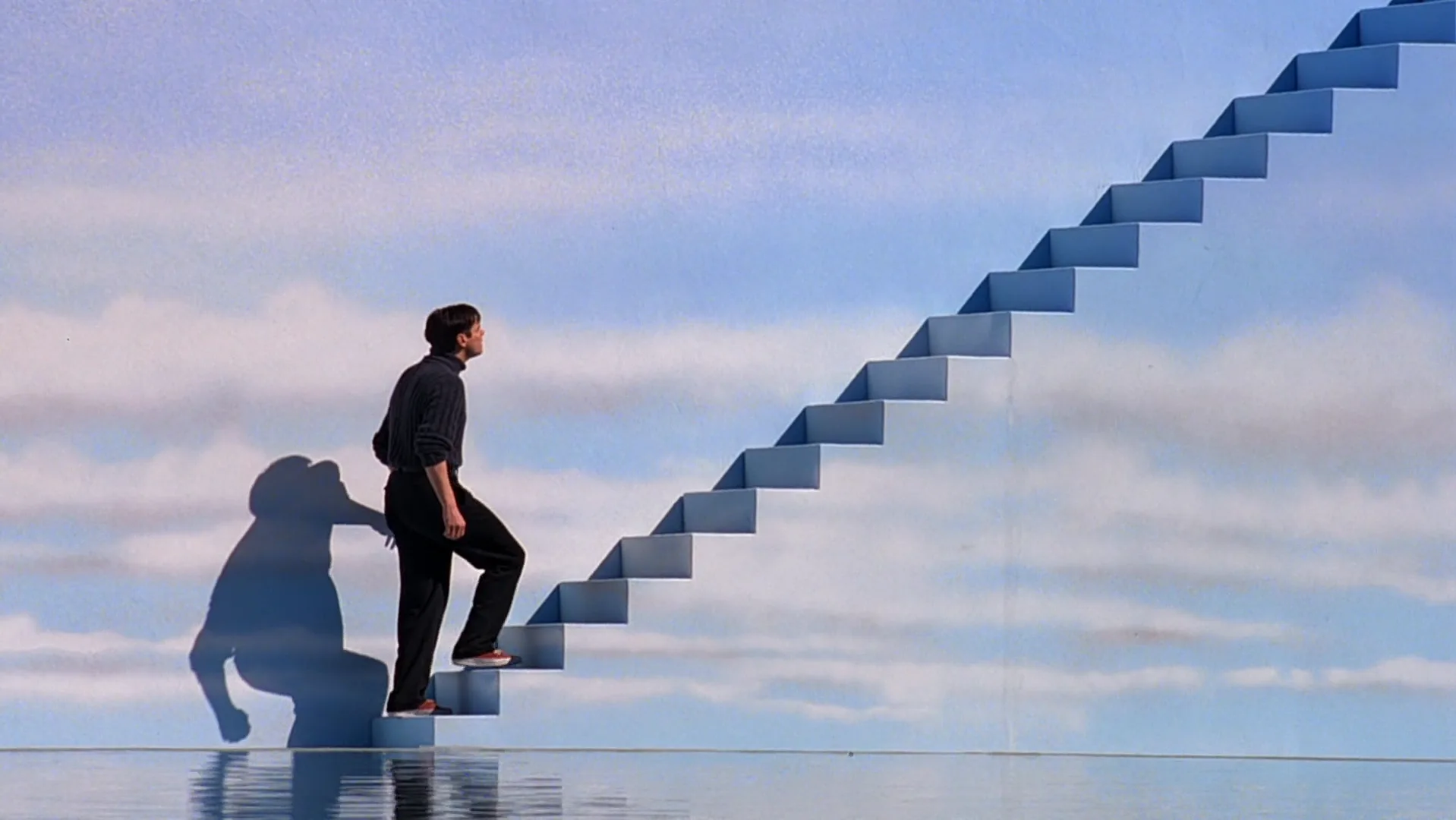
"output": "Full-screen live-action single continuous shot from its very first frame, one take with no cuts, from The Truman Show (1998). 1990s 35mm color film, soft late-afternoon sun from the left, pastel palette of pale blue, lilac and cream, calm and eerie.",
"characters": {
"S1": {
"name": "Truman Burbank, played by Jim Carrey",
"look": "slim man in his late thirties, short dark hair, dark long-sleeved shirt and dark trousers soaked to the shins, barefoot",
"voice": "silent, only breathing"
}
},
"setting": "A towering flat wall painted as a sky, pale blue with long soft white and pink clouds, rising straight out of calm shallow sea water. A staircase of pale blue blocks is built into the wall, running diagonally from the waterline up to the top right corner of the frame. The still water in the foreground mirrors the painted sky.",
"shots": [
{
"shot": 1,
"camera": "wide side-on shot at waist height from the water, 35mm lens, S1 small in the left third of the frame with the painted sky filling the frame and the staircase rising to the top right; a slow steady tilt up that follows him as he climbs, ending with him framed a little higher on the staircase",
"action": [
"BEGINNING: alive from the first frame, S1 is already walking in profile from left to right along the foot of the painted wall, ankle-deep in the water, head lowered, his large soft shadow cast onto the painted clouds behind him.",
"THEN: he reaches the bottom step, places one bare foot on it and starts climbing the pale blue staircase step by step, his shadow sliding up the painted sky beside him.",
"END: a few steps up, he lifts his right arm and stretches his open hand toward the painted clouds as if to touch the sky."
],
"voice": "silence: nobody speaks in this shot, no voice at all",
"dialogue": []
}
],
"sound": {
"ambience": "gentle lapping of water, bare wet feet on hollow steps, a faint breeze",
"speech": "no words in this video; the only human sounds are breaths and movement",
"never_spoken": "no narration and no voice-over: the descriptions, performance notes and step words of this prompt are never spoken aloud",
"music": "a film score under the scene, always below the voices: a slow, hushed piano and soft strings, wistful and luminous",
"subtitles": "none"
}
}Remakes the stair climb near the end of The Truman Show (1998), keeping the side-on wide frame, the shadow on the painted clouds, the slow tilt up and the hand reaching for the fake sky.
The JSON names Truman and the film, builds the false sky as a physical wall in setting, and splits the walk, the climb and the reaching hand into three phases under a slow tilt up. The shot stays silent apart from a quiet score.
Open FlashBoardsCommon mistakes
- The light drifts to the front: state that the source is behind the people.
- Soft haze replaces shadows: ask for hard backlight and sharp shadows.
- Everyone turns to camera: say the others keep staring at the wall.
- The false world looks merely pretty: give it one visible rule.
Keep the reference frames, prompts and every generated take side by side — images and video in one canvas.
FAQ
4 questionsWhat is the allegory of the cave in film?
It is Plato's story of prisoners who mistake shadows on a wall for reality. Filmmakers use it as a model of cinema, an audience in the dark accepting projected light as real, and as a plot template: a character discovers their world is manufactured, escapes and tries to free others.
Is The Matrix based on Plato's allegory of the cave?
The Matrix (1999) follows the cave closely: people live in a simulation they take for the world, Neo is freed, his eyes hurt because he has never used them, and he goes back to free others.
What movies are based on Plato's cave?
Common examples include The Conformist (1970), which discusses the myth directly, The Truman Show (1998), Dark City (1998), The Matrix (1999), Cube (1997), The Lego Movie (2014) and Us (2019). All share a sealed world and a painful move into light.
Why is cinema compared to Plato's cave?
The setup matches: viewers sit in the dark facing a wall, a light behind them projects moving images, and for the length of the film they treat those images as real. Jean-Louis Baudry built his apparatus theory on this comparison.
Related terms
4- AllegoryStorytelling
An allegory is a story whose characters and events stand, as a whole, for something else — a political system, a moral idea, a historical moment — so the literal plot carries a second meaning throughout.
- Postmodernism in FilmFilm Movements & Styles
Postmodern film mixes genres and high and low culture, quotes and remixes other films, breaks linear time and plays self-consciously with its own artifice — Pulp Fiction, Blade Runner, The Truman Show.
- WorldbuildingStorytelling
Worldbuilding is designing the rules, history, geography, cultures and look of a story's world so that everything on screen feels consistent — the groundwork for production design and for coherent AI-generated scenes.
- Film TheoryFilm History & Theory
Film theory is the body of ideas about what cinema is and how it produces meaning and pleasure — from Soviet montage and Bazin's realism to auteur theory, psychoanalytic and feminist criticism.
Further reading
Plato, Republic, Book VII. Jean-Louis Baudry, "The Apparatus" (1975), in Narrative, Apparatus, Ideology, ed. Philip Rosen (1986).