 FlashBoards Learn
- Learn
- Storytelling
- Worldbuilding
Storytelling · Film language
Worldbuilding
Also called: world-building, world creation
Worldbuilding is designing the rules, history, geography, cultures and look of a story's world so that everything on screen belongs to one consistent place. The audience rarely hears the rules explained. They feel them in architecture, costume, props and behavior, and that consistency is what makes an invented world believable.
- What it does
- Makes every location, object and custom feel like part of one place with its own logic and past.
- Use it when
- Your story runs on rules that differ from the audience's world: a future, a fantasy realm, a closed subculture or a distant period.
- Watch out
- Lore the camera never shows is homework, not cinema. Build deep, reveal only what the scene needs.
- Try this prompt
Extreme wide shot of a city built into a dried-up seabed, stranded ships turned into houses on stilts, rope bridges, windcatchers, dusty golden light, cinematic film still.
What is worldbuilding?
Worldbuilding is the design work behind a story's world: what is possible there, what it costs, who holds power, what happened before and what it all looks like. It is the widest-scale tool of storytelling.
The term comes from fantasy and science fiction, but every film has a world. The Godfather (1972) builds one from family codes and rituals; Taxi Driver (1976) from 1970s New York at night. The Lord of the Rings or Blade Runner (1982) differ only in how much had to be invented rather than researched.
Most of a world stays off screen. Like backstory, it is an iceberg: the filmmakers know the economy and the history; the audience sees one worn uniform and one hand-painted sign.
The five layers of a film world
A practical world bible answers five groups of questions:
- Rules. What is possible, what isn't, and what it costs: magic with a price, technology with limits, laws people fear.
- History. Wars, disasters and inventions that left visible marks: ruins, scars, patched machines.
- Geography. Distances, climate, where places sit. It decides how long a journey takes and what people eat and wear.
- Cultures. Classes, religions, languages, manners. A world with one culture feels like a set.
- Look. Palette, materials, shapes, light, level of wear. Here worldbuilding turns into production design and mise-en-scène.
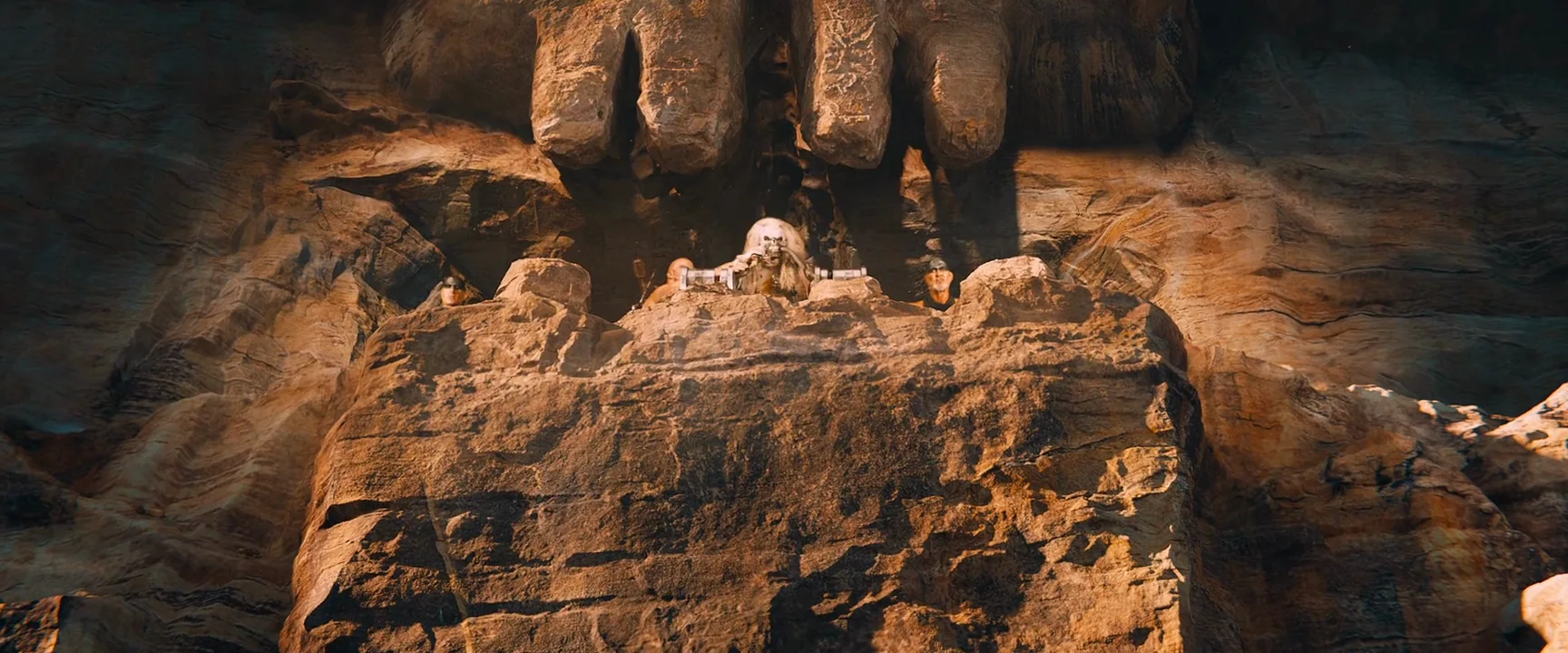
The layers feed each other. In Mad Max: Fury Road (2015) water is scarce, so whoever controls it rules.
Why worldbuilding matters on screen
Belief. Viewers accept dragons and hyperdrives as long as the world obeys its own rules. Consistency beats realism.
Stakes. If crossing a border or spending water has a cost, characters face choices that belong only to this story.
Economy. A well-built world explains itself. The original Star Wars (1977) is famous for its used, dented machines: nobody has to say the galaxy is old and at war. Blade Runner fills its future Los Angeles with rain, ads and street vendors instead of a lecture.
How to build a world for a story
Start from the story, not the map: build what the characters touch first.
- Ask what the story needs. Invent the one or two rules that sharpen the central conflict.
- Give every rule a cost. Costs create classes, and classes create costume, architecture and grudges.
- Decide what history left behind. Pick marks the camera can photograph: ruins, veterans, patched walls.
- Draw the map and the timeline. They prevent continuity errors.
- Write a visual bible. Palette, materials, shape language, signage, wear. Collect reference in a mood board and fix each character's look in a character sheet.
- Reveal through action. Let characters use the world rather than explain it. Heavy exposition means the design isn't doing its job.
In FlashBoards the world bible can live on one board: reference frames grouped by location and faction, rules and history as notes beside them, and AI generations checked against that canon before they reach the storyboard.
Worldbuilding vs. setting
Setting is where and when a particular story or scene takes place: the part the audience sees. Worldbuilding is the system that setting is cut from.
A diner scene has a setting. Whether the diner serves real eggs or printed ones, and why its windows are barred, is worldbuilding. A present-day drama borrows its world from reality; a science-fiction epic designs it first.
Worldbuilding examples in film
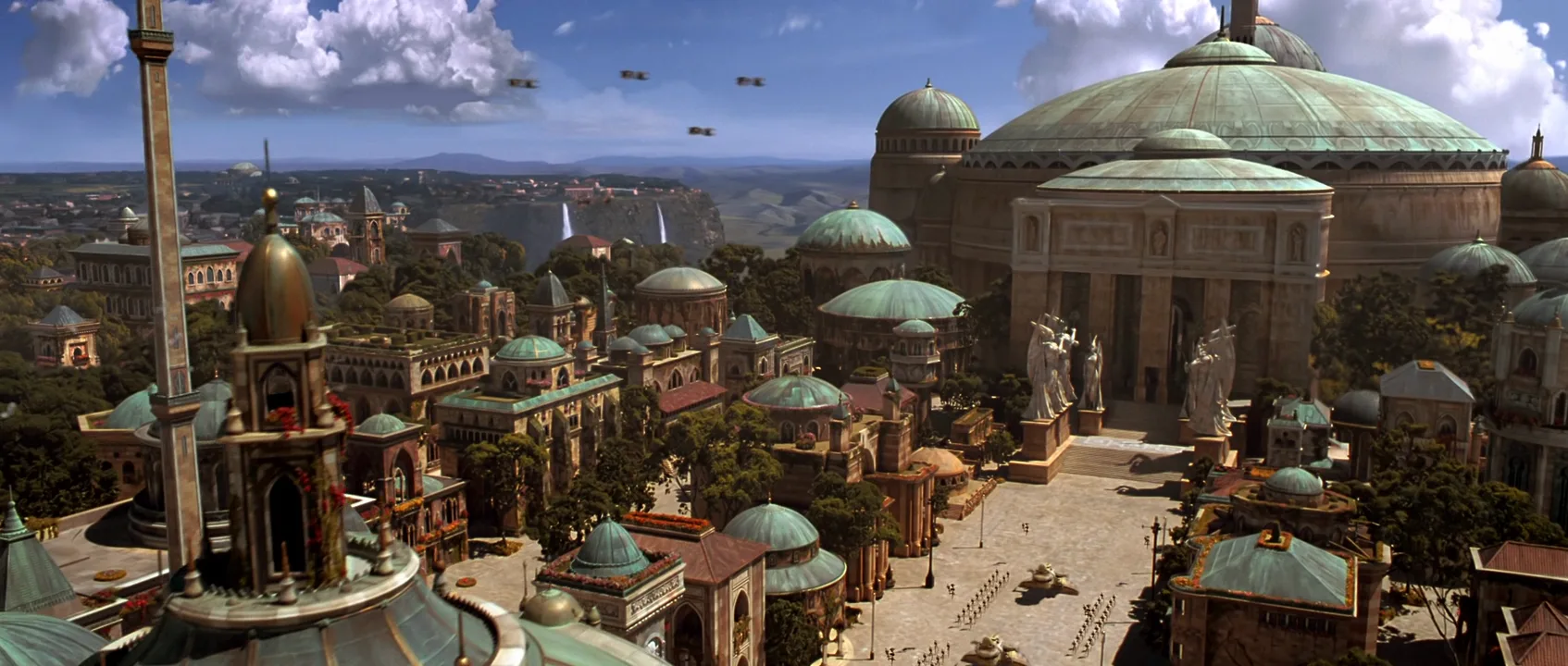
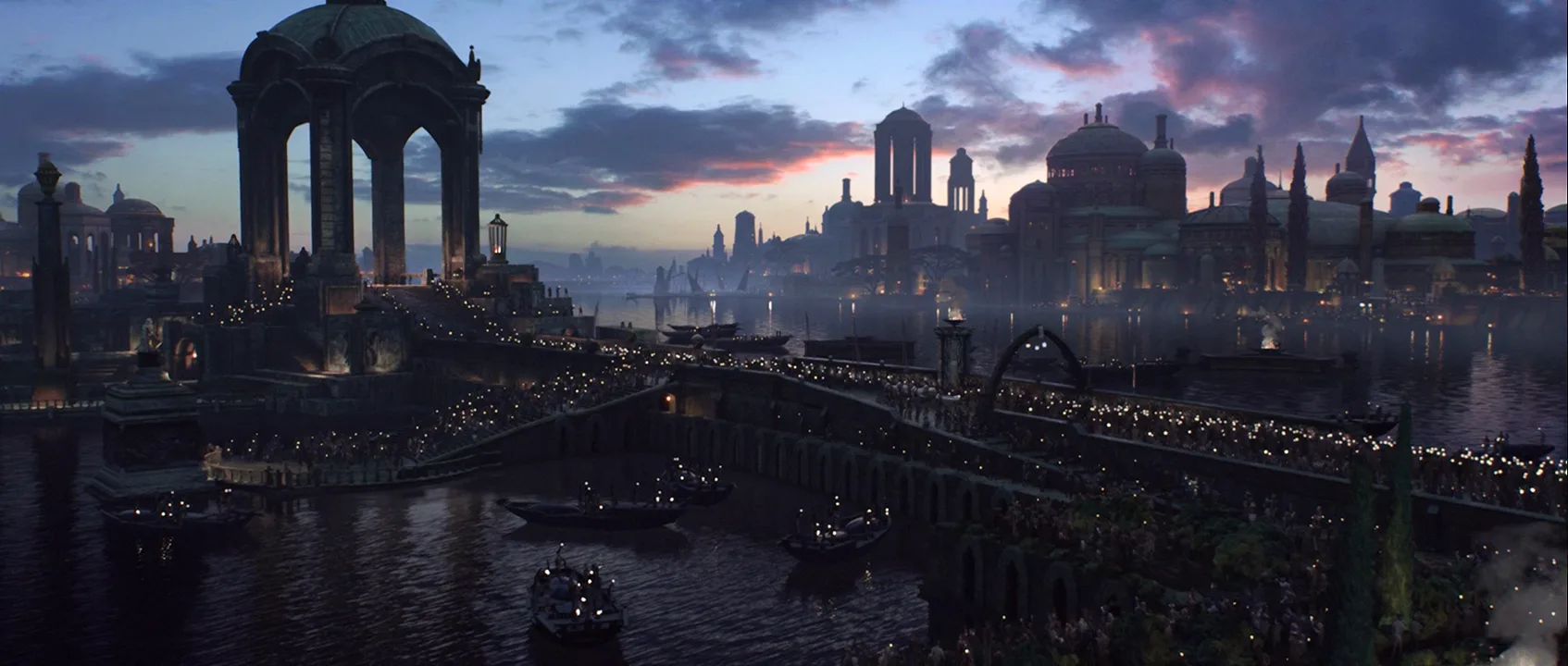
5 framesWide frames where design explains who lives there and what came before.

How to create a worldbuilding with AI
4 promptsImage models build a world well when the prompt states its rules as visible things. Repeat a short world line (materials, palette, light) word for word in every prompt so separate generations stay in one world, and keep the takes on your FlashBoards world board next to the references. The fourth prompt re-shoots a real film shot from a text description alone, and the original plays next to the result so you can compare.
Extreme wide establishing shot of a city on the floor of a dried-up sea. Rusted fishing ships stranded on tall wooden stilts serve as houses, linked by rope bridges. Clay windcatcher towers with red cloth sails rise between them. White salt crust covers the ground; an old waterline stains the cliffs behind. Small figures in pale hooded robes cross the bridges. World line: rust, bleached wood, red cloth, salt white; low golden sun, dusty haze. High camera, 24mm lens, cinematic film still.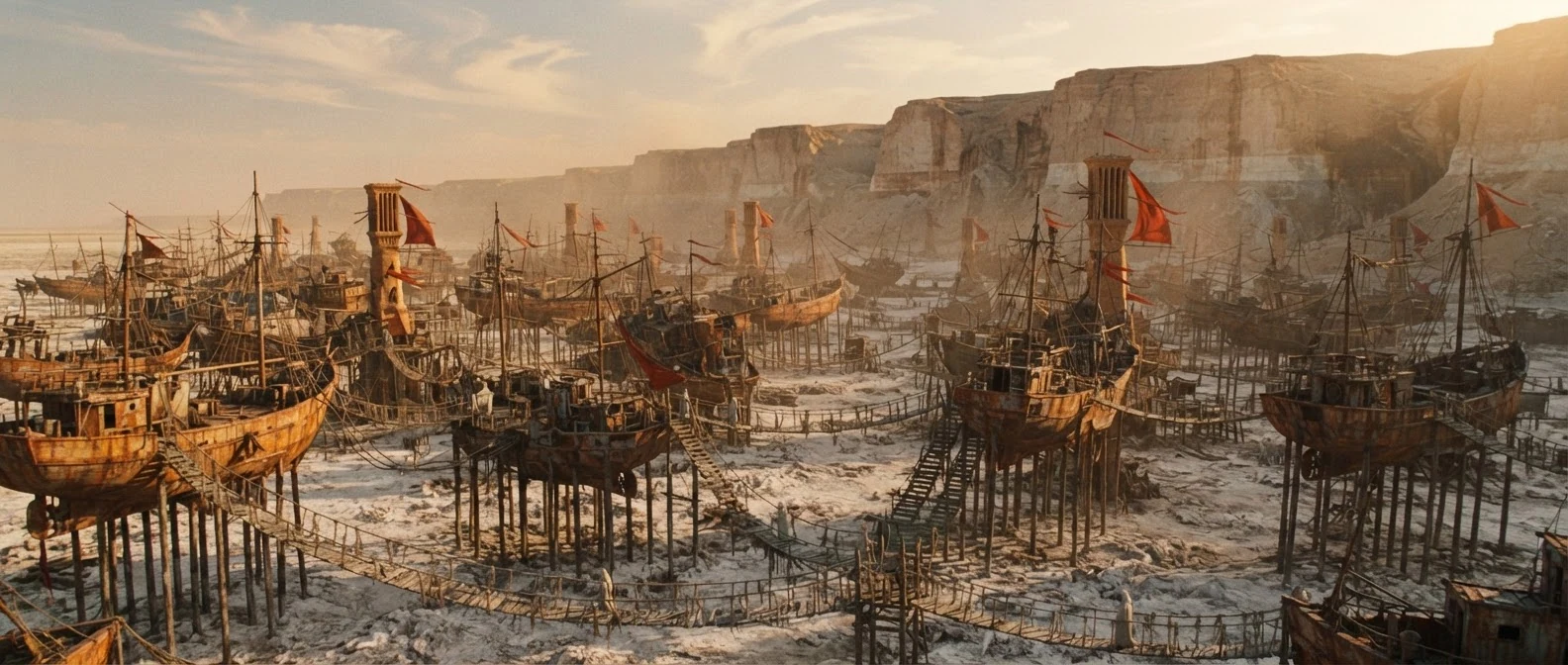
One rule (the sea left) shows three ways: stranded ships, salt crust, the waterline. The world line fixes materials, palette and light for later prompts. This is the video's start frame.
Open FlashBoardsStreet-level medium wide shot in the same dry-seabed city: a narrow market lane under the hull of a stranded ship on stilts. A woman in her sixties with a shaved head, deep sun lines and a blue tattoo across her chin trades small clay jars of water for dried fish on a brass scale. World line: rust, bleached wood, red cloth, salt white; low golden sun, dusty haze. 35mm lens, eye level, cinematic film still.
Same world line, new scale. Culture comes through props: water as currency, weighed on a scale. The specific face keeps the character fictional.
Open FlashBoardsCamera: a slow, steady aerial glide forward and slightly down toward the stilt houses, ending closer to the rope bridges. Action: from the first frame the red sails on the windcatchers turn in a steady wind and dust drifts across the salt floor. The robed figures keep walking across the swaying bridges. At the end one figure stops mid-bridge and looks toward the cliffs.Turning sails and drifting dust make the shot alive from frame one; the action uses only what is already in the frame.
Open FlashBoards{
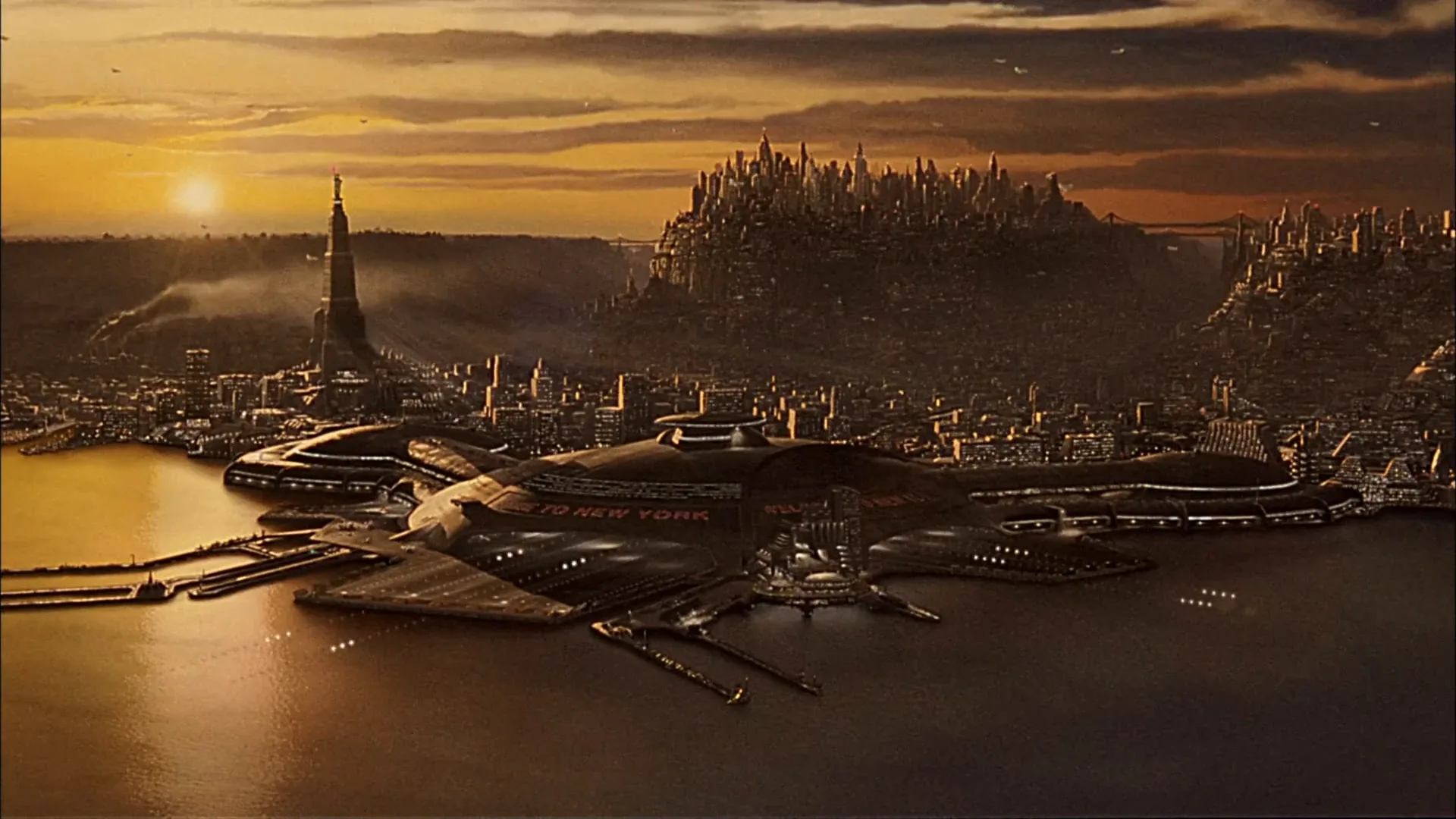
"output": "Full-screen live-action science-fiction film shot from The Fifth Element (1997), alive from its very first frame: one continuous shot, no cuts. 35mm film stock, golden-hour backlight, amber and bronze palette with deep brown shadows, a future New York harbour at sunset.",
"characters": {},
"shots": [
{
"shot": 1,
"camera": "wide establishing shot from low over the water, locked high-angle framing with a slow, gentle tilt up through the whole shot; long lens feel, deep focus on the far skyline",
"action": [
"BEGINNING: alive from the first frame, a low sun sits in the upper left of a hazy orange sky; on the left third of the far horizon stands the Statue of Liberty, small and dark against the glow, and to its right a dense wall of towering stacked skyscrapers fades into haze",
"BEGINNING: in the foreground a huge dark flat harbour platform spreads across the frame, ringed with docks and thin landing arms, lying on calm water that reflects a gold streak of sunlight at the left edge",
"THEN: a small silver passenger airliner appears low at the left edge, just above the platform, flying left to right and climbing toward the camera, growing larger with each moment",
"THEN: tiny aircraft drift slowly between the distant towers and thin smoke trails rise from the city on the left",
"THEN: the airliner banks and fills the upper centre of the frame, backlit by the sun, then passes over the lens and exits through the top right edge",
"END: the frame settles on the calm harbour platform, the statue on the left horizon and the stacked towers under the orange sky, small craft still crossing far away"
],
"voice": "silence: nobody speaks in this shot, no voice at all",
"dialogue": []
}
],
"sound": {
"ambience": "a wide city hum heard from far away, soft water lapping, a jet engine roar that swells as the airliner passes over the camera and fades",
"speech": "no words in this video; the only human sounds are breaths and movement",
"never_spoken": "no narration and no voice-over: the descriptions, performance notes and step words of this prompt are never spoken aloud",
"music": "a film score under the scene, always below the voices: warm swelling strings and brass with a slow, awed pulse",
"subtitles": "none"
}
}Remakes the sunset harbour shot of future New York from The Fifth Element (1997); the prompt carried over the statue on the horizon, the platform, the slow tilt up and the airliner climbing over the lens.
The world is carried by fixed landmarks (the statue, the stacked towers, the harbour platform) and one moving vehicle that proves the place is in use.
Open FlashBoardsCommon mistakes
- Models default to generic domes and neon. Name materials and show one unusual rule physically.
- Separate prompts drift into different worlds. Reuse the world line word for word and compare takes on the board.
- Lore without visible marks disappears: "war-torn kingdom" draws nothing; "collapsed bridge patched with timber" does.
Keep the reference frames, prompts and every generated take side by side — images and video in one canvas.
FAQ
4 questionsWhat is worldbuilding in film?
Worldbuilding in film is designing the system behind a story's world: its rules, history, geography, cultures and visual style. On screen it shows through production design, costume, props and behavior. Done well, the audience never hears the rules explained but still understands and believes the world.
How do you build a world for a story?
Start from the central conflict and invent only the rules that sharpen it. Give each rule a cost, decide which past events left visible marks, sketch a map and timeline, then write a visual bible of palette, materials and shapes. Reveal the world through characters using it.
Is worldbuilding only for fantasy and science fiction?
No. Every film has a world; realist stories borrow most of theirs from real places and periods. The Godfather, Mad Men and Taxi Driver build detailed social worlds with their own codes and costume. The work is research and selection rather than invention, but the goal is the same consistency.
What is the difference between worldbuilding and setting?
Setting is the specific time and place where a story or scene happens, the part the audience sees. Worldbuilding is the larger design behind it: the rules, history and cultures that decide what any place in that world looks like.
Related terms
5- SettingStorytelling
Setting is where and when a story takes place — period, location, social world — and in film it's made concrete by locations, production design and light.
- BackstoryStorytelling
Backstory is everything that happened to the characters and their world before the film begins; it shapes their motives and is revealed through hints, dialogue or flashbacks rather than dumped on the audience.
- Mise-en-ScèneFilm History & Theory
Mise-en-scène is everything placed and arranged in front of the camera — setting, props, costume, makeup, lighting, and the actors' positions and movement — and how it is composed in the frame to create meaning.
- Color SymbolismColor
Color symbolism uses colors as signs — red for love, danger or power, green for envy or sickness — but in film the meaning is set by context and repetition inside the story, not by a universal chart.
- Character SheetScreenwriting
A character sheet is a one-page reference that fixes who a character is: for writers it lists traits, goals and history; for artists it shows the face, costume and turnaround views so every drawing, shot or AI generation stays consistent.
Further reading
Jeff VanderMeer, Wonderbook (2013) — chapters on worldbuilding. Mark J. P. Wolf, Building Imaginary Worlds (2012).