 FlashBoards Learn
Genres · Film language
Dystopian Film
Also called: dystopia, dystopian sci-fi, cyberpunk dystopia
A dystopian film shows a society gone wrong, whether totalitarian, polluted or collapsed, and makes that wrongness visible. Crushing architecture, surveillance, drained color and crowds in uniform tell the viewer the rules before any character explains them. Metropolis, Brazil and Children of Men built the genre's look; most dystopias still borrow from them.
- What it does
- Turns a political or social fear into a physical world the audience can see and feel trapped in.
- Use it when
- Your story is about control, conformity or collapse and the setting itself should be the antagonist.
- Watch out
- Generic grey ruins and random neon read as wallpaper; every design choice should express one rule of the regime.
- Try this prompt
Extreme wide shot, brutalist concrete plaza, workers in identical grey coveralls marching in formation, smog, sodium light, desaturated, one red scarf
What is a dystopian film?
A dystopian film is set in an imagined society that is worse than ours in a specific, recognizable way: the state watches everyone, a corporation owns the air, the climate has failed, children have stopped being born. The word is the negative of utopia, a perfect place. It sits inside film genres as a branch of science fiction, but it is defined less by technology than by power: who controls the world and what that control costs.
On screen, a dystopia is mostly a production problem. The audience has to understand the system without a lecture, so worldbuilding moves into architecture, costume, light and color. The recurring conventions:
- Architecture that dwarfs people: towers, bunkers, endless corridors, concrete with no human scale.

- Uniformity: identical clothes, shaved heads, numbered citizens, people moving in lines.
- Surveillance: cameras, screens, watching eyes, framing that feels like someone else's point of view.
- Rationed color: grey, green-grey or sickly amber, with one accent color that stands for what the regime has taken away.
- Bad air: smog, smoke, rain, haze that makes distance fade and daylight never quite arrive.
The canonical references are few and worth knowing by sight. Metropolis (1927) splits its city into gardens on top and workers' machine halls below. Brazil (1985) buries its characters in ducts and paperwork. Blade Runner (1982) invented the rain-soaked, advertising-lit megacity. Children of Men (2006) made collapse look like tomorrow's news, with grey streets and refugee cages.
Why do filmmakers set stories in a dystopia?
Because a dystopia lets a film talk about the present at one step's distance. Most dystopias are an allegory: Fahrenheit 451 (1966) is about what happens to a culture that burns its books, Gattaca (1997) about genetic sorting, Snowpiercer (2013) about class, laid out as a train where the rich ride in front and the poor in the tail. Push the exaggeration further and you get satire, as in Brazil, where the horror is bureaucratic and often funny.
For the viewer, the effect is claustrophobia with recognition. The world is strange enough to be a future and familiar enough to be a warning: the housing blocks, uniforms and screens are ours, only more so. That is why the strongest dystopias spend their design budget on ordinary things: a ration counter, a queue, a commuter train, a checkpoint. Children of Men is frightening because its London looks like a bus ride away.
The setting also becomes the antagonist. In a thriller, a villain blocks the hero; in a dystopia the villain is the whole environment, and every wide shot reminds the audience that there is nowhere to run. That shapes the genre's structure: characters discover the rules, test them, break one, and pay. The camera's job is to make the rules visible at each stage.
The dystopian aesthetic: how the look is built
A convincing dystopian look comes from a handful of choices applied consistently across production design, camera and grade. Pick a rule for each layer and never break it without a story reason.
Architecture and scale
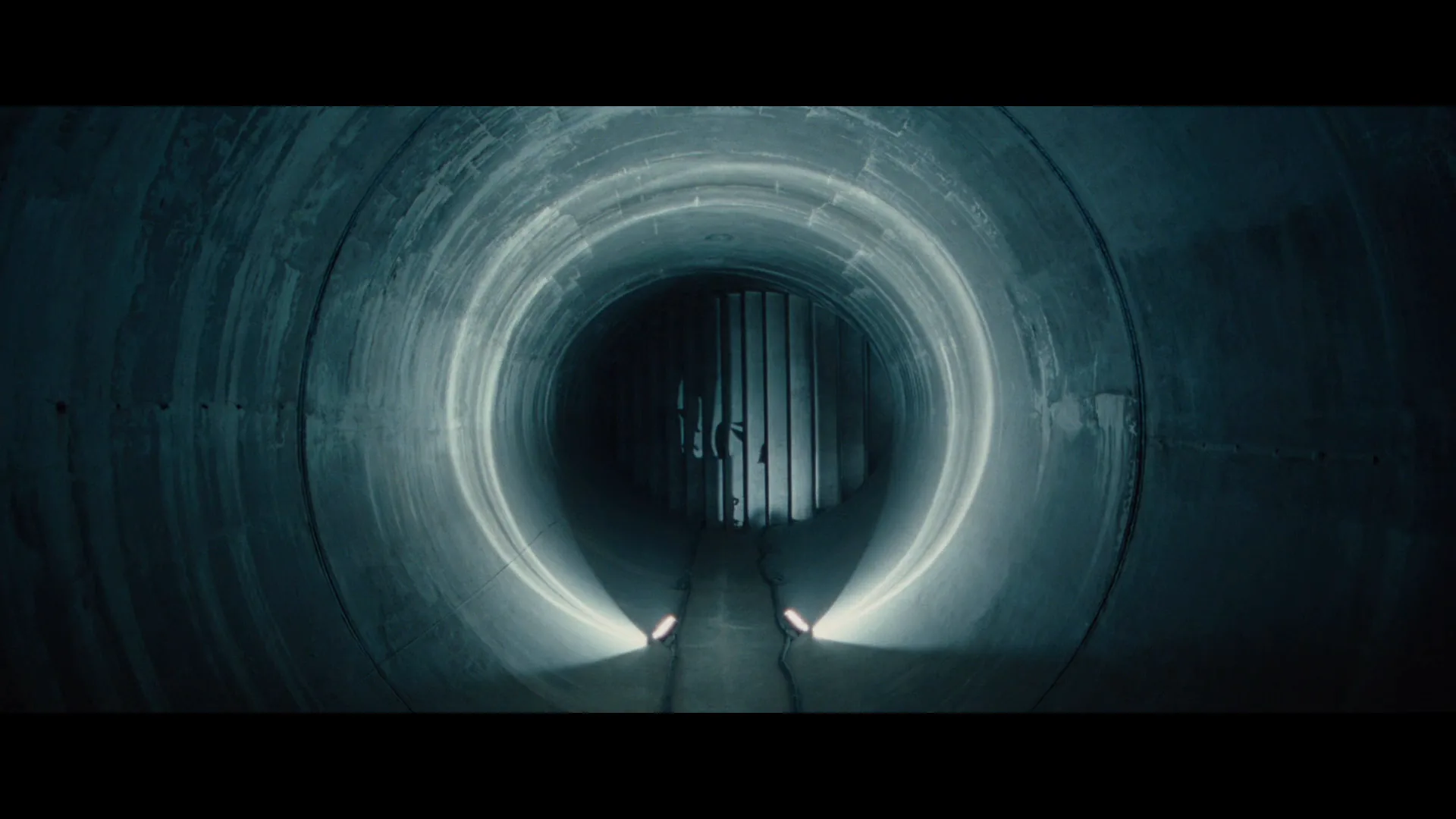
Brutalist concrete, repeated windows, monumental stairs and tunnels are the genre's vocabulary. A Clockwork Orange (1971) shot in real concrete estates in south-east London; Gattaca used modernist civic buildings to suggest a clean, controlled future. Frame people small: an extreme wide with the building filling the top two-thirds says more about power than any dialogue.
Symmetry and repetition
The regime likes order, so the camera can too. One-point perspective down a corridor, rows of identical doors, workers in step: symmetry becomes a sign of control, and the character who breaks the line breaks the frame.
Costume and crowds
Costume design does as much as sets. THX 1138 (1971) puts shaved citizens in white against white; Metropolis marches workers in dark uniforms with bowed heads. A crowd dressed alike reads as a system; a single figure in color reads as a person.
Color and light
Most dystopias drain color toward a desaturated look, then keep one accent. Light is institutional: overhead fluorescent tubes, sodium-vapor street lamps, searchlights, screens. The cyberpunk branch flips this into saturated neon lighting reflected on wet streets, but it is still light sold by someone, not sunlight.
Surveillance in the frame
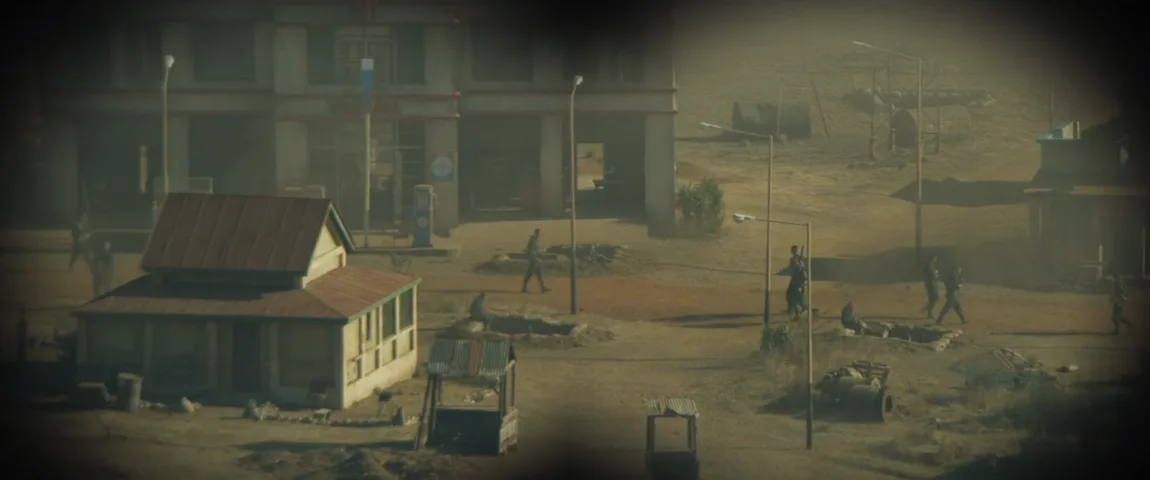
Show the watching: lenses on poles, monitors, telephoto shots from rooftops, binocular or scope masks. When the audience watches a character through a device, they become part of the system for a moment, which is uncomfortable in exactly the right way.
How to shoot a dystopian film

Locations first. Dystopias are cheaper than they look if you find the right buildings. Jean-Luc Godard shot Alphaville (1965) in the modern Paris of its day with no futuristic sets at all. Scout brutalist housing, car parks, underpasses, power stations, empty industrial halls and water tunnels. One distinctive location, shot from several heights, can carry a whole world.
Lenses and height. For establishing the system, go wide: 18–24mm on full frame, camera at 1–1.5 m or lower so buildings lean over the actors. Keep verticals straight when you want order, tilt up and let them converge when you want menace. For surveillance point-of-view, switch to a long lens, 135mm and up, from high and far away, and let foreground railings or glass soften the edges. For intimacy inside the regime, a 35–50mm handheld close-up breaks the cold geometry the way Children of Men does with its long, reactive takes.
Blocking. Move crowds in lines and in step; move your protagonist against the flow, slower, or in the opposite direction. Put guards and cameras in the background of ordinary scenes so control is always present.
Lighting. Motivate everything from institutional sources: overhead fluorescent grids at 4000–5000K with a green spike left in, sodium-vapor practicals around 2000K for night streets, a hard searchlight or a screen as the key. Low-key lighting with big black areas hides the edges of a small set. Add smoke or haze so beams read and distance falls off into grey.
Color and grade. Decide the palette in prep with the designer: two or three muted hues plus one accent reserved for the story (a scarf, a flower, a warning light). In the grade, pull saturation down 20–40 percent, keep skin just alive, and push shadows toward the palette's cold hue.
Types of dystopian films and their looks
"Dystopian" covers several distinct visual traditions. Knowing which one you are making keeps the design coherent.
Totalitarian dystopia
The state is the threat: Metropolis, Nineteen Eighty-Four (1984), THX 1138, Equilibrium (2002). Monumental architecture, uniforms, rallies, propaganda screens, a cold and drained palette. The camera favors symmetry and wide, static frames.
Cyberpunk dystopia
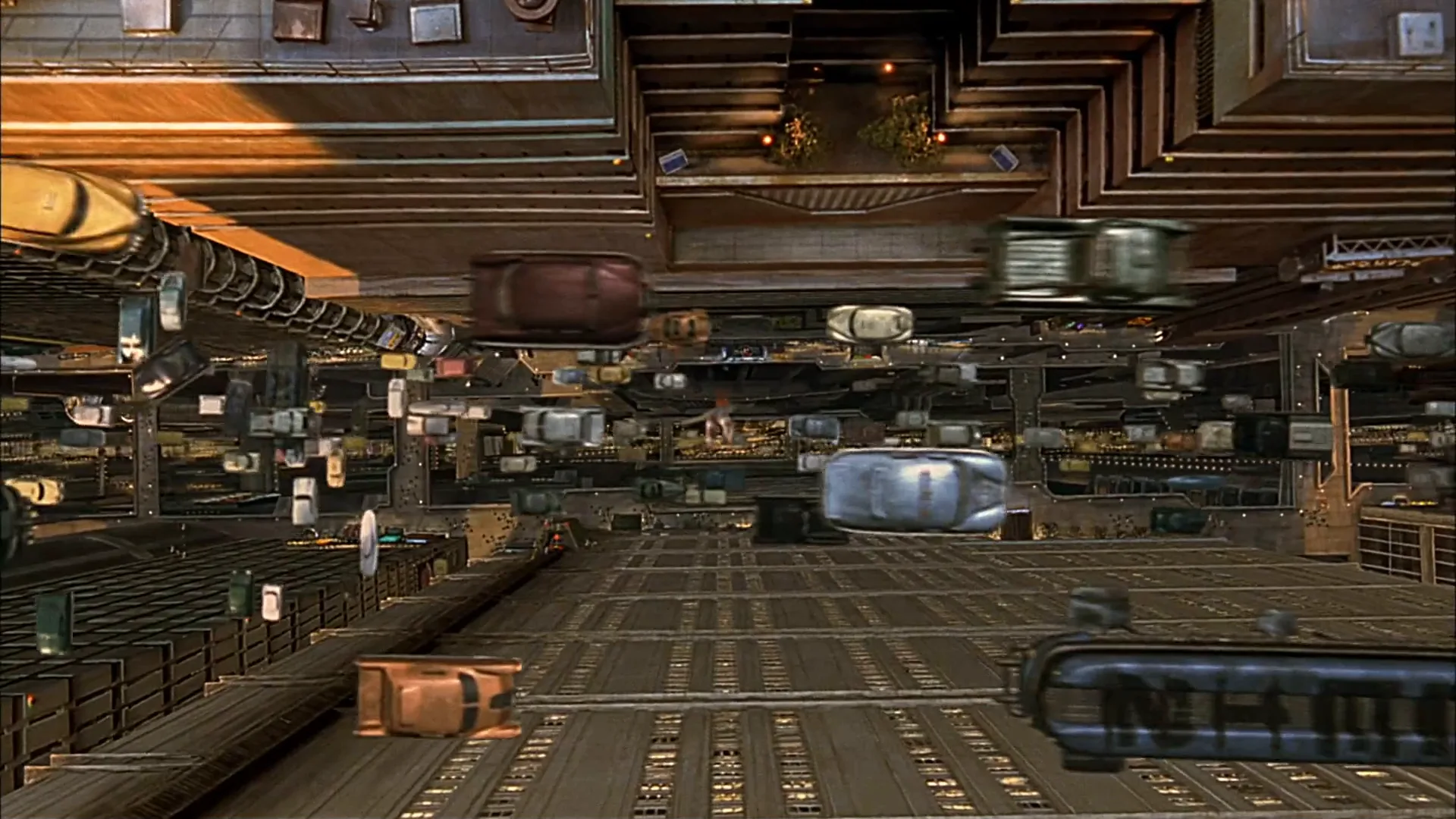
The corporation is the threat: Blade Runner, Ghost in the Shell (1995). Vertical megacities, rain, smoke, advertising light, crowded street markets. It overlaps with film noir in its lonely investigator and hard shadows, and it is the look most people mean when they search for a dystopian city.
Ecological and collapse dystopia
The planet or society is failing: Children of Men, Blade Runner 2049 (2017) with its orange, dust-choked ruins of Las Vegas, Snowpiercer. Dust, ash, snow, rust and makeshift repairs; the grade is often one dominant color that stands for the poisoned air.
Quiet or social dystopia
Nothing explodes: Gattaca, Never Let Me Go (2010), The Lobster (2015). Clean modern interiors, restrained costumes and calm, composed frames. The horror is that everyone accepts the rules, so the look stays polite and the unease comes from order itself.
Many films mix these, which makes the dystopia one of the most flexible settings for a hybrid genre story: a dystopian thriller, romance or comedy keeps the other genre's structure and borrows the world.
Dystopian vs. post-apocalyptic film
The two overlap but they are not the same. A dystopian film shows a society that still works, only horribly: there is a government, an economy, rules and people enforcing them. A post-apocalyptic film shows the world after the system has broken: small groups, scavenging, empty landscapes, law replaced by survival.
Visually, the difference is order versus entropy. Dystopia is full of structure, with lines of workers, clean corridors, screens, checkpoints and uniforms. Post-apocalypse is full of emptiness, with open horizons, wrecked cars, improvised clothing and nature taking back the city. Mad Max: Fury Road (2015) is post-apocalyptic, though the Citadel inside it is a small dystopia with its own ruler, water rationing and caste of war boys. Children of Men sits on the border: the state still exists and runs camps while the world outside it falls apart.
For design, ask one question: who is in charge? If the answer is a system, build order and surveillance. If the answer is no one, build emptiness and improvisation.
Dystopian Film in motion
2 clipsThese loops show dystopian film in motion, where a still frame can't: watch how the effect plays out over a few seconds.
Dystopian Film stills
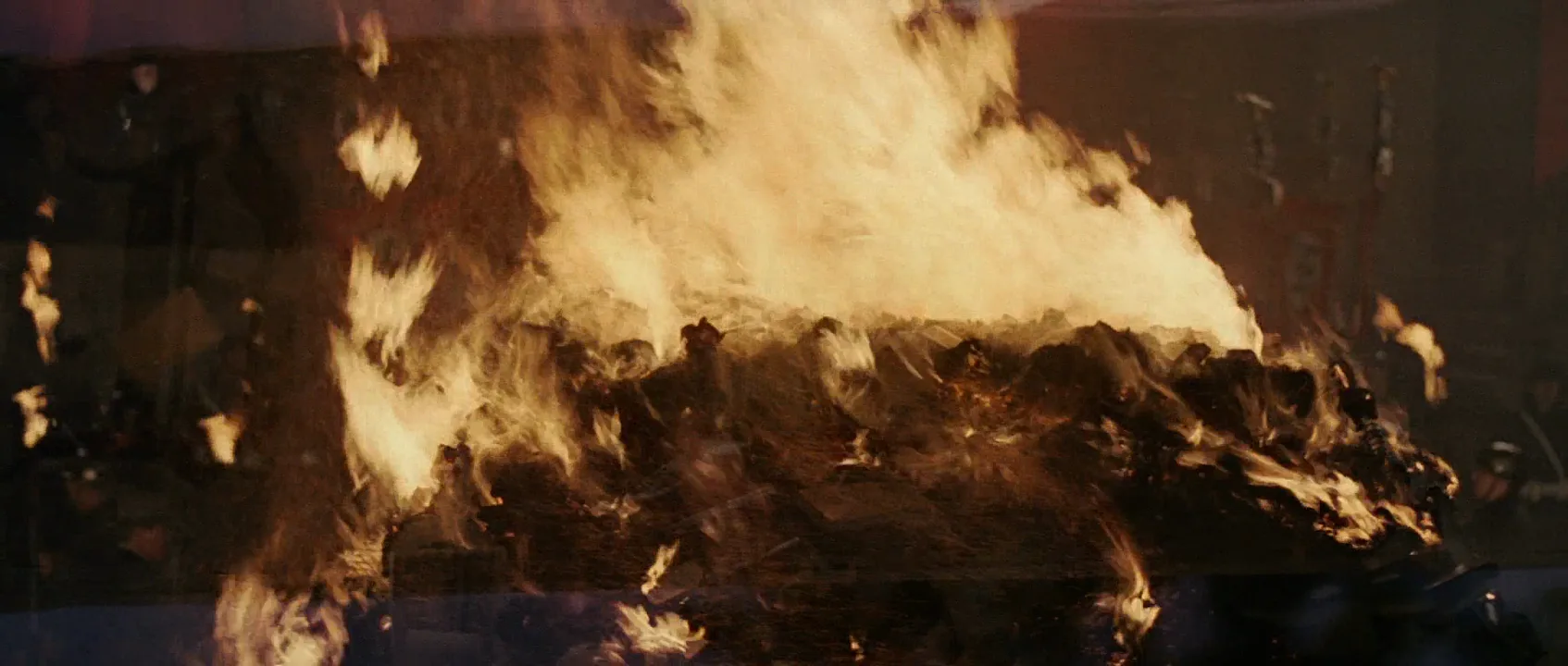
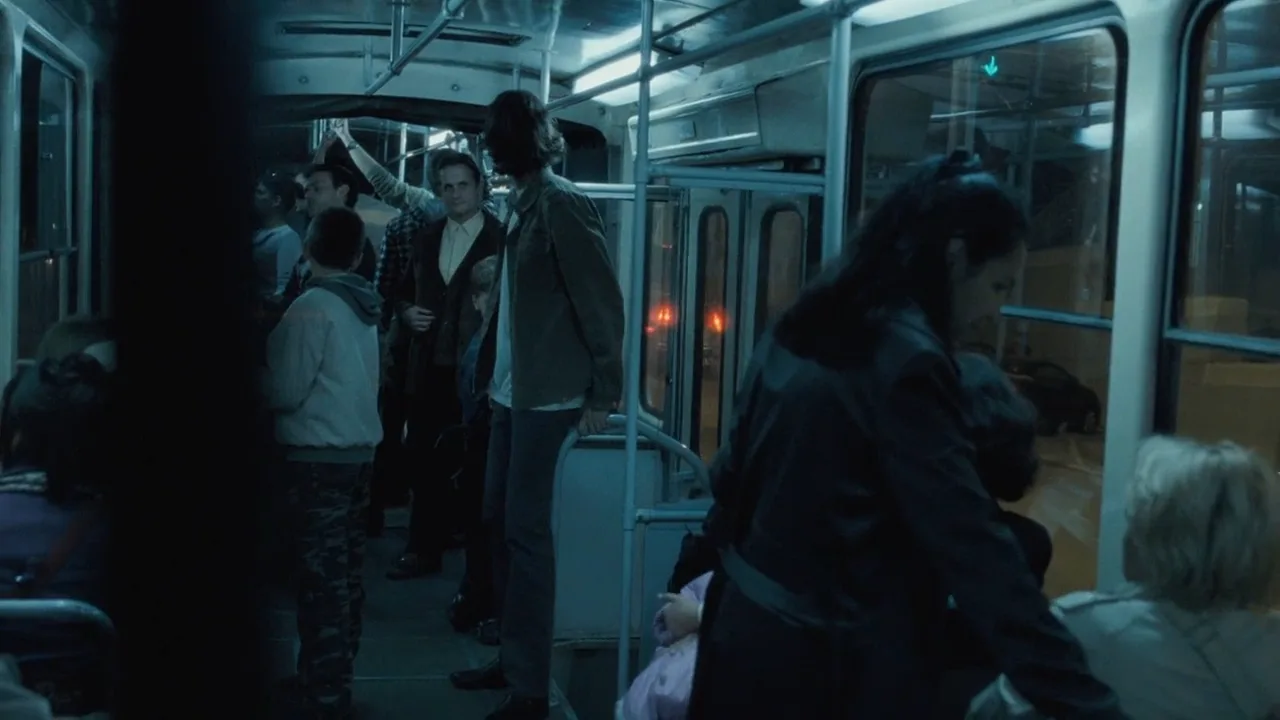
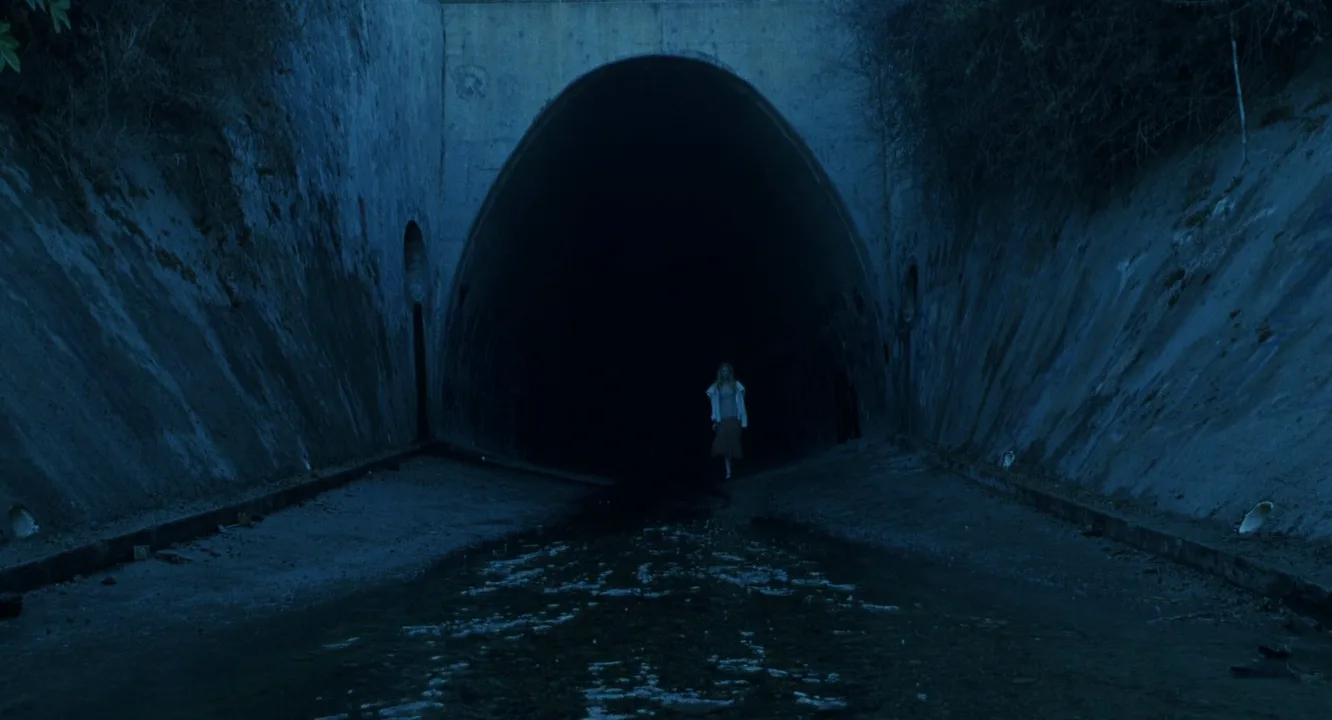
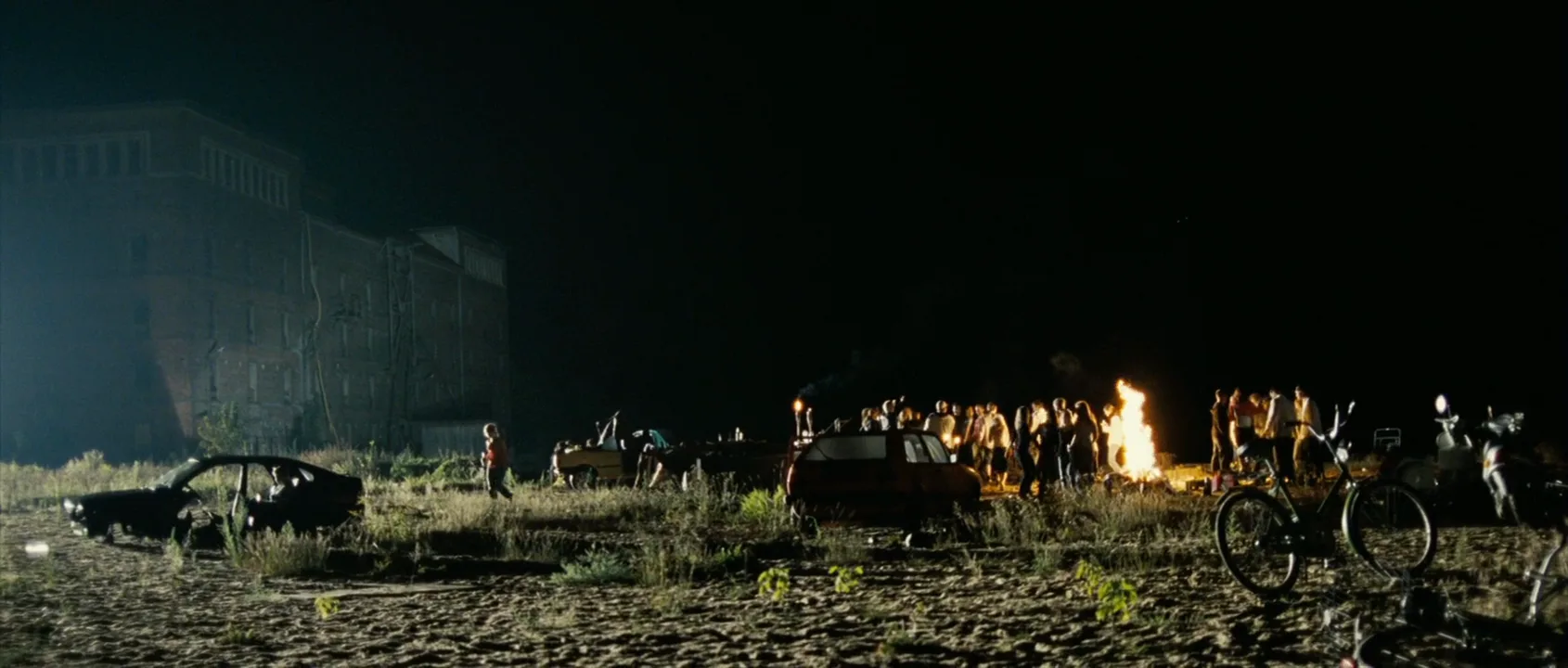
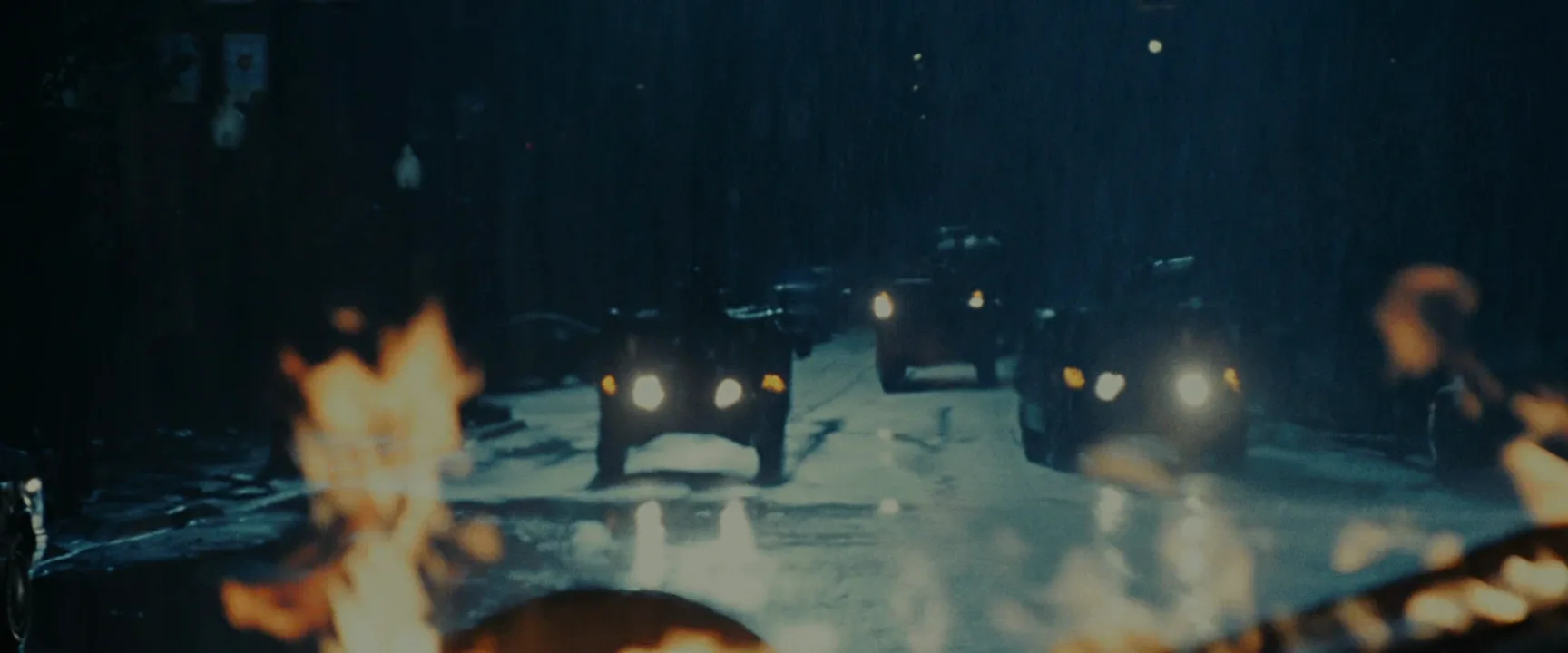
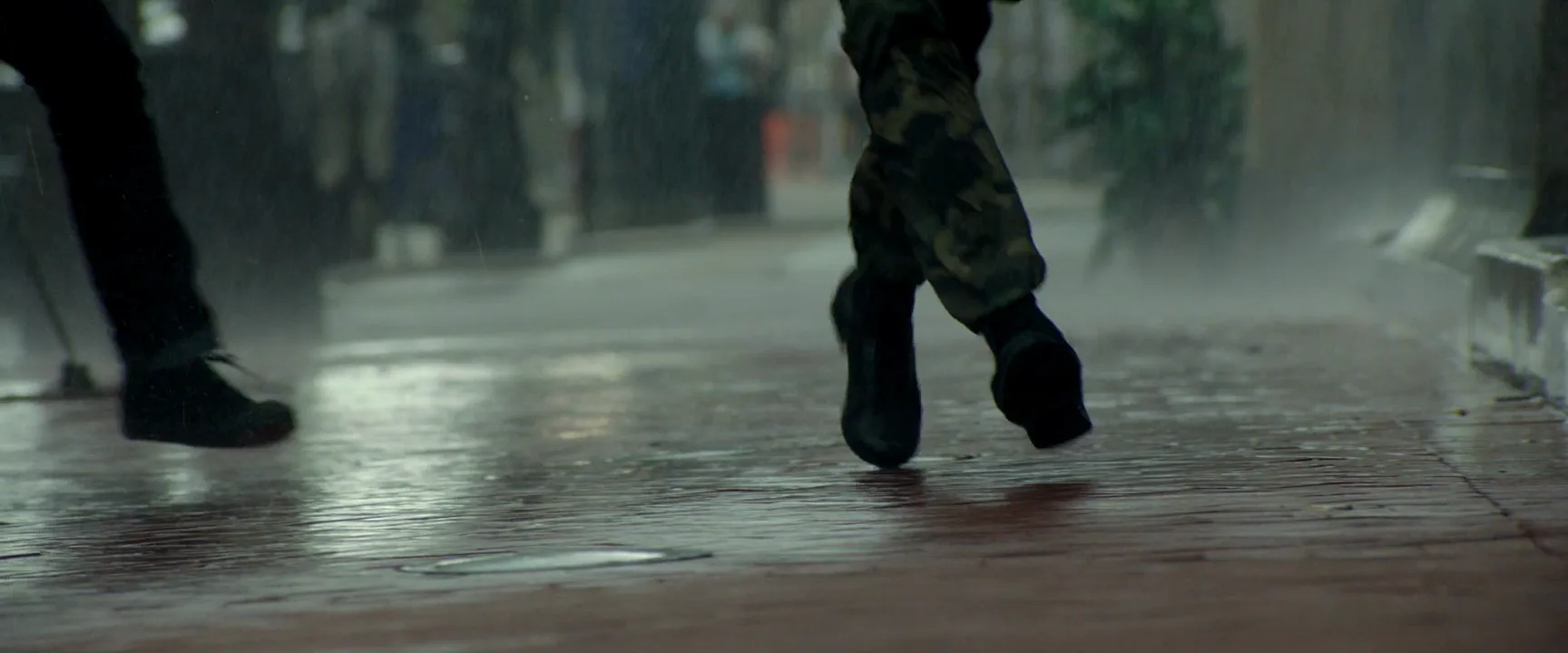
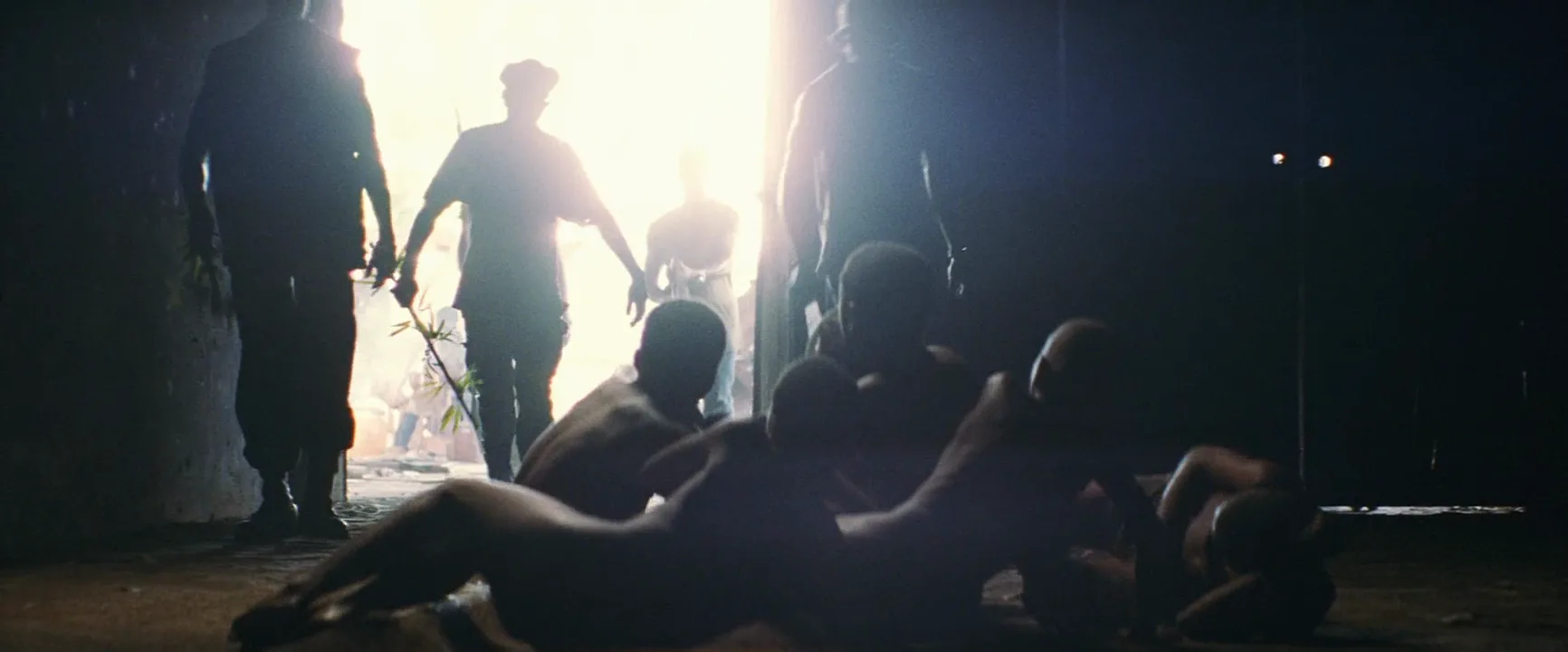
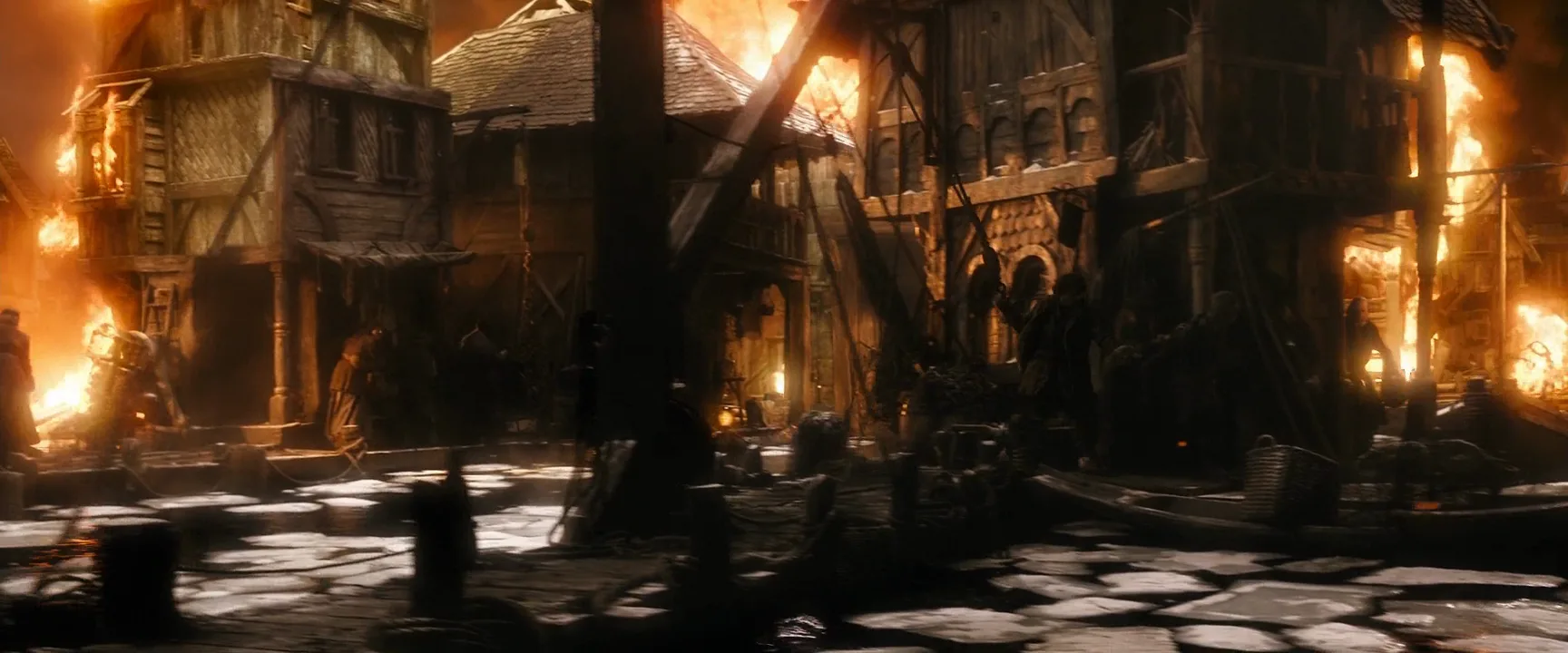
12 framesFrames that carry the building blocks of the dystopian look: concrete scale, tunnels, crowds, fire in the street, faceless force and the watcher's point of view.
How to create a dystopian film with AI
4 promptsImage models know the words dystopian and cyberpunk too well: left alone they deliver generic ruins or purple neon. Direct them like a production designer instead: name the architecture, the uniform, the light sources, the one accent color and where the camera sits. Keep the film frames, your palette notes and every take on one FlashBoards board so the world stays consistent from shot to shot. The fourth prompt re-shoots a real film shot from a text description alone, and the original plays next to the result so you can compare.
Cinematic film still, dystopian city at dawn. Extreme wide shot, 24mm lens, camera at waist height. A vast brutalist concrete plaza in front of a windowless monolithic ministry tower that fills the top two-thirds of the frame. A column of workers in identical grey coveralls and grey caps marches in formation across the wet plaza toward the tower. Surveillance cameras on tall steel poles line the route. Thick yellow-grey smog, sodium street lamps still burning, a white searchlight beam from the top of the tower cutting through the haze. In the right foreground, a fictional young woman with a close-cropped silver buzz cut, a crooked nose and a faded red scarf walks the opposite way. Desaturated grey-green palette, the red scarf is the only color. Film grain, anamorphic widescreen feel.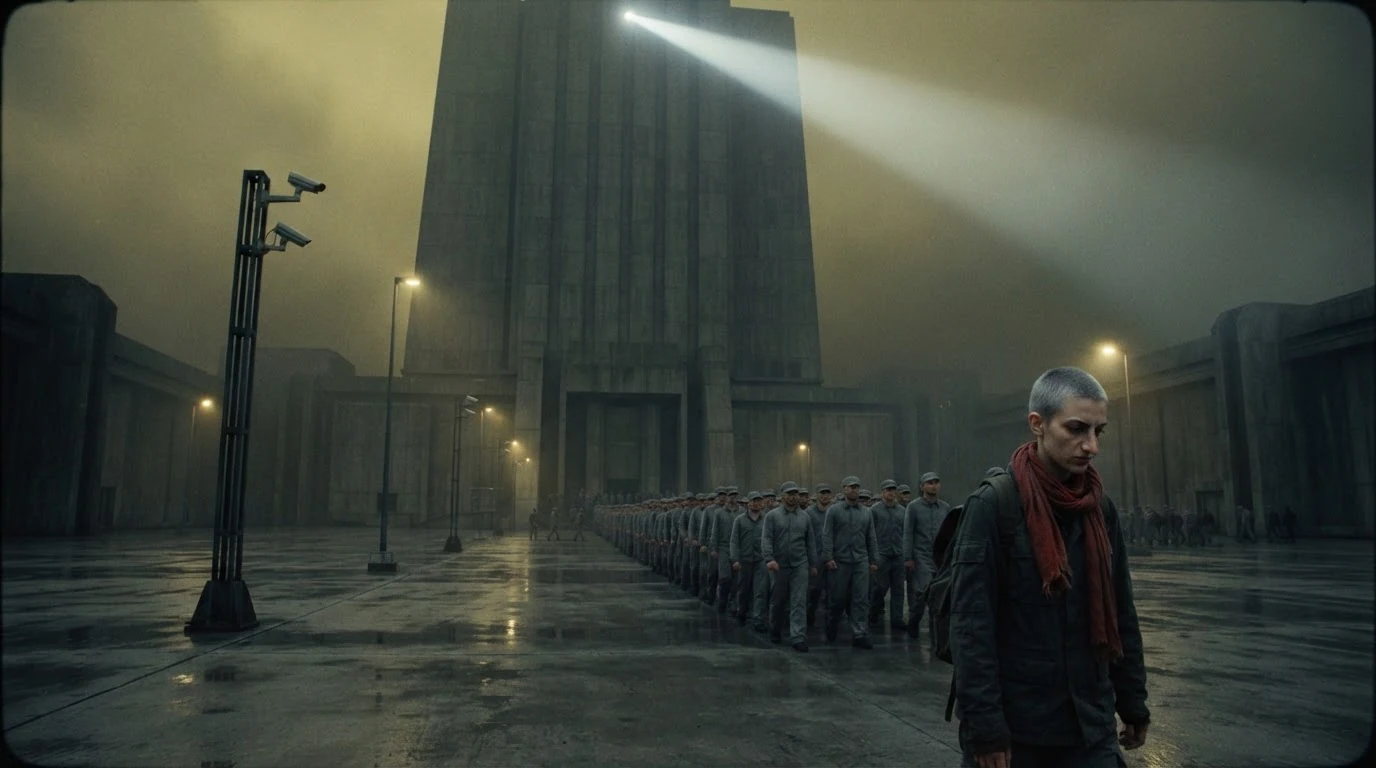
"Fills the top two-thirds" and "camera at waist height" force the scale that makes architecture oppressive. "Identical grey coveralls" and "marches in formation" turn a random crowd into a system. The red scarf gives the grade one accent, and the searchlight, smog and marching column are motion sources the video can use.
Open FlashBoardsWide cinematic frame, quiet sterile dystopia. A long white corridor in one-point perspective, 18mm lens at eye level, perfectly symmetrical. Identical white doors repeat on both sides, each with a small black number plate and no other markings. A grid of flat overhead fluorescent panels gives cold, shadowless top light. In the center of the corridor stands a fictional tall, gaunt man in his fifties with a shaved head, deep-set pale grey eyes and a small vertical scar on his chin, wearing a seamless white uniform. At the far end, two figures in the same white uniforms walk away in step. Pale mint-white palette, clinical, silent, unsettling calm.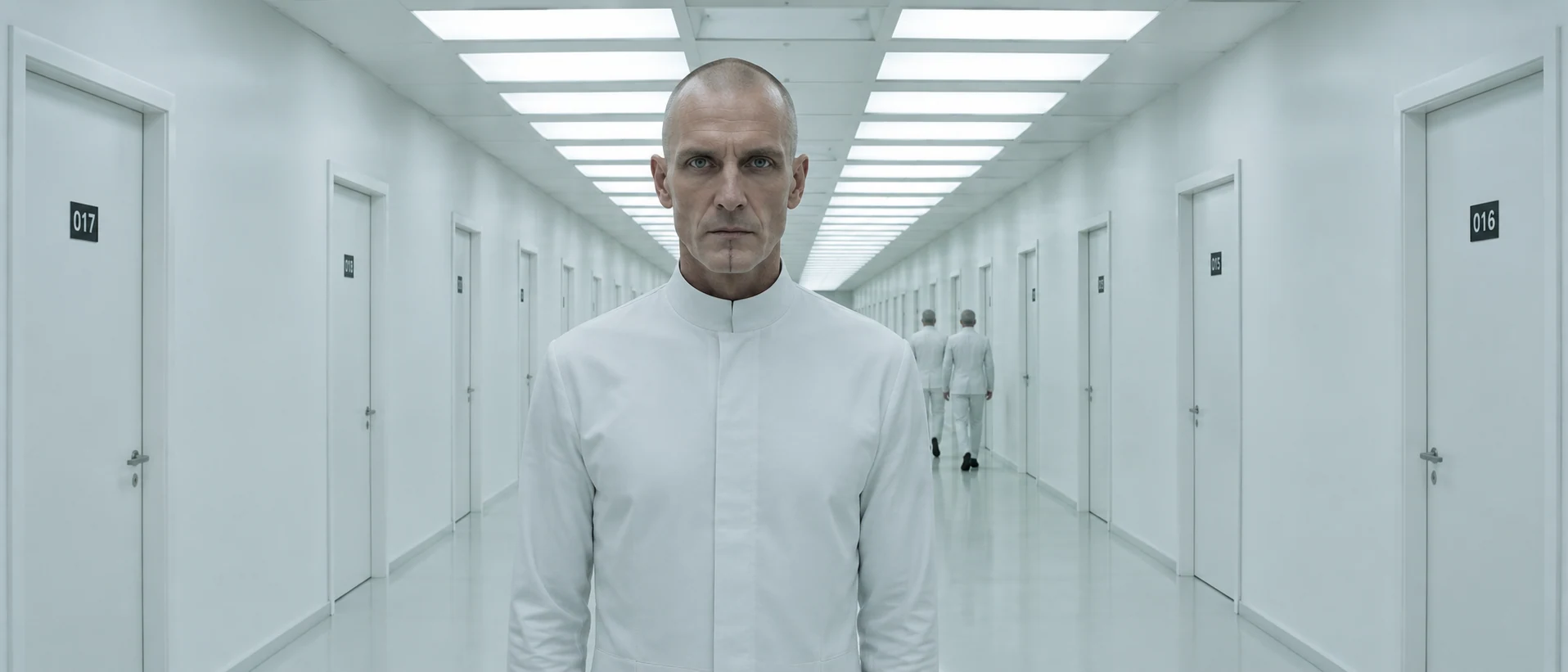
The second take swaps the grimy totalitarian city for the polite, clean dystopia of THX 1138 or Gattaca. "One-point perspective", "perfectly symmetrical" and "identical doors" carry the order, "shadowless top light" keeps it clinical, and the 21:9 frame stretches the corridor into something endless.
Open FlashBoardsCamera: a slow, steady push-in at waist height toward the woman in the red scarf, starting immediately and ending in a medium wide shot of her with the plaza behind. Action: the grey column of workers marches across the wet plaza in step, their reflections moving on the concrete. Smog drifts left across the ministry tower. The searchlight beam sweeps from left to right through the haze and passes over her. She stops, looks up at the camera on the nearest pole, then lowers her head and keeps walking against the flow.Everything that moves already exists in the start frame: the column, the smog, the searchlight, the pole camera. That keeps the shot alive from the first moment and stops the model from inventing new background. The look up at the camera is the dystopian beat: the character acknowledges she is watched.
Open FlashBoards{
"output": "Full-screen live-action single continuous shot from Brick (2006), one unbroken take from its very first frame. 2000s 35mm film look, fine grain, blue dusk after sunset, soft shadowless skylight, deep teal-blue palette on gray concrete, a still evening in a vast empty concrete storm-drain channel that ends in a huge arched tunnel mouth.",
"characters": {
"S1": {
"name": "Emily Kostich, played by Emilie de Ravin",
"look": "slim teenage girl, long straight pale blond hair past the shoulders, loose open off-white cardigan over a gray top, knee-length brown skirt, bare legs, flat shoes",
"voice": "silent"
},
"S2": {
"name": "Brendan Frye, played by Joseph Gordon-Levitt",
"look": "seen only from behind as a soft, out-of-focus dark shape: dark hair and a dark jacket, never shows his face",
"voice": "silent"
}
},
"shots": [
{
"shot": 1,
"camera": "static: locked-off tripod, perfectly still for the whole shot, camera low just above the wet channel floor, 24mm wide lens, symmetrical extreme wide shot looking straight into the tunnel mouth; the black arch fills the upper centre of the frame, steep slanted concrete walls with dry weeds on top rise on both sides, the wet floor with pale scattered debris and shallow water fills the bottom third; deep focus on the arch, the framing stays identical from first frame to last",
"action": [
"BEGINNING: alive from the first frame, the tunnel mouth is an empty pitch-black void, nobody in frame, the shallow water on the channel floor glints faintly, weeds on the wall tops stir.",
"THEN: a faint pale shape appears deep inside the blackness, slightly right of the arch's centre, and becomes S1, walking slowly and evenly straight toward the camera out of the dark, very small in frame, arms hanging at her sides, her off-white cardigan catching the blue light.",
"THEN: S1 reaches the threshold where the tunnel floor meets the open channel and stops, standing upright just right of centre inside the arch, arms still at her sides, face toward the camera, dwarfed by the concrete.",
"THEN: S1 holds completely still, no gesture, hands motionless at her sides; only the water and the weeds move.",
"END: the dark out-of-focus back of S2's head and shoulders rises slowly into the bottom centre of the frame from just in front of the lens, filling the lower middle as a black silhouette facing the tunnel; S1 stays motionless in the arch, framed above his shoulder."
],
"dialogue": [],
"voice": "silence: nobody speaks in this shot, no voice at all"
}
],
"sound": {
"ambience": "low hollow hum and faint echo breathing out of the tunnel, a thin trickle of shallow water, crickets heard from far outside the channel, soft cloth rustle of S2 moving at the end",
"speech": "no words in this video; the only human sounds are breaths and movement",
"never_spoken": "no narration and no voice-over: the descriptions, performance notes and step words of this prompt are never spoken aloud",
"music": "a film score under the scene, always below the voices: a sparse, uneasy score of one low sustained drone with a faint metallic bell tone that rings once as the girl stops",
"subtitles": "none"
}
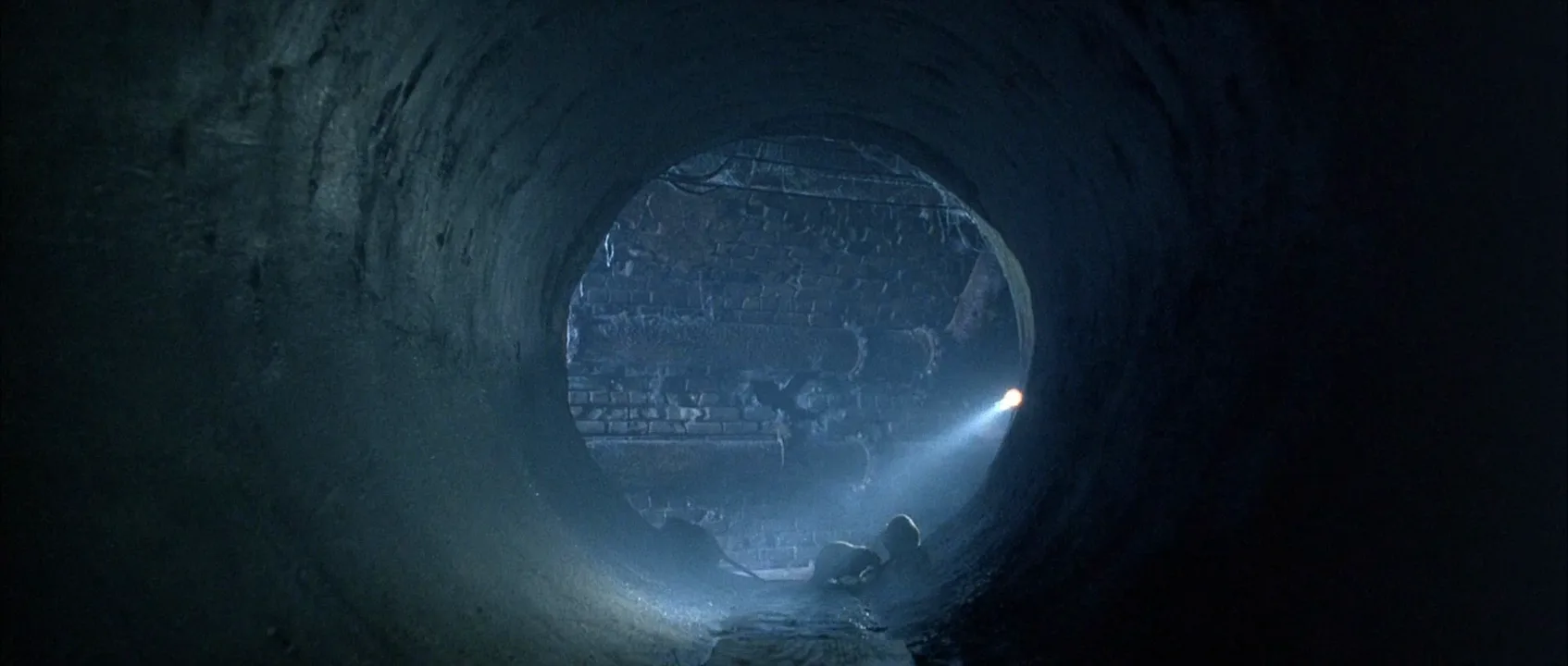
}Remakes the static tunnel-mouth shot from Brick (2006), where Emily walks out of the dark arch and stops while Brendan's silhouette rises into the foreground; the prompt keeps the locked-off extreme wide, the silence and that single beat.
The camera block pins the rule the article keeps returning to: a locked-off extreme wide from floor height, the arch filling the upper frame, the person tiny. Naming the characters and film anchors wardrobe and mood, the silent shot and one line of score keep the sound from filling the emptiness, and the END phase adds a watcher's silhouette so the architecture does the storytelling.
Open FlashBoardsCommon mistakes
- Generic ruins. "Dystopian" alone often produces a post-apocalyptic wasteland. If your world still has a government, say so in objects: ministry tower, checkpoint, uniforms, cameras, queues.
- Purple cyberpunk. "Cyberpunk" pulls saturated magenta neon into everything. For a totalitarian look, name sodium lamps, fluorescent tubes and searchlights and give the palette in plain words.
- Random crowds. Models dress extras in mixed clothes. Specify identical clothing, color and "marching in formation" or "standing in a single line".
- Lost scale. Buildings shrink to background props at eye level. State the lens, a low camera and how much of the frame the architecture fills.
- Garbled slogans. Readable propaganda text usually comes out as nonsense letters. Ask for blank banners with a single abstract emblem, or number plates only.
- Grey mush. "Desaturated" alone flattens the image. Name the two or three hues that remain and the one accent color.
Keep the reference frames, prompts and every generated take side by side — images and video in one canvas.
FAQ
5 questionsWhat is a dystopian film?
A dystopian film is set in an imagined society that has gone badly wrong, usually through total state control, corporate power, environmental collapse or enforced conformity. It is a branch of science fiction defined by power rather than technology, and it shows its world through oppressive architecture, surveillance, uniforms and drained color. Classic examples include Metropolis (1927), Brazil (1985), Blade Runner (1982) and Children of Men (2006).
What is the dystopian aesthetic?
The dystopian aesthetic is the visual language of oppressive futures: brutalist or monumental architecture that dwarfs people, symmetrical corridors, crowds in identical clothes, cameras and screens everywhere, smog or rain, institutional light such as fluorescent tubes and sodium lamps, and a desaturated palette with one accent color. Its cyberpunk branch replaces the grey with neon advertising reflected on wet streets in a crowded vertical city.
Which dystopian movies should filmmakers study for their visuals?
Start with Metropolis (1927) for monumental scale and marching workers, Brazil (1985) for bureaucratic clutter, Blade Runner (1982) for the rain-and-neon megacity, Gattaca (1997) for the clean, quiet version, Children of Men (2006) for handheld, documentary-style collapse, and Blade Runner 2049 (2017) for a single dominant color that stands for poisoned air. Together they cover nearly every look the genre uses.
How do you make a dystopian city look real on a low budget?
Use real places instead of building sets. Brutalist housing, car parks, underpasses, industrial halls and tunnels already look like the future of a controlled society; Alphaville (1965) was shot in the modern Paris of its day. Frame them wide and low, fill the air with haze, light with practical fluorescent or sodium sources, dress a few extras identically and grade toward a muted palette with one accent color.
Is cyberpunk the same as dystopian?
Cyberpunk is one type of dystopia, not a synonym. It imagines a high-tech, low-life future where corporations hold more power than governments, shown through vertical megacities, neon advertising, rain and crowded street markets, as in Blade Runner and Ghost in the Shell (1995). Many dystopian films have no cyberpunk elements at all: Gattaca is clean and quiet, while Metropolis and Nineteen Eighty-Four are industrial and totalitarian.
Related terms
7- WorldbuildingStorytelling
Worldbuilding is designing the rules, history, geography, cultures and look of a story's world so that everything on screen feels consistent — the groundwork for production design and for coherent AI-generated scenes.
- Production DesignProduction Design
Production design is the creation of the entire physical world of a film — locations, sets, props, colors and textures — led by the production designer together with the director and cinematographer.
- Desaturated LookColor
A desaturated look drains color intensity across the frame without going fully black-and-white, giving a muted, cold, war-weary or documentary feel.
- Neon LightingLighting
Neon lighting builds a scene from saturated colored tubes and signs — pinks, cyans, reds — reflected on wet streets and faces against deep shadow, a look tied to Hong Kong cinema and neo-noir.
- AllegoryStorytelling
An allegory is a story whose characters and events stand, as a whole, for something else — a political system, a moral idea, a historical moment — so the literal plot carries a second meaning throughout.
- SettingStorytelling
Setting is where and when a story takes place — period, location, social world — and in film it's made concrete by locations, production design and light.
- Film GenresGenres
A film genre is a category of films that share recognizable conventions of story, setting, character and style — western, horror, musical, noir — letting audiences know what to expect and filmmakers play with it.
Further reading
Dietrich Neumann (ed.), Film Architecture: Set Designs from Metropolis to Blade Runner (Prestel, 1996).