 FlashBoards Learn
- Learn
- Film History & Theory
- Pre-Code Hollywood
Film History & Theory · Film language
Pre-Code Hollywood
Also called: Pre-Code era, pre-Code films
Pre-Code Hollywood is the short run of American sound films made between about 1929 and July 1934, after the Production Code was written but before it was enforced. Films like The Public Enemy, Baby Face and The Divorcee treated sex, crime, drugs and moral failure with a frankness Hollywood would not allow again until the late 1960s.
- What it does
- Names the loosely policed early sound years when studio films showed adultery, gangsters and ambition without punishing them.
- Use it when
- You study or recreate early-1930s American cinema, or need to explain why some classic films feel strikingly modern.
- Watch out
- The Code already existed from 1930; pre-Code means unenforced, not unwritten.
- Try this prompt
1932 black and white studio still, 4:3, sharp-eyed secretary in a bias-cut satin dress leaning on her boss's desk, hard glamour key light
What was Pre-Code Hollywood?
Pre-Code is a label historians applied later. It covers the films the major studios released from the arrival of synchronized sound until the Hays Code got real teeth in mid-1934. The Production Code was adopted in March 1930, but for four years the office behind it could advise and negotiate, not forbid. Producers often ignored its notes, and state censor boards cut prints locally instead.
These films come early in the Golden Age of Hollywood, made inside the studio system with contract stars and polished craft, yet their stories let women sleep their way up, let criminals enjoy their money and let marriages end without punishment.
When was the pre-Code era?
- 1927–1929. Sound arrives, and dialogue makes innuendo explicit in a way intertitles never did.
- March 1930. The studios adopt the Production Code. Their Studio Relations Committee reviews scripts but cannot block a release.
- 1930–1933. The Depression cuts ticket sales. Studios answer with sex, crime and cynicism: the gangster cycle, the "fallen woman" dramas, early sound horror.
- 1934. Under boycott threats from the Catholic Legion of Decency, the studios create the Production Code Administration under Joseph I. Breen. From July 1, 1934 no film can be released without its seal.
Many pre-Code titles were later re-released with cuts, so some circulated for decades only in trimmed versions.
What made pre-Code films different?
The difference is less about nudity than about consequences. Under the enforced Code, sin had to be punished. Pre-Code stories often let characters get away with it:
- The gangster as star. Little Caesar (1931), The Public Enemy (1931) and Scarface (1932) put charismatic killers at the center. Moral forewords were added, but the energy belongs to the villain, an early anti-hero.
- Women who want more. In The Divorcee (1930) Norma Shearer answers her husband's affair with her own. Jean Harlow in Red-Headed Woman (1932) and Barbara Stanwyck in Baby Face (1933) use sex as a career ladder.
- Horror with a mean streak. Frankenstein, Freaks (1932) and Island of Lost Souls (1932) went further into cruelty than horror films of the next decade.
- Adult comedy. Ernst Lubitsch's Trouble in Paradise (1932) and Mae West's She Done Him Wrong (1933) traded in double meanings; in 1935 the Breen office refused both a reissue.
The pre-Code look: how to recreate it
Pre-Code is a set of stories more than a style, but the films share a surface you can reproduce:
- Frame. Black and white, near-square Academy frame. Compose for 4:3 with generous headroom.
- Light. Hard key light from a high three-quarter angle, strong hair backlight, bright sets. MGM glamour is silvery; Warner Bros. crime pictures are grittier. It is not yet the low-key lighting of 1940s film noir.
- Wardrobe and sets. Bias-cut satin gowns, marcel waves, speakeasies, penthouse offices, cigarette smoke in the light.
- Pace. Running times often 65–80 minutes, fast overlapping dialogue, hard cuts.
In FlashBoards, pin stills from these films on one board next to your generated frames and wardrobe notes, so lighting and costume period stay consistent from shot to shot.
Pre-Code vs. the Hays Code era
Both periods had the same rulebook; the difference is enforcement. Before July 1934, a producer could ignore script notes and risk local censors. After it, the seal was mandatory, with a $25,000 fine for releasing without one.
| | Pre-Code (1930–34) | Enforced Code (1934–68) | |---|---|---| | Adultery | Can go unpunished | Must be punished or regretted | | Criminals | Glamorous leads | Die or go to prison by the last reel | | Bedroom scenes | Shown, often in lingerie | Implied by a cut or fade | | Endings | Can be cynical | Restore marriage and law |
The Code was replaced in 1968 by the rating system run by the MPAA. More in film history and theory.
How to create a pre-code hollywood with AI
3 promptsImage models drift to modern glamour or 1940s noir, so name the year, the 4:3 frame, the wardrobe and the hard studio key light. Keep period stills and your takes on one FlashBoards board to compare them side by side.
1932 Hollywood studio film still, black and white, 4:3 frame, fine grain. Medium shot in a wood-paneled office. A sharp-eyed young secretary with a platinum marcel wave, thin penciled brows and a beauty mark on her left cheek, in a clinging bias-cut satin dress, sits on the corner of a large desk holding a cigarette. Behind the desk a heavyset balding banker with round wire spectacles looks up at her, pen frozen. Hard key light from high camera left, bright backlight on her hair, venetian blinds behind. Eye-level camera, 40mm lens.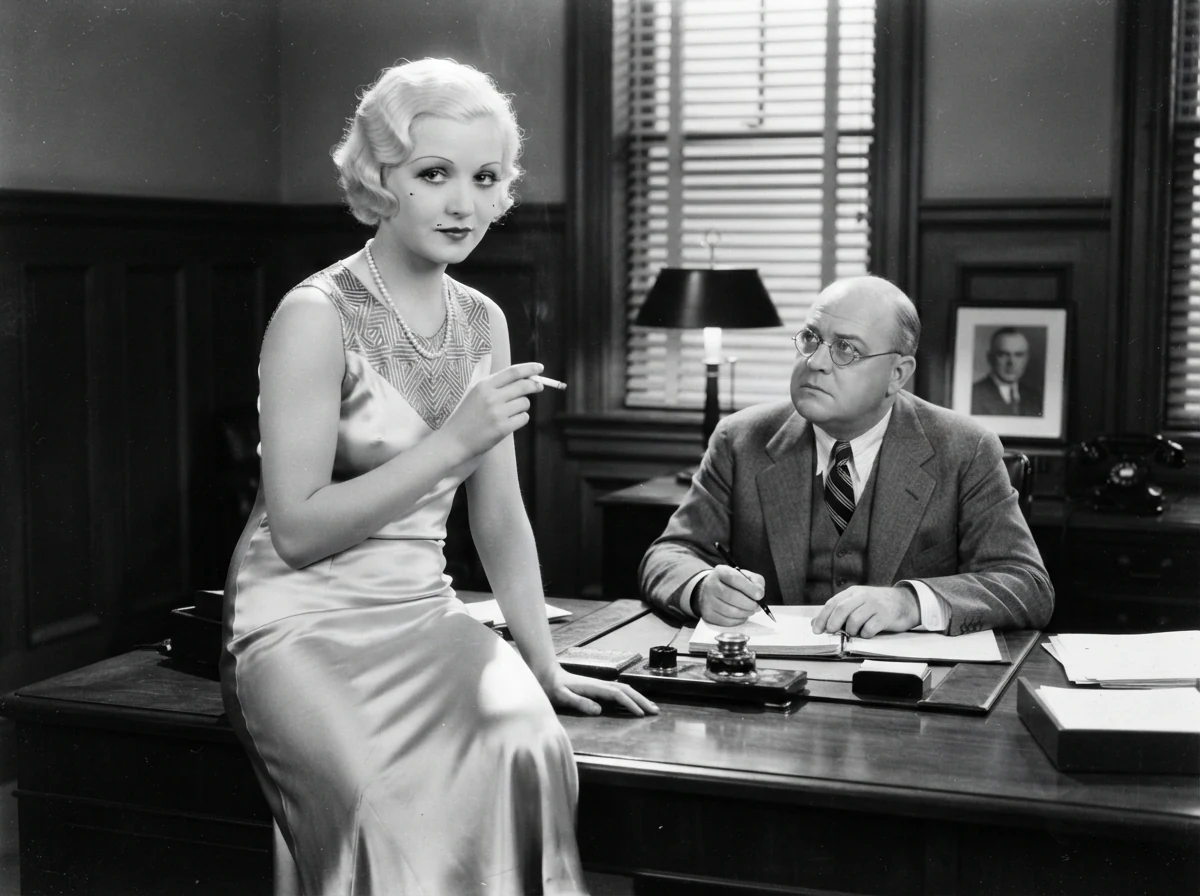
"1932", "4:3" and "marcel wave" pin the period; "bias-cut satin" and "sits on the corner of a large desk" carry the pre-Code attitude. Hard key plus backlight gives studio glamour instead of noir shadow.
Open FlashBoards1931 Hollywood gangster film still, black and white, 4:3 frame, fine grain. A crowded speakeasy at night. In the foreground a wiry young gangster with a boyish grin, a crooked nose and a pinstripe suit leans back in a booth, arm around a laughing woman in a beaded dress, bootleg whiskey and two glasses on the table. Behind them a jazz trio plays in cigarette haze. Hard spotlights from above, crisp shadows, low camera at table height, 35mm lens.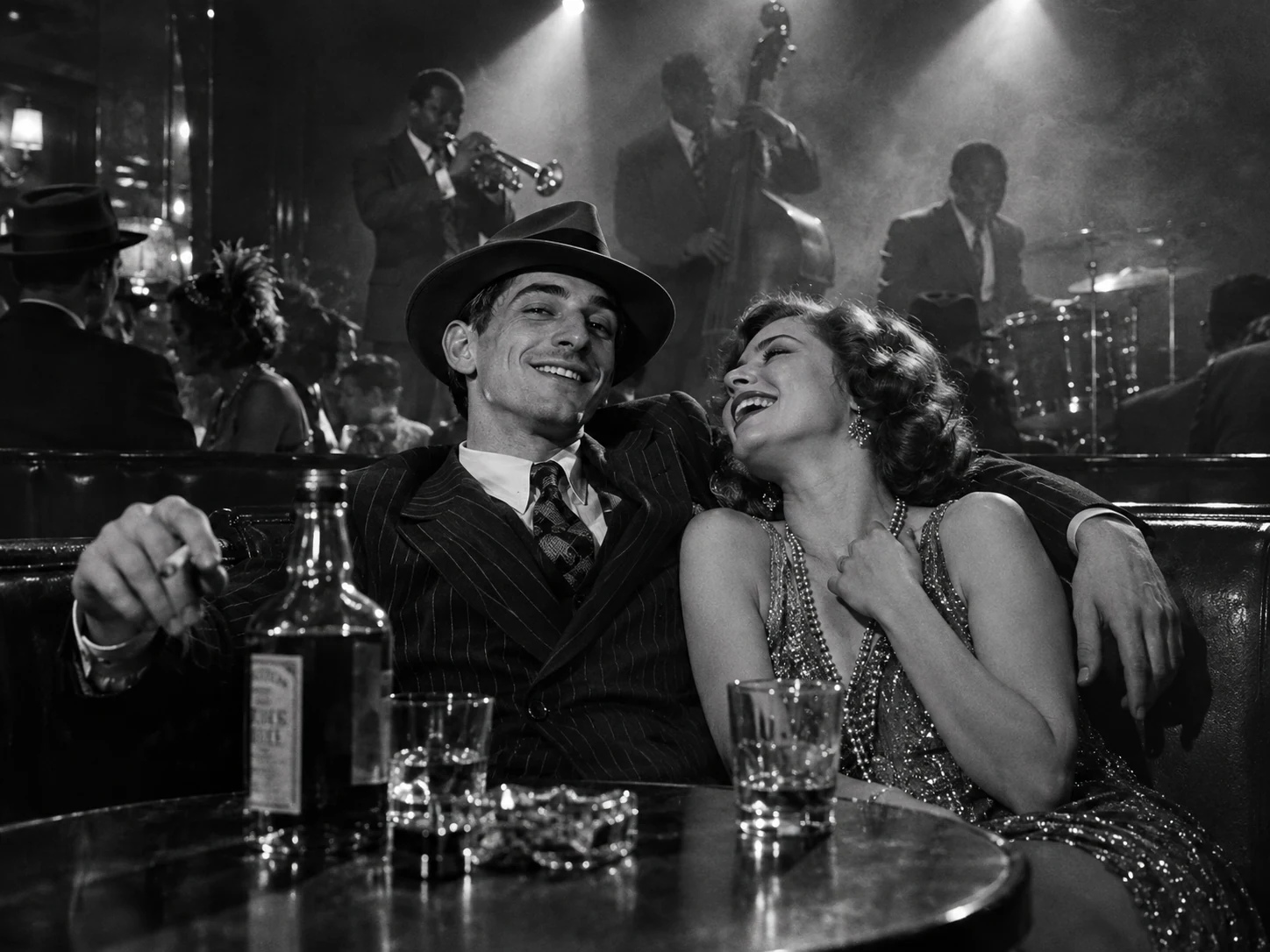
The second take switches to the gangster cycle. "Speakeasy", "bootleg whiskey" and "boyish grin" frame the criminal as someone the film enjoys; the table-height camera adds swagger.
Open FlashBoards1932 black and white studio film, fine grain, 4:3. Camera: starts moving at once, a slow smooth push in from the medium shot to a medium close-up of the secretary. Action: The secretary is already exhaling smoke into the key light. She leans toward the banker and slides a folded paper across the desk. He takes off his spectacles, reads it and gives a nervous smile. She stands up from the desk with a satisfied half-smile.Smoke and the push-in start in the first frame, so the shot is alive. The action uses only what recipe 1 shows and plays the bargain the pre-Code way: she wins, nobody stops her.
Open FlashBoardsCommon mistakes
- Noir instead of 1932. Models reach for 1940s shadow. State the year and "bright backlight on her hair".
- Wrong frame. Without "4:3" you get widescreen that reads as a modern period piece.
- Modern hair and fabric. Name "marcel wave", "penciled brows" and "bias-cut satin".
Keep the reference frames, prompts and every generated take side by side — images and video in one canvas.
FAQ
5 questionsWhat does pre-Code mean in film?
Pre-Code refers to Hollywood sound films released between roughly 1929 and July 1934, before the Production Code Administration enforced the Hays Code. They are known for frank treatment of sex, crime and drugs, and for stories where wrongdoing often goes unpunished. The Code existed from 1930 but was widely ignored until 1934.
What are the most famous pre-Code films?
Often cited titles include The Divorcee (1930), Little Caesar (1931), The Public Enemy (1931), Frankenstein (1931), Scarface (1932), Red-Headed Woman (1932), Baby Face (1933) and She Done Him Wrong (1933). Together they cover the era's main strands: gangsters, fallen women, horror and adult comedy.
Why did the pre-Code era end?
Religious groups, especially the Catholic Legion of Decency, threatened boycotts in 1933–34, and federal censorship loomed. The studios created the Production Code Administration under Joseph I. Breen, and from July 1, 1934 every film from member studios needed its seal of approval. That ended the pre-Code era.
Were pre-Code films uncensored?
Not fully. Studios had script advisers, and many states and cities ran censor boards that cut prints before local release. What was missing was mandatory national approval. Several films were later reissued in trimmed versions, and uncut prints of some, like Baby Face, resurfaced decades later.
Is pre-Code the same as the Golden Age of Hollywood?
No. The Golden Age is the whole studio era, from the late 1920s to the early 1960s. Pre-Code is its first few years, roughly 1929 to mid-1934. The same studios and stars made both, but pre-Code films came before strict censorship, so they feel more cynical and daring than most later classics.
Related terms
3- Hays CodeFilm History & Theory
The Hays Code was Hollywood's self-censorship rulebook, adopted in 1930 and strictly enforced from 1934 to the late 1960s: it limited sex, violence, profanity and 'immoral' endings until the MPAA rating system replaced it in 1968.
- Golden Age of HollywoodFilm History & Theory
The Golden Age of Hollywood is the studio era from the arrival of sound (late 1920s) to the early 1960s, when a few studios controlled stars, production and theaters and perfected the invisible classical style — Casablanca, Citizen Kane, The Wizard of Oz.
- MPAAFilm Industry
The MPAA — renamed the Motion Picture Association (MPA) in 2019 — is the trade body of the major Hollywood studios; it lobbies for the industry, fights piracy and runs the voluntary G/PG/PG-13/R/NC-17 rating system.
Further reading
Thomas Doherty, Pre-Code Hollywood: Sex, Immorality, and Insurrection in American Cinema, 1930–1934 (Columbia University Press, 1999). Mick LaSalle, Complicated Women: Sex and Power in Pre-Code Hollywood (2000). Mark A. Vieira, Sin in Soft Focus: Pre-Code Hollywood (1999).