 FlashBoards Learn
- Learn
- Film History & Theory
- Propaganda Film
Film History & Theory · Film language
Propaganda Film
Also called: propaganda, propaganda movie
A propaganda film is a movie made to push an audience toward a political belief or action rather than to inform or entertain. It works through the emotions: heroic low angles, crowds turned into patterns, montage that builds an argument, rousing music and a confident narrator. Battleship Potemkin, Triumph of the Will and Why We Fight are the classic examples.
- What it does
- Uses framing, editing, music and narration to make one political view feel natural, heroic and inevitable.
- Use it when
- You study film history and persuasion, or build a fictional regime's newsreels for a dystopia, satire or period piece.
- Watch out
- The same tools that move an audience can mislead it; show the machinery or give it context instead of repeating it straight.
- Try this prompt
1930s propaganda film still, black and white, camera at knee height looking up at a steelworker against a bright sky, banner snapping behind him
What is a propaganda film?
A propaganda film is a film whose main job is persuasion on behalf of a state, party or cause. It can be a feature, a documentary, a newsreel or a cartoon; what makes it propaganda is the aim. The film exists to change what the audience believes and often what it does next.
Propaganda rarely lies in every shot. It selects: the leader from below, the enemy from above, doubts kept off screen, images cut into a sequence that feels like proof. That is why these films remain a core chapter of film history and theory, however ugly their message.
What are the most famous propaganda films?
- Battleship Potemkin (1925). Sergei Eisenstein's film was commissioned for the 20th anniversary of the 1905 revolution. Its Odessa Steps sequence is the textbook case of editing as argument, the idea behind Soviet montage theory and the Kuleshov effect.
- Triumph of the Will (1935). Leni Riefenstahl's film of the 1934 Nazi Party rally in Nuremberg turns tens of thousands of men into geometric blocks. Its craft is why it is still studied and why it still disturbs.
- Why We Fight (1942–1945). Frank Capra's seven films for the U.S. War Department, ending with War Comes to America, recut the enemy's own footage with maps, narration and music to turn its meaning around.
- Der Fuehrer's Face (1943). Disney's Donald Duck dreams he works in a Nazi munitions factory: propaganda through ridicule.
- Saludos Amigos (1942). Disney's Latin American tour, in the spirit of the U.S. Good Neighbor policy: soft propaganda that sells friendship.
How do propaganda films persuade?
The toolkit is ordinary film language pushed to one purpose:
- Heroic framing. A low-angle shot from knee height with only sky behind makes a worker or leader monumental; the enemy gets high angles and shadow.
- The crowd as ornament. A normal group shot shows relationships; shot from a tower, the propaganda crowd erases the individual so the mass reads as one will.
- Montage as argument. Juxtaposition feels like logic even when it is only association.
- Repetition, music, narrator. The same symbol returns, a marching score swells and a calm voice leaves no gap for doubt.
- Us and them. Our side appears as individuals with families, the other as a faceless mass.
Propaganda vs. documentary and agitprop
Every documentary has a point of view, so the test is what a film does with evidence it doesn't like. A documentary can hold contradiction and show its sources. A propaganda film removes the contradiction, speaks for its subjects and hides the edit behind one confident voice.
Agitprop is narrower: openly political Soviet work meant to stir action, like the films screened from agit-trains. It never pretends to be neutral, while much state propaganda poses as news or plain entertainment.
Propaganda imagery in modern films
Modern filmmakers borrow this grammar mostly to expose it. Michael Radford's 1984 (1984) covers the walls with the Party's posters, Paul Verhoeven's Starship Troopers (1997) parodies wartime newsreels, and Taika Waititi's Jojo Rabbit (2019) sees indoctrination through a child's eyes.
If your project needs a fictional state's broadcast or rally, keep the reference frames, invented emblems and generated shots on one FlashBoards board, with notes on what makes each image persuasive, so you can decide where to play the tricks straight and where to let the audience see through them.
Propaganda Film examples in film
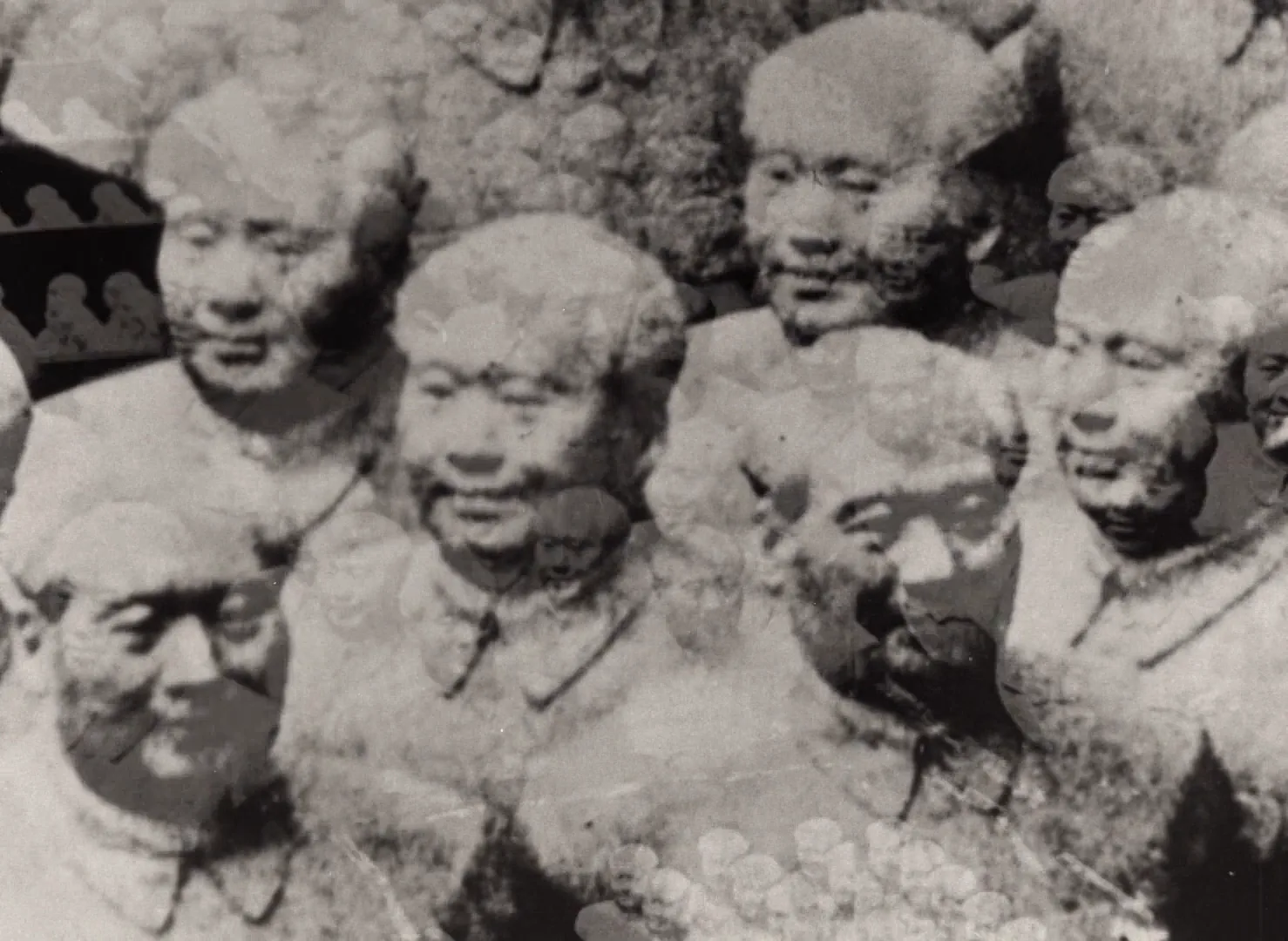
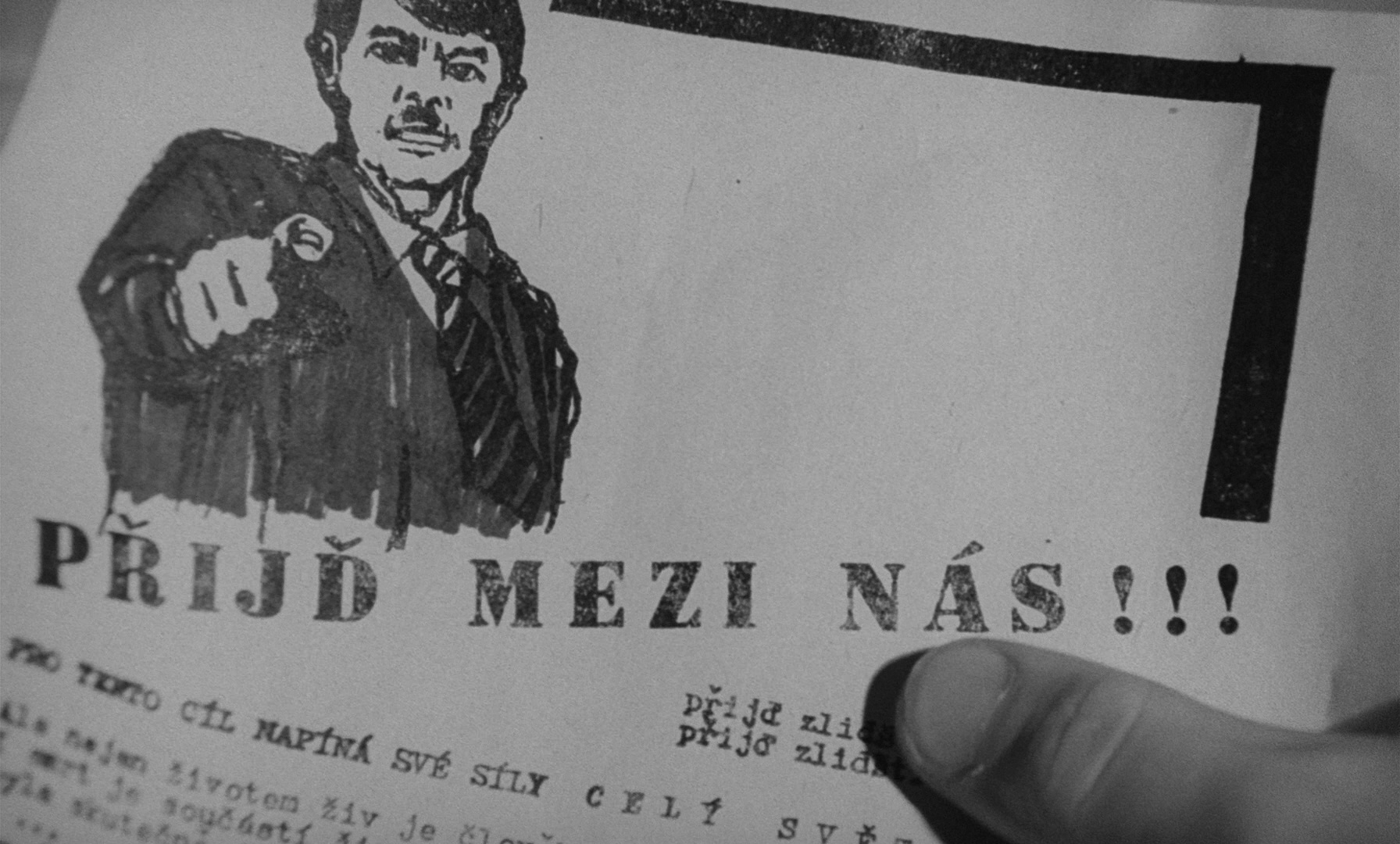
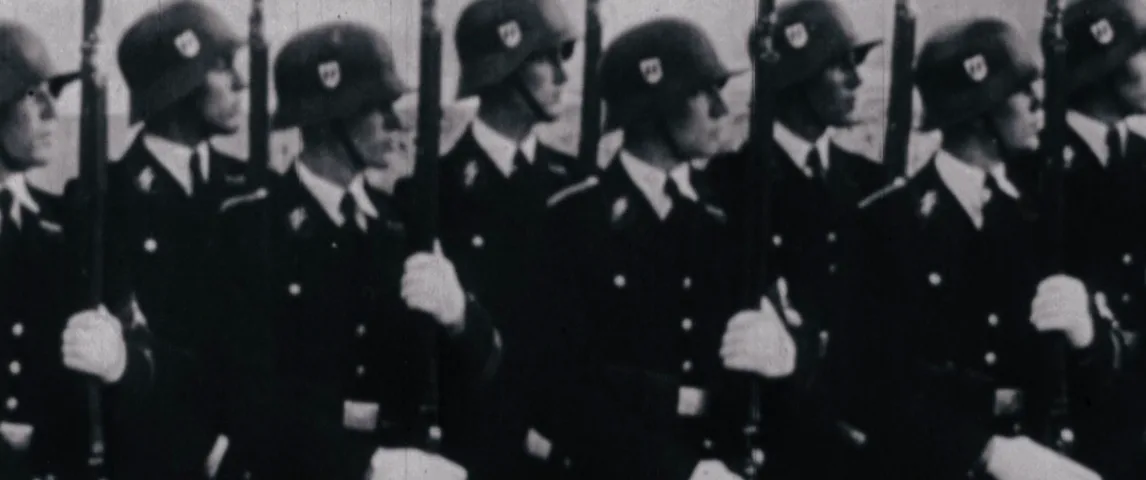
6 framesFrames where films show or recreate propaganda imagery.
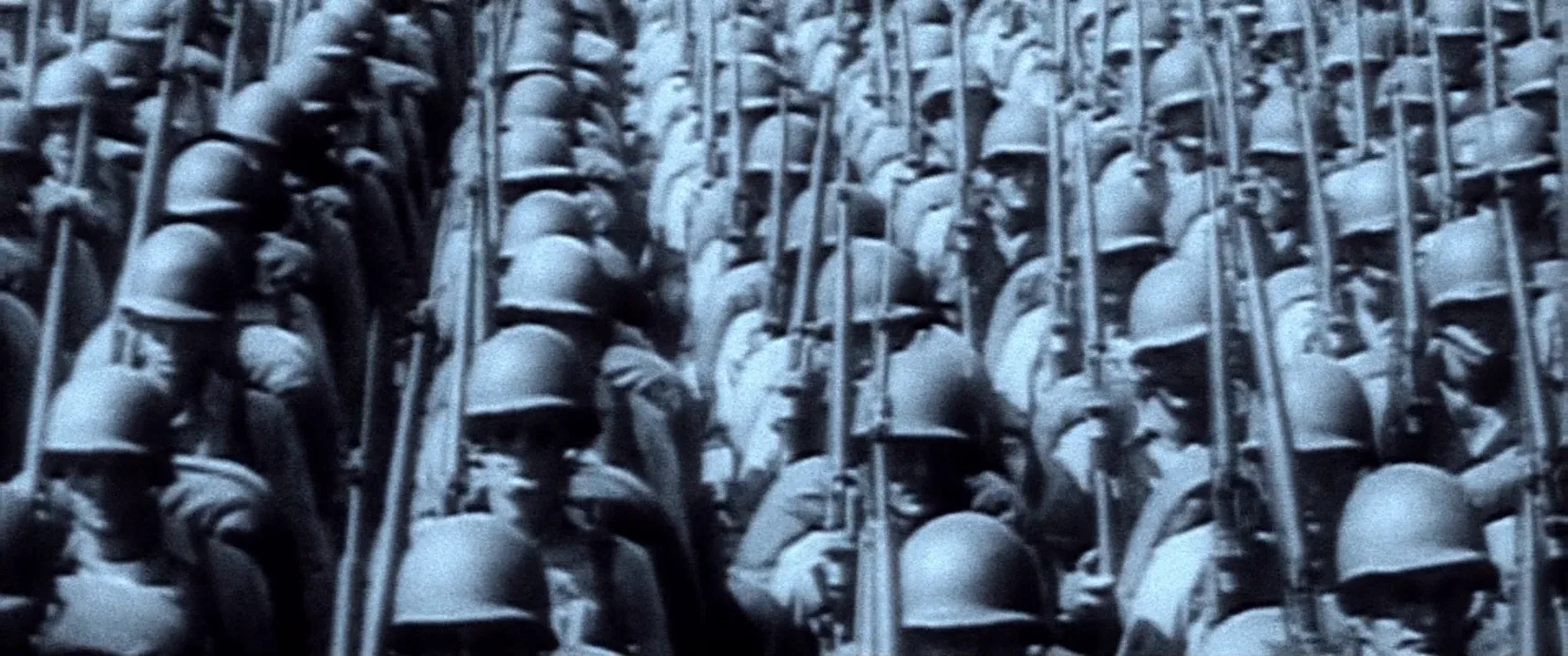
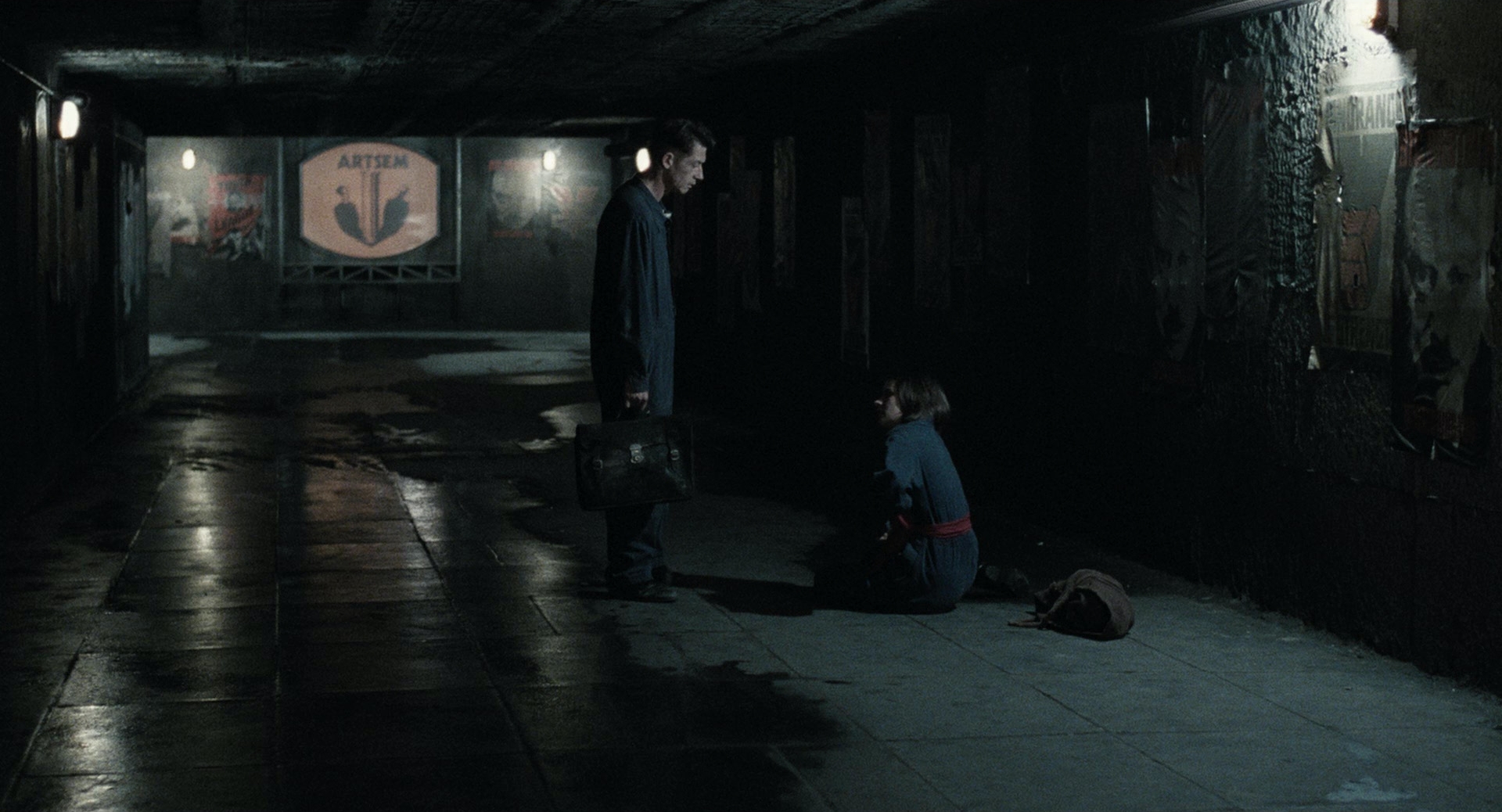
How to create a propaganda film with AI
4 promptsInvent the regime — a fictional emblem, worker and rally — then name the devices the model must reproduce: camera height, sky, massed ranks, newsreel grain. Keep the takes next to your real reference frames on a FlashBoards board to compare. The fourth prompt re-shoots a real film shot from a text description alone, and the original plays next to the result so you can compare.
1930s propaganda film still, high-contrast black and white, 4:3. Camera at knee height looking up at a fictional steelworker in his thirties with a shaved head, broad flat nose, a thin scar through his left eyebrow and a heavy square jaw, a sledgehammer across his chest, eyes fixed above the lens on the horizon. Behind him only bright sky, towering clouds and the edge of a huge banner with a stylized gear emblem snapping in the wind. Hard sun from high left, 28mm lens, fine grain.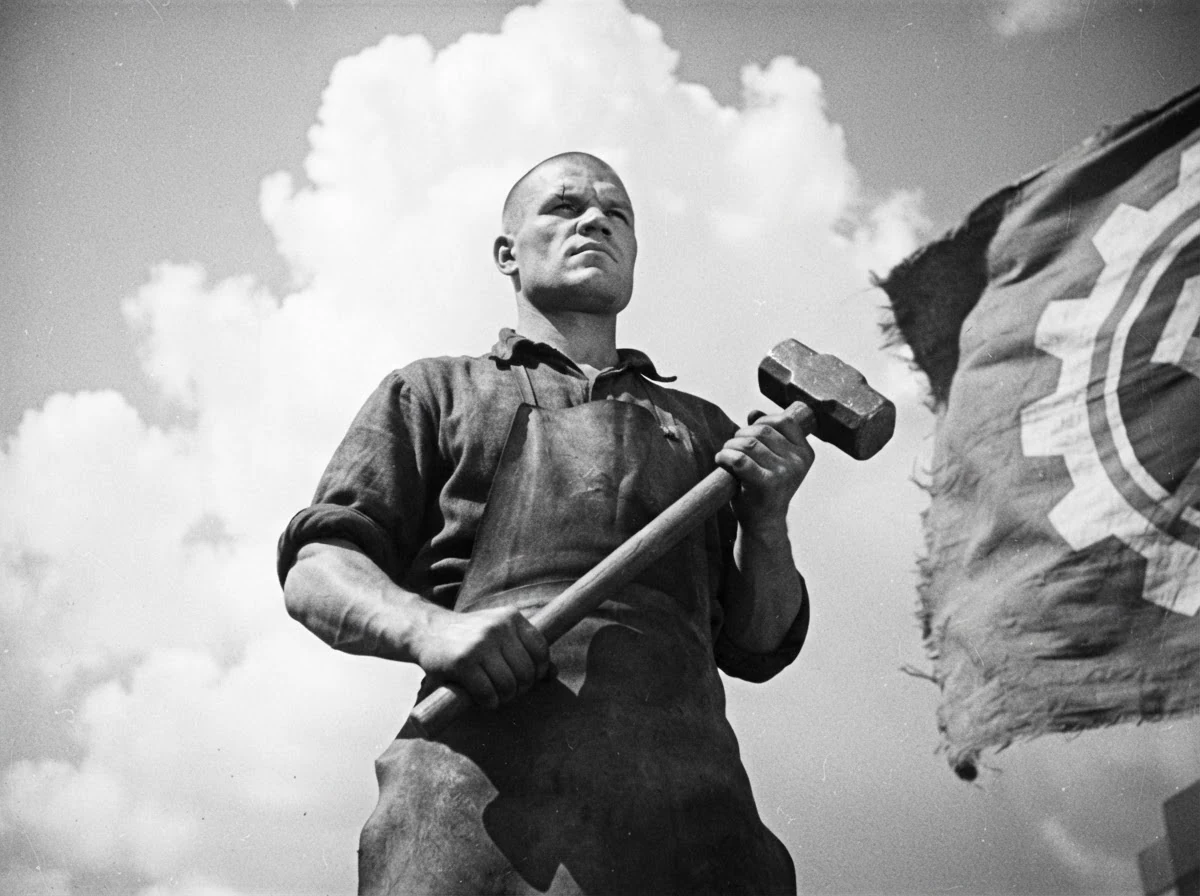
"Camera at knee height looking up" and "only bright sky" make him monumental; without them models drift to eye level. The horizon gaze is the classic propaganda pose, and the invented emblem and specific face keep it fictional.
Open FlashBoardsExtreme wide shot from the top of a tall tower over a fictional state rally in a vast stone stadium: thousands of marchers in identical pale grey uniforms in perfect rectangular blocks, an empty central aisle leading to a stone podium with three enormous vertical banners bearing a white circle-and-wheat emblem. One small figure walks alone up the aisle. Low side sun throws long parallel shadows. Monochrome newsreel look, faint sepia, coarse grain.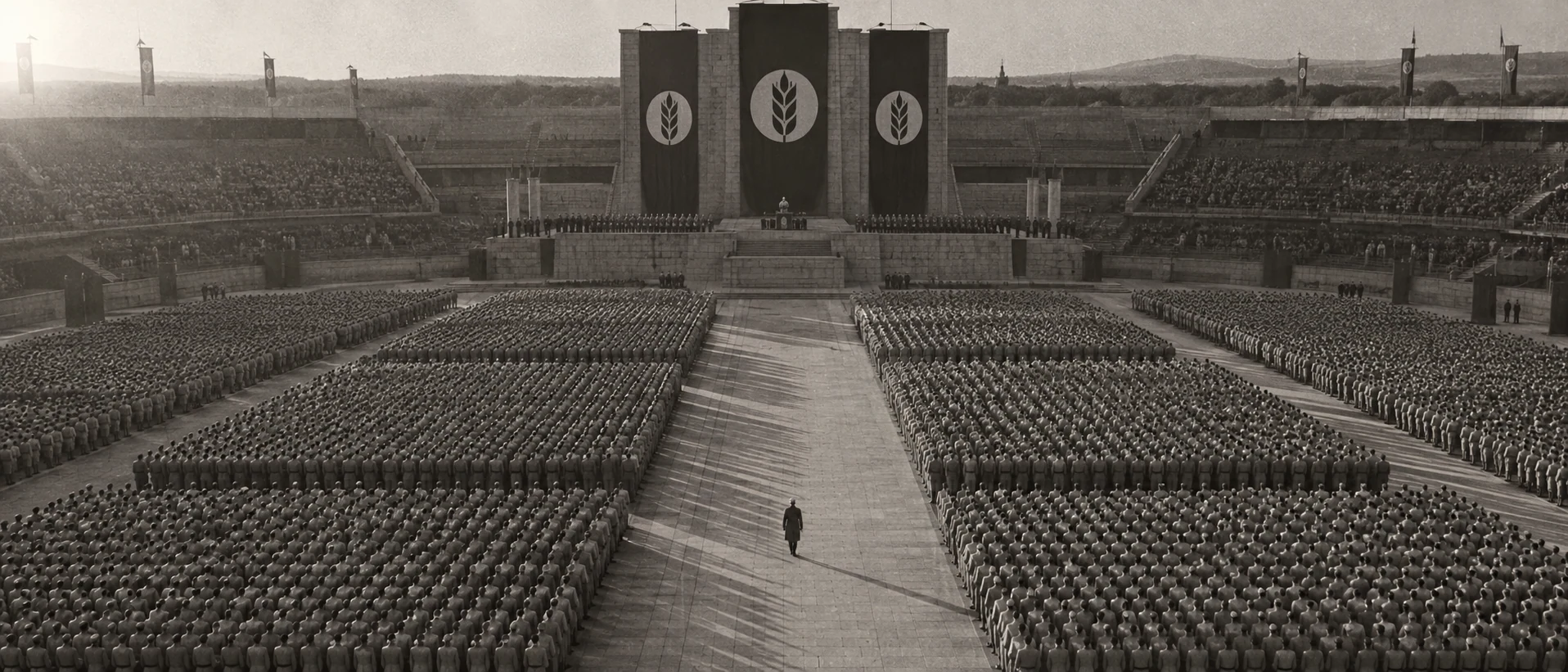
The second take is the mass. "Perfect rectangular blocks" seen "from the top of a tall tower" dissolve individuals into pattern, and the lone figure in the aisle gives the eye one point of power.
Open FlashBoardsBlack and white 1930s newsreel look, fine grain. Camera: slow, steady push in while sinking lower through the whole shot, so the worker grows taller against the sky. Action: The banner behind him is already snapping hard and clouds race across the sky. He swings the sledgehammer onto his shoulder and holds still, eyes on the horizon, as sun flares across his face.The banner and clouds move from the first frame, so the clip doesn't stall, and sinking lower during the push strengthens the heroic angle.
Open FlashBoards{
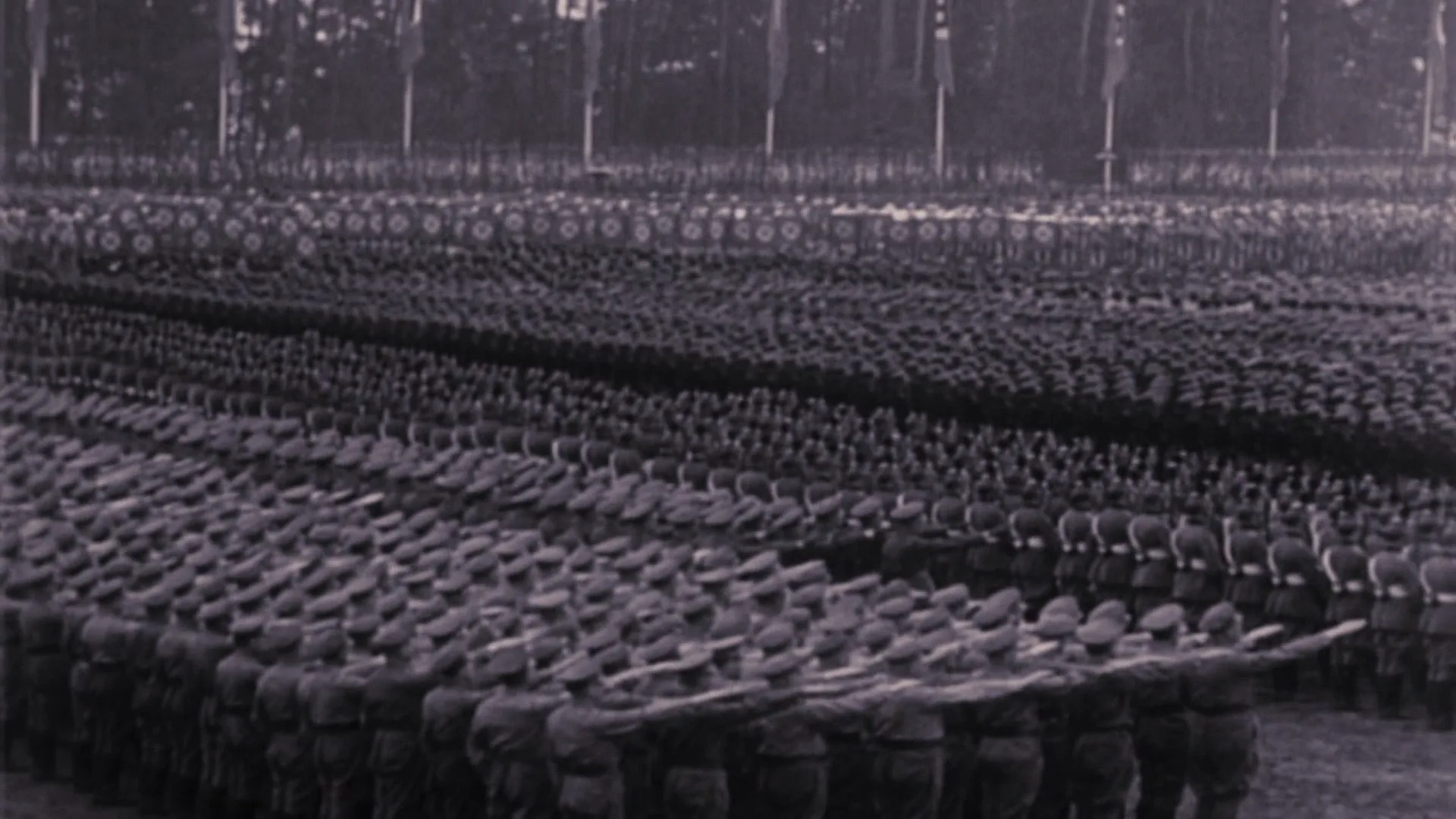
"output": "Full-screen live-action shot from The King's Speech (2010) from its very first frame: one continuous locked-off shot, no cuts, of the 1930s rally newsreel the film shows, restaged for a fictional one-party state. Black-and-white archival film with a faint cool mauve-gray tint, soft washed-out contrast, heavy grain, dust specks and a gentle exposure flicker; flat overcast daylight with no shadows; a vast parade ground packed edge to edge with tens of thousands of tiny uniformed men seen from very far away.",
"characters": {},
"shots": [
{
"shot": 1,
"camera": "locked-off static camera on a high tower very far back from the field, looking down at a shallow angle, very long telephoto lens that flattens the depth into stacked horizontal bands of men; every man is small, faces too small to read, only rows of cap tops and shoulders; the frame is filled to every edge with people and the framing stays exactly the same to the end",
"action": [
"BEGINNING: alive from the first frame, tens of thousands of men in identical dark peaked caps and belted field-gray tunics stand in dense rectangular blocks that touch one another; the nearest block fills the lower half of the frame from the left edge to the right edge, the bottom edge of the frame cutting its front rank at the chest, its rows of caps running in long straight lines from lower left toward the right; only a small triangle of pale trampled grass shows in the bottom right corner.",
"THEN: right of center, pressed directly against the back of the nearest block, a separate block in black tunics with pale cross-belts stands in tight columns, every man the same height.",
"THEN: across the upper middle of the frame, with massed men packed directly in front of and behind them, one straight line of standard-bearers holds dozens of round standards topped with a white gear-wheel emblem, evenly spaced from the left edge to the right edge; above them lies another dense dark band of massed men.",
"THEN: along the top edge a row of tall, evenly spaced flagpoles with long pale vertical banners stands against a dark wall of trees; the banners hang still.",
"END: nobody in the whole mass moves: every man stands at rigid attention, arms straight down at his sides, chin up, eyes front, so the crowd reads as one still pattern of repeated caps; only the film grain and flicker live in the frame."
],
"voice": "silence: nobody speaks in this shot, no voice at all",
"dialogue": []
}
],
"sound": {
"ambience": "the hiss and crackle of an old optical newsreel soundtrack and a faint wind over a huge open field",
"speech": "no words in this video; the only human sounds are breaths and movement",
"never_spoken": "no narration and no voice-over: the descriptions, performance notes and step words of this prompt are never spoken aloud",
"music": "a film score under the scene, always below the voices: a slow, heavy brass march with a pounding bass drum, like a 1930s newsreel band",
"subtitles": "none"
}
}Remakes the rally newsreel from The King's Speech (2010), dir. Tom Hooper, DP Danny Cohen: the locked-off high telephoto view, the blocks of men filling every edge, the line of round standards and the flagpoles against the trees, with an invented emblem and rigid attention in place of the real banners and salute.
The shot's power is that nothing moves, so the JSON spends its words on layout: which block fills which band of the frame, edge to edge, from a far tower on a long lens. The last beat keeps every man at rigid attention, and an invented gear-wheel emblem stands in for the real party's banners.
Open FlashBoardsCommon mistakes
- Eye-level heroes. State "camera at knee height looking up".
- Loose crowds. Ask for "identical uniforms in perfect rectangular blocks" seen from high above.
- Real symbols. Invent the emblem and the face; never name real leaders, parties or flags.
- Too clean. Add "newsreel grain" to kill digital sharpness.
Keep the reference frames, prompts and every generated take side by side — images and video in one canvas.
FAQ
4 questionsWhat is a propaganda film?
A propaganda film is a movie made to persuade an audience to accept a political idea or take an action, usually for a government, party or cause. It works on emotion rather than balanced evidence: heroic angles, massed crowds, montage that implies cause and effect, stirring music and a confident narrator.
What are famous examples of propaganda films?
The most studied are Eisenstein's Battleship Potemkin (1925), Riefenstahl's Triumph of the Will (1935) and Capra's Why We Fight series (1942–1945). Disney's Der Fuehrer's Face (1943) shows wartime propaganda as comedy, and Saludos Amigos (1942) a softer goodwill version.
What is the difference between propaganda and documentary?
Both can argue a point of view. A documentary can include contradiction, let subjects disagree and show its sources. A propaganda film removes anything that complicates its message and uses editing and music to make one conclusion feel like the only possible one.
Are propaganda films still made today?
Yes, though rarely under that name. State broadcasters, campaigns and recruitment videos still rely on heroic angles, crowds, music and one authoritative voice. Fiction films also borrow the style on purpose, as parody or warning, in dystopias, satires and war dramas.
Related terms
4- MontageEditing
A montage is a sequence of short shots, usually set to music, that compresses time or builds an idea — weeks of training, a relationship, a city waking up — in a minute or two.
- Kuleshov EffectEditing
The Kuleshov effect is the finding that viewers read the same neutral face differently depending on the shot cut next to it — food, a coffin, a child — so meaning comes from the edit, not the single shot.
- Low-Angle ShotCamera Angles
A low-angle shot looks up at the subject from below eye level, making them loom larger against the ceiling or sky — used for power, menace or heroism, or to make a space feel monumental.
- Group ShotCamera Shots
A group shot holds several characters in one frame as a unit, letting the audience read their positions, hierarchy and reactions at once instead of cutting between singles.
Further reading
Siegfried Kracauer, From Caligari to Hitler (1947). Richard Taylor, Film Propaganda: Soviet Russia and Nazi Germany (1979; rev. 1998). Erik Barnouw, Documentary: A History of the Non-Fiction Film (1974).