 FlashBoards Learn
Editing · Film language
Kuleshov Effect
Also called: Kuleshov experiment
The Kuleshov effect is the way viewers read the same neutral face differently depending on the shot cut next to it: after a bowl of soup the face looks hungry, after a coffin it looks grieving. The meaning is built in the edit, from the pairing of shots, not stored in any single shot.
- What it does
- Lets the next shot decide what a neutral face is feeling, so the audience writes the emotion themselves.
- Use it when
- You want a reaction to feel deep without the actor showing it, or you need to reshape a performance in the edit.
- Watch out
- It only works on an ambiguous face with a clear eyeline; a big expression overrides whatever you cut to.
- Try this prompt
Close-up at eye level, 85mm, a man with a shaved head and a gray beard, relaxed neutral face, eyes resting just below and right of the lens, soft window light
What is the Kuleshov effect?
The Kuleshov effect is a basic law of film editing: an audience never judges a shot alone, it judges it by the shots around it. Put a calm close-up of an actor next to a plate of food and viewers see hunger. Put the same close-up next to a child in a coffin and they see grief. The face never changed; the context did.
The name comes from Lev Kuleshov, a Soviet director and teacher who ran a film workshop in Moscow after the revolution. In experiments usually dated to the late 1910s and early 1920s, he and his students, Vsevolod Pudovkin among them, cut one close-up of the star Ivan Mozzhukhin against different images. The best-known account lists three: a bowl of soup, a dead child in a coffin and a woman reclining on a divan. Audiences, the story goes, praised the actor's range: hunger, sorrow, desire. Kuleshov did not invent the phenomenon, since editors of silent film had been leaning on it from the first cuts, but his workshop demonstrated it deliberately and turned it into a teaching principle.
Two details matter if you quote the experiment. The original footage is not known to survive, and the accounts Kuleshov and Pudovkin wrote years apart disagree on the specifics, so treat the three pairings as a well-told reconstruction rather than a lab record. And the lesson was never that acting doesn't matter. The lesson is that a shot works like a word, and the sentence is written in the cut.
Creative geography
The same workshop ran a companion test, usually called creative geography. Two actors were filmed in different parts of Moscow, and the shots were cut so they seemed to walk toward each other, meet and look up at a building that was really the White House, taken from existing footage. It is the Kuleshov effect applied to space instead of emotion: viewers assume that shots placed side by side share one place and one moment. Every eyeline match and every cross-cutting sequence depends on that assumption.
Why do filmmakers use the Kuleshov effect?
The audience does the acting. A face that holds back invites the viewer to fill it in, and what people fill in themselves feels truer than what is shown to them. Alfred Hitchcock demonstrated this on himself in a 1964 television interview: the same mild squint reads as kindly after a shot of a mother with a baby and as leering after a young woman in a bikini. Rear Window (1954) stretches the idea across a whole film: Jeff sits in his chair, and our reading of his face depends on which window across the courtyard we cut to.
A reveal lands twice. Cutting to the reaction shot before the thing itself primes the emotion. In Jurassic Park (1993), Spielberg holds on the paleontologists' stunned faces before showing the first dinosaur, so the awe is already in the room when the creature appears.
Geography can lie. Creative geography lets an editor place people where they never were. In The Silence of the Lambs (1991), cross-cutting between an FBI team at a front door and a doorbell ringing inside the killer's house makes us assume they are at the same address. They are not, and the reveal works because the audience trusted the cut.
Performances get shaped in post. Because the neighbor shot supplies the meaning, an editor can move a neutral look from one scene to another, or swap the POV shot it answers, and change what a character seems to feel. Editors often keep a bin of unused looks for exactly this.
Sound counts as the second shot. A neutral face under a low drone reads as dread; the same face under a children's choir reads as nostalgia. Music and off-screen sound work as the insert when no picture follows.
How to shoot and edit for the Kuleshov effect
The effect is made in the edit, but it has to be planned on set. The face and the insert are two halves of one idea, so shoot them as a pair.
- Direct a neutral, not an empty face. A blank stare looks dead on screen. Give the actor a private task, like recalling a phone number or listening to a sound off set, so the eyes stay alive while the face stays unreadable. Roll 5 to 10 seconds per take and grab a few extra wild looks at the end of each setup.
- Keep the framing plain. A close-up or medium close-up on a 50 to 85mm lens (full-frame) at eye level lets the face read without the angle commenting on it. A strong high or low angle adds its own meaning and competes with the insert.
- Set a precise eyeline. Put a mark just off the lens on the side the insert will be. If the insert is a plate on a table, the eyes drop about 15 to 20 degrees; if it is a person across the room, they sit near lens height. Tape a mark on a C-stand arm so every take hits the same spot.
- Shoot the insert from the character's position. Put the camera at the actor's eye height, tilted to match that eyeline, with a similar focal length. The object must read in one second: one clear subject, uncluttered background.
- Match light and color. The key should come from the same side in both shots, at the same color temperature. A mismatch tells the viewer the two shots were made in different places, which breaks the link unless that is what you want.
- Cut in the A-B-A order. Face, insert, face. The second face is where the emotion appears, so hold it 2 to 3 seconds, longer than feels natural, and let the viewer project. Cutting out of the first face on a small eye shift or blink sells the connection.
- Bridge with sound. Keep room tone continuous across the cut, or start the insert's sound under the face as an L-cut, so the ear confirms the two shots belong to one moment.
In a dialogue scene this is everyday craft: the listener's close-ups in a shot reverse shot exchange are small Kuleshov pairs, and choosing which look follows which line is most of the job.
Does the Kuleshov effect really work?
Yes, with a caveat. When researchers tried to replicate the experiment, the results were more modest than the legend. A 1992 re-creation by Stephen Prince and Wayne Hensley found little evidence that context changed how viewers judged a neutral face. Later studies with more controlled designs, including a brain-imaging study by Dean Mobbs and colleagues in 2006 and a 2016 study by Daniel Barratt and colleagues, found that context does shift the emotion people attribute to a face, but the shift is gradual and stronger for some emotions than others.
For a filmmaker the practical reading is simple. Context nudges an ambiguous face; it does not turn a clear smile into grief. The more neutral and alive the face, the more the neighbor shot can steer it. And in a real film the effect is stronger than in a lab, because story, music, performance and the shots before all stack up behind each cut.
Kuleshov effect vs. juxtaposition
Both come from the same insight, that two images together mean something neither means alone, but they point it in different directions.
Juxtaposition sets two contrasting images against each other so the collision produces an idea, and the viewer is meant to notice the collision. Sergei Eisenstein's Strike (1925) cuts the shooting of workers against the slaughter of a bull: nobody believes the bull is in the same place; the pairing is a metaphor. Juxtaposition can even happen inside one frame, through what shares the composition.
The Kuleshov effect usually hides the cut. The viewer believes the character is looking at the thing, in the same space and time, and assigns the emotion to the character, not to the film. It depends on continuity, so eyelines, light and sound have to match, while juxtaposition is free to break them.
In practice the two sit on a scale that runs from invisible continuity editing to open montage. A reaction shot that borrows grief from a coffin sits at the Kuleshov end; a cut from a crowd to a herd of sheep sits at the juxtaposition end. Soviet filmmakers of the 1920s explored the whole range, which is why both ideas are core to film theory.
Kuleshov Effect in motion
5 clipsWatch the order of the shots, not the acting. In each clip a face that gives little away sits next to what it looks at, and the neighboring shot decides what that face feels. Notice how little the faces move before and after the cut.
How to create a Kuleshov effect with AI
4 promptsAI makes the Kuleshov effect cheap to test: generate one neutral face, cut it against several inserts and watch the meaning move. The hard part is neutrality, because image models like to add a smile or a frown. Nano Banana 2 Lite builds the face, GPT Image 2.5 builds the matching point-of-view insert, and MiniMax H3 Max Turbo keeps the face alive for a few seconds without acting. Lay the pairs out in order on one FlashBoards board and read them left to right like a cut. The fourth prompt re-shoots a real film shot from a text description alone, and the original plays next to the result so you can compare.
Cinematic film still, close-up at eye level, 85mm lens, shallow depth of field. A man in his late forties with a shaved head, a short salt-and-pepper beard, a small scar on his chin and deep-set gray eyes, wearing a charcoal knit sweater, sits in a plain room. His face is relaxed and neutral: mouth closed and soft with straight corners, no smile, brows level, eyes calm and lowered to something just below and to the right of the lens. Soft window light from the left, gentle shadow on the right cheek, dark gray wall behind, fine film grain.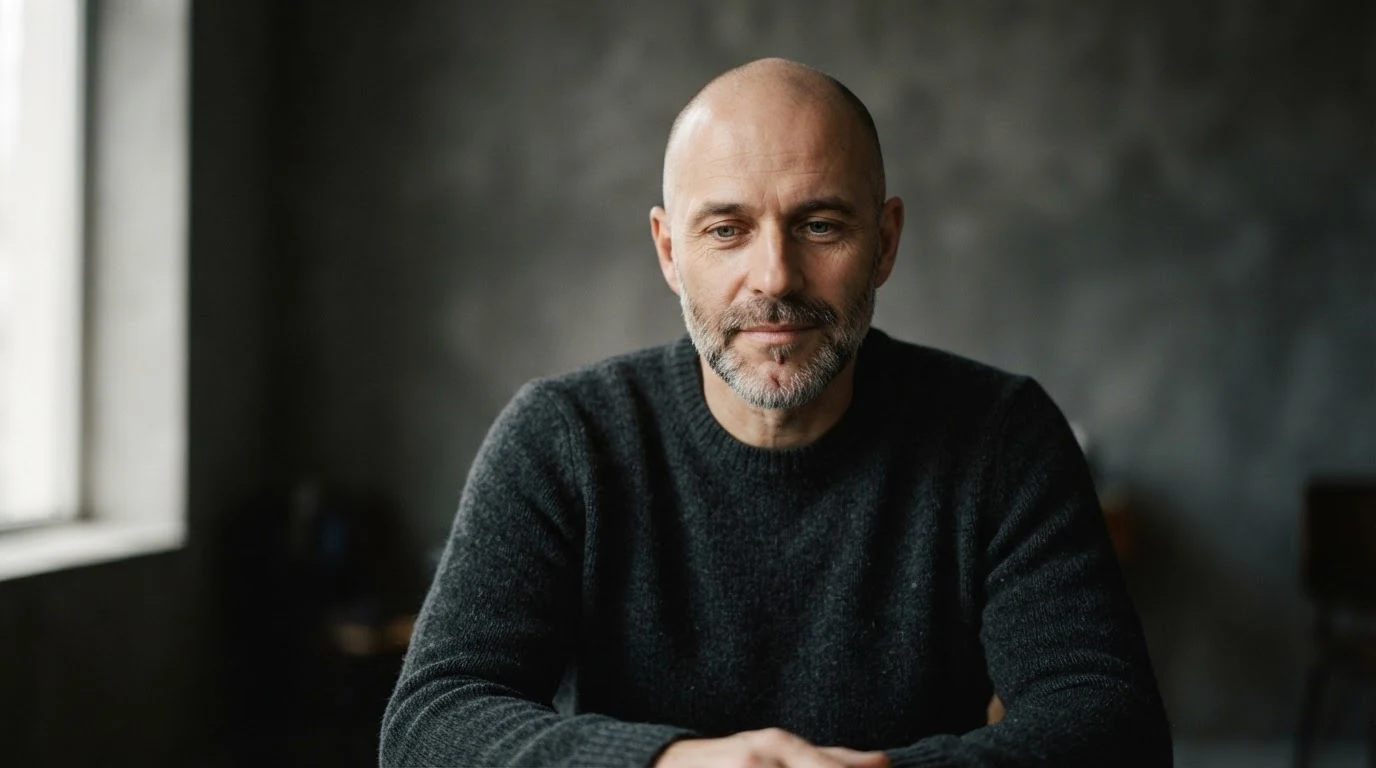
Mouth closed and soft with straight corners, no smile, brows level, eyes calm describes neutral muscles instead of the word neutral alone, which often comes back as a faint smile. Lowered to something just below and to the right of the lens gives the eyeline the insert will answer, and the plain wall keeps context out of the frame so the next shot can supply it.
Open FlashBoardsPoint-of-view insert shot from a seated man's eye height, looking down at about 30 degrees, 50mm lens. On a worn wooden table by a window: a white ceramic bowl of steaming vegetable soup, a spoon beside it, a torn piece of bread. Soft window light from the left, warm late-afternoon color, the edge of the table falling out of focus, dark gray wall in the soft background, fine film grain, cinematic still.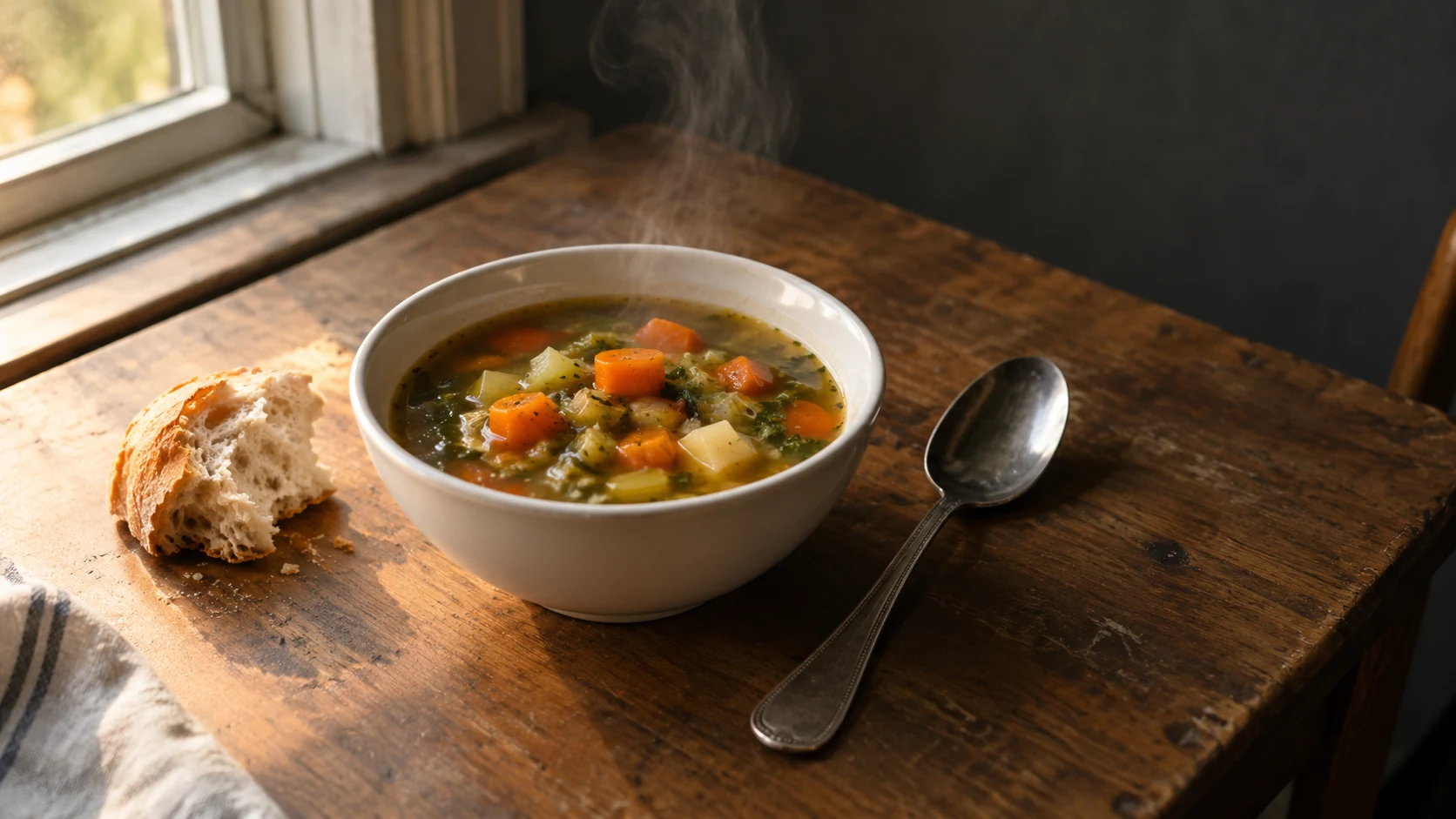
From a seated man's eye height, looking down at about 30 degrees matches the eyeline of recipe 1, so the cut reads as what he sees. Light from the same side and the same gray wall tie the two frames into one room. Keep this prompt and swap only the table object, for example a small wooden coffin or a sleeping child, to build Kuleshov's three pairs.
Open FlashBoardsCamera: locked-off static close-up at eye level, completely still for the whole shot. Action: he is already breathing slowly, eyes resting on something just below and to the right of the lens. In the middle he blinks once, and his eyes shift a few millimeters as if studying it more closely. Nothing enters the frame. At the end he lifts his gaze slightly, holds it, and takes one slow breath through the nose, lips closed and face relaxed.Already breathing slowly makes the shot alive from the first frame, so the model animates the face instead of pushing in on a still. The action is only blinks, eye shifts and breath, which gives the editor a neutral take with small beats to cut on, while lips closed and face relaxed keeps the model from inventing an emotion the insert should supply, and nothing enters the frame stops it from adding the object he looks at.
Open FlashBoards{
"output": "Full-screen live-action scene from Memento (2000) from its very first frame: two shots joined by one hard cut. Black-and-white 35mm with fine grain, a dim late-1980s suburban living room, soft grey daylight through sheer curtains behind, gentle contrast, anamorphic widescreen.",
"characters": {
"S1": {
"name": "Sammy Jankis, played by Stephen Tobolowsky",
"look": "balding man in his late forties, short dark hair at the sides, heavy brows, pale knit cardigan over a light open-collar shirt, sunk deep in a dark upholstered armchair",
"voice": "silent: his lips stay closed for the whole video"
},
"S2": {
"name": "Leonard, played by Guy Pearce",
"look": "never seen: heard only as the calm narrator over both shots",
"voice": "quiet, even, matter-of-fact male voice-over, close to the microphone"
}
},
"shots": [
{
"shot": 1,
"camera": "static, locked-off, eye level, normal lens, medium close-up of S1 in the centre-right of frame, the armchair back dark around his shoulders, sheer curtains and dark drapes soft and out of focus behind him",
"action": [
"BEGINNING: alive from the first frame, S1 already sits still in the armchair, head turned slightly toward screen left, eyes fixed on a point low and to screen left of the lens where the television is.",
"THEN: he keeps staring at that same point, brows level, mouth closed, jaw relaxed; no nod, no smile, hands out of frame.",
"THEN: his head settles a hair lower in the chair, nothing more; his gaze does not move.",
"END: the same blank, unreadable stare toward screen left, perfectly still."
],
"dialogue": [
{
"speaker": "S2",
"on_screen": false,
"when": "from the first frame, over S1's still face; S1's lips never move",
"delivery": "calm narration, slightly weary",
"line": "<d>[English] He'd watch TV... but anything longer than a couple of minutes was too confusing.</d>"
}
]
},
{
"shot": 2,
"cut_at": "00:03.340",
"camera": "static, locked-off, seated eye level, normal lens, a wood-cabinet console television set centred in frame in the dark room, a small side table at the left edge and a bookshelf at the right edge in shadow",
"action": [
"BEGINNING: on the glowing black-and-white screen, a commercial: a tight close-up of a man in profile facing screen right, holding a small cracker with a topping to his lips in one hand.",
"THEN: he bites into it, eyes half closed with pleasure, and chews slowly.",
"THEN: he lifts the cracker for a second bite, lips closing around it.",
"END: the picture inside the television screen changes to a smiling young woman and a man eating side by side, while the set, the room and the camera stay exactly the same."
],
"dialogue": [
{
"speaker": "S2",
"on_screen": false,
"when": "right after the cut to this shot, never before the cut",
"delivery": "calm narration, flat",
"line": "<d>[English] He couldn't remember how it began.</d>"
}
]
}
],
"sound": {
"ambience": "quiet room tone, the faint tinny murmur of the television set",
"speech": "exactly these spoken phrases, each said once, in this order, both by S2 as voice-over",
"never_spoken": "no narration and no voice-over except S2's two quoted lines: the descriptions, performance notes and step words of this prompt are never spoken aloud",
"music": "a film score under the scene, always below the voices: a sparse, low ambient synth drone with a slow melancholy pulse",
"subtitles": "none"
}
}Remakes Sammy Jankis (Stephen Tobolowsky) staring at the television in Memento (2000): the locked-off black-and-white framing, the three-second blank stare, the cut to a man eating in a commercial and Leonard's voice-over lines as spoken in the film.
Two shots and one cut_at, so the cut lands where Nolan's does. Shot 1 gives Sammy only stillness (closed lips, a fixed stare to screen left) while Leonard's voice-over, quoted word for word from the film, carries the words; shot 2 hands the meaning to the insert, a man eating in a commercial. Face first, food second: Kuleshov's soup bowl in two shots.
Common mistakes
- The model adds an emotion. Neutral expression often returns a polite smile. Describe relaxed muscles: mouth closed and soft, brows level, eyes calm.
- The eyes hit the lens. A stare into camera breaks the link to the insert. Say exactly where the gaze lands and on which side.
- Face and insert don't match. Light from opposite sides or different color temperatures makes the cut read as two places. Repeat the light direction and background in both prompts.
- The insert looks like a product shot. Flat top-down framing doesn't read as someone's view. State the viewer's eye height and the downward angle.
- The video starts acting. Without guidance the face drifts into a frown or smile. Write small physical beats (blink, eye shift, breath) and state what the face is doing: relaxed, lips closed.
Keep the reference frames, prompts and every generated take side by side — images and video in one canvas.
FAQ
6 questionsWhat is the Kuleshov effect in simple terms?
It is the tendency of viewers to read a character's emotion from the shot placed next to their face. A neutral close-up followed by food looks hungry; the same close-up followed by a coffin looks grieving. The actor did nothing different. The meaning was created by the edit, which is why editors can shape a performance by choosing what a look is cut against.
What was the Kuleshov experiment?
In the late 1910s and early 1920s, Soviet filmmaker Lev Kuleshov and his students cut one close-up of actor Ivan Mozzhukhin against different shots, most famously a bowl of soup, a child in a coffin and a woman on a divan. Viewers reportedly praised the actor's subtle hunger, grief and desire. The footage is not known to survive, and later accounts differ on the details.
What are some Kuleshov effect examples in movies?
Hitchcock built Rear Window (1954) on it: Jeff's face means whatever the window we cut to shows. Jurassic Park (1993) holds on stunned faces before revealing the first dinosaur. The Silence of the Lambs (1991) uses cross-cutting between two doors to make the audience assume one location. Any reaction shot in a dialogue scene uses a small version of the same effect.
Does the Kuleshov effect really work?
Mostly, but less dramatically than the legend. A 1992 re-creation found little effect, while later controlled studies found that context does shift the emotion viewers attribute to a face, especially an ambiguous one. The lesson for filmmakers: the effect is strongest with a neutral but alive face, a clear eyeline and support from story, sound and music.
What is the difference between the Kuleshov effect and juxtaposition?
Juxtaposition sets contrasting images against each other so the audience notices the collision and draws an idea from it, like a metaphor. The Kuleshov effect hides the cut: viewers believe the character is looking at the thing and assign the emotion to the character. Juxtaposition can break continuity; the Kuleshov effect depends on matched eyelines, light and sound.
How do you create the Kuleshov effect with AI?
Generate one neutral close-up with a defined eyeline, describing relaxed muscles rather than just saying neutral. Then generate point-of-view inserts from the character's eye height with the same light direction, swapping only the object. Animate the face with blinks and breaths, not an expression, and cut face, insert, face. Changing the insert changes the emotion.
Related terms
7- JuxtapositionEditing
Juxtaposition places two contrasting images side by side — in one frame or across a cut — so their collision creates a meaning neither has alone.
- Eyeline MatchEditing
An eyeline match cuts from a character looking off-screen to what they are looking at, with the gaze direction matched so the audience instantly reads the second shot as their view.
- Reaction ShotCamera Shots
A reaction shot cuts away from an action or line to show how another character responds — usually a close-up of their face — so the emotional meaning of the moment lands through the listener.
- MontageEditing
A montage is a sequence of short shots, usually set to music, that compresses time or builds an idea — weeks of training, a relationship, a city waking up — in a minute or two.
- Film TheoryFilm History & Theory
Film theory is the body of ideas about what cinema is and how it produces meaning and pleasure — from Soviet montage and Bazin's realism to auteur theory, psychoanalytic and feminist criticism.
- POV ShotCamera Angles
A POV shot shows exactly what a character sees by placing the camera at their eyes — usually right after a shot of them looking — so the audience shares their perspective, including movement, obstruction or distortion.
- Film EditingEditing
Film editing is the selection and ordering of shots — where each one starts, ends and what follows it — to build continuity, rhythm and meaning out of the raw footage.
Further reading
Lev Kuleshov, Kuleshov on Film, ed. and trans. Ronald Levaco (1974). Vsevolod Pudovkin, Film Technique and Film Acting. Daniel Barratt et al., "Does the Kuleshov Effect Really Exist? Revisiting a Classic Film Experiment on Facial Expressions and Emotional Contexts," i-Perception (2016).