 FlashBoards Learn
- Learn
- Film History & Theory
- Queer Theory
Film History & Theory · Film language
Queer Theory
Also called: queer film theory, queer reading
Queer theory in film is a way of reading movies against fixed ideas of gender and sexuality. It looks for desire the story hides or punishes — the coded characters of the Hays Code era, the subtext in glances and costume — and studies how queer filmmakers, from New Queer Cinema on, answered with their own images.
- What it does
- Asks how a film builds, hides or polices gender and desire — and what it looks like read against the grain.
- Use it when
- Analyzing coded characters, subtext between same-sex leads, camp, or the politics of how queer people are shown.
- Watch out
- A queer reading is an argument from evidence on screen — eyelines, staging, costume, censorship history — not a label.
- Try this prompt
1950s dining car, two women at separate tables, one watching the other's reflection in the dark window, 50mm, tungsten light
What is queer theory in film?
Queer theory came out of the humanities around 1990. Teresa de Lauretis named it in a 1991 issue of the journal differences; Judith Butler’s Gender Trouble (1990) argued that gender is performed through repeated acts rather than expressed from a fixed core; Eve Kosofsky Sedgwick’s Epistemology of the Closet (1990) showed how the closet shaped modern culture. The shared move: treat “normal” gender and sexuality as constantly produced, and so open to question.
In film theory this becomes a practice of reading. Earlier gay and lesbian criticism mostly judged images — were queer characters visible, and were they villains, victims or jokes? Queer theory asks how a film organizes desire and identity, so any film can be read queerly, including one with no openly queer character.
Queer coding under the Hays Code
From 1934 the Hays Code banned “sex perversion or any inference to it,” so queerness in Hollywood survived only as code. The looser pre-Code years had allowed Marlene Dietrich in a tuxedo kissing a woman in Morocco (1930); after 1934 such moments went under the surface.
In The Maltese Falcon (1941), Joel Cairo’s business card is scented with gardenia — a signal audiences read without a word said. Mrs. Danvers in Rebecca (1940) handles her dead mistress’s furs and lingerie with a devotion the film never names. Hitchcock’s Rope (1948) gives two young men a shared apartment and a shared murder.
Vito Russo’s The Celluloid Closet (1981; documentary 1995) showed the cost: queer-coded figures were so often villains or suicides that punishment became the convention. Coding is a special case of subtext — meaning carried by performance, costume and staging because dialogue was not allowed to carry it.
What was New Queer Cinema?
In 1992 critic B. Ruby Rich named a wave of independent films New Queer Cinema: Poison (Todd Haynes, 1991), My Own Private Idaho (Gus Van Sant, 1991), Edward II (Derek Jarman, 1991), Swoon (Tom Kalin, 1992), The Living End (Gregg Araki, 1992) and the documentary Paris Is Burning (Jennie Livingston, 1990).
Made during the AIDS crisis, these films refused the job of positive representation. Their characters are angry and unsympathetic; their form mixes film stocks, direct address and pastiche.
The mainstream followed — Brokeback Mountain (2005), Carol (2015), Moonlight (2016), Portrait of a Lady on Fire (2019). Queer theory asks of them what it asked of the Code era: whose desire gets a point of view, and what ending does the story allow?
How to do a queer reading of a scene
A queer reading is film analysis with a specific set of questions:
- Eyelines. Who looks at whom, for how long, and does the edit return the look? A glance held longer than the plot needs is evidence.
- Staging. Bodies kept close in the frame, rivals whose rivalry plays like courtship.
- Costume and performance. Gender presented against type — Dietrich’s tuxedo, a villain’s silk and perfume.
- Camp. Susan Sontag’s “Notes on ‘Camp’” (1964) described a love of artifice and exaggeration.
- Endings. Who is punished, killed off or “cured” in the last reel, and what did the censors demand?
In FlashBoards you can pin Code-era reference frames next to your storyboard, note on each shot who holds the look, and generate the scene both ways — coded and explicit — to decide how much stays under the surface.
Queer theory vs. the male gaze
Laura Mulvey’s male gaze (1975) describes classical cinema as one looker — a heterosexual man — and one object, a woman. Queer theory keeps the idea that looking is structured but unfixes the positions: a gay man can take up Dietrich’s look, a lesbian viewer can read two heroines against the romance plot, and male bodies can be the spectacle.
| | Male gaze | Queer theory | |---|---|---| | Spectator | Heterosexual man | Many, shifting positions | | Desire | Active male, passive female | Runs in any direction |
The gaze shows how a film wants to be seen; queer theory, how else it is seen.
How to create a queer theory with AI
3 promptsQueer coding is built from glances, staging and restraint, so it can be directed: a Code-era scene where desire lives only in a look, a New Queer Cinema take that states it openly, and a clip where the look is held. Compare coded and explicit versions side by side on one FlashBoards board.
1950s Hollywood melodrama still, Technicolor, 4:3 frame. Night train dining car with white tablecloths and brass lamps. In the foreground on the right, at her own table, a fictional woman in her forties with a silver-streaked black chignon, a long nose and a gray tweed suit, holding a coffee cup and looking across the aisle. On the left, at a separate table, a fictional younger woman with a short auburn bob, round wire glasses and a mustard cardigan reads a letter, her reflection visible in the dark window beside her. Warm tungsten lamp light, eye-level camera, 50mm lens, soft film grain.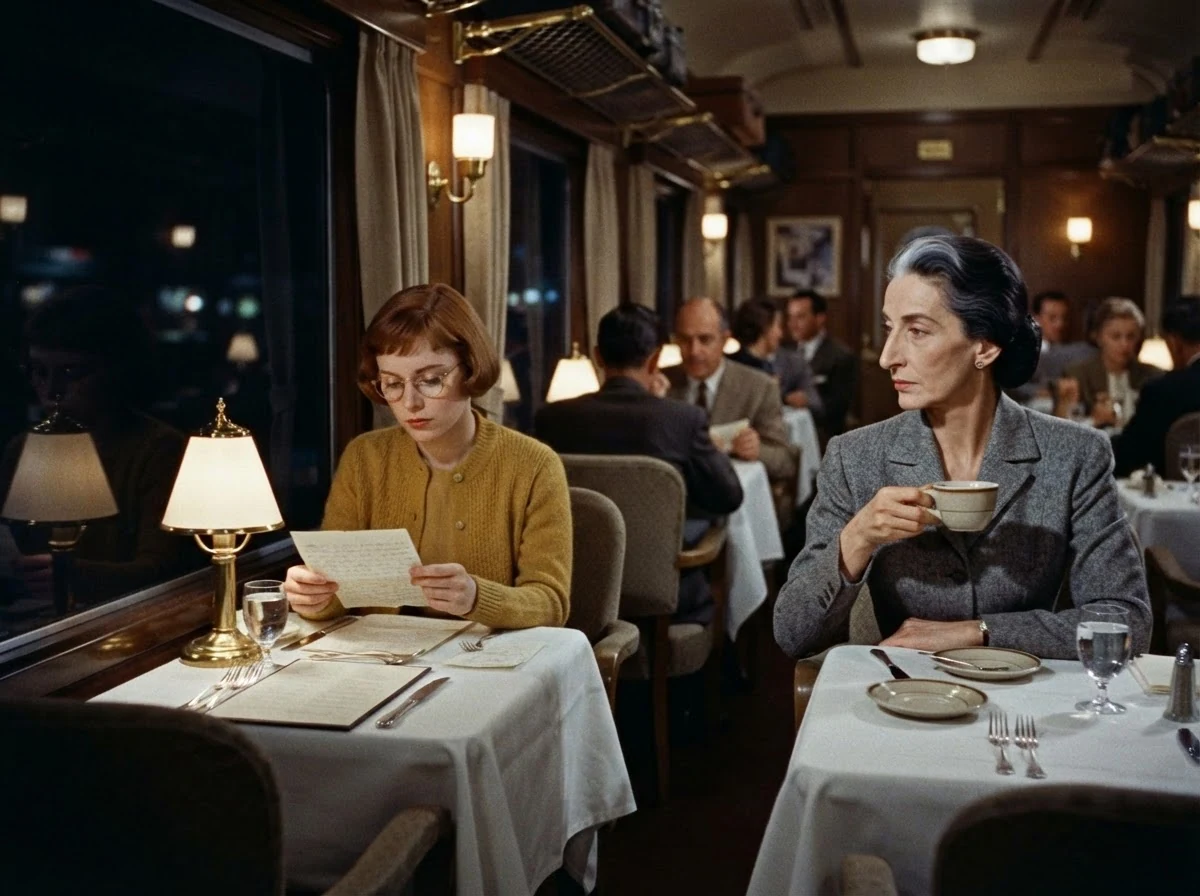
Separate tables and “looking across the aisle” keep desire in the eyeline, as the Code forced. The window reflection gives the watcher a safer image to look at — a classic coding device.
Open FlashBoardsEarly 1990s independent film still, grainy 16mm color with slightly faded greens. Dusk on an empty two-lane highway. Two fictional young men sit on the hood of a dented red station wagon: one with a shaved head and a leather jacket, the other with long bleached hair, a thin mustache and a torn flannel shirt, his head resting on the first one’s shoulder. Both look straight into the lens. Medium wide shot, handheld at hood height, 25mm lens, natural dusk light with a pink sky.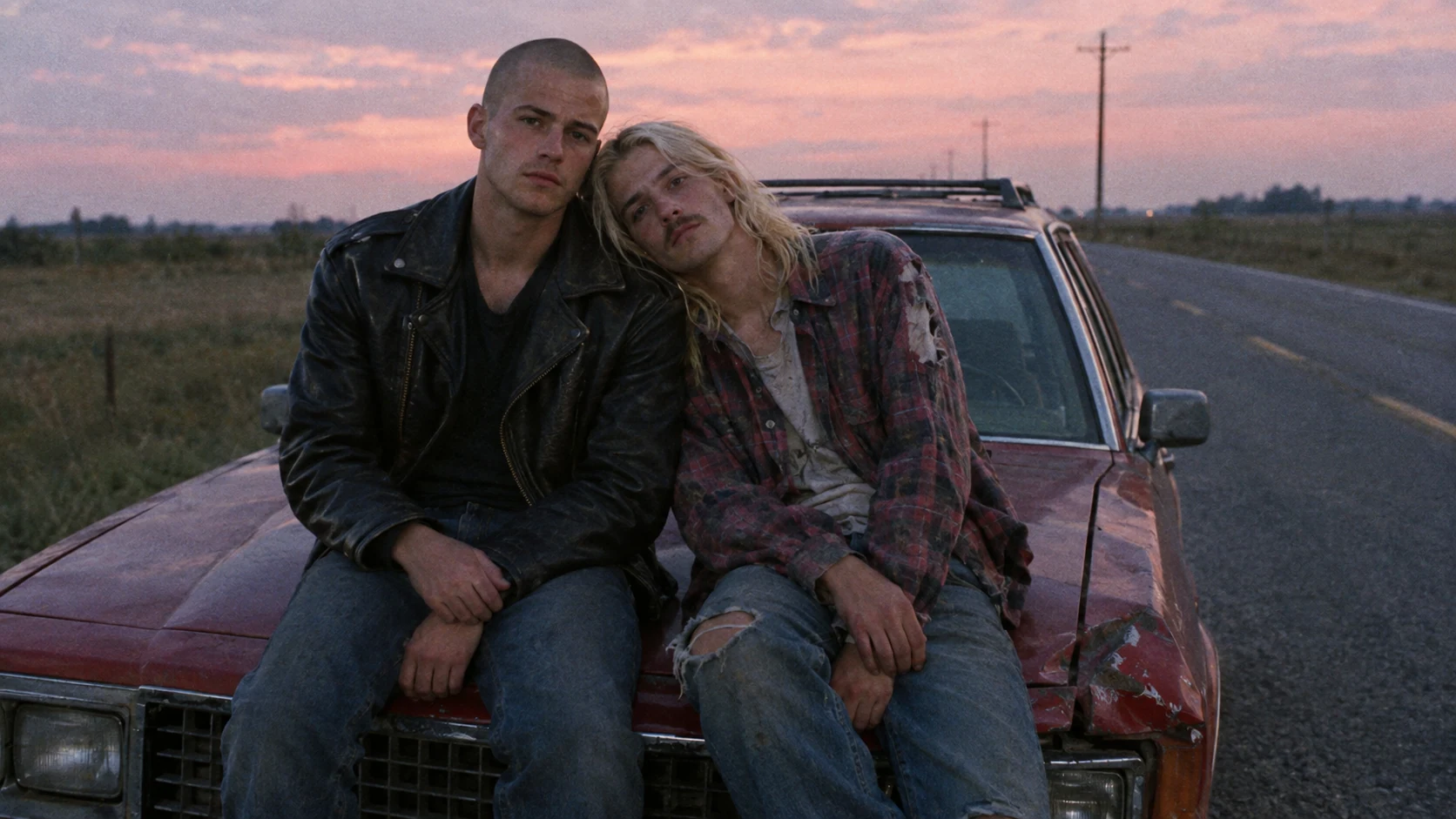
The New Queer Cinema answer to coding: intimacy stated, and “both look straight into the lens” makes the couple look back. “Grainy 16mm” and the road setting carry the early-’90s indie look.
Open FlashBoards{
"output": "Full-screen live-action film scene from its very first frame: one continuous shot in the look of a 1950s Hollywood melodrama, Technicolor, 4:3 frame, soft film grain. A night train dining car: white tablecloths, brass table lamps with cream shades, wood-panelled walls, a few diners at far tables in the background, dark glass at the left edge of the frame holding the reflection of the lamps and passing night lights outside. Warm tungsten lamp light, deep amber and gray palette.",
"characters": {
"S1": {
"name": "the older woman",
"look": "fictional woman in her forties with a silver-streaked black chignon, a long nose and a gray tweed suit, seated alone at her own table in the right third of the frame, nearest the camera, a white coffee cup raised near her chin in her right hand, her left hand with a wristwatch resting on the tablecloth, her head turned toward screen left",
"voice": "silent"
},
"S2": {
"name": "the younger woman",
"look": "fictional young woman with a short auburn bob, round wire glasses and a mustard cardigan, seated alone at a separate window table in the left third of the frame beside a lit brass lamp, holding a handwritten letter in both hands, her eyes down on the letter",
"voice": "silent"
}
},
"shots": [
{
"shot": 1,
"camera": "eye-level, 50mm lens; a very slow, steady push-in toward S1 that starts at once and continues for the whole shot, drifting gently to the right; it ends closer on S1's face and shoulders in the right half of the frame while S2 stays in frame at the left, slightly softer in focus",
"action": [
"BEGINNING: alive from the first frame, the dining car is already rocking gently, the lamp shades tremble and the lights in the dark glass at the left slide past; S1 holds the cup near her chin and looks across the aisle toward screen left at S2, while S2 reads the letter held in both hands, eyes down",
"THEN: S1 slowly lowers the cup with her right hand and sets it on its saucer, her eyes staying on S2 the whole time, her left hand still resting on the tablecloth",
"THEN: S2 lifts her eyes from the letter and turns her head toward screen right, meeting S1's look across the aisle; the letter stays in both her hands",
"THEN: the look holds for a long beat; both faces stay composed and serious, lips closed, and only the rocking of the train moves them",
"END: S2 lowers her eyes back to the letter, and a moment later S1 looks down at the cup in front of her; the train keeps rocking"
],
"dialogue": [],
"voice": "silence: nobody speaks in this shot, no voice at all"
}
],
"sound": {
"ambience": "the steady rhythmic clatter of train wheels on rails, the dining car creaking as it rocks, the soft clink of the cup on its saucer, a faint rustle of letter paper",
"speech": "no words in this video; the only human sounds are breaths and movement",
"never_spoken": "no narration and no voice-over: the descriptions, performance notes and step words of this prompt are never spoken aloud",
"music": "a film score under the scene, always below the voices: a slow, yearning 1950s melodrama string theme with a soft, hesitant harp",
"subtitles": "none"
}
}The rocking train makes the shot alive from the first frame. The returned look, held and broken without words, is coding in motion.
Open FlashBoardsCommon mistakes
- Models turn “two women on a train” into a friendly chat. Keep separate tables and tasks so the only connection is the look.
- Naming a stereotype produces caricature. Describe specific clothes, faces and actions instead.
- In video the returned look comes too early or never. Give the watcher an action first and put the look in a middle THEN step.
Keep the reference frames, prompts and every generated take side by side — images and video in one canvas.
FAQ
4 questionsWhat is queer theory in film in simple terms?
Queer theory in film questions fixed categories of gender and sexuality. It studies how films show, hide or punish queer desire, reads coded characters and subtext, takes camp seriously, and examines how queer filmmakers represent themselves. It applies to any film, including ones without openly queer characters.
What is queer coding in movies?
Queer coding is suggesting a character is gay, lesbian or gender-nonconforming through mannerisms, costume, staging and innuendo rather than stating it. It flourished under the Hays Code, which banned any inference of “sex perversion.” Joel Cairo in The Maltese Falcon (1941) and Mrs. Danvers in Rebecca (1940) are frequently cited examples.
What is New Queer Cinema?
New Queer Cinema is critic B. Ruby Rich’s 1992 name for a wave of independent films such as Poison, My Own Private Idaho, Swoon, The Living End and Paris Is Burning. Made during the AIDS crisis, they rejected polite positive images in favor of angry, stylized, formally experimental stories about queer lives.
What is a queer reading of a film?
A queer reading interprets a film for the queer desire, identity or gender play it contains, whether or not the filmmakers intended it. It argues from evidence on screen — eyelines, staging, costume, performance, endings — and from context such as censorship rules and what writers or actors later said.
Related terms
4- Male GazeFilm History & Theory
The male gaze, a term from Laura Mulvey's 1975 essay 'Visual Pleasure and Narrative Cinema', describes how classical cinema frames women as objects of heterosexual male looking — through POV, fragmenting close-ups and camera lingering on bodies.
- Hays CodeFilm History & Theory
The Hays Code was Hollywood's self-censorship rulebook, adopted in 1930 and strictly enforced from 1934 to the late 1960s: it limited sex, violence, profanity and 'immoral' endings until the MPAA rating system replaced it in 1968.
- SubtextStorytelling
Subtext is what characters mean but don't say — the real feelings or intentions beneath the dialogue, conveyed by performance, framing and context.
- Film TheoryFilm History & Theory
Film theory is the body of ideas about what cinema is and how it produces meaning and pleasure — from Soviet montage and Bazin's realism to auteur theory, psychoanalytic and feminist criticism.
Further reading
Vito Russo, The Celluloid Closet: Homosexuality in the Movies (1981; rev. 1987). Alexander Doty, Making Things Perfectly Queer: Interpreting Mass Culture (1993). B. Ruby Rich, New Queer Cinema: The Director’s Cut (2013).