 FlashBoards Learn
- Learn
- Filmmaking Process & Crew
- Cyclorama
Filmmaking Process & Crew · Film language
Cyclorama
Also called: cyc, cyc wall, infinity cove, infinity wall
A cyclorama, or cyc, is a seamless background with no visible corner between floor and wall: a curved plaster cove, a stretched cloth or a sweep of paper, lit so evenly that the space behind the subject reads as endless white, black, chroma green or sky. It removes place from the frame.
- What it does
- Erases the horizon and the room, so the subject floats in clean, controllable space.
- Use it when
- Music videos, commercials, product and dance work, fashion, chroma keying, and any scene that must feel placeless.
- Watch out
- Footprints, dirty paint and uneven light on the cove betray the curve instantly; keep the subject well off the wall.
- Try this prompt
Wide shot of a dancer on a white cyclorama, floor and wall melting into one endless white, soft shadow only under her feet, 35mm, high-key
What is a cyclorama in film?
On a film or photo stage, a cyclorama is a background built without edges. The wall meets the floor through a curved cove, and the whole surface is painted one color. Lit evenly, the camera can no longer find the corner, so the subject seems to stand in infinite space; hence the other names, infinity cove, infinity wall or simply cyc.
The word is older than cinema: 19th-century cycloramas were huge circular paintings, and theaters later used the name for the curved cloth at the back of the stage, lit as sky. Today a cyc is mainly a neutral background on a soundstage or rental stage.
Hard cyc, soft cyc and paper seamless
- Hard cyc. A permanent plaster, wood or fiberglass build with a radius cove, repainted between bookings because every footprint shows. This is the "cyc wall" studios rent by the day.
- Soft cyc. A large fabric stretched taut from a pipe, standard in theaters and quick stage rigs. Wrinkles catch light and read as texture.
- Paper seamless. Rolls of background paper, typically about 2.7 m (9 ft) wide, pulled down onto the floor; replaced when dirty.
Color defines the job: white for bright, graphic space, black to isolate, green or blue for keying, pale sky lit blue for daylight.
Why filmmakers shoot on a cyc
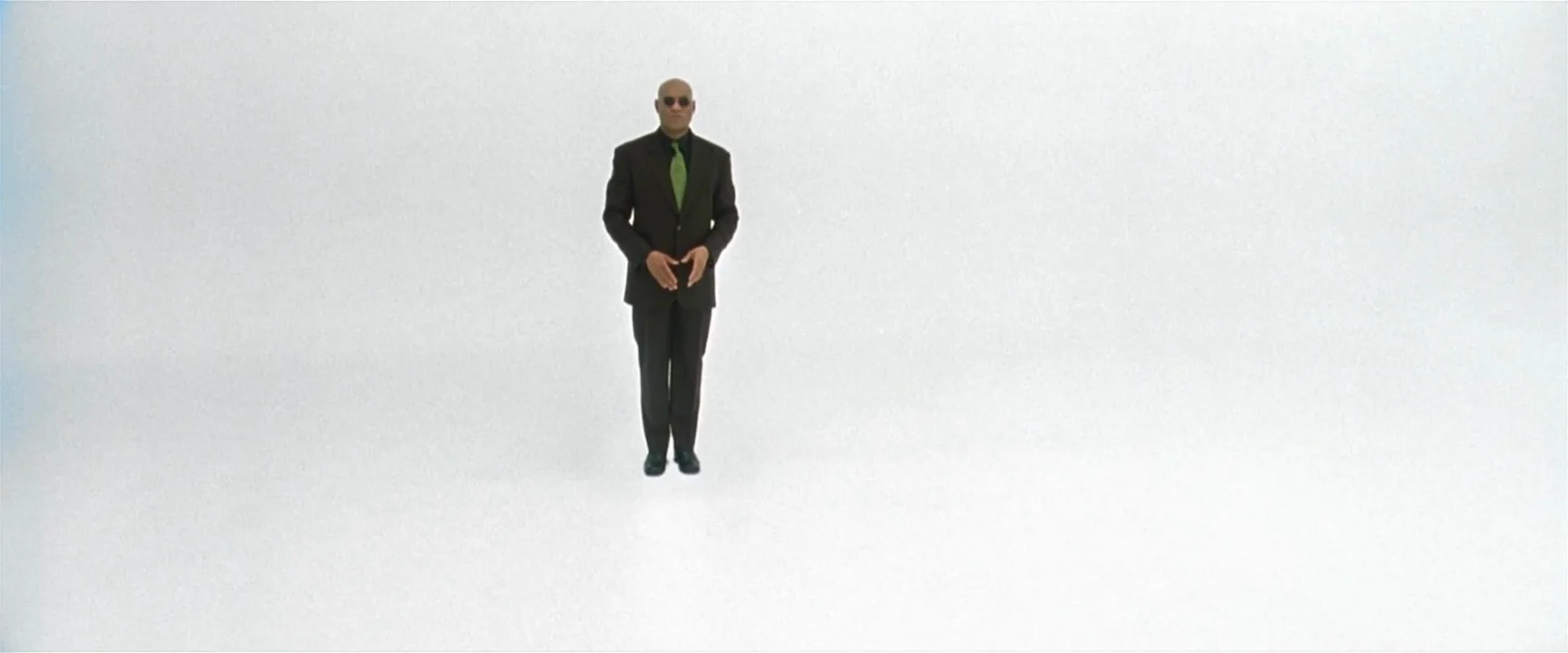
A cyc removes information. With no horizon, the viewer reads only the body, product or movement. Fiction uses this to push a scene out of reality: the white loading construct in The Matrix (1999) turns a stage into a void, a place that is no place.
Commercial work uses it for control: dance and music videos get a clean field for every step, product and fashion shoots get repeatable light. A green cyc serves background replacement: the curve lets an actor walk, fall or lie down and still be keyed head to toe, which a flat green wall cannot give.
Before booking a stage, compare white, black and green options with film references and AI tests on one FlashBoards board.
How to light and shoot a cyclorama
- Light cyc and subject separately. Strip lights or soft sources along the top of the wall (sometimes a ground row at the cove) for the background; key and fill for the talent.
- Distance. Keep the subject 3–5 m (10–15 ft) off the wall to kill cast shadows and color spill.
- Level. For pure white, about one stop over the key; much more and the white wraps around the subject's edges. For green, an even field within about a third of a stop, near middle grey.
- Hide the cove. Match floor to wall brightness and the curve vanishes; a longer lens keeps the top edge out of frame.
- Protect the floor. Shoe covers, no stray tape, fresh paint when scuffed.
The result is textbook high-key lighting.
Cyclorama vs. backdrop
A backdrop shows a world: a painted or printed sky, skyline or landscape that makes the stage pass for somewhere else. A cyclorama shows nothing until light or effects define it. The test is the frame: if the background carries a picture, it is a backdrop; if it carries only light with no corner to find, it is a cyc. More stage vocabulary lives in the film production hub.
Cyclorama examples in film
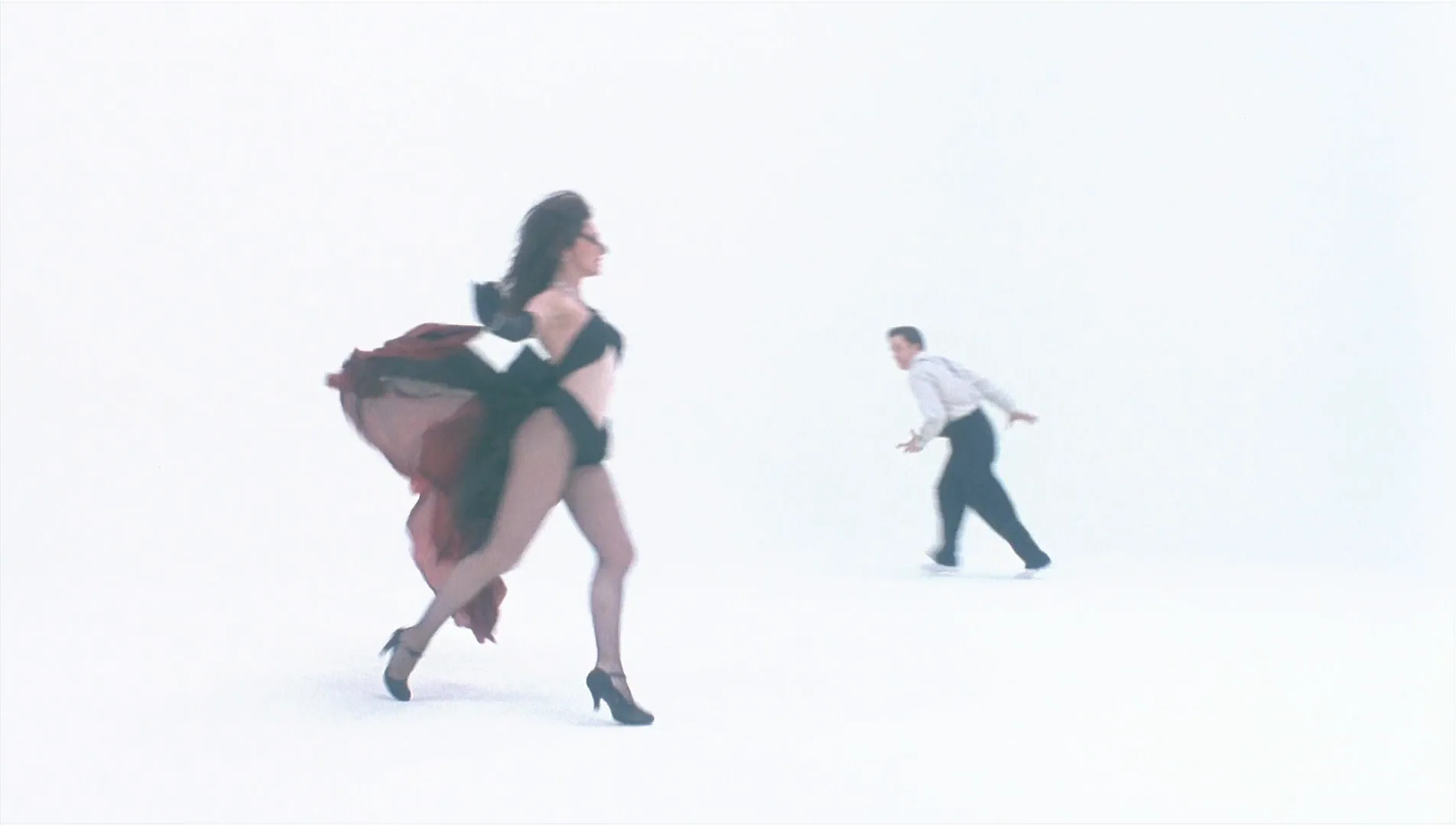
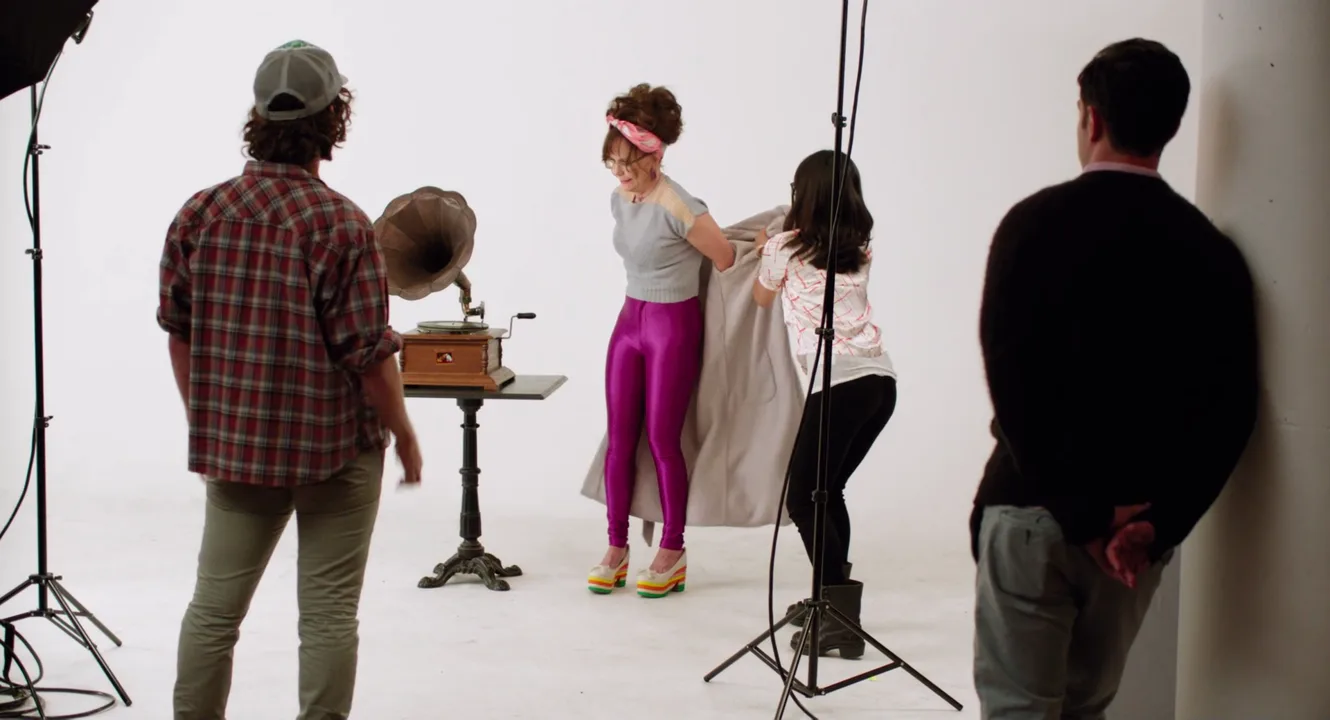
5 framesFrames where the floor-to-wall corner disappears, and two that show the studio around the cyc.

How to create a cyclorama with AI
4 promptsModels know "cyclorama" and "infinity cove" but often draw the corner or the studio unless you describe the seamless look itself. Generate a start frame, try a second take in green, then animate the first frame, all on one FlashBoards board next to your references. The fourth prompt re-shoots a real film shot from a text description alone, and the original plays next to the result so you can compare.
Wide shot on a white cyclorama, floor and wall melting into one continuous endless white, a dancer in her late twenties with a shaved head, one gold hoop earring and a loose rust-orange jumpsuit stands center frame, arms extended, soft shadow only under her feet, 35mm lens at waist height, background one stop brighter than the subject, soft key from above, high-key look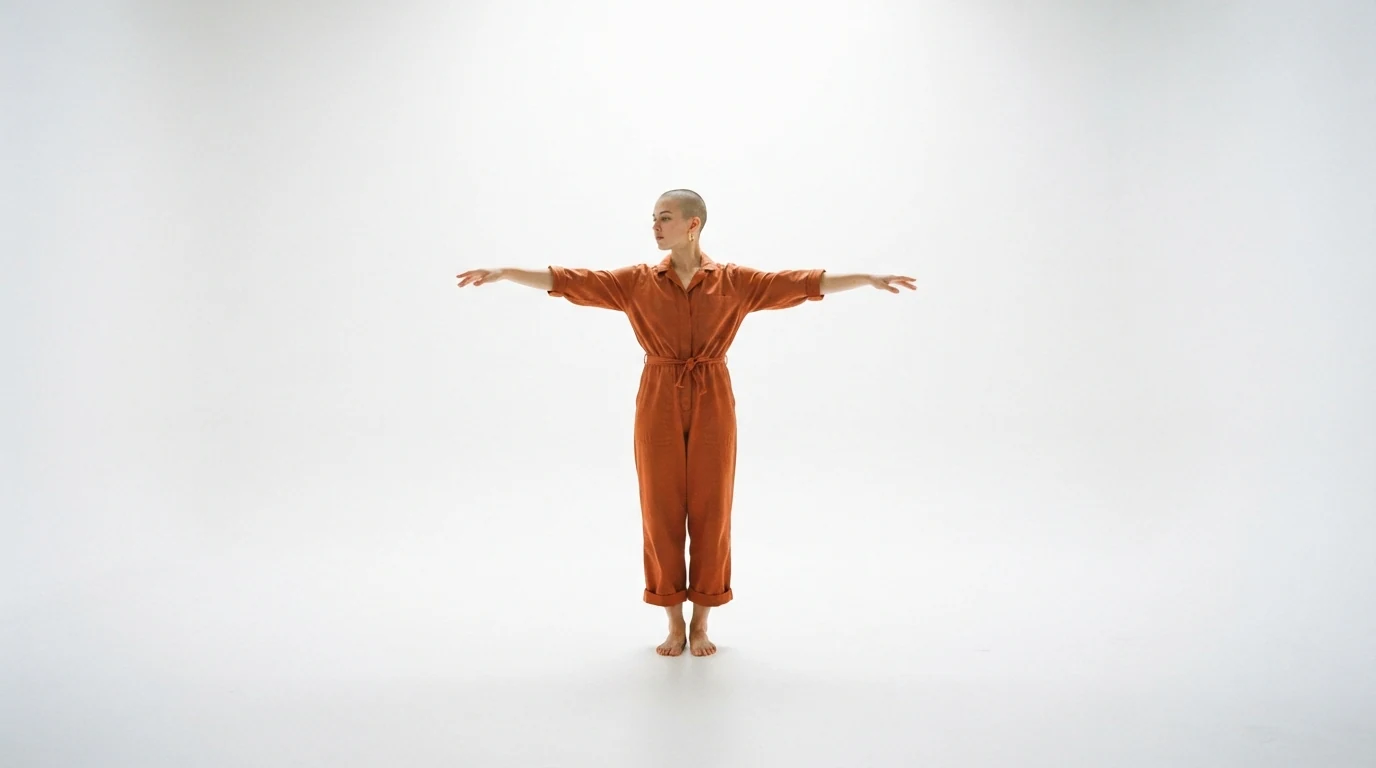
"Melting into one continuous endless white" describes the cove positively; "one stop brighter" and the shadow under the feet give classic cyc exposure; the orange costume keeps her from dissolving.
Open FlashBoardsBehind-the-scenes wide shot of a chroma green cyclorama on a dark soundstage, the green wall curving down into the green floor in one seamless sweep, soft strip lights along the top edge, a tall stunt performer with a short red beard in a grey tracking suit stands far from the wall, light stands at the frame edges, 24mm, eye level, even flat light on the green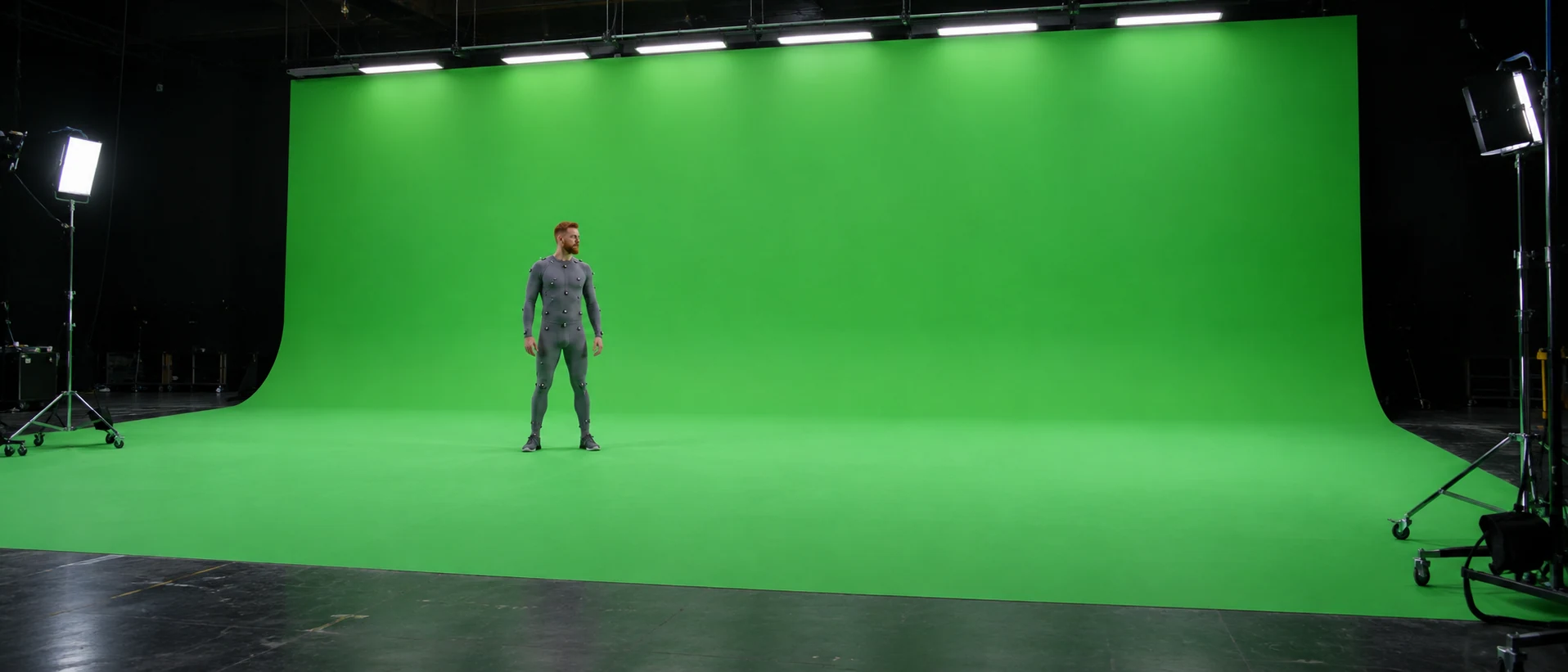
This take shows the object itself: "one seamless sweep" draws the cove, "strip lights along the top edge" and "far from the wall" put real lighting practice in the frame.
Open FlashBoardsCamera: a slow, steady dolly in at constant height, from the wide shot to a full shot by the end. Action: the dancer is already moving, sweeping both arms in a wide arc and stepping left; she spins once and the jumpsuit flares; she ends in a low lunge facing camera. The endless white stays even and her soft shadow follows her feet.Motion starts in the first words so the clip is alive from frame one; restating the even white keeps the seamless background intact.
Open FlashBoards{
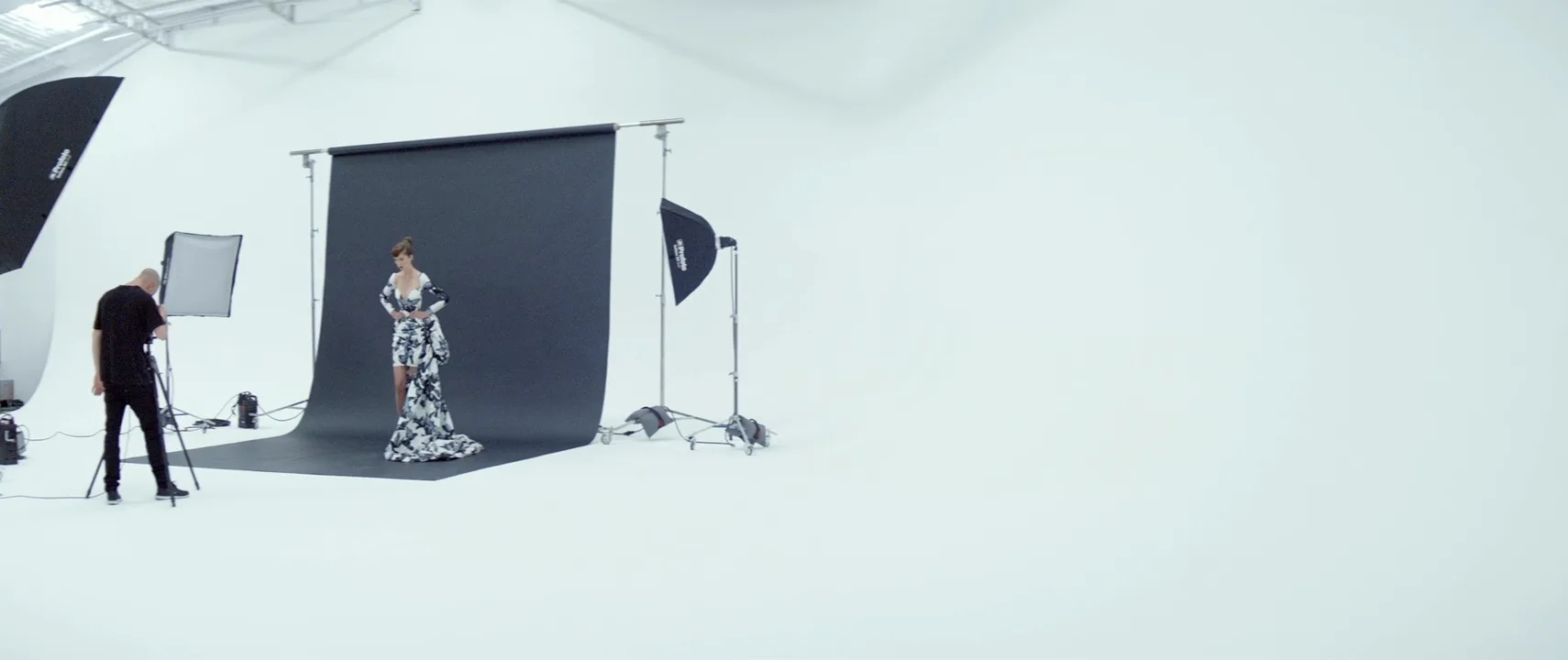
"output": "Full-screen live-action scene from The Neon Demon (2016), from its very first frame: one continuous shot. Clean modern digital cinema, anamorphic scope, cool clinical high-key light, pale white-cyan palette, a vast white photo studio by day. The whole studio floor and back wall are one seamless white cyclorama: the floor curves up into the wall in one smooth rounded sweep, so the white reads as endless space. On it stands a small set: a tall roll of charcoal-black backdrop paper hanging from a crossbar on two stands and running down onto the floor.",
"characters": {
"S1": {
"name": "Jack, the fashion photographer, played by Desmond Harrington",
"look": "stocky man with a fully shaved head, plain black T-shirt, black jeans, black shoes, working a camera on a tall tripod",
"voice": "silence"
},
"S2": {
"name": "a fashion model posing on the black paper",
"look": "slim young woman, dark brown hair pulled up in a high bun with a short fringe, strapless sweetheart-neck gown white with a navy ink-flower print, printed long sleeves, short front hem and a huge printed train pooled on the black paper behind her",
"voice": "silence"
}
},
"shots": [
{
"shot": 1,
"camera": "extreme wide shot, wide lens from very far back across the white floor, chest height, the people small: each figure about a third of the frame height, locked tripod position, a slow steady pan to the LEFT for the whole shot, everything in sharp focus. Start: the black paper set sits left of centre, small in frame, a square softbox on a stand just right of it; the right two-thirds of the frame is empty seamless white floor and wall. End: the black paper set has drifted to the centre, S1 at his tripod and a square softbox fill the left third, a huge black round parabolic reflector hangs at the top-left corner, and a gray wall with a doorway beyond the curve of the cyc appears at the far left edge.",
"voice": "silence: nobody speaks in this shot, no voice at all",
"action": [
"BEGINNING: alive from the first frame, the camera already panning left; a studio strobe fires once, washing the whole frame a touch brighter for an instant, then the light settles; S2 stands still at the middle of the black paper, both hands on her hips with elbows out, face turned in three-quarter profile toward the left of screen, head bowed, eyes lowered toward the floor there, away from the lens.",
"THEN: as the pan continues, S1 slides into frame from the left edge, already bent forward over his camera on the tripod, his back three-quarters to us, facing right across the white floor toward S2; his right-of-screen hand grips the camera body at his face, his left-of-screen arm hangs at his side.",
"THEN: S2 lifts her chin slightly and turns her face further toward S1 on the left of screen, profile to us, never looking into the lens, lips a little parted; her hands stay on her hips.",
"THEN: S1 stays bent at the viewfinder, head down, almost motionless, shifting his weight once; a square softbox on a stand stands just behind his right-of-screen shoulder.",
"END: S2 tips her head down again, face still turned toward S1, hands on hips; the huge black round reflector and the gray wall with a doorway settle into the left edge while the white cyc stays bright, even and seamless around the dark paper."
],
"dialogue": []
}
],
"sound": {
"ambience": "the hushed hum of a large empty studio, one sharp strobe pop and the rising whine of a flash recharging at the start, a faint camera shutter click",
"speech": "no words in this video; the only human sounds are breaths and movement",
"never_spoken": "no narration and no voice-over: the descriptions, performance notes and step words of this prompt are never spoken aloud",
"music": "a film score under the scene, always below the voices: a cold, slow pulsing analog synthesizer drone with a glassy high shimmer",
"subtitles": "none"
}
}Remakes the studio shot from The Neon Demon (2016), dir. Nicolas Winding Refn: the black paper set inside a white cyc, the slow pan left and the photographer, played by Desmond Harrington, sliding in at his tripod.
The output line states the cyc itself, floor curving into wall, while the slow pan left brings in the photographer, lights and studio edge; the shot stays silent under a cold synth score.
Open FlashBoardsCommon mistakes
- Models draw a corner line between floor and wall. Describe what is there ("floor and wall melting into one continuous white") instead of a negative.
- "Studio" invites softboxes into the frame; omit it unless you want the behind-the-scenes view.
- Pure white clips the subject's edges: use a saturated costume and ask for the background only one stop brighter.
Keep the reference frames, prompts and every generated take side by side — images and video in one canvas.
FAQ
4 questionsWhat is a cyc wall?
A cyc wall is the permanent, hard version of a cyclorama: a studio wall joined to the floor by a smooth curved cove and painted one color, usually white, black or chroma green. Lit evenly, the curve disappears on camera and the background reads as endless space.
Is an infinity cove the same as a cyclorama?
In practice, yes. Infinity cove, infinity wall, cyc and cyclorama all name a seamless background whose floor-to-wall join is curved so the camera cannot find the corner. Some reserve "cyclorama" for the theatrical cloth, but on set the terms are interchangeable.
What is a cyclorama in theater?
In theater, a cyclorama is a large cloth stretched across the back of the stage and lit from above and below, most often to represent sky; changing the light color changes the time of day. Film studios adopted the idea of a lit, borderless surface but mainly use it as a neutral background.
Why are cycloramas curved?
A right-angle corner catches light differently on each plane and draws a visible line. A curved cove turns that change of direction into a gradual transition that even lighting can hide, so the camera sees one continuous surface.
Related terms
4- BackdropProduction Design
A backdrop is a large painted or printed surface hung behind a set to stand in for the world beyond it — a sky, a skyline, a mountain range — so the scene can be shot on a stage.
- SoundstageFilmmaking Process & Crew
A soundstage is a large soundproofed building with a high grid for lights where sets are built and filmed under full control of light, sound and weather.
- VoidProduction Design
A void is a deliberately placeless setting — black, white or colored infinity with no horizon or detail — that isolates a figure or object and turns the scene into abstraction (Under the Skin, The Matrix's white construct).
- Background ReplacementPost-Production & VFX
Background replacement keeps the actor or object and swaps what is behind them — via green or blue screen keying, rotoscoping, masks or LED volumes.
Further reading
Harry C. Box, Set Lighting Technician's Handbook (Focal Press) — sections on cyc lighting and stage backgrounds.