 FlashBoards Learn
- Learn
- Filmmaking Process & Crew
- Soundstage
Filmmaking Process & Crew · Film language
Soundstage
Also called: sound stage, stage, studio stage
A soundstage is a large, soundproofed building with a high lighting grid where sets are built and filmed under full control of light, sound and weather. Nothing leaks in from outside, so a crew can shoot a sunlit kitchen at midnight, hold continuity for weeks and record clean dialogue on every take.
- What it does
- Replaces the real world with a controlled box: no traffic noise, no weather, no sun moving across the set.
- Use it when
- A scene needs many days in one space, walls that move for the camera, lighting a real room can't take, or clean sound.
- Watch out
- Stage time, set construction and lighting cost money every day; a set that looks built kills the illusion faster than any location.
- Try this prompt
Wide shot from the dark edge of a soundstage: a bright three-wall kitchen set under a lighting grid, crew silhouettes in the foreground.
What is a soundstage?
A soundstage (also sound stage, or just the stage) is an enclosed, acoustically isolated building on a studio lot, rented to productions as an empty box. Sets are built inside it, lit from the ceiling, and filmed as a world that exists only between those walls. It is one of the core spaces of film production, alongside locations and the backlot.
The word sound is historical. Silent films were often shot on open-air stages or under glass roofs to use daylight, and noise didn't matter. When synchronized dialogue arrived in the late 1920s, studios built heavy, windowless, insulated halls where microphones would hear only the actors. The name stuck.
What makes a building a soundstage?
A working stage has:
- Sound isolation. Insulated walls and roof, sealed doors, and ventilation that can be shut off or run quietly during takes.
- A lighting grid. A steel pipe grid or truss high above the floor, often 30–50 feet on feature stages, with catwalks for rigging.
- Power. Enough electrical service for the gaffer to run a full lighting package without generators.
- A flat, strong floor for sets, cranes and dolly track; some stages hide a water tank under removable panels.
- Elephant doors big enough for trucks and set walls.
- A red light and bell outside every door: when it spins, the camera is rolling and nobody walks in.
Many stages also keep a permanent cyclorama for sky, white or chroma backgrounds.
Why do filmmakers shoot on a soundstage?
The answer is control. On a stage the sun never sets mid-scene, the street never gets louder, and a set stays dressed as long as the schedule needs it.
- Light. Day or night comes from wherever the cinematographer puts it, and it matches across weeks.
- Camera access. Wild walls unbolt and slide away, ceilings lift out, floors are raised for low angles. A real apartment can't give you a dolly move through a wall.
- Sound. Clean dialogue means fewer lines to replace in post.
For Rear Window (1954), Paramount built the entire courtyard and the apartments across from Jeff's window on a stage, so Hitchcock controlled every window the audience spies into. The Shining (1980) built the Overlook's interiors on stages in England. The Mandalorian (2019) moved much of its world onto an LED volume inside a stage, see virtual production, and Grease: Live (2016) used a studio's soundstages and backlot as one live-broadcast set.
How a soundstage shoot works
The production designer's plans become a set build: flats, platforms and wild walls go up, painters age the surfaces, set dressers fill the rooms, and painted, printed or LED backings hang outside the windows.
Meanwhile the grip and electric crews pre-rig lights in the grid, so on shoot day most of the light is already waiting on a dimmer board. Keep window light and practicals motivated: audiences read flat, top-down light as "studio" instantly.
In FlashBoards, put the floor plan, set elevations, backing references and lighting plan on one board, then generate test frames from the planned camera positions to see which walls need to be wild before a single flat is cut.
Soundstage vs. studio vs. backlot
- Studio is the company or the whole lot: offices, workshops, stages and backlot together.
- Soundstage is one enclosed, soundproof building on that lot, where interiors and controlled exteriors are shot.
- Backlot is the open-air part of the lot with permanent exterior sets like streets and facades. Real sun, wind and aircraft noise included.
- Filming location is a real place off the lot, with real views and its own permits, neighbors and weather.
A typical feature mixes them: exteriors on location or the backlot, interiors on a stage, with a real facade matched to a stage-built interior so the audience never sees the seam.
How to create a soundstage with AI
3 promptsA soundstage shows up in one wide shot: the lit set in the middle, darkness, grid and crew around it. The same frame is a practical tool for previewing how a stage build will read from camera. Keep plans, references and these takes side by side on one FlashBoards board.
Behind-the-scenes wide shot inside a huge dark soundstage. In the center, a brightly lit three-wall 1970s living room set: mustard sofa, wood paneling, a window with a painted city backing at dusk, the fourth side open toward the camera. Above it, a black steel lighting grid with hanging lamps and a large white soft box. Foreground in shadow: a camera on a dolly, cables on concrete, and a gaffer seen from behind, a tall woman in her fifties with a long gray braid and a black work vest. Warm light on the set, deep black around it, 24mm lens, eye level.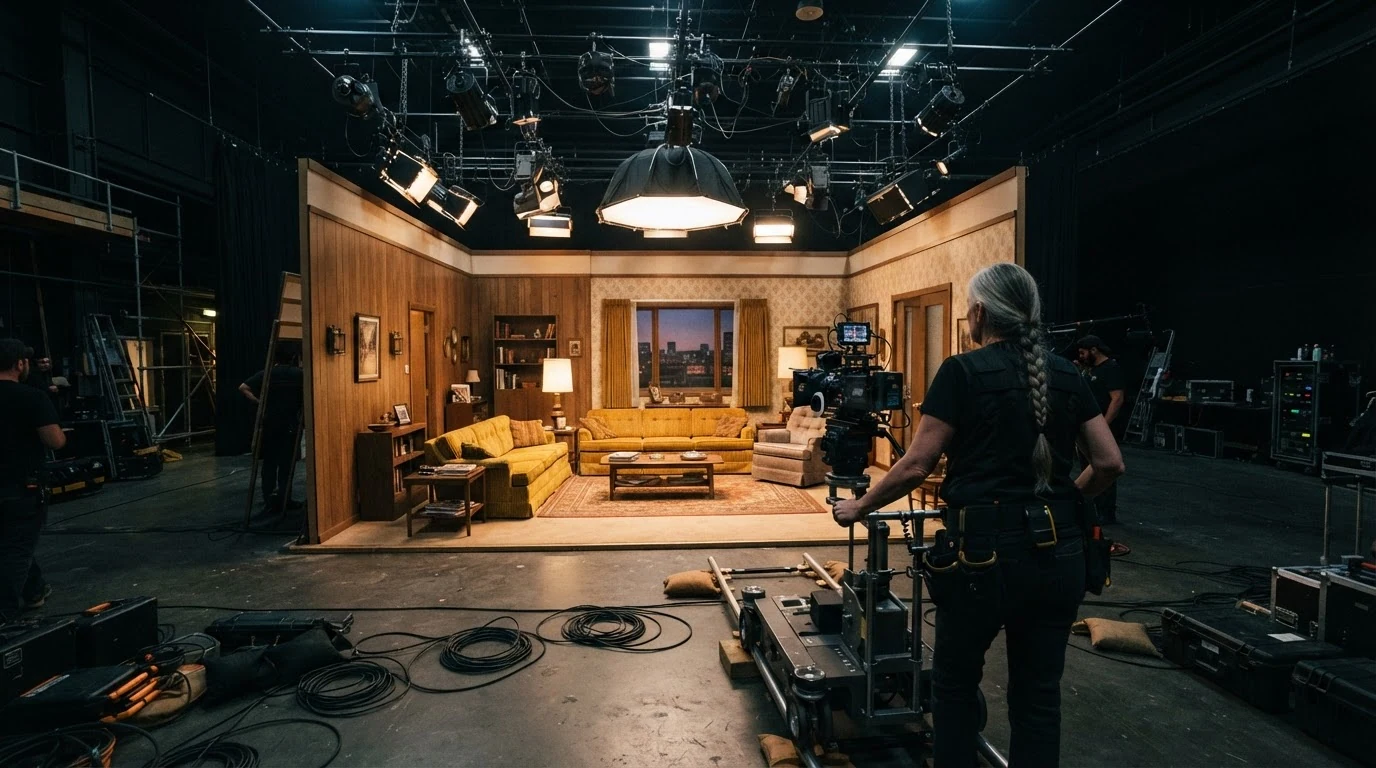
"Three-wall set", "fourth side open" and "lighting grid" make the model build a set inside a stage, not a real room. The dark foreground with camera and crew frames it as a set; "painted city backing" sells the fake view.
Open FlashBoardsHigh view from a soundstage catwalk down onto two sets side by side on a concrete floor: on the left a small diner interior with red booths lit like night, on the right a bare plywood set under construction with a ladder and stacked flats. Between them, light stands and a camera crane. Tall walls with sound-absorbing panels, a white cyclorama curtain along the back wall, a red warning light above a large closed door. Cool work lights, a few crew members in the distance.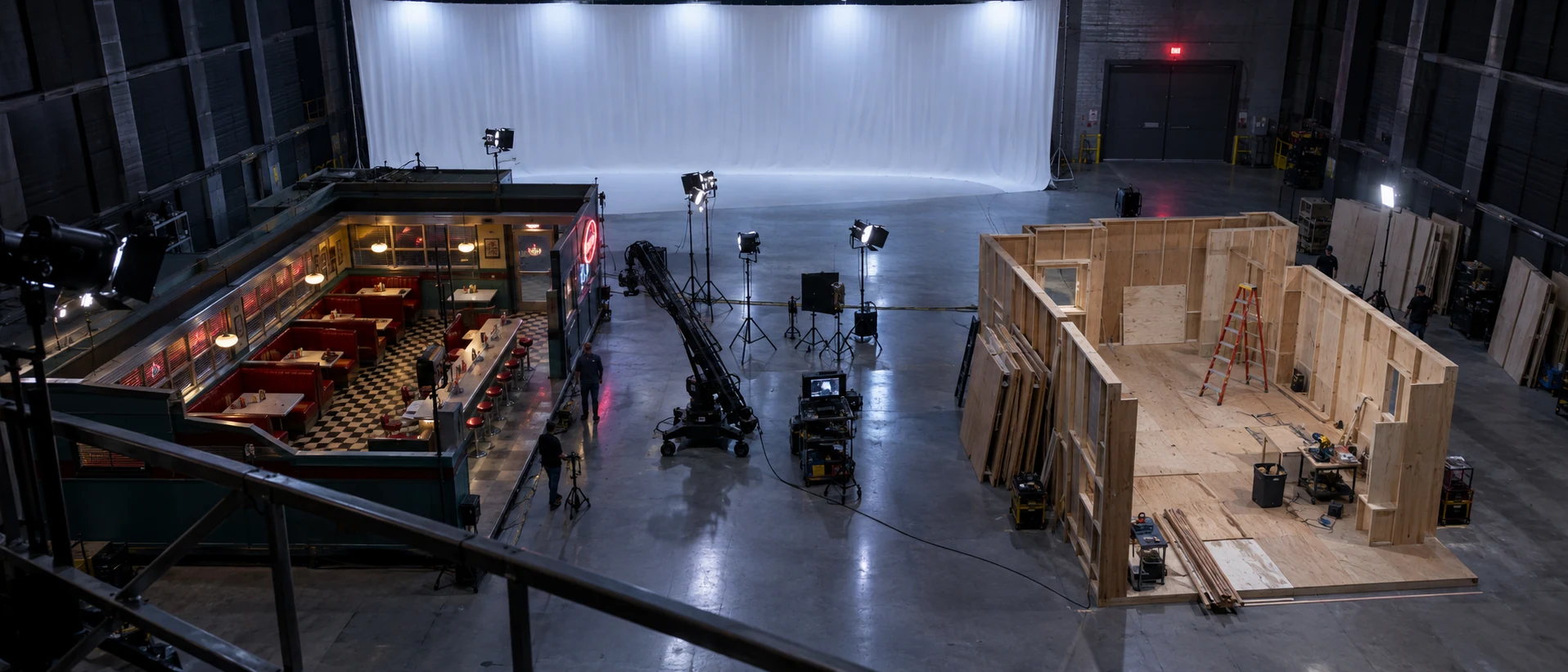
The catwalk angle shows the stage as a building: walls, cyc, red light, and a finished set beside one still being built.
Open FlashBoardsCamera: a slow, steady dolly back and slightly up from the dark foreground, moving away from the lit set for the whole shot, revealing more dark stage floor and the lighting grid above. Action: the gray-braided gaffer is already walking toward the set, raising one hand to signal up to the grid. Halfway through, one hanging lamp above the set brightens and the sofa glows warmer. At the end she stops at the edge of the set and the lit room glows alone in the darkness.The pull-back turns a room into a set: every foot adds dark stage around it. The gaffer already walking keeps the clip alive from frame one, and the lamp brightening gives the grid a job.
Open FlashBoardsCommon mistakes
- Models render a finished room with no stage around it. State "three-wall set", "open fourth side" and "lighting grid above".
- "Studio" alone tends to give a photo studio with a white backdrop; say "soundstage" and describe the set inside it.
- Backings come out as real windows unless you write "painted backing" with its edge visible.
Keep the reference frames, prompts and every generated take side by side — images and video in one canvas.
FAQ
4 questionsWhat is the difference between a sound stage and a studio?
A studio is the whole facility or company: offices, workshops, dressing rooms, stages and often a backlot. A sound stage is one soundproofed building inside it where built sets are actually filmed. Every soundstage belongs to a studio, but a studio also includes plenty of spaces where no camera rolls.
Why is it called a soundstage?
The name dates from synchronized sound in the late 1920s. Silent films were often shot on open or glass-roofed stages lit by daylight, where noise didn't matter. Recording dialogue required enclosed, insulated buildings that kept outside noise off the microphones. They were called sound stages, and the term stayed.
How big is a soundstage?
Sizes vary widely. Insert stages for product and tabletop work can be a few thousand square feet; large feature stages cover tens of thousands of square feet with grids 30 to 50 feet up. Big stages often hold several sets at once, or a ship deck, a street corner or a water tank.
Is a soundstage better than shooting on location?
Neither is better in general. A soundstage gives control: repeatable light, clean sound, wild walls and no weather, which pays off when a scene takes many days in one space. A location gives authenticity and real views, often for less construction. Most films combine both.
Related terms
5- Filming LocationFilmmaking Process & Crew
A location is any real place used for filming outside a studio; location scouting finds and vets it for look, sound, light, access, permits and cost, and the location manager secures it.
- CycloramaFilmmaking Process & Crew
A cyclorama (cyc) is a seamless curved wall or tightly stretched backdrop with no visible corner between floor and wall, lit evenly so the background reads as endless white, black, chroma green or sky.
- Virtual ProductionFilmmaking Process & Crew
Virtual production combines live-action shooting with real-time rendered environments — typically on LED walls driven by a game engine and synced to camera tracking — so backgrounds, light and parallax are captured in camera.
- Set DesignProduction Design
Set design is the planning and construction of the physical spaces a scene is shot in — from a single room built on a stage to an entire street — so that architecture, scale and texture express the story.
- Film ProductionFilmmaking Process & Crew
Film production is the whole process of making a film — development, pre-production, production (the shoot), post-production and distribution; in the narrow sense, 'production' is just the shooting phase.
Further reading
Blain Brown, Motion Picture and Video Lighting (Focal Press), on rigging and lighting sets on stages.