 FlashBoards Learn
Production Design · Film language
Void
Also called: void space, limbo set, infinite background, black void
A void background is a deliberately placeless setting: black, white or colored infinity with no horizon, walls or detail. It cuts a figure or object loose from any location, so the viewer loses scale and distance and reads the scene as abstraction: a mind, a dream, a limbo.
- What it does
- Removes place from the frame so only the figure, its shape and its light remain.
- Use it when
- The scene happens inside a head, between worlds, or outside ordinary time and space.
- Watch out
- Any visible seam, corner or floor edge turns the void back into a studio.
- Try this prompt
lone figure in an edgeless pure black void, single hard top light, glossy black floor fading to black, 35mm, eye level
What is a void background?
A void is a setting that refuses to be a place. The background is one continuous field of black, white or color, with no horizon, no corner between floor and wall, and nothing that tells you how big the space is. Television crews called it a limbo set; you will also hear void space, infinite background or black void.
It is a production design decision first and a lighting job second. A void removes the space itself, so the figure seems to float and the eye has nowhere to go but the subject and its outline. It is negative space taken to the limit.
Why do filmmakers use a void background?
Because it tells the audience the normal rules are off:
- The Matrix (1999). The white Construct, where Morpheus shows Neo a loading program, reads as software: a space that exists only while someone runs it.
- Under the Skin (2013). Jonathan Glazer's black room, with a glossy floor that swallows the men who follow Scarlett Johansson's character, is a trap without walls.
- Get Out (2017). The Sunken Place drops Chris into black emptiness. The void becomes paralysis.
Without scale or horizon the viewer cannot orient, so the character's state of mind becomes the location. Voids also isolate shape, which is why they pair so well with silhouette.
The black void


A black void keeps light off everything except the subject: low-key lighting with fill and background removed. A hard top light, side key or rim shapes the figure; everything else falls to true black. A glossy black floor adds a thin reflection that suggests a surface without showing where it ends.
White void

A white void is a seamless, evenly lit white space with no visible horizon, where figures seem to float in infinite light. It is high-key lighting pushed until the background loses all texture and reads as clinical, digital or heavenly.
The enemy is contrast. Pale faces and light costumes dissolve into white, so white voids are cast with dark or saturated wardrobe and a faint shadow at the feet. Haze is the other route: dense backlit atmosphere turns even a location white, and gels turn it into a colored void.
How to shoot a void background
Black void. Hang black duvetyne or velvet and keep the subject 4–5 m in front of it so spill dies with distance. Light with grids, snoots and flags; meter the background 4–5 stops under the key. A 50–85mm lens sees less background than a 24mm, so a small black stage goes further.
White void. Light a cyclorama or paper seamless evenly, about 1–1.5 stops over the subject's key. Keep the subject well forward so the white does not wrap around them, and flag the bounce.
Colored void. Gel the cyc lights, or haze the stage and backlight it through color, keeping the key on the subject neutral.
Void vs. cyclorama and minimalist sets
A cyclorama is a tool; a void is the look you get when a cyc, a black stage, haze or post work removes place entirely.
A minimalist set is the closer neighbor. A bare white room or Dogville's chalk lines on a black stage floor are sparse, but they still mark a location. The test: if you can judge how far the subject is from the back of the space, it is a minimalist set. If you cannot, it is a void.
Void in motion


11 clipsLook for what is missing: no horizon, no corner where floor meets wall, nothing that gives the space a size. Then notice how each example keeps the subject readable against the void, with dark clothes on white, a pool of top light or glowing edges on black.


How to create a void with AI
3 promptsImage models often read void as outer space, or quietly add a floor line and a studio wall. Describe the emptiness positively: edgeless black, one continuous white, and the light that shapes the subject. Keep references, takes and the video on one FlashBoards board to compare how clean each void is.
Wide shot, a woman in her forties with close-cropped silver hair and a thin scar through her left eyebrow, in a long oxblood wool coat, stands alone in an edgeless pure black void. A single hard top light makes a small circle on a glossy black floor that fades to total black within two meters. 35mm lens, eye level, low-key, matte black everywhere beyond the light.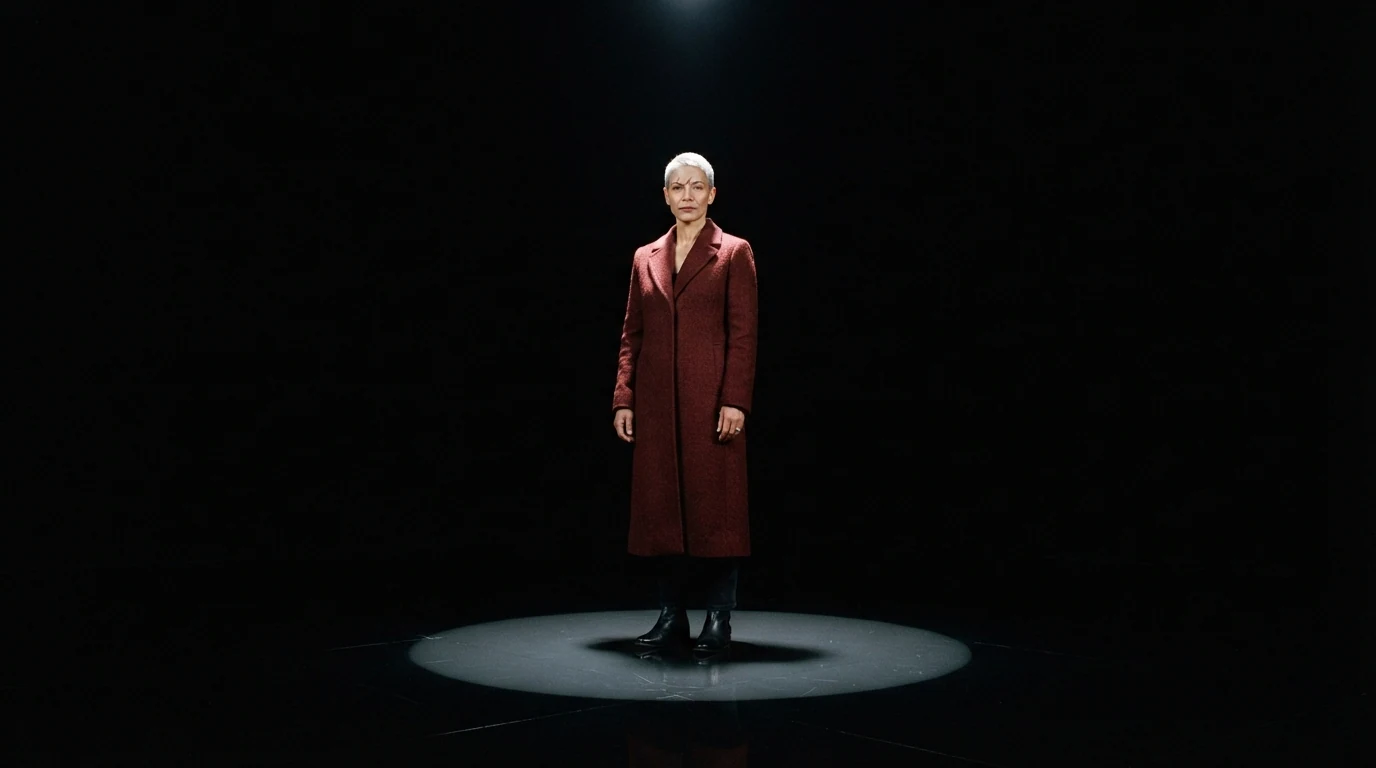
"Edgeless pure black" and "matte black everywhere beyond the light" describe the void without naming anything to remove; the fading glossy floor gives the Under the Skin surface; the oxblood coat separates her from the dark.
Open FlashBoardsWide cinematic shot of a white void: a lanky man in his sixties with a long white beard braided at the tip, in a charcoal raincoat and red wool socks, sits on a wooden chair in endless luminous white. Floor and background are one continuous white with no horizon line, only a soft grey shadow under the chair. 50mm lens at chest height, high-key, clinical and calm.
"One continuous white with no horizon line" is the white-void instruction; the chair's shadow anchors him; the dark coat and red socks keep him from dissolving.
Open FlashBoardsCamera: a slow, steady dolly in at eye level, from the wide shot to a full shot of the woman by the end. Action: she is already walking forward into the circle of top light, her coat swinging; she stops at the center of the light and tilts her face up toward it; her reflection moves with her on the glossy floor. The black around her stays empty and edgeless.The walk starts in the first sentence, so the clip is alive from frame one; restating the empty black keeps walls and horizons out.
Open FlashBoardsCommon mistakes
- "Void" alone brings stars or smoke. Say "pure matte black" or "one continuous white" and describe the light.
- Models add a floor line or wall corner. Describe the floor positively: "fades to total black within two meters".
- On white, pale faces and light clothes melt away: use dark or saturated wardrobe and a soft shadow at the feet.
- In video, any scenery you mention gets drawn. Restate that the background stays empty.
Keep the reference frames, prompts and every generated take side by side — images and video in one canvas.
FAQ
4 questionsWhat is a void background in film?
A void background is a setting with no visible place: pure black, white or colored space with no horizon, walls or corners. It isolates a character or object so the viewer loses scale and distance and reads the scene as psychological or abstract, as in the white Construct of The Matrix or the black room of Under the Skin.
How do you create a black void background?
Hang black velvet or duvetyne, keep the subject several meters in front of it and light only the subject with gridded or snooted units, flagging all spill. Meter the background four to five stops under the key. A longer lens sees less background, so a small black stage goes further.
What is a white void?
A white void is a seamless, evenly lit white space with no visible horizon, where figures seem to float in light. It is usually shot on a white cyclorama lit about one stop over the subject, or made with backlit haze, and it needs dark or saturated wardrobe so the subject does not disappear.
What is a limbo set?
Limbo set is an older studio and television term for a void: a background lit or draped so no walls, corners or horizon show, leaving performers in undefined space. Today filmmakers more often say void, infinite background or black void, but the craft of hiding every edge is the same.
Related terms
5- CycloramaFilmmaking Process & Crew
A cyclorama (cyc) is a seamless curved wall or tightly stretched backdrop with no visible corner between floor and wall, lit evenly so the background reads as endless white, black, chroma green or sky.
- BackdropProduction Design
A backdrop is a large painted or printed surface hung behind a set to stand in for the world beyond it — a sky, a skyline, a mountain range — so the scene can be shot on a stage.
- Negative SpaceComposition & Framing
Negative space is the empty area around a subject — sky, wall, darkness, water — deliberately left large so the subject feels isolated, small, lonely or expectant, and the eye settles on it.
- SilhouetteLighting
A silhouette shows a subject as a dark, featureless shape against a brighter background — sky, window, fire — exposed for the background, so only the outline tells us who they are and what they are doing.
- DreamcoreFilm Movements & Styles
Dreamcore is an internet-born surreal aesthetic that imitates the feel of dreams: pastel skies, empty playgrounds and hallways, soft glow, eyes and clouds in odd places — nostalgic and slightly unsettling.
Further reading
Blain Brown, Motion Picture and Video Lighting (Focal Press). Vincent LoBrutto, The Filmmaker's Guide to Production Design (Allworth Press).