 FlashBoards Learn
- Learn
- Filmmaking Process & Crew
- Micro-Budget Film
Filmmaking Process & Crew · Film language
Micro-Budget Film
Also called: micro-budget production, no-budget film, ultra-low budget
A micro-budget film is a feature made for a tiny fraction of a normal budget, usually tens of thousands of dollars, with a skeleton crew, a handful of actors and very few locations. The limits are written into the script from the start, so the constraints shape the style instead of showing up as flaws.
- What it does
- Gets a feature made for the money a small team can actually raise, by designing the story around what it already owns.
- Use it when
- You need a first feature or a calling card, want full creative control, or have a story that lives in one place with a few people.
- Watch out
- Bad sound and an overstuffed script sink more micro-budget films than a cheap camera ever does.
- Try this prompt
Single-location film still, two actors at a kitchen table at night, lit only by a hanging practical lamp, 35mm, handheld
What is a micro-budget film?
"Micro-budget" describes the scale of the production budget. There is no official threshold: some people draw the line at $25,000, others at $100,000 or a few hundred thousand. The $25,000 figure is one informal marker among many, not an industry standard, and union agreements for small productions set their own caps.
A rough ladder:
- No-budget: own savings and gear, friends working for free, often under $10,000.
- Micro-budget: from the low tens of thousands up to roughly $100,000–$250,000, with small payments, insurance and a real sound mix.
- Ultra-low and low budget: above that, with a paid crew, union actors and proper film financing.
The method matters more than the number: the story is designed around resources the team already has.
Why filmmakers make micro-budget films
The main reason is control. With few investors to answer to, the director keeps the final cut and the rights, and a finished feature proves more than a script or a short.
The classic cases each turned a limit into a look:
- El Mariachi (1992). Robert Rodriguez shot it on 16mm for about $7,000, often one take per setup, with a wheelchair as a dolly. Columbia bought it and spent far more to finish it for release.
- Clerks (1994). Kevin Smith shot in black and white, at night, in the convenience store where he worked.
- Primer (2004). Shane Carruth made a dense time-travel film for roughly $7,000 in garages, offices and storage units.
- Paranormal Activity (2007). Oren Peli shot almost entirely in one house on a consumer camera; the found-footage form made the cheap image part of the story.
- Tangerine (2015). Sean Baker shot on iPhones with anamorphic adapters, moving his cast through real Los Angeles streets.
The 2000s mumblecore movement built a whole style on the same economics: apartments, improvised dialogue, cheap digital video.
How to make a micro-budget film
Write for what you own. List every location, prop, vehicle and person you can get for free, then write from that list: one or two locations, three to six speaking roles, interiors you control. Crowds, period costume, weather, stunts and night exteriors are where the money goes.
Keep the shoot short. Two to four weeks at 5–8 script pages a day is typical. Decide the setups before you arrive: a tight shot list is the cheapest way to protect a day.
Crew of five to ten. Director, a DP who operates, a sound recordist, one or two grip-electric hands, a producer who handles locations and food. Feed people always.
Light with what is there. Fast lenses and modern sensors let you use windows, lamps and street light. Build scenes around practical lighting, with a small LED panel or bounce for faces.
Spend on sound. Audiences forgive grain and soft focus; they walk out on hiss and echo.
Save money for the end. Color, sound mix, music licenses, festival fees, insurance and delivery files are real costs, and 10% contingency is not a luxury. Put what is left into cheap production value: golden hour, haze, a wet street.
Micro-budget film vs. guerrilla filmmaking
The two overlap but answer different questions. Micro-budget is about how much the film costs. Guerrilla filmmaking is about how you shoot: fast, unannounced, in public, often without permits.
Many micro-budget films are not guerrilla at all: Paranormal Activity was shot in a private house with full control. Micro-budget producers usually avoid guerrilla risk where they can, because a fine or a seized camera costs more than a permit.
Planning a micro-budget film on one board
Every setup decided in prep saves time on set. In FlashBoards you can keep scout photos, generated frames, the storyboard and shot notes on one board, grouped by location, so each location's whole shoot reads at a glance, and test lighting ideas before you rent anything. For the other stages, see the filmmaking process hub.
How to create a micro-budget film with AI
3 promptsA micro-budget film lives on what one location and two actors can carry, so check it in previs: generate key frames, see whether the space and its practical light hold a whole scene, then animate one. Keep the takes next to your scout photos on a FlashBoards board.
Indie drama film still, single location: a cramped apartment kitchen at night. A young man with a buzz cut, a thin mustache and a mustard-yellow cardigan sits at a small formica table across from an older woman with short silver curls, round tortoiseshell glasses and a navy apron. The only light is one warm hanging lamp over the table; the window behind is dark blue. Medium two-shot, 35mm lens at seated eye level, handheld, soft grain.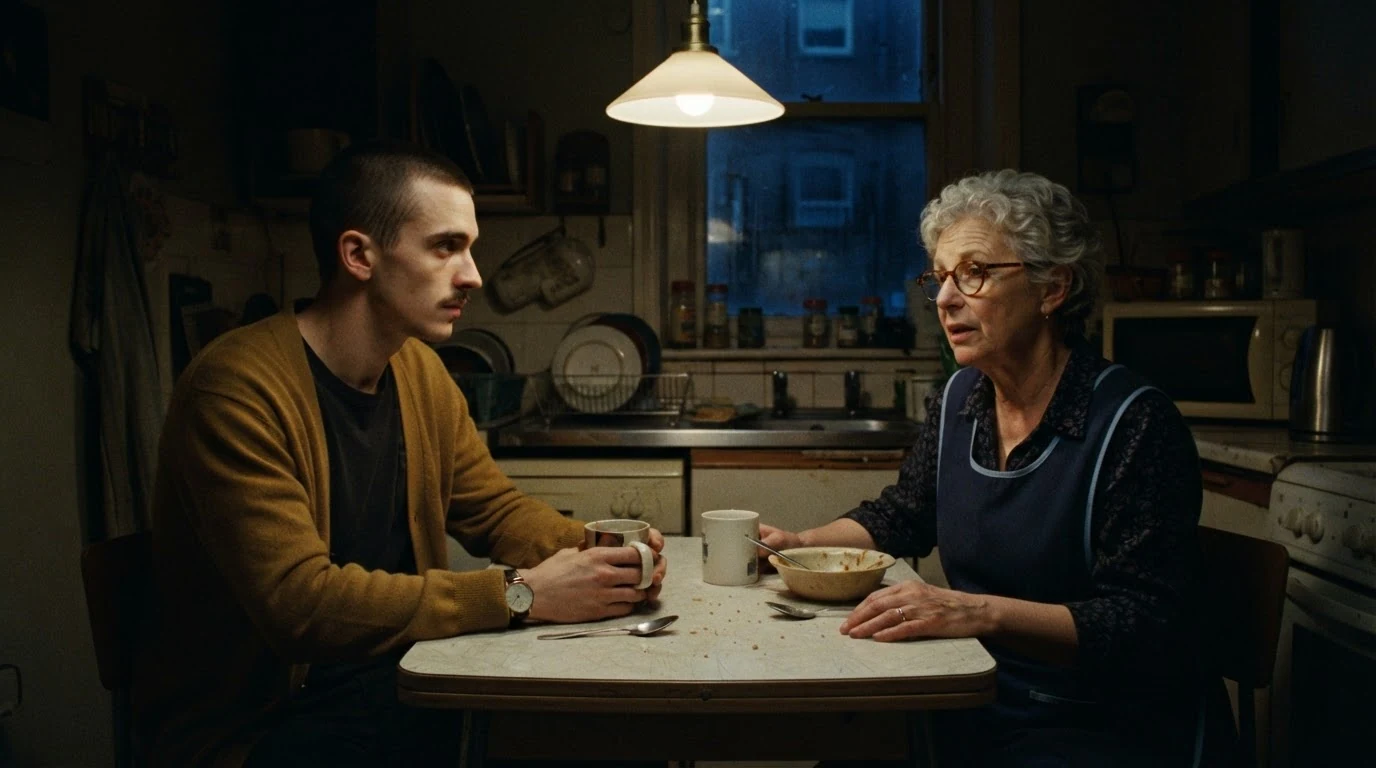
Single location, cramped and the only light is one warm hanging lamp set the micro-budget terms. Specific features keep both characters fictional and consistent for the video.
Open FlashBoardsStoryboard page, six numbered panels in two rows, loose pencil and gray marker, all in the same small kitchen with one hanging lamp over a formica table. 1: wide from the doorway. 2: two-shot of a young man in a cardigan and an older woman in an apron at the table. 3: over-the-shoulder on her. 4: over-the-shoulder on him. 5: close-up of her hands turning a coffee cup. 6: the man alone, lamp swinging.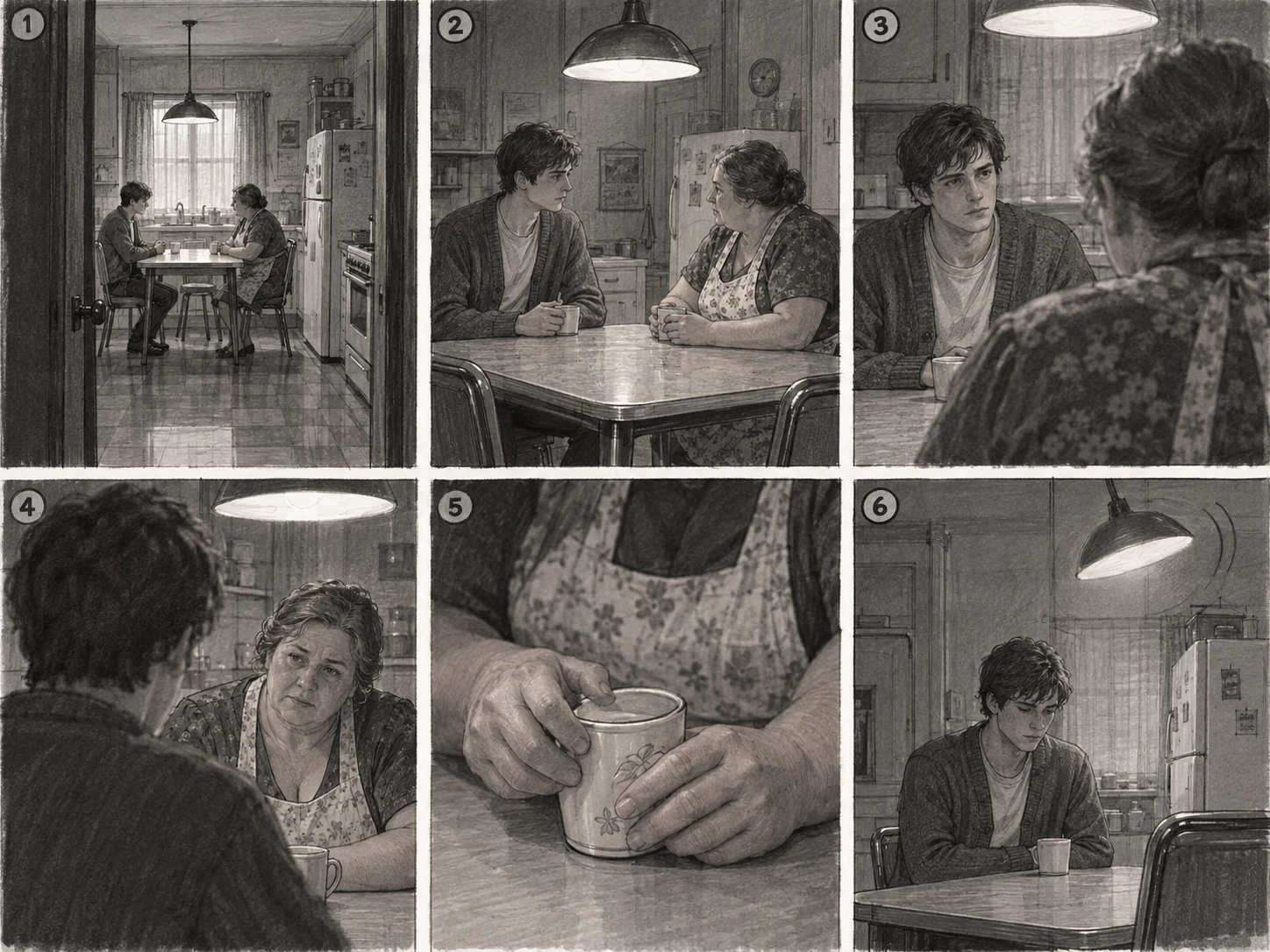
All in the same small kitchen plus named setups (wide, two-shot, two overs, insert) show full coverage of a scene without moving the company.
Open FlashBoardsCamera: handheld, a slow slight drift to the right at seated eye level, holding the two-shot. Action: the older woman is already sliding a coffee cup across the table to the young man. He looks at the cup, then at her, and pushes it back halfway. She takes off her glasses and rubs her eyes. The hanging lamp sways gently, its light moving across both faces.Motion starts in the first sentence (already sliding), so the clip doesn't open frozen. The swaying lamp is a free effect that makes the single source feel alive.
Open FlashBoardsCommon mistakes
- Models dress small rooms like sets, with extra lamps and fill. Name the one light source and say cramped.
- Two-shots drift into a glossy commercial look; indie drama, handheld and soft grain pull them back.
- In storyboard pages the room changes between panels; repeat the location and its key object.
Keep the reference frames, prompts and every generated take side by side — images and video in one canvas.
FAQ
5 questionsWhat is considered a micro-budget film?
There is no official definition. Most people mean features made for a few thousand up to roughly $100,000–$250,000, with a tiny crew, few locations and little outside financing. Thresholds like $25,000 are informal markers, not standards. The shared idea is a script written around resources the team already has.
How do you make a micro-budget film?
Start from what you own: free locations, available actors, your own gear. Write a script set in one or two places with a small cast, plan a two-to-four-week shoot with five to ten crew, light with windows and practical lamps, spend real money on sound, and reserve part of the budget for post-production and festivals.
What are famous micro-budget films?
Well-known examples include El Mariachi (1992), made by Robert Rodriguez for about $7,000; Clerks (1994), shot in a convenience store; Primer (2004), a time-travel film made for roughly $7,000; Paranormal Activity (2007), shot mostly in one house; and Tangerine (2015), shot on iPhones.
Is low-budget filmmaking the same as micro-budget?
Not quite. Low-budget is a broader label for films that are cheap by industry standards but may still cost a few million dollars, with paid union crews and investors. Micro-budget sits far below that, often under $100,000, with volunteers or stipends and a script built around free resources. No-budget is the step below.
What should you spend the most money on in a micro-budget film?
Sound and food. Clean dialogue recorded on set is expensive to fix later, and a well-fed crew works longer and better for little pay. After that come locations, insurance and post-production: color, sound mix, music licenses and delivery files for festivals and distributors.
Related terms
5- Guerrilla FilmmakingFilmmaking Process & Crew
Guerrilla filmmaking is shooting fast and cheap with a tiny crew, real locations and often no permits, grabbing scenes in public before anyone stops the shoot.
- Film FinancingFilmmaking Process & Crew
Film financing is how a production assembles its budget — studio money, pre-sales, equity investors, gap and bank loans, tax incentives, grants or crowdfunding — before and during production.
- MumblecoreFilm Movements & Styles
Mumblecore is the 2000s American micro-budget indie movement — Andrew Bujalski, the Duplass brothers, Joe Swanberg — built on improvised, naturalistic dialogue among twentysomethings, cheap digital video and domestic locations.
- Production ValueFilmmaking Process & Crew
Production value is how expensive and polished a film looks on screen — sets, locations, costumes, lighting, extras, effects — relative to what it actually cost.
- Production BudgetFilmmaking Process & Crew
A production budget is the itemized cost of making a film — development, above-the-line talent, below-the-line crew and equipment, post-production and contingency — usually excluding prints and advertising.
Further reading
Robert Rodriguez, Rebel Without a Crew (1995), his production diary of El Mariachi.