 FlashBoards Learn
- Learn
- Filmmaking Process & Crew
- Proof of Concept Film
Filmmaking Process & Crew · Film language
Proof of Concept Film
Also called: proof of concept, concept short, sizzle short
A proof of concept film is a short, usually 3 to 15 minutes, that stages one or a few key scenes of a planned feature or series. Its job is to show financiers and producers the tone, world, lead performance and the director's control, so the project stops being a script and becomes something they can watch.
- What it does
- Turns a script nobody can picture into a few minutes of finished film that proves tone, world and director.
- Use it when
- The feature is hard to imagine on paper, the director has no feature credit, or the genre depends on execution.
- Watch out
- A short that works only as a short: if it tells a complete joke or twist, nobody needs the feature.
- Try this prompt
Film still, 2.39:1, a salvage diver with a shaved head rows a flat-bottomed boat through a flooded church at dawn, pale mist, 35mm grain
What is a proof of concept film?
A proof of concept film is a sales tool you can watch. The filmmaker picks the scene or sequence of the feature (or series) script that best carries the idea and shoots it at full quality on a small budget.
Three common forms:
- The scene excerpt. A scene lifted straight from the script and shot as written, so a reader can compare page and screen.
- The standalone short set in the world. A new mini-story with the feature's characters, rules and look.
- Test footage. A minute or two that proves one technical risk: a creature, a VFX-heavy world, an unusual style. Tim Miller's CG test for Deadpool is the famous case.
A proof of concept is not a trailer. It plays in real time, with real performance, so it demonstrates direction rather than editing tricks.
Why filmmakers make a proof of concept short
A financier reading a script has to imagine the tone, the lead and whether a first-time director can hold a scene. The short removes that guesswork, which is why it sits early in film financing for independent projects.
- ***Whiplash* (2013 short, 2014 feature).** Damien Chazelle could not raise money for his feature script, so he shot one of its scenes as an 18-minute short with J.K. Simmons as the band leader. The short won a jury award at Sundance 2013; the feature, with Simmons again, won the Grand Jury Prize there a year later.
- ***Saw* (2004).** Leigh Whannell and James Wan filmed the reverse bear trap scene as a short to show what their low-budget thriller would feel like.
- ***District 9* (2009).** Neill Blomkamp's short Alive in Joburg (2006) set up the documentary style and alien-refugee premise the feature expanded.
- ***Mama* (2013).** Andy Muschietti's three-minute short proved the creature and the scare.
The short also lives a second life at a film festival in front of agents and producers.
How to make a proof of concept film
Choose the scene that only this film has. Not the opening or the ending, but the scene that shows the engine: the central relationship under pressure, the genre set piece, the world rule. Shoot whatever a financier doubts most.
Keep it short. Five to ten minutes is the working range; decision-makers judge the first two.
Spend where the feature will spend. If the pitch is performance, spend on casting and rehearsal. If it is a world, spend on one location and design and keep the cast tiny. Keep a micro-budget discipline.
Plan it like the feature. Build a lookbook so the short and the future feature share one look, then a storyboard for the scene.
End on an open question. Stop where the feature's story would take off.
Package it. In FlashBoards you can keep the whole package on one board: lookbook frames, AI key frames of scenes you have not shot yet, the short's storyboard and director's notes, so a producer sees the short next to the feature it stands for.
Proof of concept vs. pilot episode
Both sell something bigger, but they are different objects. A pilot episode is a complete first episode, 22 to 60 minutes, built to show the series engine and often paid for by a network or studio. A proof of concept is a fragment the creator usually finances alone, proving tone and team before anyone commits pilot money. For series, it often travels with a TV pitch deck.
Proof of concept vs. sizzle reel and teaser
A sizzle reel is a fast montage, often cut from existing or borrowed footage, that sells a mood. A teaser markets a film that already exists. A proof of concept is new footage of your actual film, acted in real time, which is why it carries weight across film production: it shows what the director can do, not just what the idea sounds like.
How to create a proof of concept film with AI
3 promptsBefore you shoot the short, image and video models let you prototype it: a key frame to pick the moment, a pitch page for the deck, and a moving tone test. The recipes build a fictional flood drama, Drowned Parish. Keep them next to the lookbook and storyboard on one FlashBoards board and compare takes before you spend a shooting day.
Film still, anamorphic 2.39:1, 35mm lens at water level. A salvage diver, a woman in her forties with a shaved head, a burn scar along her left forearm and a faded yellow drysuit, rows a flat-bottomed aluminum boat down the flooded aisle of a small wooden church at dawn. Brown water up to the tops of the pews, a broken stained-glass window throwing pale blue light, mist on the water. Muted colors, soft backlight, heavy 35mm film grain.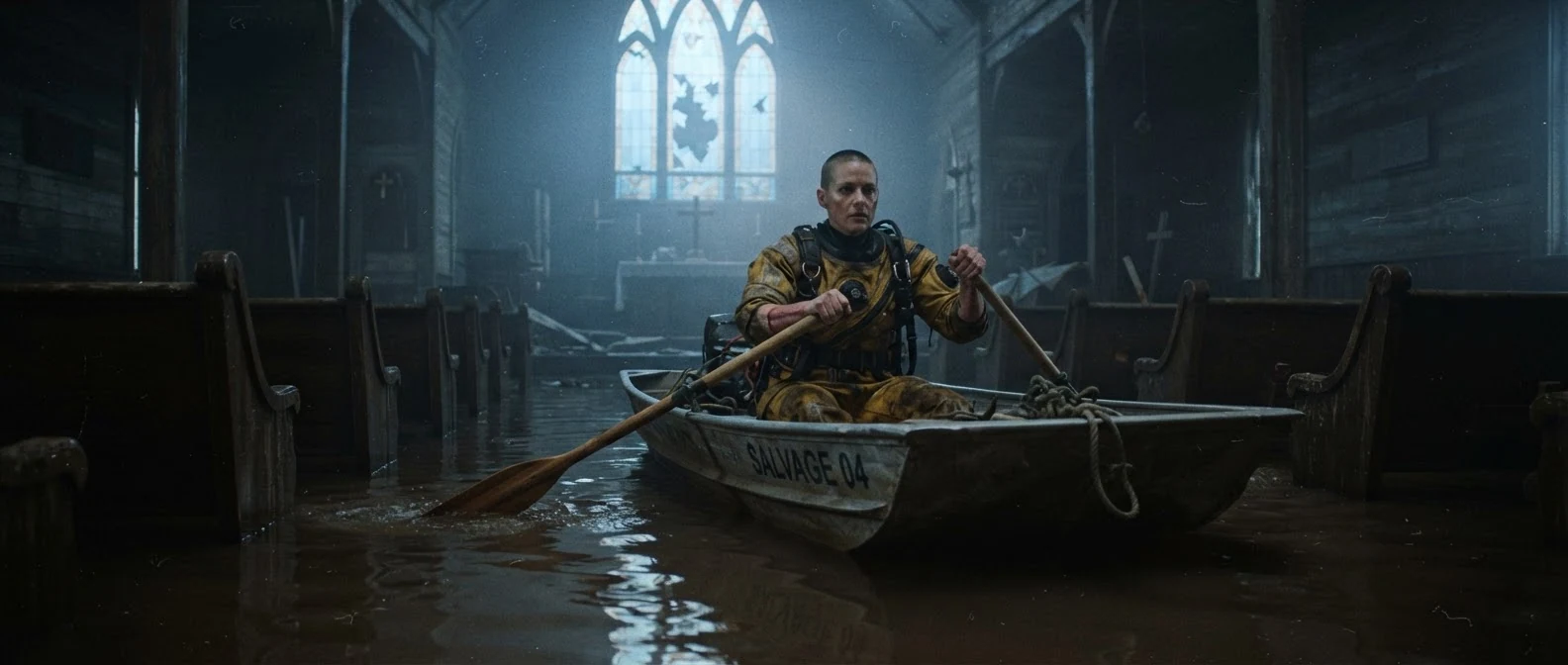
One image states the concept: the character (three specific features), the world rule (water up to the tops of the pews) and the look (2.39:1, 35mm at water level, heavy grain).
Open FlashBoardsA pitch deck page on a plain off-white background. Left two thirds: one wide film still of a flooded small town at dawn, rooftops and a white church steeple rising from brown water, a lone flat-bottomed boat in the middle distance, pale mist. Right third: three small stacked film stills in the same muted grade: a diver's yellow drysuit hanging on a nail, a stained-glass window half under water, a hand gripping a boat oar. Small black serif title at top left: DROWNED PARISH.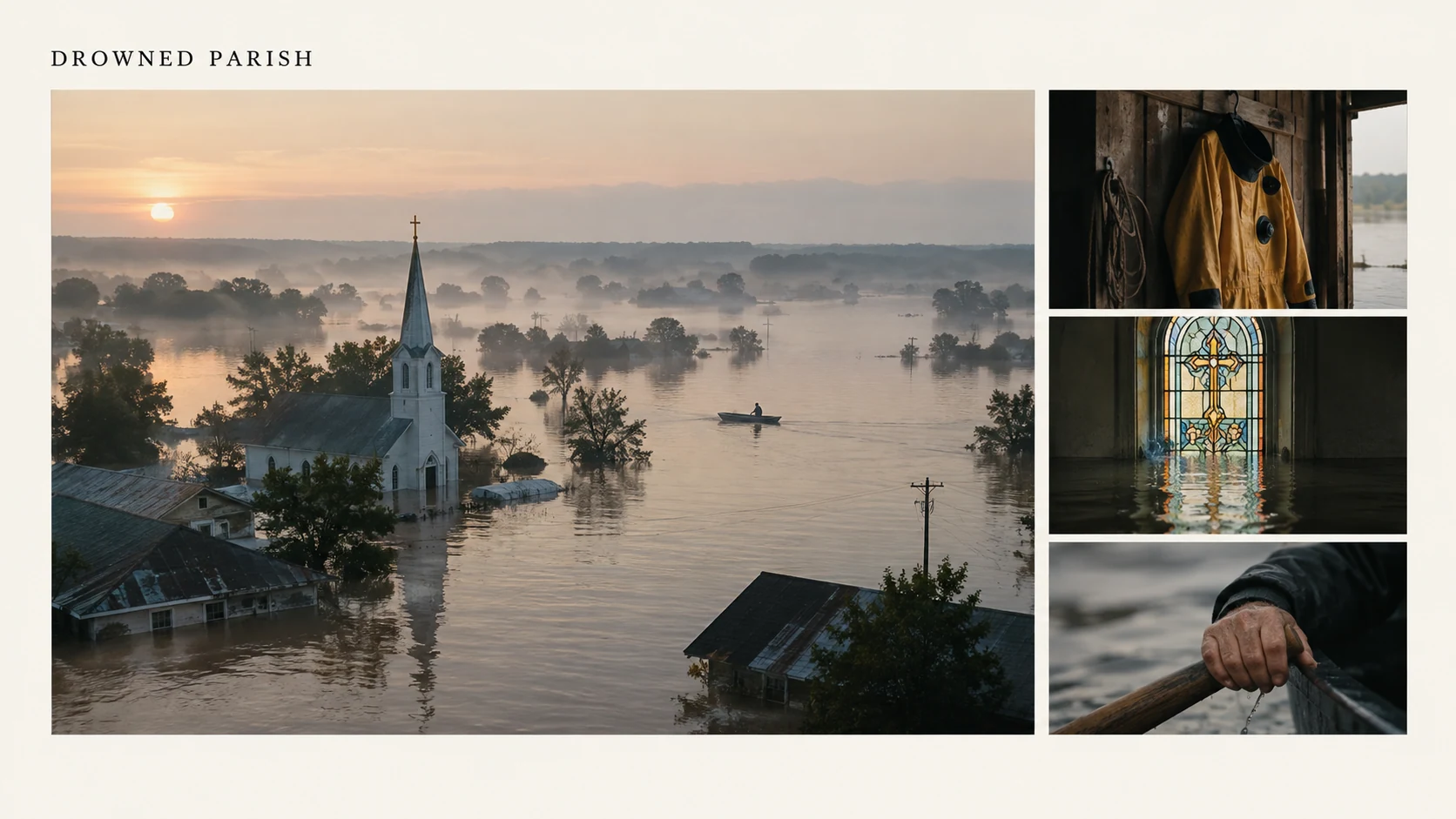
Pitch deck page, three small stacked film stills and same muted grade produce the page itself. A two-word title keeps the lettering clean.
Open FlashBoardsCamera: slow, steady push forward at water level, following behind the boat down the aisle. Action: the oars are already dipping and ripples spread across the brown water between the pews. The diver pulls two long strokes, then lets the boat glide and looks up at the broken stained-glass window. At the end she lifts one oar out of the water and holds still while mist drifts through the blue light.Ripples and dipping oars in the first sentence keep the clip alive from frame one; every object already exists in recipe 1, so the model invents nothing.
Open FlashBoardsCommon mistakes
- Stock-photo polish. Name the texture: muted colors, heavy film grain.
- A generic world. "Flooded town" gives a cliché. Name the one detail that makes it yours: water up to the tops of the pews.
- Drifting lead. Repeat the same three features and wardrobe in every prompt.
- Garbled deck text. Keep titles to two words and add the rest in your layout.
Keep the reference frames, prompts and every generated take side by side — images and video in one canvas.
FAQ
5 questionsWhat is a proof of concept in film?
A short film, usually 3 to 15 minutes, that stages one or a few key scenes of a planned feature or series at full quality, to prove the tone, world, lead and director to financiers before the bigger project is funded.
How long should a proof of concept short film be?
Five to ten minutes is the practical range: a full scene with real performance, short enough that a busy producer watches to the end. VFX or creature test footage can run one to three minutes.
Which famous movies started as proof of concept shorts?
Whiplash (a scene from the script shot as a 2013 short), Saw (the reverse bear trap scene), District 9 (from Neill Blomkamp's Alive in Joburg) and Mama (from Andy Muschietti's short) all grew from shorts. Deadpool was helped by a CG test made years before the feature.
Is a proof of concept the same as a sizzle reel?
No. A sizzle reel is a quick montage, often built from existing or borrowed footage, that sells a mood. A proof of concept is original footage of your own film, staged and acted in real time, so it proves the director can execute the scene.
Which scene should I shoot for a proof of concept?
The scene that answers the biggest doubt about the project: the central relationship under pressure, the genre set piece, or the rule that defines the world. Avoid the ending or a twist that resolves the story; the short should leave viewers wanting the feature.
Related terms
6- Pilot EpisodeFormats & Exhibition
A pilot episode is the first episode of a proposed series, made to sell the show to a network or platform — it must establish the world, characters, tone and the engine that will generate future episodes.
- TV PitchFilmmaking Process & Crew
A TV pitch is a short verbal or deck presentation of a series idea — logline, world, characters, pilot story and season engines — aimed at getting producers or a network to buy or develop it.
- Film FinancingFilmmaking Process & Crew
Film financing is how a production assembles its budget — studio money, pre-sales, equity investors, gap and bank loans, tax incentives, grants or crowdfunding — before and during production.
- LookbookFilmmaking Process & Crew
A film lookbook is a curated document of reference images, frames, palettes and short text that shows how a specific film will look and feel — used to pitch the project and to align the director, DP and designers.
- StoryboardFilmmaking Process & Crew
A storyboard is a sequence of drawn or generated panels, one per planned shot, showing framing, action and camera movement with notes — a visual draft of the film before anything is shot.
- Film ProductionFilmmaking Process & Crew
Film production is the whole process of making a film — development, pre-production, production (the shoot), post-production and distribution; in the narrow sense, 'production' is just the shooting phase.
Further reading
Damien Chazelle's Whiplash short (2013) and feature (2014), Sundance Film Festival program records.