 FlashBoards Learn
- Learn
- Formats & Exhibition
- Pilot Episode
Formats & Exhibition · Film language
Pilot Episode
Also called: TV pilot, pilot
A pilot episode is the first episode of a proposed TV series, made to sell the show to a network or streamer. In one hour or half hour it has to establish the world, the main characters, the tone and the engine that will keep generating episodes for years.
- What it does
- Proves to buyers, and later to viewers, that a series idea works as a repeatable show, not just a good story.
- Use it when
- Pitching, writing or shooting the first episode of a series, or a sample episode to show what a season would look like.
- Watch out
- A pilot that spends everything on setup and never shows a typical episode leaves buyers asking what episode five looks like.
- Try this prompt
Wide shot at dawn, frozen northern lake, an old car ferry iced in at a wooden dock, a woman in her fifties unlocking the ticket booth, 35mm film still
What is a pilot episode?
A pilot is a test episode, named after the pilot program: a small trial run before anyone commits to the full thing. A network or streamer pays for one episode, watches it and decides whether to order a season.
The path runs from pitch to pilot script, pilot order, shoot and executive screening, then a series order or a pass. Most pilots are never picked up. Those that are usually air as episode one, sometimes after reshoots or recasting.
On the page a pilot follows standard TV script format: about 50 to 65 pages for a one-hour drama, 25 to 35 for a single-camera comedy.
What does a pilot episode have to establish?
A pilot has to tell a good story and prove more will keep coming. Four jobs in one episode:
- World. Where the show lives and its rules; the pilot carries most of the series' worldbuilding.
- Characters. The lead and the ensemble, each introduced by an action.
- Tone. The mix of comedy, dread and melodrama viewers will expect every week.
- Engine. The situation that produces episodes: a case per week, a business under pressure, a mystery.
The Sopranos pilot (1999) covers all four with one device: Tony Soprano in a psychiatrist's office, with therapy sessions framing the episode. The Twin Peaks pilot (1990) opens on the discovery of Laura Palmer's body, and who killed her drives the first season. Many pilots front-load that promise with a cold open.
Types of TV pilots
Premise pilot. Shows the moment the situation begins. In the Breaking Bad pilot (2008) we see Walter White's life turn and why he starts cooking.
Non-premise pilot. Drops us into a situation that already runs, like a typical week. Procedurals and many sitcoms work this way.
Presentation pilot. A shorter, cheaper version, sometimes just key scenes, made to show cast chemistry and tone.
Backdoor pilot. An episode of an existing series that introduces new characters to launch a spin-off.
Self-made pilot. It's Always Sunny in Philadelphia began as a homemade pilot its creators shot on consumer video and sold to FX. The US The Office pilot (2005), by contrast, was an adaptation that closely followed the British original's first script.
How pilots get made and sold
Broadcast networks traditionally worked in a pilot season: pilots ordered in winter, shot in spring and judged before the May upfronts. Streamers often order straight to series from scripts, a series bible and a strong TV pitch. The pilot's writer usually becomes the showrunner, and the pilot director sets the visual grammar later directors inherit.
Some unsold pilots survive. Heat Vision and Jack (1999), directed by Ben Stiller with Jack Black and Owen Wilson, was never picked up and lives on as a cult curiosity. David Lynch shot Mulholland Drive as a pilot for ABC; after the network passed, he filmed new material and finished it as the 2001 feature.
How to write and plan a pilot
Open on the show, not the backstory. The first image should say what kind of series this is.
Introduce characters by what they do. One action per lead that shows a want and a flaw.
Show a typical episode inside the special one. Include a sequence that looks like week five, so the buyer sees the engine running.
End on a door opening. The last scene points forward to a question or a threat.
Lock the look early. In FlashBoards, keep the opening image, character references and tone frames on one board beside the beat outline, and compare generated key frames before they go into the pitch deck.
Pilot episode vs. proof of concept film
A pilot is a complete episode at broadcast length, meant to air if the show is bought. A proof of concept film is a short sample, a few scenes or a condensed story, made to prove tone, world or a hard technical idea to financiers.
Presentation pilots blur the line: they are proofs of concept for TV buyers. A pilot shows the series; a proof of concept shows it can be done. More formats live in the formats and exhibition hub.
How to create a pilot episode with AI
3 promptsA pilot is sold on its first image and its ensemble, so board those first: Nano Banana 2 Lite for the opening image of a fictional series, GPT Image 2.5 for the ensemble frame, MiniMax H3 Max Turbo to animate the opening. Keep all three on one FlashBoards board beside the outline.
Opening image of a TV drama pilot. Wide shot, 32mm lens, eye level, a frozen northern lake at dawn. An old white car ferry sits iced in beside a weathered wooden dock. In the foreground a woman in her mid-fifties with cropped silver hair, a thin scar through her left eyebrow and a navy wool peacoat unlocks a small green ticket booth, breath steaming. Cold blue light, a warm strip of sunrise on the horizon, quiet and melancholy, 35mm film still.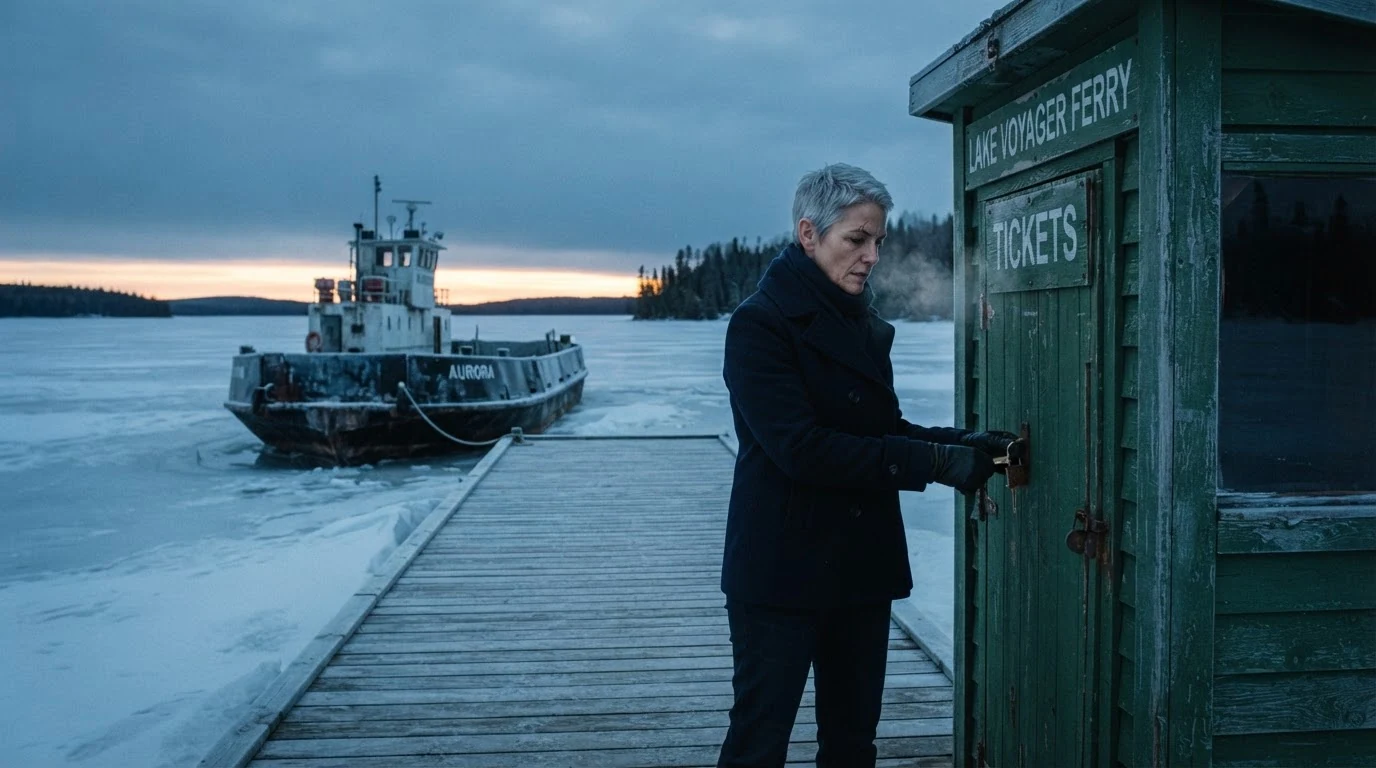
Frozen lake and iced-in ferry build the world, and the ferry is the engine: every crossing can bring a story. Unlocks the ticket booth introduces the lead through action; cold blue light sets the tone.
Open FlashBoardsEnsemble frame from a TV drama pilot. Medium wide shot, 28mm lens, inside the narrow cabin of an old car ferry in winter. At the wheel, a woman in her mid-fifties with cropped silver hair and a navy peacoat. Beside her, a lanky deckhand in his twenties in a red beanie pours coffee from a thermos. On the bench, a shaved-head man in his forties with round wire glasses grips a locked metal briefcase. Fogged windows, warm tungsten lamp, 35mm film still.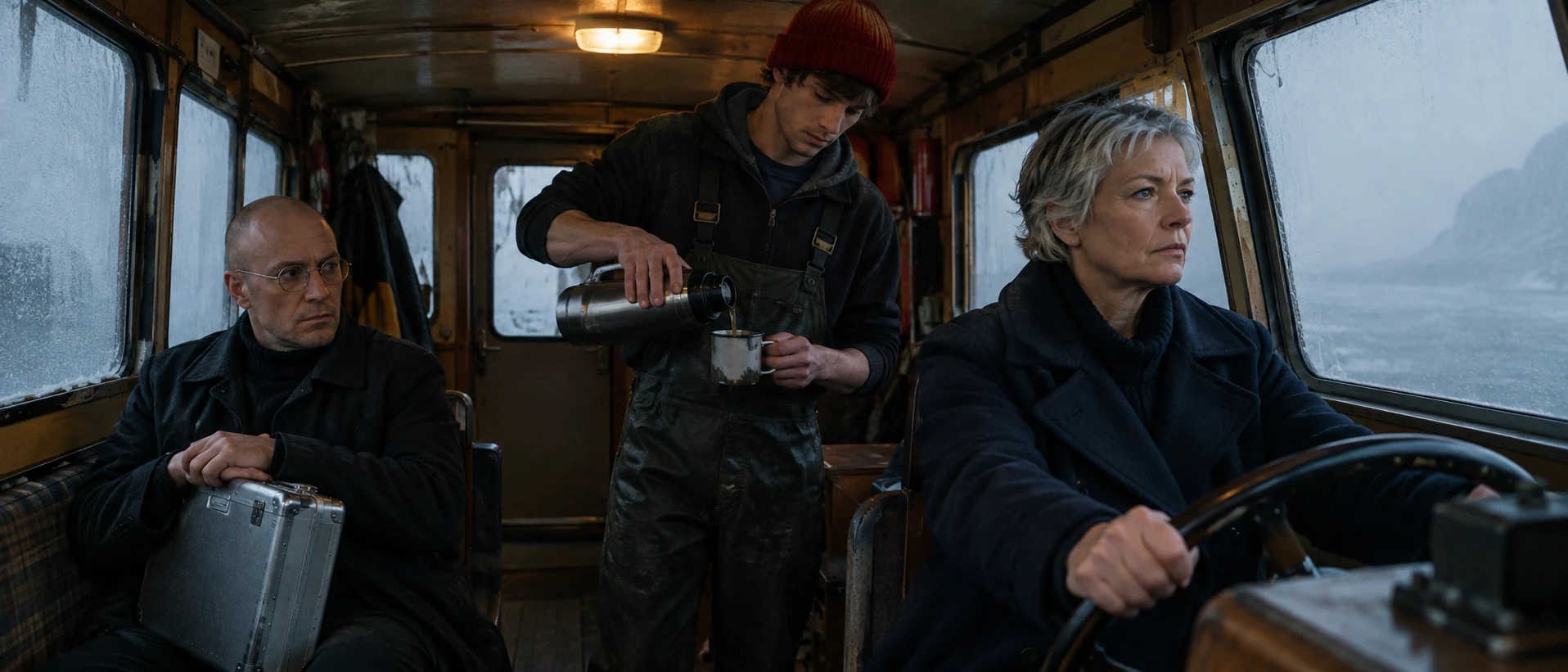
The typical episode shot: the recurring crew in their roles and a stranger with a locked briefcase as the passenger of the week. The 21:9 frame keeps all three readable.
Open FlashBoardsCamera: a slow, steady truck left along the dock, ending in a balanced wide shot of the woman and the ferry. Action: The woman is already turning the key in the booth lock, breath steaming. She pulls the stiff door open and switches on the light inside. She turns and looks out at the iced-in ferry as the sunrise brightens.Already turning the key makes the shot move from the first frame. The truck left ends on lead and ferry together, an image a title card can land on.
Open FlashBoardsCommon mistakes
- Models default to a generic establishing shot. Name what generates episodes (the ferry, the precinct) and put the lead in frame.
- Ensemble frames collapse into matching faces. Give each character one distinct feature and action.
- Video models add unearned events. Keep the opening clip to one characterizing action.
Keep the reference frames, prompts and every generated take side by side — images and video in one canvas.
FAQ
5 questionsWhat is a pilot episode?
A pilot episode is the first episode of a proposed TV series, produced so a network or streamer can decide whether to order the show. It introduces the world, characters and tone, and proves the premise can generate many more episodes. If the series is picked up, the pilot usually airs as episode one.
Why is it called a pilot?
The name comes from pilot in the sense of a trial run, as in a pilot program: a small test before full commitment. It is the test episode a buyer pays for to see whether the idea, cast and tone work on screen before ordering a season.
How long is a TV pilot?
A pilot usually matches the planned series length: roughly 50 to 65 script pages for a one-hour drama, 25 to 35 for a single-camera comedy. Pilots can run slightly longer than later episodes because of setup; presentation pilots are much shorter.
What are some of the best TV pilots?
Pilots often cited as models include Twin Peaks (1990), The Sopranos (1999), Lost (2004), Mad Men (2007) and Breaking Bad (2008). Each establishes its world and lead and ends with a clear engine for the season.
What happens to a pilot that doesn't get picked up?
Most unsold pilots are shelved and never air. Some are shopped to another buyer, reshot with a new cast or released later as curiosities. David Lynch turned his rejected Mulholland Drive pilot into a 2001 feature by shooting new material.
Related terms
6- Proof of Concept FilmFilmmaking Process & Crew
A proof of concept film is a short that stages a few key scenes of a planned feature or series to prove its tone, world and cast to financiers — Whiplash began as one.
- TV PitchFilmmaking Process & Crew
A TV pitch is a short verbal or deck presentation of a series idea — logline, world, characters, pilot story and season engines — aimed at getting producers or a network to buy or develop it.
- ShowrunnerFilmmaking Process & Crew
A showrunner is the top creative and managerial authority on a TV series — usually the head writer and an executive producer — running the writers' room, casting, directors, edits and budget.
- Bottle EpisodeFormats & Exhibition
A bottle episode is a TV episode confined to existing standing sets and a minimal cast to save money, which often forces an intense, dialogue-driven character study — Breaking Bad's 'Fly' is the textbook case.
- Cold OpenStorytelling
A cold open drops the audience straight into a scene before the title card or opening credits, usually to hook them with a mystery, a joke or a jolt of action.
- TV Script FormatScreenwriting
TV script format is how episodes are laid out on the page: one-hour dramas follow screenplay format split into acts or a teaser, while multi-camera sitcoms use double-spaced dialogue and capitalized action.
Further reading
Alex Epstein, Crafty TV Writing (2006). Neil Landau, TV Outside the Box (2016).