 FlashBoards Learn
- Learn
- Filmmaking Process & Crew
- TV Pitch
Filmmaking Process & Crew · Film language
TV Pitch
Also called: pitch, series pitch, pitch deck
A TV pitch is a short spoken presentation of a series idea, usually backed by a pitch deck, that walks buyers through the logline, the world, the characters, the pilot story and the engine that keeps episodes coming. Its only job is to make a producer, studio or streamer want to develop the show.
- What it does
- Sells a series idea in about twenty minutes by proving it has a hook, a world and an engine for many episodes.
- Use it when
- You have a pilot script or a developed concept and a meeting with a producer, studio, network or streamer.
- Watch out
- Retelling the pilot beat by beat; buyers are buying season two and three as much as episode one.
- Try this prompt
TV pitch deck key art, 16:9 film still, a late-night radio host alone in a small desert-town studio booth, red ON AIR light, sodium streetlight through blinds, 35mm grain
What is a TV pitch?
In practice a TV pitch is two things: a verbal pitch of roughly 15 to 20 minutes, in a room or on a video call, and a pitch deck, a visual PDF of 10 to 20 pages shown while you talk or sent afterward as a leave-behind.
A series buyer is committing to a machine that must produce eight, ten or sixty episodes, so a TV pitch has to answer a question a film pitch never faces: what happens in episode 23? That is why the pilot episode is pitched as a sample of the show, not the whole show. It is the front door of film production for television.
What goes into a TV pitch?
Most pitches follow this order, because it matches how buyers weigh risk:
- Why you, why now. A minute or two on your personal connection to the material.
- The logline. One or two sentences: who, what they want, what stands in the way. Vince Gilligan framed Breaking Bad as turning Mr. Chips into Scarface: a whole series arc in one line.
- The world. Where and when, and why this place generates conflict on its own.
- The characters. The lead in depth, then the ensemble as relationships: what each person wants from the others.
- The pilot. Episode one in its big turns, three to five minutes, ending on the question that makes the series necessary.
- The engine. What a typical episode looks like: a case of the week, a new client, a family crisis.
- Season one and beyond. The first season's arc and the direction of seasons two and three.
- Tone and comps. Two or three recent shows the buyer knows, to locate tone and audience.
In the room, tell it as a story; the numbered order belongs in the deck.
How to pitch a TV show, step by step
Write first. New writers are rarely bought on an idea alone. Have a pilot script in proper TV script format, and know who would run the show day to day: buyers will ask whether you can be the showrunner.
Find a way in. Buyers seldom take unsolicited pitches; the usual routes are an agent or manager, a producer who attaches to the project, a fellowship or a festival pitch market.
Rehearse to time. Pitch out loud until you need no notes. Leave half the meeting for questions.
Read the room. Pause after the pilot and after the engine. Questions there are a good sign; answer them, don't defend every detail.
Leave something behind. Send the deck, a one-page summary and, if you have one, a short sizzle reel or a proof of concept film. A pass is normal.
How to build a TV show pitch deck
A TV show pitch deck follows the verbal order, one idea per page: title and key art, logline, why now, world, a page per lead, pilot, engine, season arc, future seasons, tone and comps, team. Text stays short; pictures carry the tone.
Borrowed stills from famous shows read as someone else's series. Show your lead in your world instead: key art, a portrait per main character and a few tone frames in one grade, the same discipline as a film lookbook. In FlashBoards you can keep the logline, references, character generations and notes for every page on one board, compare takes side by side and pull the winners into the deck.
TV pitch vs. series bible vs. treatment
- Pitch and pitch deck: a selling tool, short and built to earn a meeting or a development deal.
- Series bible: a working document with the world's rules, character backstories, episode ideas and the season plan; it guides the writers' room.
- Treatment: present-tense prose telling a story scene by scene, often the pilot's story before a script exists.
A deck borrows the best pages from the bible. Keep the rest ready for questions.
How to create a TV pitch with AI
3 promptsA deck needs original pictures long before there is money for photography. The recipes below build pages for a fictional series, Dead Air: a late-night radio host in a desert town whose callers describe crimes before they happen. Keep the outline and every take on one FlashBoards board so all pages share one grade.
TV series key art, cinematic 16:9 film still, 35mm lens at eye level. A woman in her late forties with a gray buzz cut, a thin scar through her left eyebrow and silver hoop earrings, in a faded denim work shirt, sits alone at a mixing desk in a cramped small-town radio booth at night, headphones around her neck, leaning toward a microphone. A red ON AIR light glows above her. Orange streetlight cuts through half-open blinds across her face. Deep shadows, orange and dark teal palette, 35mm grain.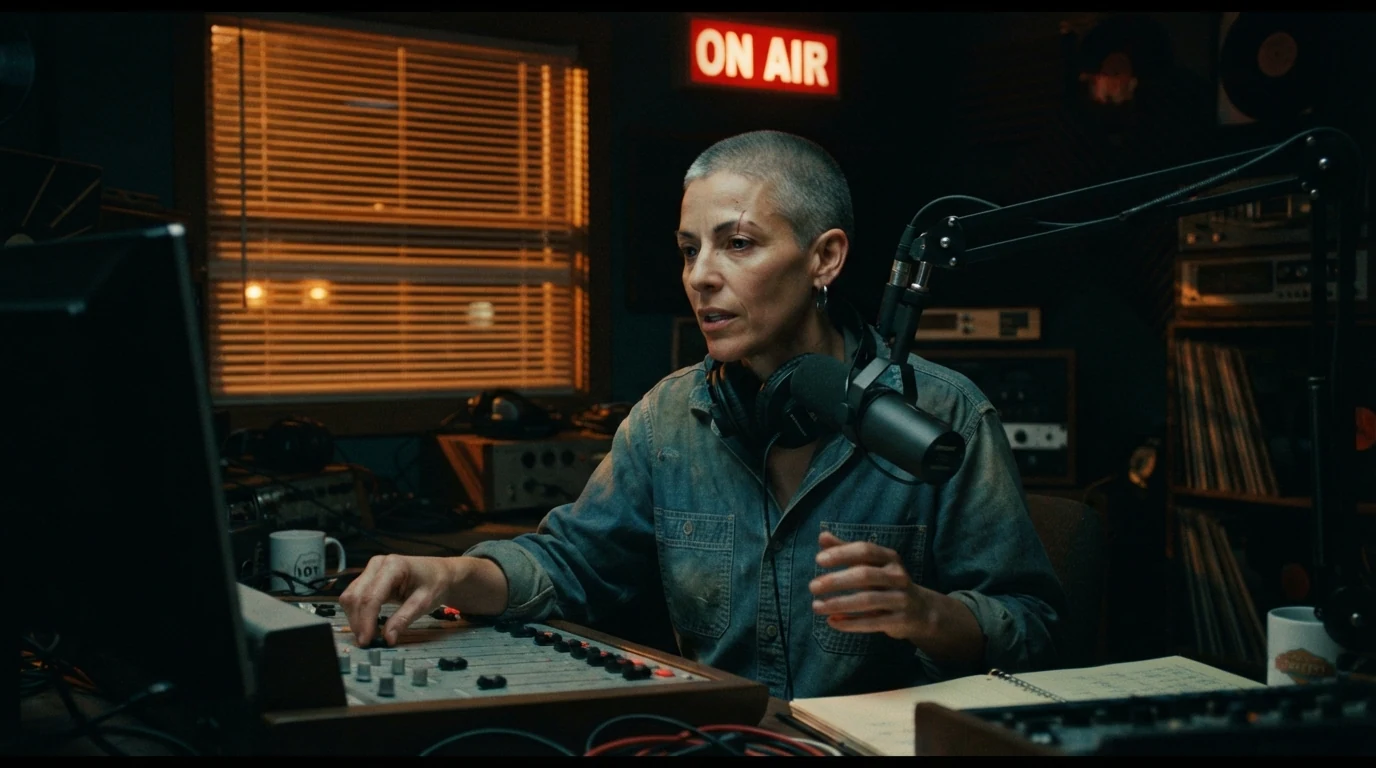
Key art, film still asks for a cover image, not a poster with lettering. Three fixed features let the host repeat on her character page; the ON AIR light and streetlight through blinds carry the show's tone.
Open FlashBoardsA TV pitch deck page on a plain black background. Left half: one large film still of a small desert town at night seen from a highway, a radio tower blinking red above low motel roofs. Right half: a vertical stack of three smaller film stills in the same orange and dark teal grade: a landline phone ringing on a diner counter, a pickup truck alone at a gas station, a hand turning a car radio dial. Small white serif title at top left: DEAD AIR.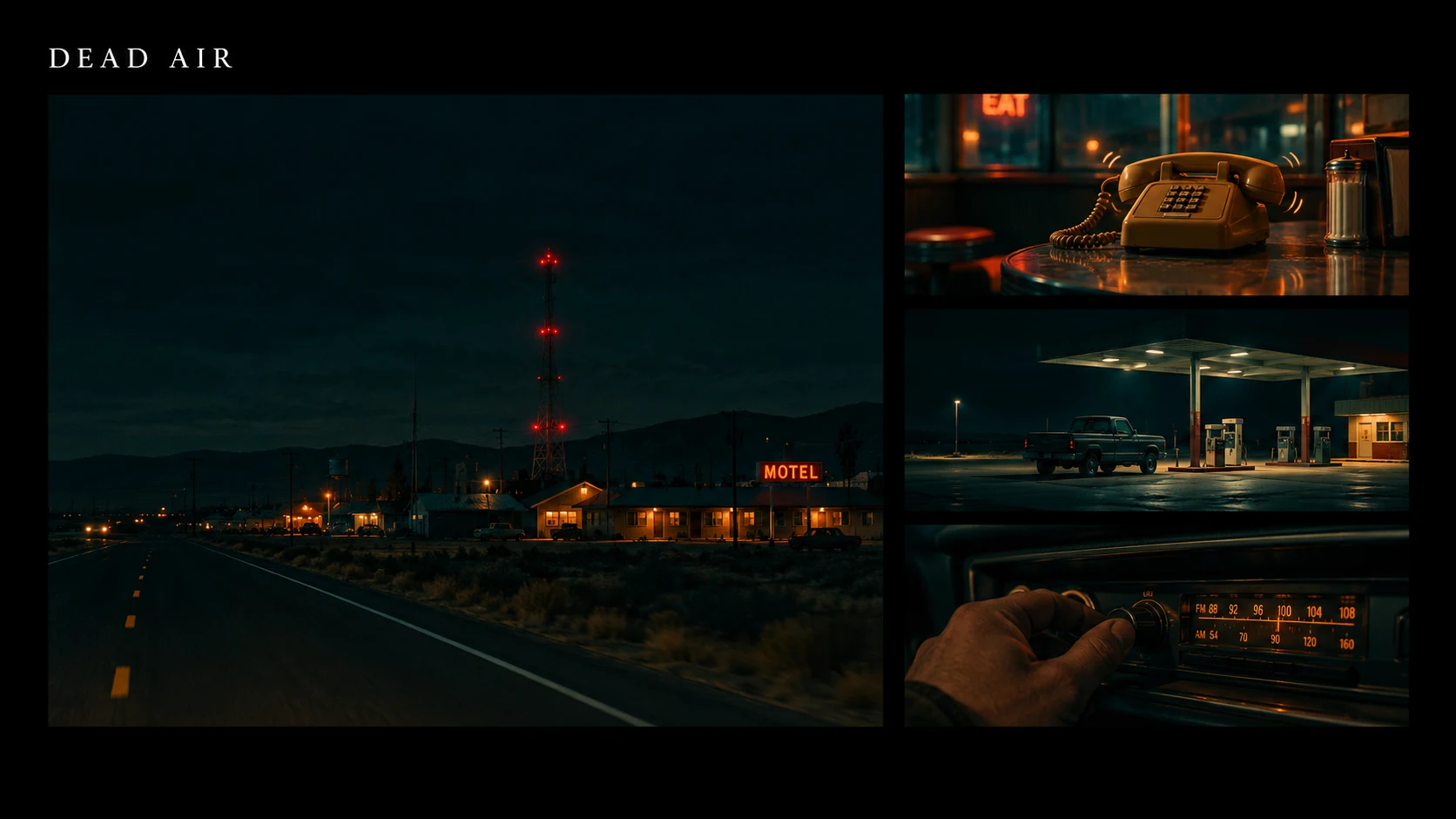
Pitch deck page, left half and right half produce a laid-out world page. The three small stills are objects from the engine, and the same orange and dark teal grade ties the page to the key art. A two-word title keeps lettering clean.
Open FlashBoardsCamera: slow push-in from the medium framing toward the woman's face, ending in a close-up at eye level. Action: the red ON AIR light is already glowing and stripes of orange streetlight slide across her face as a car passes outside. She presses one headphone to her ear and listens, eyes narrowing. Then she leans to the microphone, speaks one quiet sentence and holds still, listening.The sliding streetlight makes the shot alive from frame one, and every object already exists in recipe 1. The result is a tone clip for a sizzle reel.
Open FlashBoardsCommon mistakes
- Poster clichés. "TV show poster" brings floating heads and fake credits. Ask for key art, film still.
- Drifting faces. Repeat the same three features and wardrobe in every prompt for a character.
- Garbled text. Keep generated lettering to one or two words; set slide text yourself.
- Inconsistent grade. Name the same light sources and palette words on every page.
Keep the reference frames, prompts and every generated take side by side — images and video in one canvas.
FAQ
4 questionsHow long should a TV pitch be?
Plan for 15 to 20 minutes of talking inside a meeting of 30 to 45 minutes, leaving room for questions, which is where buyers show interest. If the pilot takes more than five minutes, you are retelling scenes instead of the story. An email query should be one paragraph: logline, format and why you.
What should a TV show pitch deck include?
Title and key art, logline, why now, the world, a page for each lead, the pilot, the episode engine, the season arc, future seasons, tone and comps, and the team. Keep it to 10 to 20 pages with little text and original images of your characters, not stills from other series.
Can I pitch a TV show without an agent?
Yes, but rarely straight to a studio or streamer, since most refuse unsolicited submissions. Unrepresented writers get in through producers who attach to a project, writing fellowships and festival pitch markets. A strong pilot script and a produced short convince a producer to take the pitch into the room with you.
Do I need a pilot script to pitch a TV show?
For a new writer, almost always. The pilot proves you can deliver the voice the pitch promises, and buyers often ask for it. Writers with produced credits can sell on a pitch alone and write the pilot as part of the deal.
Related terms
7- LoglineScreenwriting
A logline sums up a film in one or two sentences: the protagonist, their goal, the obstacle and what's at stake — the hook that sells the script and, today, the seed for an AI storyboard.
- Pilot EpisodeFormats & Exhibition
A pilot episode is the first episode of a proposed series, made to sell the show to a network or platform — it must establish the world, characters, tone and the engine that will generate future episodes.
- ShowrunnerFilmmaking Process & Crew
A showrunner is the top creative and managerial authority on a TV series — usually the head writer and an executive producer — running the writers' room, casting, directors, edits and budget.
- LookbookFilmmaking Process & Crew
A film lookbook is a curated document of reference images, frames, palettes and short text that shows how a specific film will look and feel — used to pitch the project and to align the director, DP and designers.
- Film TreatmentScreenwriting
A treatment is a prose document, usually 2–10 pages written in present tense, that tells the whole story of a planned film scene by scene and conveys its tone before the screenplay is written.
- Proof of Concept FilmFilmmaking Process & Crew
A proof of concept film is a short that stages a few key scenes of a planned feature or series to prove its tone, world and cast to financiers — Whiplash began as one.
- Film ProductionFilmmaking Process & Crew
Film production is the whole process of making a film — development, pre-production, production (the shoot), post-production and distribution; in the narrow sense, 'production' is just the shooting phase.
Further reading
Neil Landau, TV Outside the Box: Trailblazing in the Digital Television Revolution (Focal Press). Pamela Douglas, Writing the TV Drama Series (Michael Wiese Productions).