 FlashBoards Learn
Genres · Film language
Blaxploitation
Also called: blaxploitation film, blaxploitation cinema
Blaxploitation is a cycle of low-budget American genre films, mostly from 1971 to 1976, made for Black audiences with Black heroes who outwit crooked cops, mobsters and "the Man." Street locations, funk and soul scores, bold costume and fast violence gave viewers a hero who won on screen.
- What it does
- Puts a confident Black hero at the center of a fast, street-level genre film scored with funk and soul.
- Use it when
- You want 1970s urban grit, swagger and music-driven pacing, or an homage to the era.
- Watch out
- Copying the costumes without the attitude and the city turns the style into a costume party.
- Try this prompt
1970s blaxploitation film still, low-angle medium shot, fictional detective in burgundy suede coat on a neon-lit avenue at dusk, 35mm grain
What is blaxploitation?
The word joins "Black" and "exploitation," the industry label for cheap, fast films sold on sensation. Blaxploitation sits among the film genres as a production cycle more than a single genre: its heroes run through crime thrillers, horror, westerns and martial-arts comedy.
The typical film has a Black lead cooler than everyone around them, a big-city setting such as Harlem or Los Angeles, corrupt white authority figures and a soul or funk score. Budgets were modest and marketing loud, in the tradition of the B-movie.
Where did blaxploitation come from?
Two 1971 films opened the door. Melvin Van Peebles wrote, directed and starred in Sweet Sweetback's Baadasssss Song, an independent film about a man running from the police. The same year MGM released Shaft, directed by Gordon Parks, with Richard Roundtree as a Harlem private detective and an Isaac Hayes theme that won the Academy Award for Best Original Song.
Studios followed fast. Super Fly (1972), directed by Gordon Parks Jr., came with a Curtis Mayfield album. American International Pictures made Blacula (1972) and the Pam Grier vehicles Coffy (1973) and Foxy Brown (1974). Warner Bros. had Cleopatra Jones (1973). Rudy Ray Moore self-produced Dolemite (1975).
The cycle ran alongside New Hollywood and shared its real streets and anti-authority heroes. Civil-rights groups, including the NAACP, objected to pimps and dealers as role models. By the mid-1970s the formula had worn thin.
What defines a blaxploitation film?
The hero. A private eye, cop, vigilante or hustler who beats a rigged system on their own terms. Women led some of the best-known titles: Pam Grier in Coffy, Tamara Dobson in Cleopatra Jones.
The city. Tenements, bars, rooftops and traffic, shot on location. The neighborhood is what the hero defends.
The music. The score drives the cuts. Isaac Hayes, Curtis Mayfield and Marvin Gaye (Trouble Man, 1972) wrote albums as famous as the films; a strong soundtrack was part of the pitch.
Style as statement. Leather, furs and custom cars: a hero who won't blend in.
Genre mixing. Blacula reworked the vampire film; Bill Gunn's Ganja & Hess (1973) turned a similar premise into art-house horror; Dolemite mixed kung fu with stand-up comedy.
How to shoot the blaxploitation look
Stock and grain. Early-1970s 35mm color negative, often pushed at night. Expect visible film grain, warm midtones, lifted blacks and slightly faded reds. In the grade, add 35mm-size grain and never crush shadows to pure black.
Lenses. Zooms were everywhere: a 25–250mm lets a small crew reframe without laying track. Use slow zoom-ins on faces and 100–200mm street shots that compress traffic behind the hero.
Locations and light. Shoot real streets. At night, let sodium-vapor streetlights, neon and shop windows do the work, with one hard source for the face.
Camera. Hero entrances play from waist height looking up, medium or medium-full. Chases go handheld. Cut on the music: a drum break or wah-wah sting cues the next shot.
Costume and cars. Give each lead one signature texture: suede, leather, fur. Period cars are the most convincing detail you can add.
Blaxploitation's legacy and homage
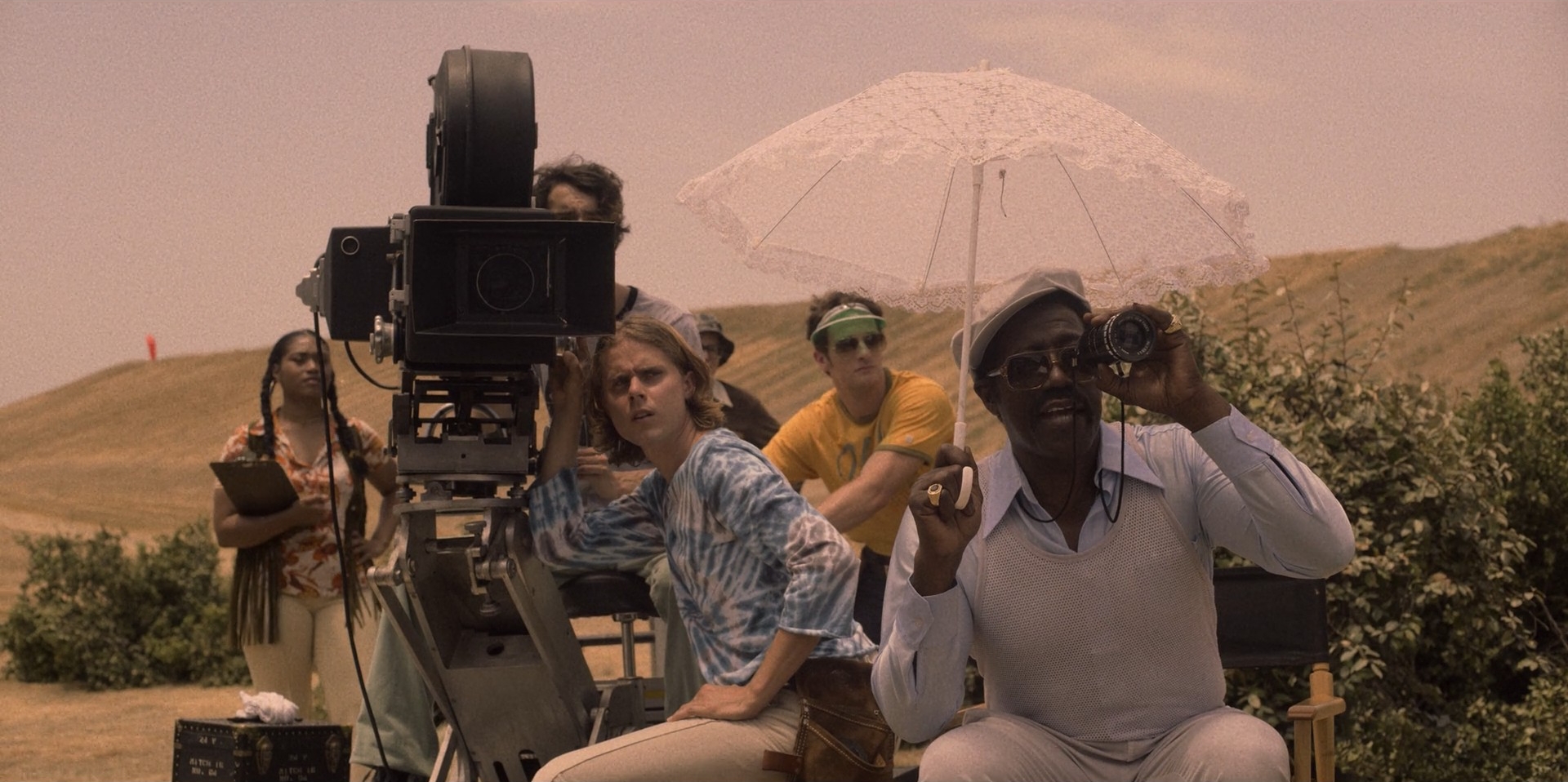
The cycle trained a generation of Black actors, composers and crews. Quentin Tarantino built Jackie Brown (1997) around Pam Grier; Black Dynamite (2009) is a deadpan parody; Dolemite Is My Name (2019), directed by Craig Brewer, restages the making of Dolemite. Each is a deliberate homage to the grain, zooms and swagger.
Blaxploitation vs. grindhouse
Grindhouse names a venue and a sensibility: rundown downtown theaters running any cheap sensational film non-stop. Blaxploitation played there, but also in first-run houses. Grindhouse is defined by where films were shown; blaxploitation by who they starred and who they were made for.
Blaxploitation examples in film
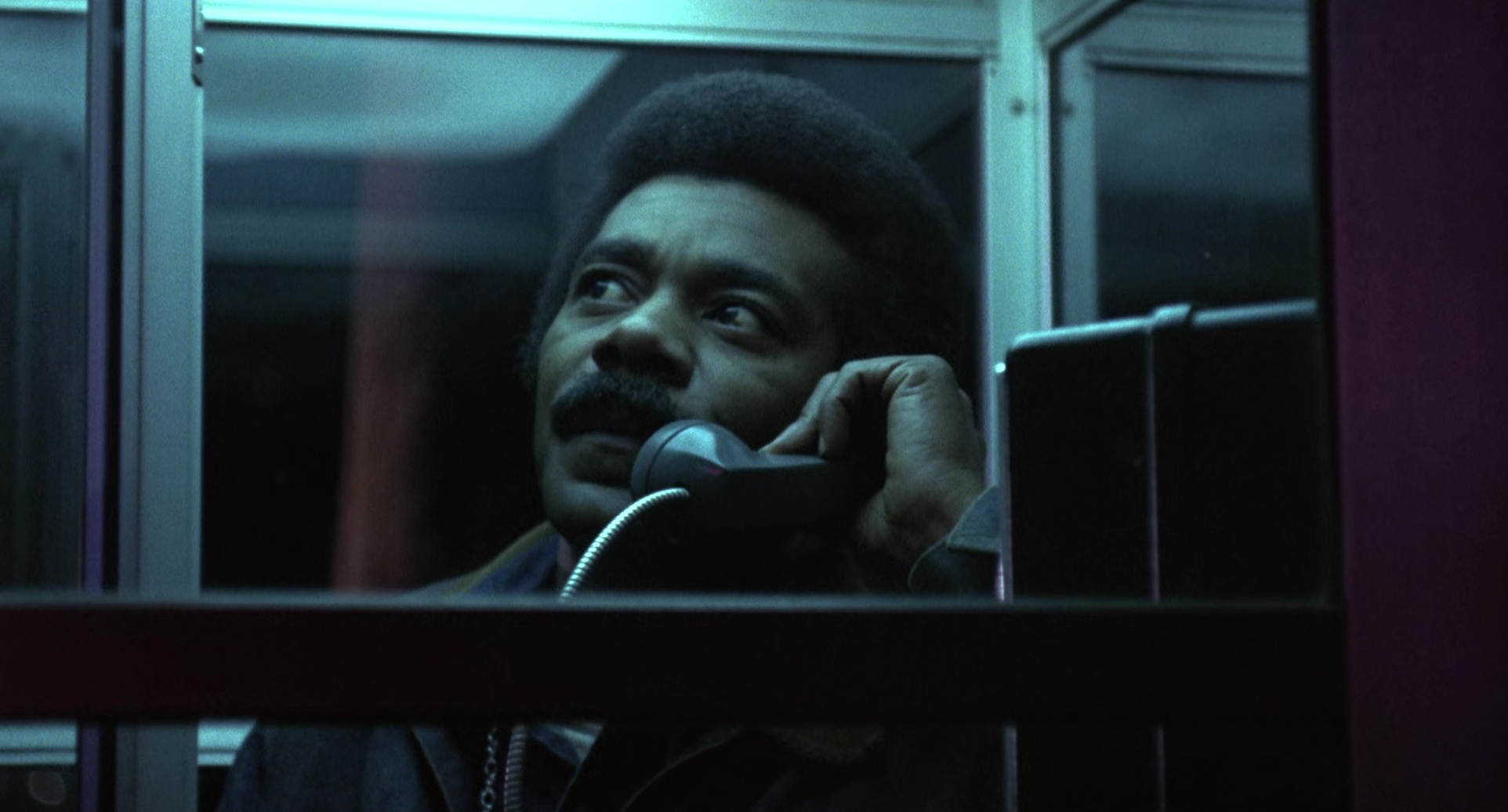
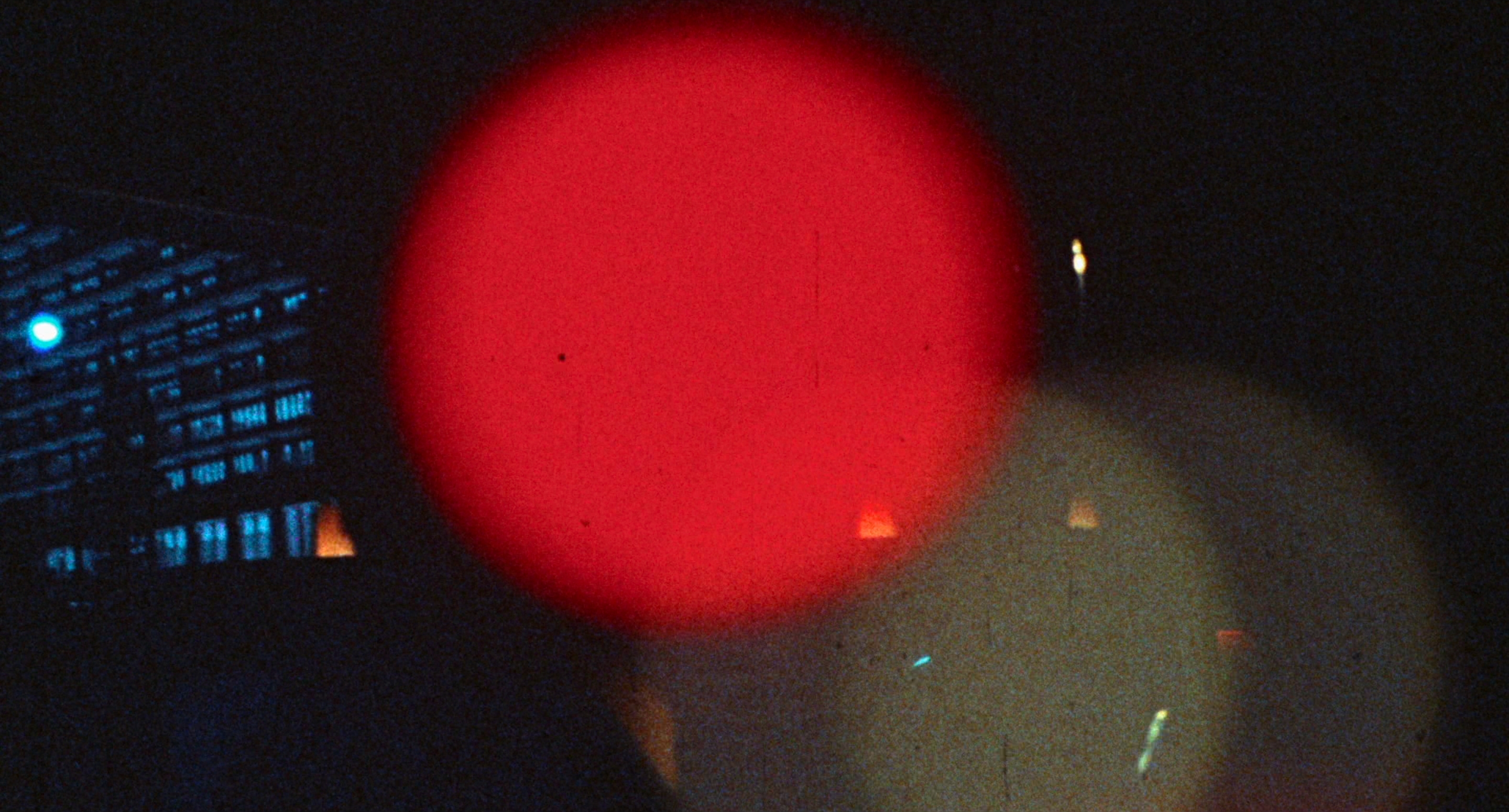
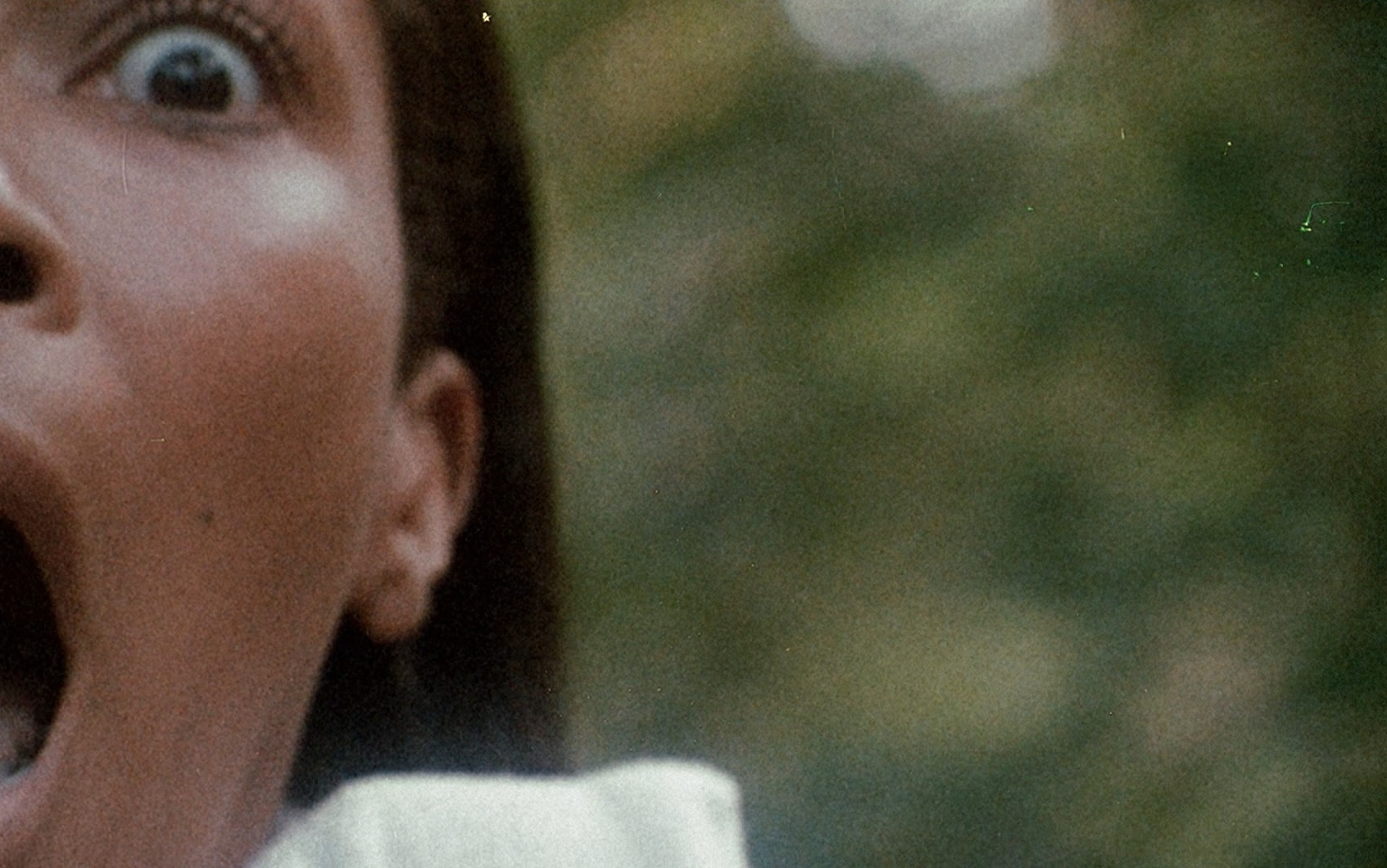
8 framesFrames from the cycle, a modern restaging, and 1970s crime films that shared its streets and light.
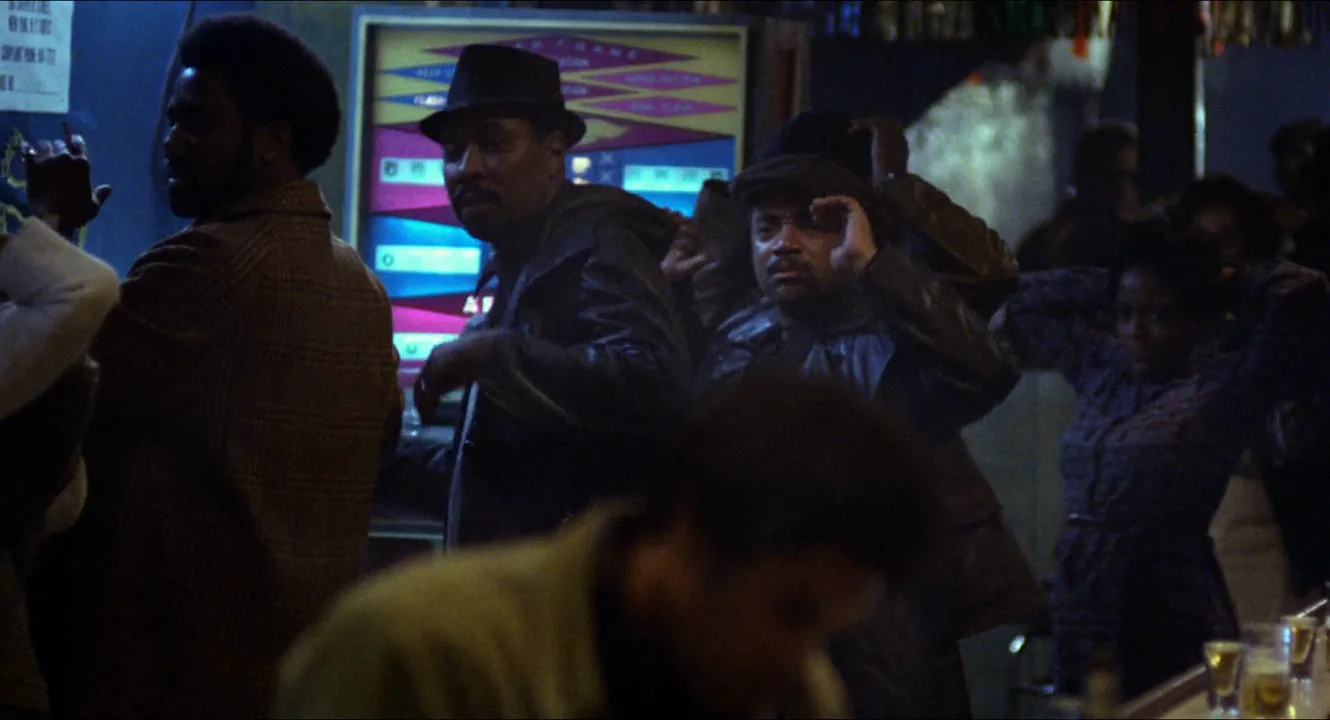
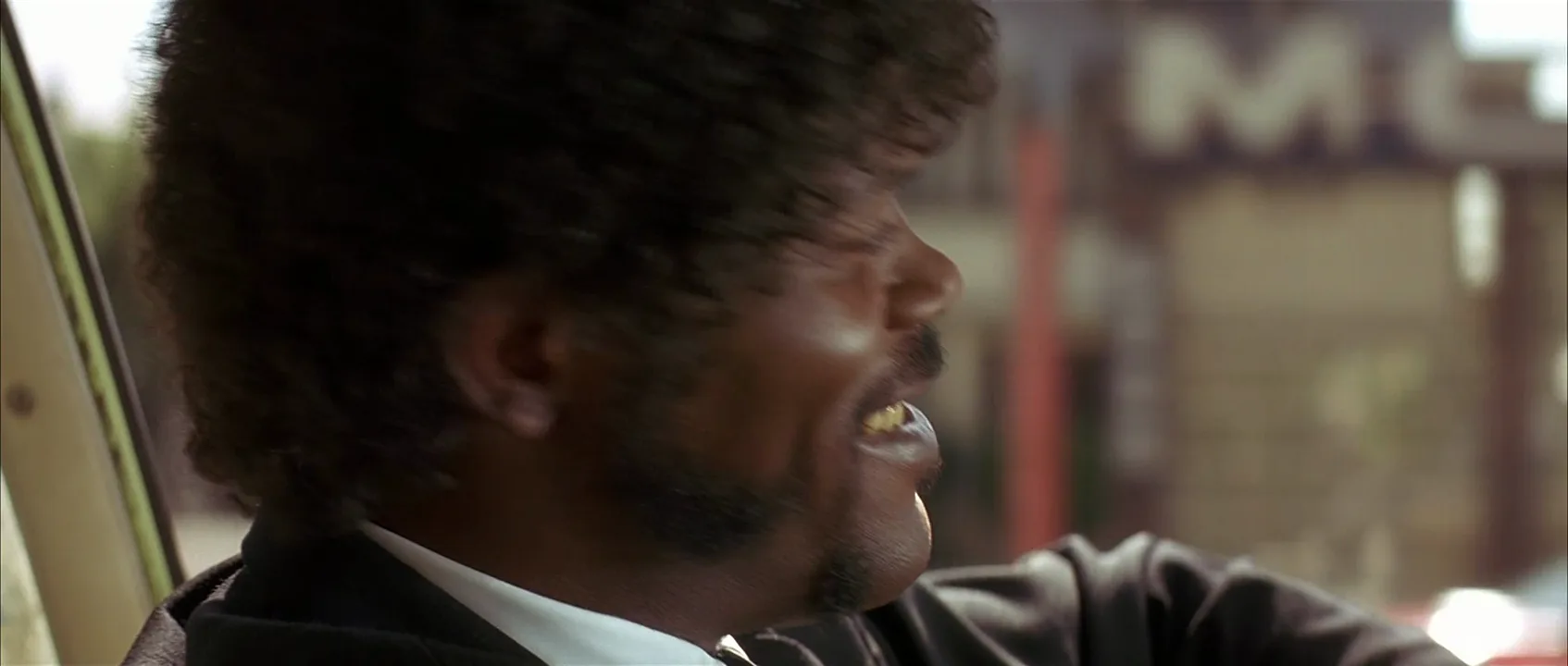
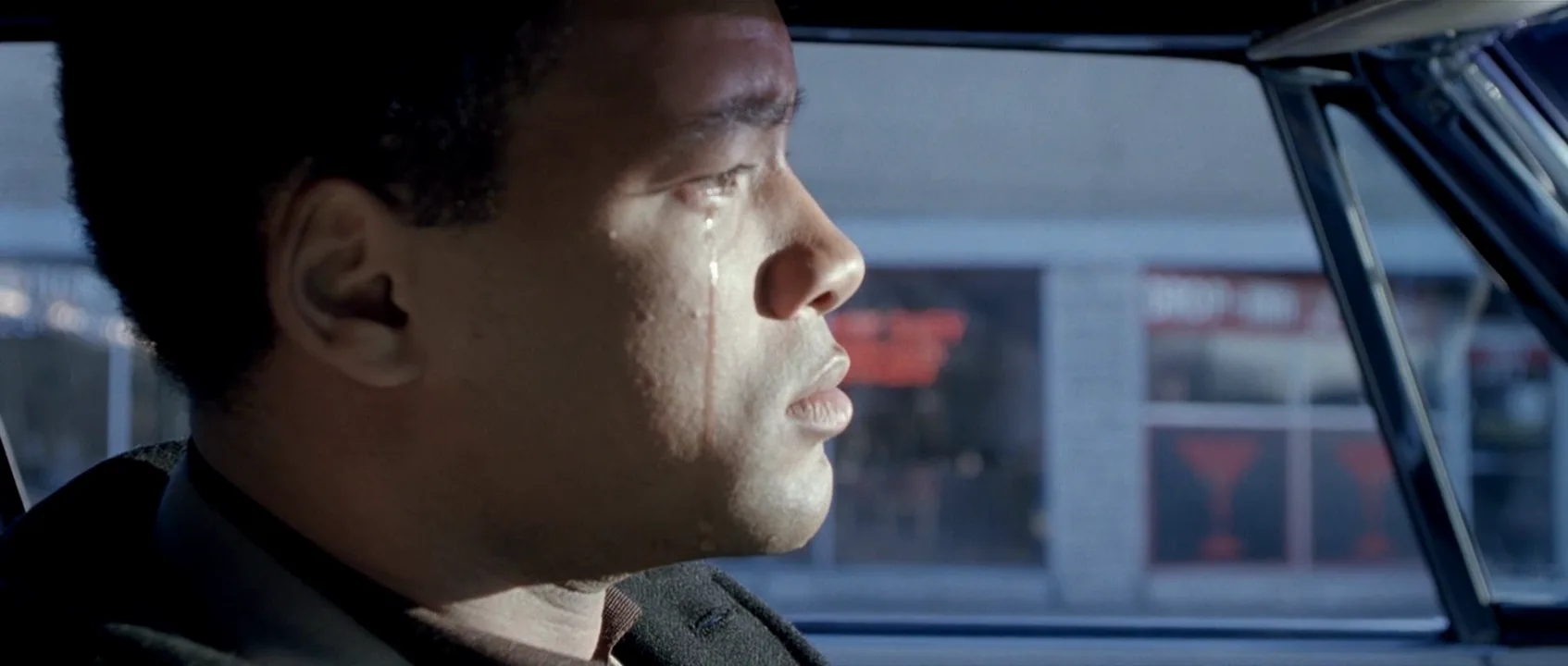
How to create a blaxploitation with AI
4 promptsDescribe the film stock, the city light and a specific fictional hero rather than naming a film, which drags models toward famous faces. In FlashBoards, keep period references, the start frame and every take on one board to match grain and palette across a sequence. The fourth prompt re-shoots a real film shot from a text description alone, and the original plays next to the result so you can compare.
1970s crime film still, low-angle medium-full shot from waist height: a fictional private detective striding toward camera on a busy uptown avenue at dusk. Tall Black man in his late thirties, shaved head, full short beard, burgundy suede car coat over a cream turtleneck. Red and green neon storefront signs, a yellow taxi passing behind him, wet asphalt. Sodium streetlight, 35mm color negative, visible grain, faded reds, lifted blacks.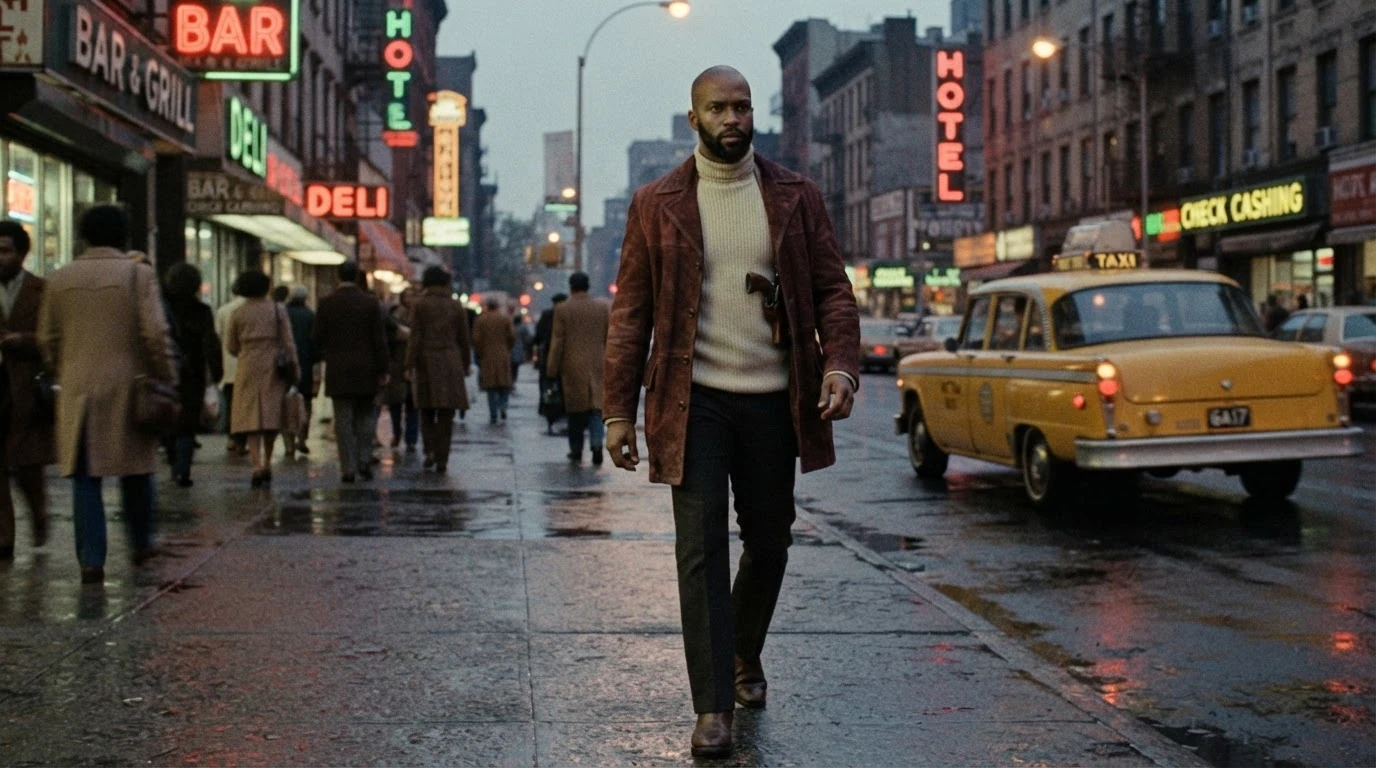
"Low-angle medium-full shot from waist height" sets the heroic entrance; specific features keep him fictional. "35mm color negative, visible grain, lifted blacks" and "sodium streetlight" carry the period more than costume words.
Open FlashBoardsWidescreen 1970s action film still, telephoto 135mm: a fictional vigilante heroine leaning on a mint-green 1972 convertible outside a roadside motel at night. Black woman in her late twenties, short platinum-dyed natural hair, freckles, gold hoop earrings, emerald wide-collar jumpsuit, arms crossed, looking at camera. Red neon motel sign behind her with soft halation, sodium-orange light, compressed background, heavy 35mm grain.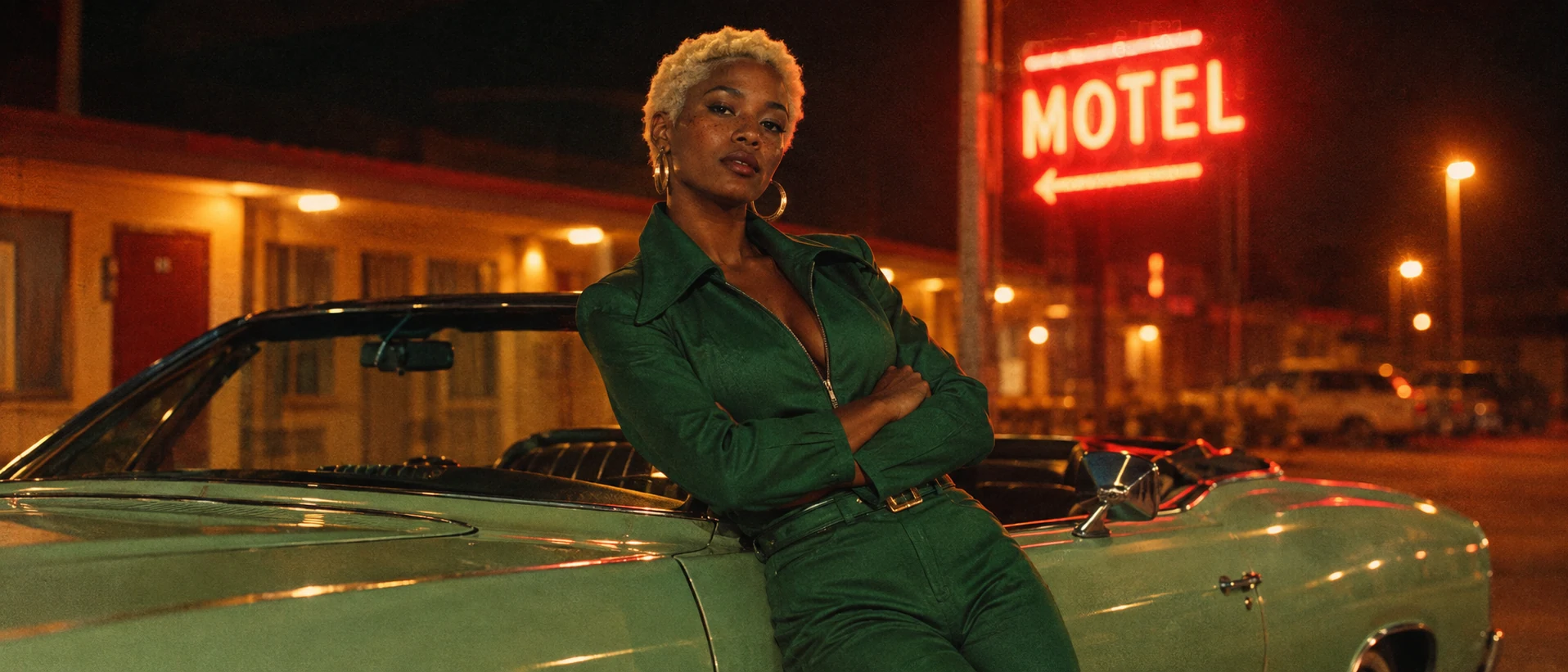
A female lead and a telephoto frame: "135mm" and "compressed background" stack the neon sign behind her; "halation" and "heavy 35mm grain" pull away from clean digital.
Open FlashBoardsCamera: handheld at waist height, backing away in front of the detective at his walking pace, with a slow zoom in toward his face near the end. Action: The detective is already mid-stride as the shot begins, suede coat swinging with each step. The yellow taxi slides past behind him and he turns his head to follow it. He looks back toward the lens, straightens his collar with one hand and keeps walking under the flickering neon signs."Already mid-stride" makes the shot move from frame one. The camera line names the two period moves, handheld backpedal and slow zoom; the action uses only what the start frame holds.
Open FlashBoards{
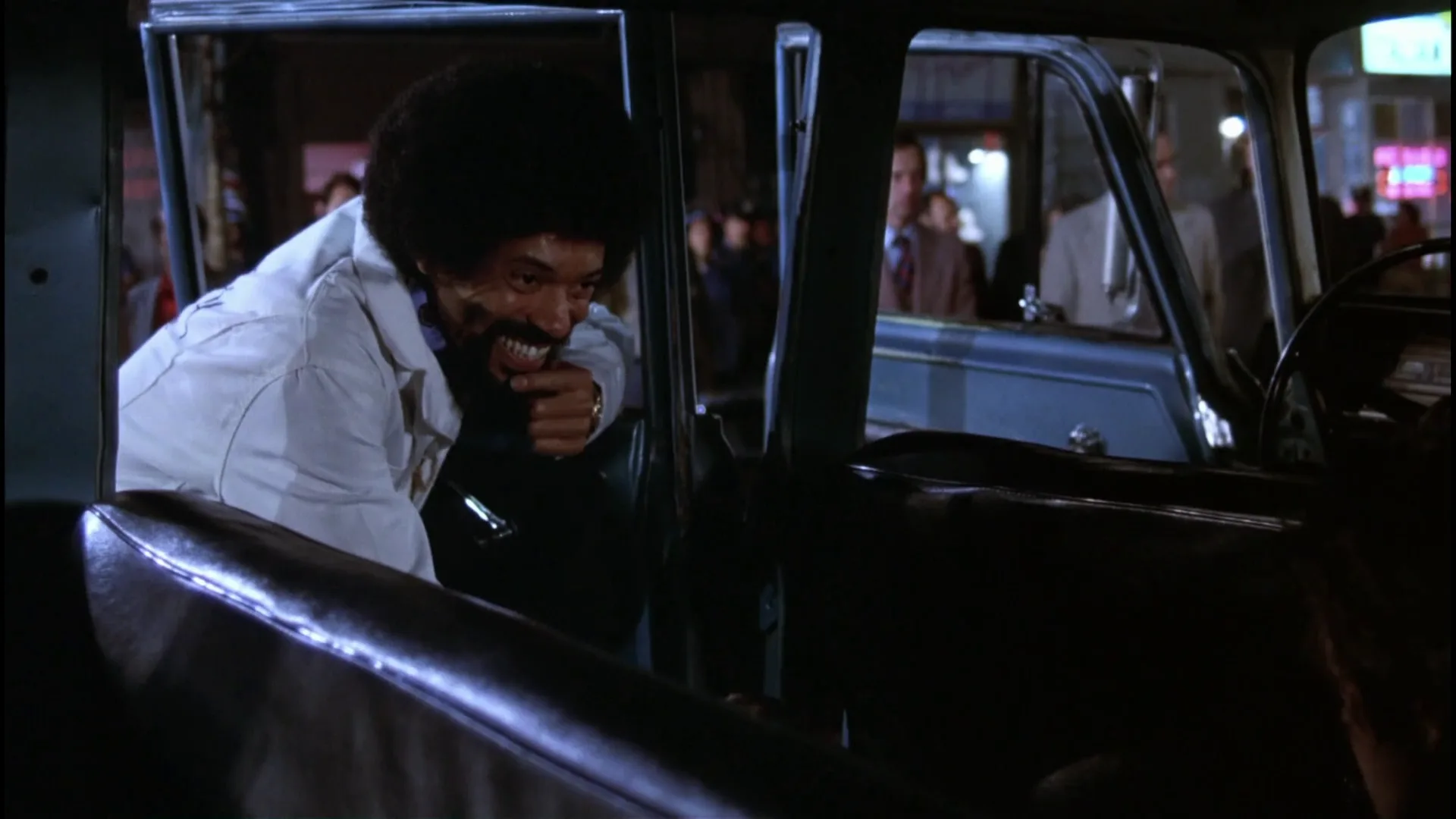
"output": "Full-screen live-action scene from Dog Day Afternoon (1975) from its very first frame: one continuous handheld shot, no cuts. Grainy mid-1970s 35mm color negative pushed at night, lifted blacks, warm skin, magenta and white neon shop signs and a street crowd behind, New York summer night, available light only.",
"characters": {
"S1": {
"name": "Driver, played by Dick Anthony Williams",
"look": "Black man around forty, big round afro, moustache and short goatee, white short-sleeved uniform shirt with epaulettes, steel watch on his wrist",
"voice": "warm, cracking up with laughter, fast street cadence"
}
},
"shots": [
{
"shot": 1,
"camera": "handheld, eye level of a seated passenger, medium shot from inside a dark car looking across the black vinyl seat back toward the open passenger door in the left third; the frame drifts and breathes slightly the whole time; the blue door frame stands in the centre, the crowd and neon are soft behind",
"action": [
"BEGINNING: alive from the first frame, S1 is already leaning in through the open car door in the upper left third, face turned to the screen-right foreground, grinning wide with teeth, his screen-right hand raised in a loose fist near his chin; the dark shoulder of a passenger sits in the bottom-right corner.",
"THEN: still laughing, he swings his screen-right hand down and forward and points a finger across the seat toward the passenger, wrist watch catching the light, leaning a little deeper in.",
"THEN: he pulls the hand back up to his mouth, knuckles against his lips, shoulders shaking with laughter, head dipping and bobbing, eyes on the passenger the whole time.",
"THEN: the grin stays, he lowers the hand to chest height and leans farther into the car, head dropping lower, still looking at the passenger.",
"END: he leans in lowest, head near the seat back, hand reaching forward toward the passenger, mouth open on the last words, crowd and neon signs still moving softly behind him."
],
"dialogue": [
{
"speaker": "S1",
"on_screen": true,
"when": "from the first frame, while he points and laughs",
"delivery": "laughing, delighted, fast",
"line": "<d>[English] I was watching. I saw you, man.</d>"
},
{
"speaker": "S1",
"on_screen": true,
"when": "as he leans farther in toward the end of the shot",
"delivery": "laughing, shaking his head",
"line": "<d>[English] You should see yourself, you wouldn't believe it.</d>"
}
]
}
],
"sound": {
"ambience": "muffled street crowd heard from outside the car, distant sirens, night traffic",
"speech": "exactly these spoken phrases, each said once, in this order",
"never_spoken": "no narration and no voice-over: the descriptions, performance notes and step words of this prompt are never spoken aloud",
"music": "a film score under the scene, always below the voices: a loose 1975 funk bass line with a soft wah-wah guitar and hi-hat pulse",
"subtitles": "none"
}
}Remakes the Dog Day Afternoon (1975) shot of the driver laughing in through the car door; the prompt carried over the handheld interior framing, the neon crowd behind him, his point and hand-to-mouth beats and his two lines.
The output line carries the period as stock and light ("35mm color negative pushed at night, lifted blacks") plus neon and a street crowd, the article's city. The character is one look, afro and white uniform shirt, not a name the model can copy. The action steps time the laugh, the point and the hand to the mouth so the handheld shot has beats to play, and the two lines are the original's, verbatim.
Common mistakes
- Too clean. Models default to sharp digital night. State "35mm color negative, visible grain, lifted blacks."
- Famous faces. Naming a real film or star pulls in likeness. Describe age, hair and wardrobe instead.
- Costume caricature. "70s outfit" gives a party costume. Name materials: suede car coat, wide-collar jumpsuit.
- Static video. Open with the character already moving, or the clip slowly pushes in on a still.
Keep the reference frames, prompts and every generated take side by side — images and video in one canvas.
FAQ
4 questionsWhat is blaxploitation?
Blaxploitation is a cycle of American genre films, mostly from 1971 to 1976, made for Black audiences and starring Black heroes. Most are urban crime thrillers, some are horror or martial-arts comedies, shot fast on real city locations with funk and soul scores. Shaft, Super Fly, Coffy and Foxy Brown are the best-known titles.
What was the first blaxploitation film?
Sweet Sweetback's Baadasssss Song (1971), made independently by Melvin Van Peebles, is usually named as the film that started the cycle, with MGM's Shaft following the same year. Cotton Comes to Harlem (1970), directed by Ossie Davis, is often cited as a precursor. Their success showed studios an audience they had ignored.
Why is it called blaxploitation?
The name blends "Black" and "exploitation," the trade term for cheap films sold on sex, violence and sensational ads. Critics in the early 1970s used it partly as a complaint about studios profiting from Black audiences while repeating stereotypes of pimps and dealers. Over time it became a neutral genre label.
Is blaxploitation offensive?
It was debated from the start. Civil-rights groups objected to drug dealers and pimps as heroes and to white control behind the camera. Defenders point to Black heroes who won, Black composers and crews getting work, and audiences who loved the films. Modern homages usually engage with that tension.
Related terms
5- GrindhouseGenres
Grindhouse refers to run-down urban theaters of the 1960s–70s that ran cheap exploitation films non-stop, and to those films themselves — later homaged by Tarantino and Rodriguez's Grindhouse (2007).
- B-MovieFilm Industry
A B-movie was originally the cheaper second feature of a studio-era double bill; today the term means any low-budget genre film — horror, sci-fi, crime — often made fast and loose by producers like Roger Corman.
- New HollywoodFilm Movements & Styles
New Hollywood (c. 1967–1980) was the era when young auteurs — Coppola, Scorsese, Altman, Friedkin — took control from a collapsing studio system and made darker, personal, formally freer films, from Bonnie and Clyde to Taxi Driver.
- SoundtrackSound & Music
A soundtrack is the music of a film — most often the songs, licensed or original, released as an album; technically the word also means the whole audio track on film.
- Film GenresGenres
A film genre is a category of films that share recognizable conventions of story, setting, character and style — western, horror, musical, noir — letting audiences know what to expect and filmmakers play with it.
Further reading
Donald Bogle, Toms, Coons, Mulattoes, Mammies, and Bucks: An Interpretive History of Blacks in American Films. Ed Guerrero, Framing Blackness: The African American Image in Film (1993). Novotny Lawrence, Blaxploitation Films of the 1970s: Blackness and Genre (2008).