 FlashBoards Learn
- Learn
- Film Industry
- B-Movie
Film Industry · Film language
B-Movie
Also called: B-film, B-picture, programmer
A B-movie is a low-budget genre film. The term began in 1930s Hollywood, where the B picture was the cheap second half of a double bill. Today it means any fast, inexpensive horror, sci-fi, crime or monster movie that sells on a hook, a title and a poster rather than stars or polish.
- What it does
- Delivers a clear genre thrill (a monster, a crime, an invasion) on a small budget and a short schedule.
- Use it when
- You have a strong hook, few locations and little money, and the genre itself can carry the audience.
- Watch out
- Cheap is not the same as careless. The best B-movies hide their limits with shadow, pace and wit; the worst sink into Z-movie territory.
- Try this prompt
1950s drive-in monster movie still, night parking lot, a rubber-suited swamp creature emerging from fog under a red neon sign, saturated Technicolor, hard low key light.
What is a B-movie?
The "B" first described a slot on the program, not a level of quality. During the Depression, theaters sold the double feature: two films for one ticket. The A picture on top had stars and big sets. The B picture below ran 60 to 75 minutes, was shot in a week or two on standing sets, and was usually rented for a flat fee rather than a share of the box office.
Under the Hollywood studio system, the majors ran their own B units, and "Poverty Row" companies such as Monogram, Republic and PRC made little else. A mid-budget film that could play either half of the bill was called a programmer.
After the 1948 Paramount antitrust decision separated the studios from their theater chains, the B units faded, but the label stayed. Today, anywhere in the film industry, a B-movie simply means a cheap genre picture.
From Poverty Row to drive-ins: a short history
1930s–40s. Val Lewton's RKO unit made Cat People (1942), directed by Jacques Tourneur, which scares with shadow instead of a visible monster. Edgar G. Ulmer's Detour (1945), made for PRC, is a model of lean film noir.
1950s–60s. Independents took over. American International Pictures sold titles and posters to teenagers at the drive-in, and atomic-age science fiction filled the screens. Don Siegel's Invasion of the Body Snatchers (1956) is a B picture that outlived most A pictures of its year.
Roger Corman is the name most tied to the term: hundreds of fast films on reused sets. The Little Shop of Horrors (1960), shot in a couple of days, is the classic case; the 1986 musical is a big-studio remake, not a B-movie. Corman gave early breaks to Francis Ford Coppola, Martin Scorsese and Jonathan Demme.
1970s–today. Exploitation moved to the grindhouse and home video, and independent horror like Night of the Living Dead (1968) and The Evil Dead (1981) launched careers. The blockbuster is partly the B-movie subject given A money. Made-for-TV creature features like Sharknado (2013) keep the tradition alive.
What makes a movie a B-movie?
Most B-movies share several of these traits:
- A one-line genre hook. Killer plant, giant ants, zombie siege.
- A title and poster that promise more than the budget.
- Short schedules, few locations, unknown actors.
- Visible seams. Stock footage, rubber suits, models on wires, day for night exteriors.
- Freedom. Nobody expected much, so directors slipped in satire, politics and personal obsessions.
That freedom is why so many became cult films.
How to make a B-movie that works
Treat the budget as a design constraint from page one.
- Write for what you own. One main location, two or three minor ones, 5–8 script pages a day with simple coverage: a master, a two-shot, singles only where the scene turns.
- Hide the monster. Silhouette, fog, a closing door; reveal it fully once.
- Use the night. One hard key light, black backgrounds and a colored practical erase cheap sets.
- Build practical effects you can relight. One good prop head and one claw can cover a whole creature.
- Commit to a tone. Deadpan or knowing humor both work; indecision just looks cheap.
In FlashBoards, one board can hold the poster concept, reference frames from 1950s creature features, generated monster reveals and the location plan before anyone builds the creature. For the production side, see micro-budget film.
B-movie vs. Z-movie
A B-movie is defined by budget and genre, and it can be excellent. A Z-movie sits below it: made for almost nothing, without the craft to hide it, and enjoyed mostly for its mistakes. Ed Wood's Plan 9 from Outer Space (1959) is the standard example. Detour uses its poverty as style; a Z-movie is visibly beaten by it.
How to create a b-movie with AI
4 promptsThe B-movie look is a period style plus a genre promise: saturated color or hard black and white, one strong key light, proudly handmade sets and a threat in the frame. Name the era, the film look and the creature, and keep your reference posters on the same FlashBoards board so every take matches. The fourth prompt re-shoots a real film shot from a text description alone, and the original plays next to the result so you can compare.
1950s drive-in monster movie still. Night, gravel parking lot outside a roadside diner with a red neon EATS sign. A young woman with a platinum pixie cut, black cat-eye glasses and a mint-green poodle skirt presses against a turquoise-and-white sedan, screaming. Behind her a tall rubber-suited swamp creature with olive scales and fin-shaped ears steps out of ground fog. Medium wide shot, waist height, 32mm lens. Hard single key light from the left, black sky, red neon on the fog. Saturated Technicolor, visible grain.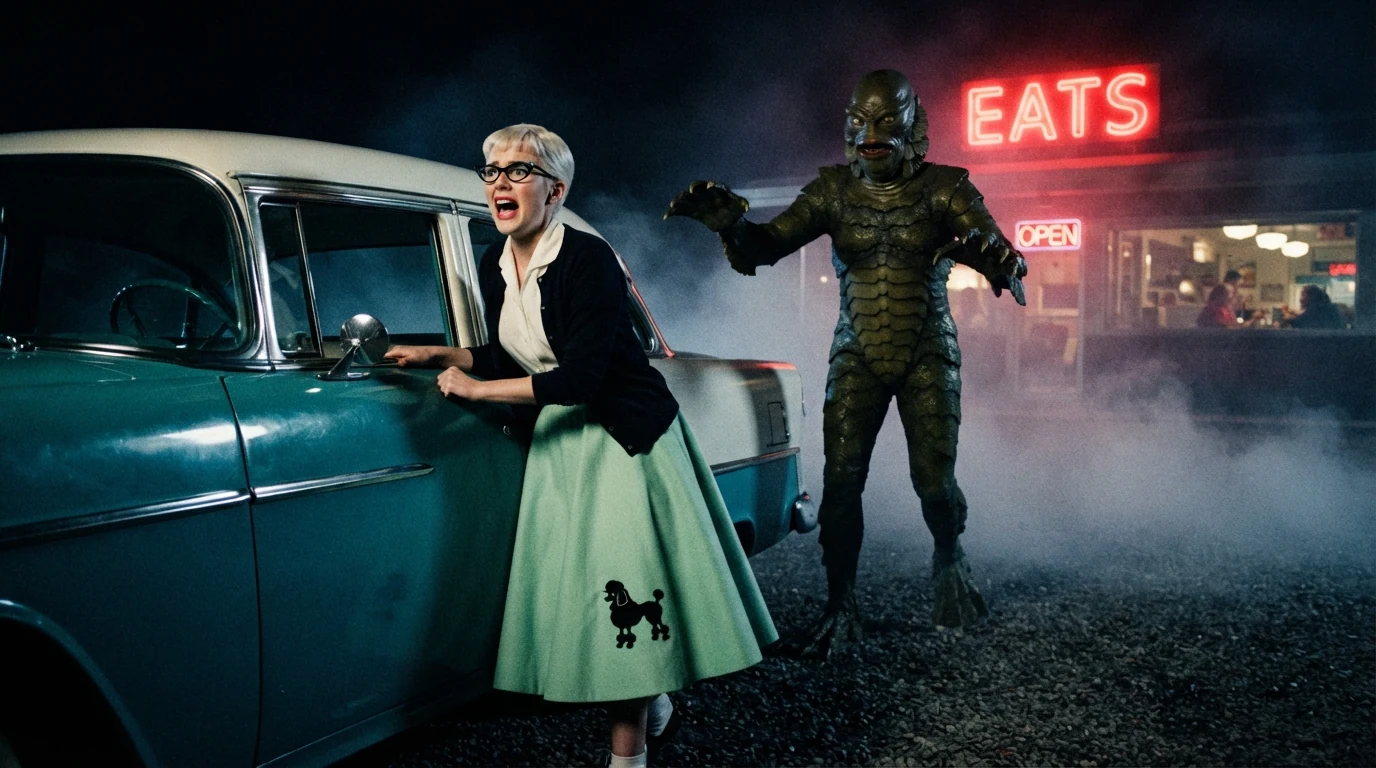
"Drive-in monster movie," "rubber-suited" and "Technicolor" set the era and the honest cheapness; "hard single key light" and "black sky" hide the set the way B cinematographers did. The pixie cut and cat-eye glasses make the heroine an invented character. This is the video's start frame.
Open FlashBoardsBlack-and-white 1950s science fiction B-movie still, 4:3 frame. A cramped lab set with painted flat walls, two glowing oscilloscopes and oversized dials. A heavyset scientist in his fifties with a pencil mustache, a receding widow's peak, round wire glasses and a rumpled lab coat points at a window where a small silver flying saucer model hangs against a painted night sky. Medium shot, eye level, 40mm lens. Hard top light, strong shadows, crisp monochrome contrast.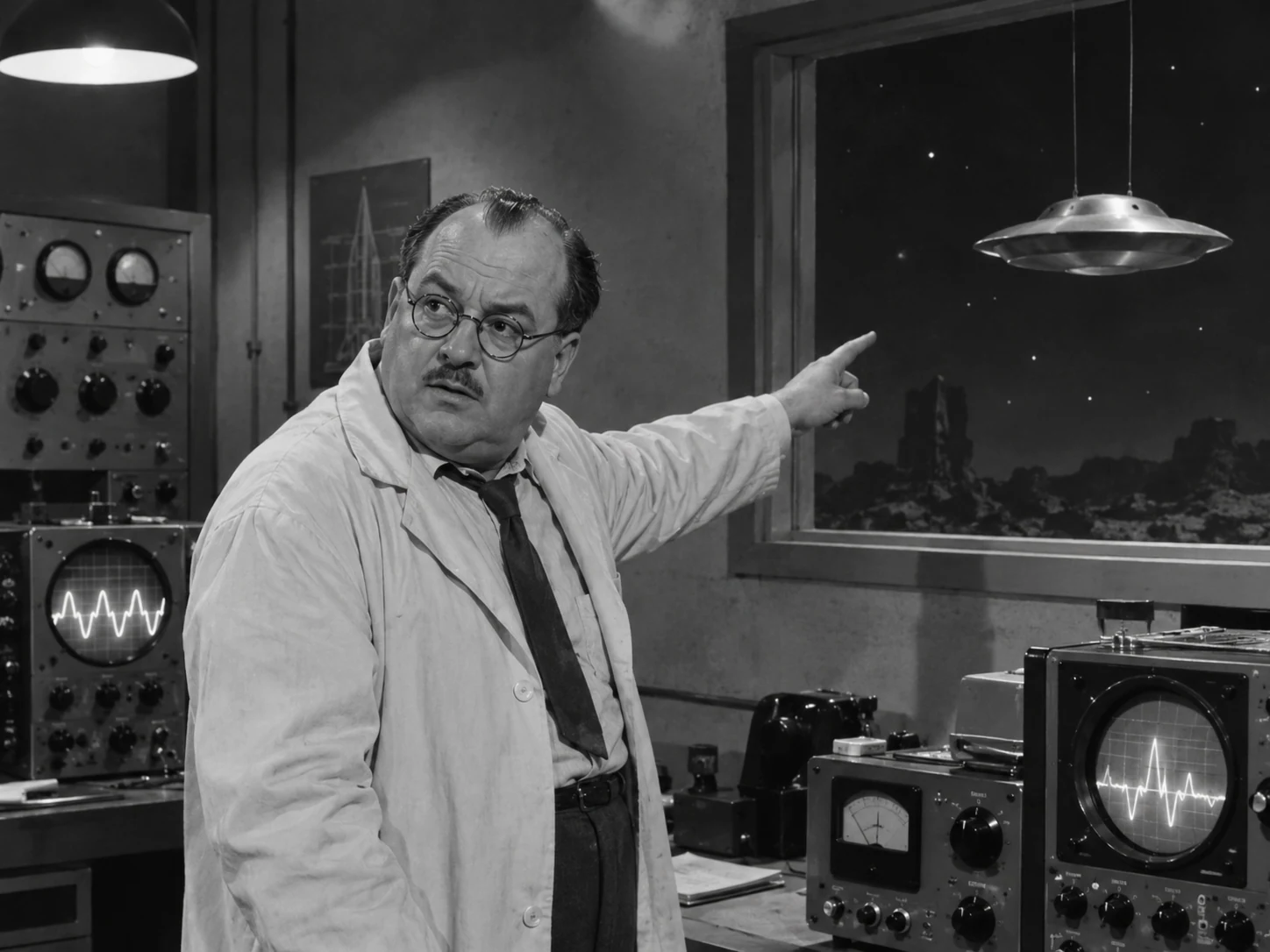
The other classic B register: monochrome atomic-age sci-fi. "Painted flat walls" and "model" ask for handmade production value instead of modern realism.
Open FlashBoardsCamera: slow, steady push in toward the woman at waist height, about one meter over the shot. Action: from the first frame fog rolls across the gravel and the neon sign flickers. The creature lurches two heavy steps forward, arms rising. The woman screams and slides along the sedan to the right. At the end the creature's shadow falls across the car door as she ducks out of frame.Fog and flicker from the first frame keep the clip alive at once; the push in is stated with speed and distance so it does not drift. Everything named is already in recipe 1's frame.
Open FlashBoards{
"output": "Full-screen live-action scene from Halloween (1978) from its very first frame: one continuous shot. Low-budget 1970s 35mm horror, anamorphic widescreen, heavy film grain, deeply underexposed night interior. A cramped laundry room with pale grey-painted vertical board walls. The only light is one hard, cold blue-white key coming through a tall paned window with a thin sheer curtain behind the woman: the window glows, and everything else sits in deep blue-black shadow. The left quarter of the frame is pure black, the walls are dim grey-blue, the machines on the right are only faint shapes catching a thin edge of blue light; no warm light anywhere.",
"characters": {
"S1": {
"name": "Annie Brackett, played by Nancy Loomis",
"look": "young woman, early twenties, shoulder-length dark curly hair, an oversized white man's button-down shirt worn loose and open at the collar, sleeves hanging past her wrists, bare legs",
"voice": "silence: she never speaks"
}
},
"shots": [
{
"shot": 1,
"camera": "locked-off tripod shot at chest height, slightly wide lens, medium-wide framing. S1 stands in the left-centre third, backlit against the glowing window. On the left edge a dark door with a round metal knob at her hip height. On the right, low in the frame and deep in shadow, a washing machine and dryer whose chrome control panels catch a thin line of blue light; a cardboard box of laundry soap stands at the right edge. Near the end the camera pans slowly right to keep S1 in frame as she crosses close to the lens.",
"voice": "silence: nobody speaks in this shot, no voice at all",
"action": [
"BEGINNING: alive from the first frame, S1 is yanking the door: her screen-left arm is stretched out to the door knob, her body thrown back, her head tipped back with her hair swinging; a dark pair of trousers hangs from her screen-right hand.",
"THEN: she rattles the knob twice more, torso now square to the camera, her head turned up toward the upper right of the room, eyes searching.",
"THEN: her screen-left hand lets go of the knob and drops to her side; she stands still in front of the window, shirt glowing blue-white at its edges, face half in shadow, looking up to screen right, lips pressed shut.",
"THEN: with her screen-right hand she swings the dark trousers onto the top of the washing machine and leaves the hand resting on its edge, still looking up to screen right, brow tight.",
"THEN: she turns her body toward screen right and steps forward, leaning in, moving toward the camera and to the right past the washing machine.",
"END: she passes close to the lens in the right half of the frame as a near-black silhouette in profile facing right, her curly hair and shirt outlined against the pale moonlit wall, and reaches a dark door frame at the right edge as the camera finishes its slow pan right."
],
"dialogue": []
}
],
"sound": {
"ambience": "a quiet room at night: the metal door knob rattling, bare feet on a wooden floor, fabric landing on metal, faint crickets heard from outside",
"speech": "no words in this video; the only human sounds are breaths and movement",
"never_spoken": "no narration and no voice-over: the descriptions, performance notes and step words of this prompt are never spoken aloud",
"music": "a film score under the scene, always below the voices: a sparse, low synthesizer drone with a slow ticking pulse, cold and uneasy",
"subtitles": "none"
}
}Remakes the laundry-room shot from John Carpenter's low-budget Halloween (1978), DP Dean Cundey, carrying over its single moonlight key, the black left of frame, Annie's struggle with the locked door and her exit into silhouette.
This is the B-movie night recipe from the article in one shot: a single hard blue key through a window, the rest of a cheap set dropped into black, and a threat you never see. The prompt names that one light source and what it misses, then walks the actress through each beat by screen side, so the remake keeps the locked-off frame, the trousers tossed onto the washer and the late pan right into silhouette.
Open FlashBoardsCommon mistakes
- "B-movie" alone gives generic horror. Name the decade, the film look and the handmade effects.
- The monster comes out too good. Say "rubber-suited" or "latex mask" to avoid slick modern CG.
- Soft, even light. Without "hard single key light" and "black background" the mood disappears.
Keep the reference frames, prompts and every generated take side by side — images and video in one canvas.
FAQ
5 questionsWhat is a B movie?
A B movie is a low-budget genre film. In studio-era Hollywood it was the cheaper second feature on a double bill, rented for a flat fee. Today it means any inexpensive horror, sci-fi, crime or action film made quickly with lesser-known actors and sold on its hook and poster.
What does the "B" in B movie stand for?
It is not an abbreviation. It marks the second slot on a double feature, like a record's B-side. The A picture was the prestige title at the top of the bill; the B picture was the short, cheap support feature. Over time the letter came to signal low budget.
Who is the king of B movies?
Roger Corman is the name most often given the title. As producer and director he made hundreds of fast, cheap genre films, from The Little Shop of Horrors (1960) onward, and gave early jobs to Francis Ford Coppola, Martin Scorsese and Jonathan Demme.
What are some of the best B movies?
Frequently cited classics include Cat People (1942), Detour (1945), Invasion of the Body Snatchers (1956), The Little Shop of Horrors (1960), Night of the Living Dead (1968) and The Evil Dead (1981). Each turned a small budget into atmosphere or style that still holds up.
What is the difference between a B movie and a Z movie?
A B movie is cheap but competent, and some are excellent. A Z movie is made for even less, usually without the craft to hide it, and is watched mainly for its mistakes. Plan 9 from Outer Space (1959) is the standard Z example.
Related terms
4- GrindhouseGenres
Grindhouse refers to run-down urban theaters of the 1960s–70s that ran cheap exploitation films non-stop, and to those films themselves — later homaged by Tarantino and Rodriguez's Grindhouse (2007).
- Cult FilmFilm History & Theory
A cult film gathers a passionate devoted audience — often after a commercial flop — that rewatches, quotes and ritualizes it: midnight screenings of The Rocky Horror Picture Show, The Big Lebowski fandom.
- BlaxploitationGenres
Blaxploitation is a wave of early-1970s American exploitation films made for Black audiences, with Black heroes, urban settings, funk and soul scores — Shaft and Super Fly are its emblems.
- Micro-Budget FilmFilmmaking Process & Crew
A micro-budget film is a feature made for a tiny fraction of an average budget — often tens of thousands of dollars — with a skeleton crew, few locations and every constraint turned into style; El Mariachi and Paranormal Activity are classic cases.
Further reading
Todd McCarthy and Charles Flynn (eds.), Kings of the Bs: Working Within the Hollywood System (1975). Roger Corman with Jim Jerome, How I Made a Hundred Movies in Hollywood and Never Lost a Dime (1990).