 FlashBoards Learn
Genres · Film language
Buddy Cop Film
Also called: buddy cop, cop buddy film, buddy action comedy
A buddy cop film pairs two mismatched law officers — split by temperament, age, background or method — who are forced to work one case together. The friction between them is the engine: it generates the jokes, the arguments and the action, and the case is really about the partners learning to trust each other.
- What it does
- Turns an ordinary investigation into a relationship story, with conflict built into every scene the partners share.
- Use it when
- You want action and comedy in the same film, or a procedural whose real subject is two people changing each other.
- Watch out
- If the partners differ only in wardrobe and not in how they solve problems, the friction feels staged and the jokes go flat.
- Try this prompt
Two mismatched detectives in the front seats of a parked sedan at night, one deadpan, one mid-rant, medium two-shot through the windshield, 35mm
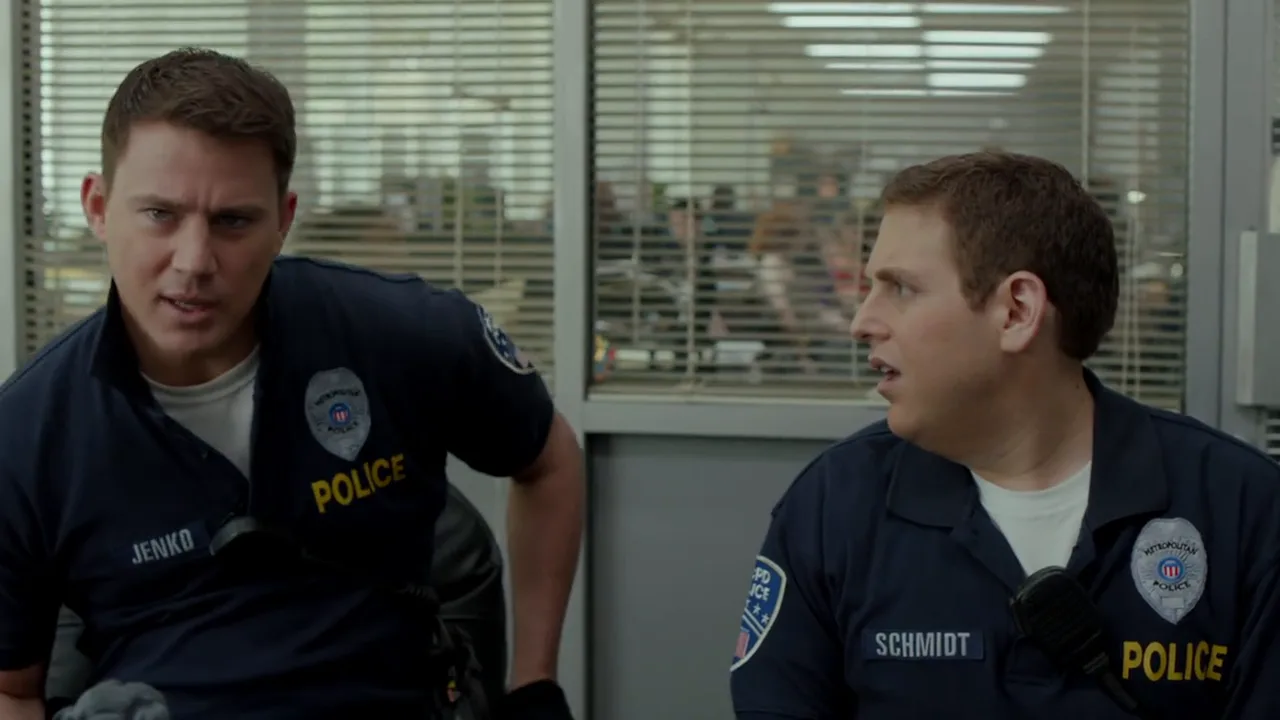
What is a buddy cop film?
The buddy cop film is a subgenre of the crime-action movie, usually played as action comedy. Its one fixed rule is the pair: two officers (or an officer and a reluctant civilian) who would never choose each other, assigned to the same case. Everything else is flexible, so the form often works as a hybrid genre.
The roots go back to In the Heat of the Night (1967), where a Black Philadelphia detective and a white Mississippi police chief share a murder case. Walter Hill's 48 Hrs. (1982) paired a cop with a convict and set the modern template; Lethal Weapon (1987) fixed the volatile loner and the careful family man. Rush Hour (1998), Hot Fuzz (2007) and 21 Jump Street (2012) run variations on the same engine, one of the most recognizable among film genres.
What is the buddy cop formula?
Most buddy cop movies hit the same beats:
- The mismatch. One axis, pushed to the extreme: by-the-book vs. reckless (Lethal Weapon), rookie vs. veteran (Men in Black), local vs. foreigner (Red Heat, Rush Hour), jock vs. nerd (21 Jump Street). Each partner is a clear character archetype, and one's strength is the other's blind spot.
- The forced pairing. A superior assigns them against both their wishes.
- Friction on the job. Every set piece doubles as an argument about method.
- The split. Late in act two the partnership breaks.
- The swap. In the finale each partner wins by using the other's method.
The tone sits between action and comedy: the wider the gap, the bigger the jokes.
Why filmmakers keep making buddy cop movies
A lone detective needs voice-over or a confidant to explain what he thinks; two partners simply argue, and exposition becomes conflict. Every clue gets two opposite readings, so the audience always has someone on screen to agree with.
The form also sells chemistry: audiences come back for the pair, which is why Lethal Weapon, Bad Boys and Rush Hour all became series.
How to shoot a buddy cop scene
The genre lives in the two-shot. Keep both partners in one frame as often as the scene allows — the joke is usually the reaction of the one who isn't talking.
- Coverage. Shoot the two-shot on a 35–50mm lens at eye level, singles on 75–100mm. For improvised dialogue, cross-cover with two cameras so both performances stay in sync.
- The car. The front seat is the genre's office. A hood or windshield mount gives a flat two-shot where both faces read; door mounts give singles. Keep the lens at dashboard height.
- Blocking. Keep each partner on their own side of frame and swap only when the relationship shifts. Posture sells the mismatch: one sprawls, one sits upright.
- The hero shot. Save the low-angle side-by-side walk for when the partnership is earned, usually near the big car chase.
Buddy cop film vs. sidekick story
In a sidekick story one character is the hero; the sidekick helps, contrasts and supplies relief, but his arc is secondary. In a buddy cop film the billing is equal: both partners have flaws, both change, and the climax needs both. Test: if you can cut one character's inner life without breaking the ending, you wrote a sidekick.
Buddy Cop Film examples in film
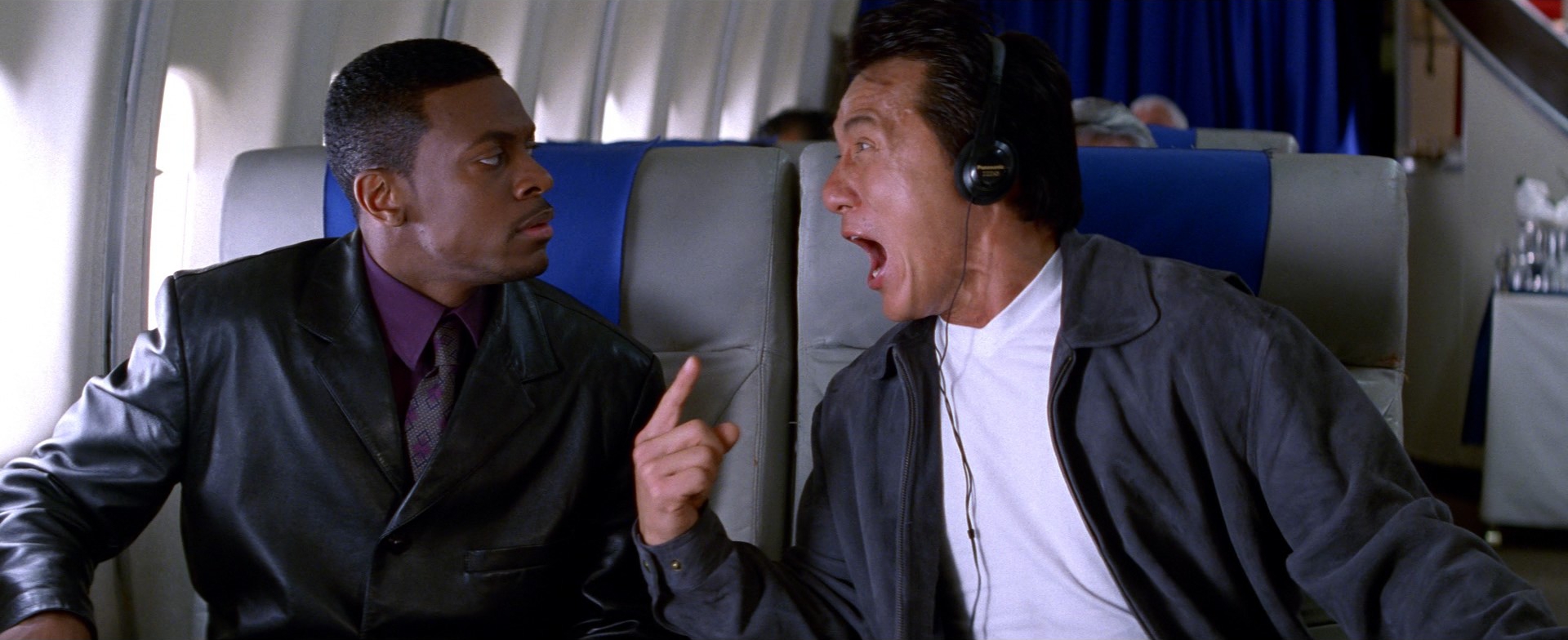
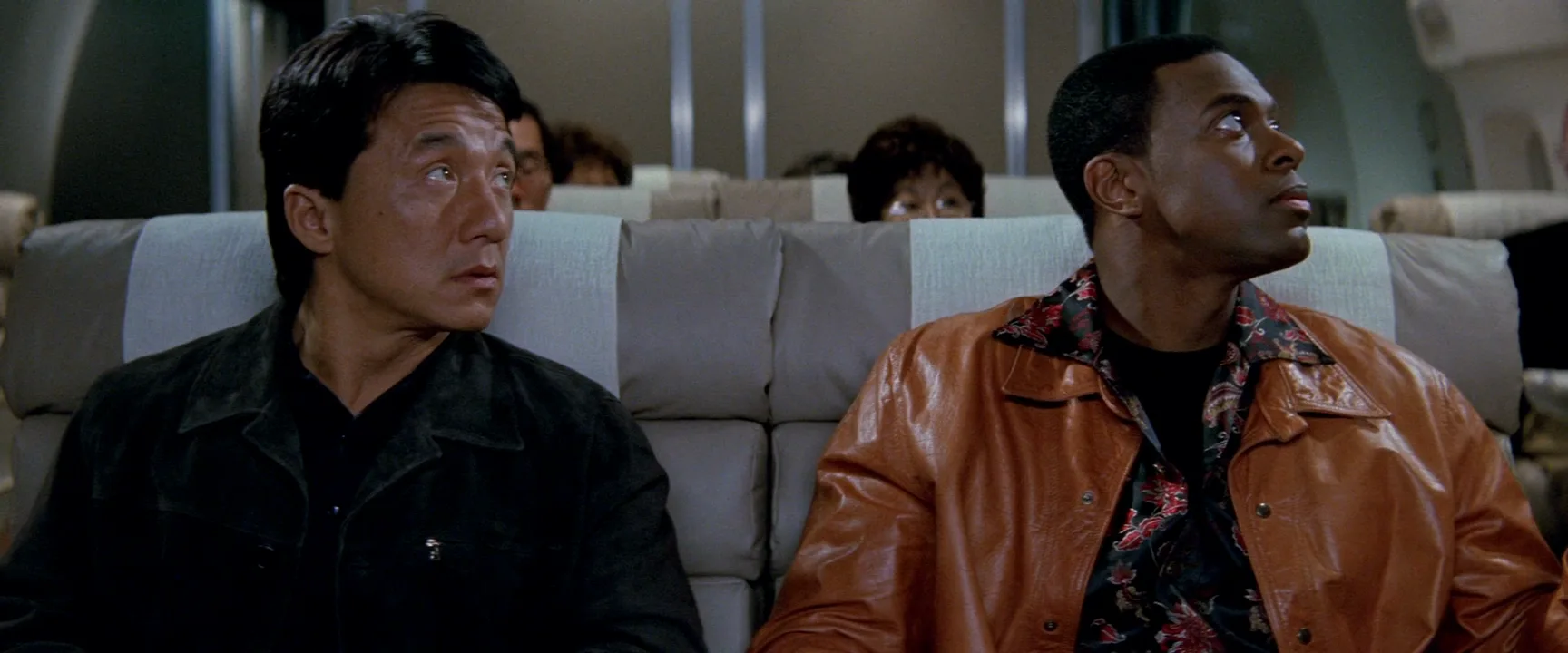
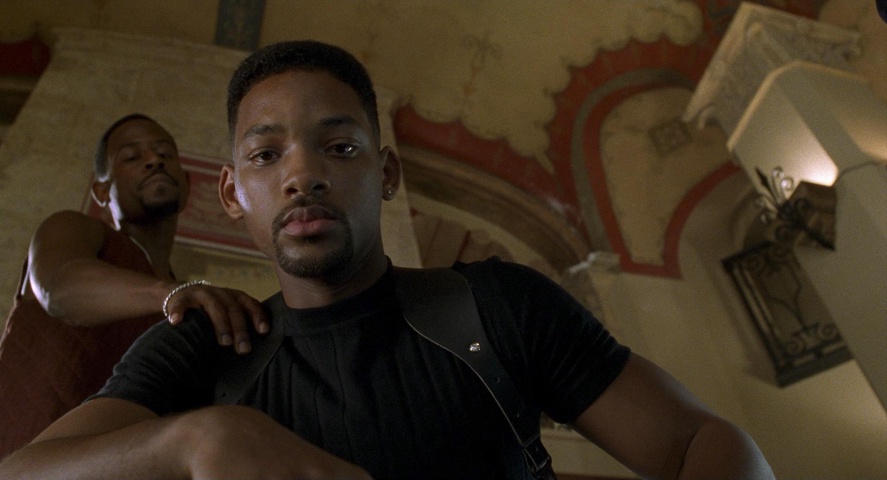
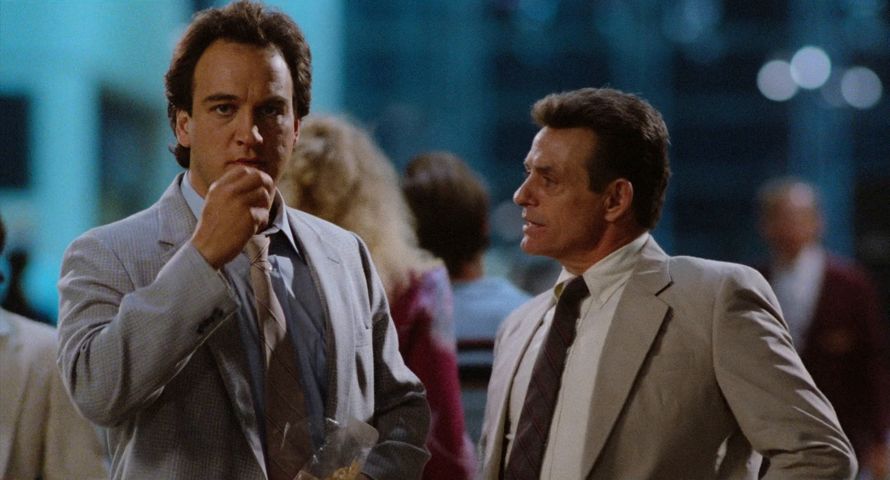
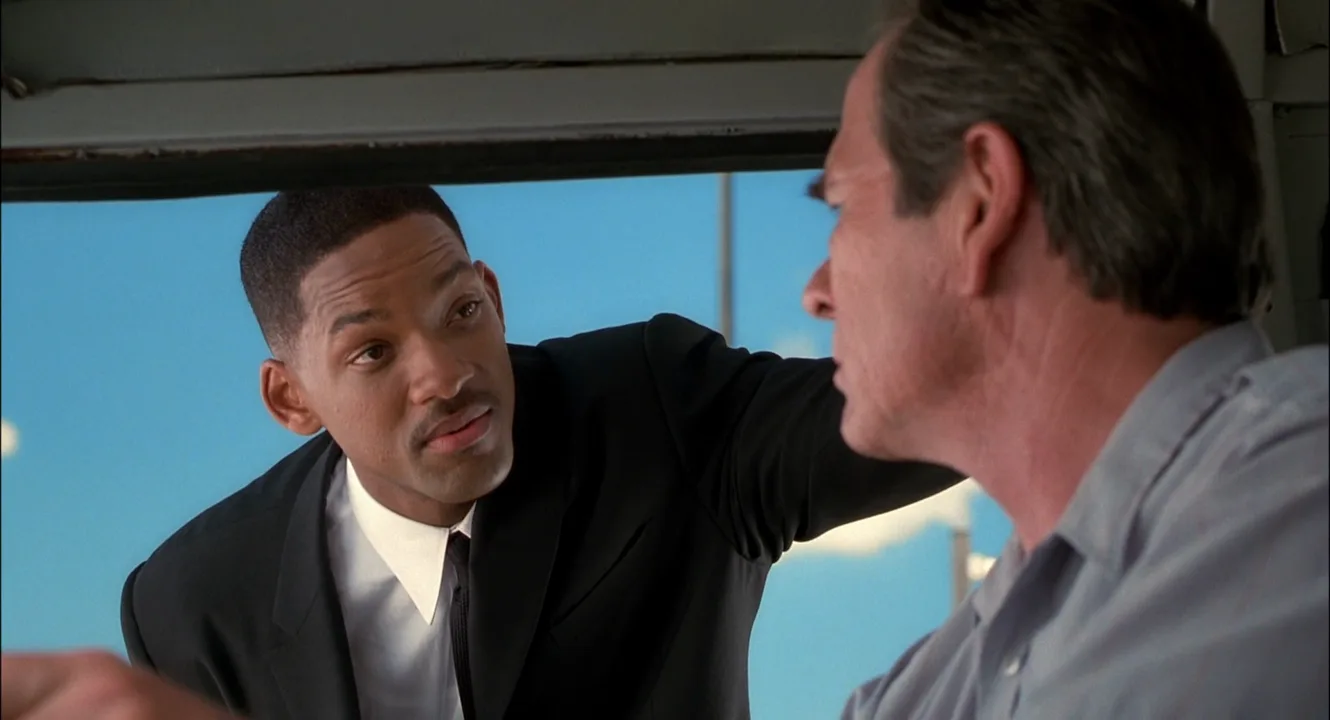
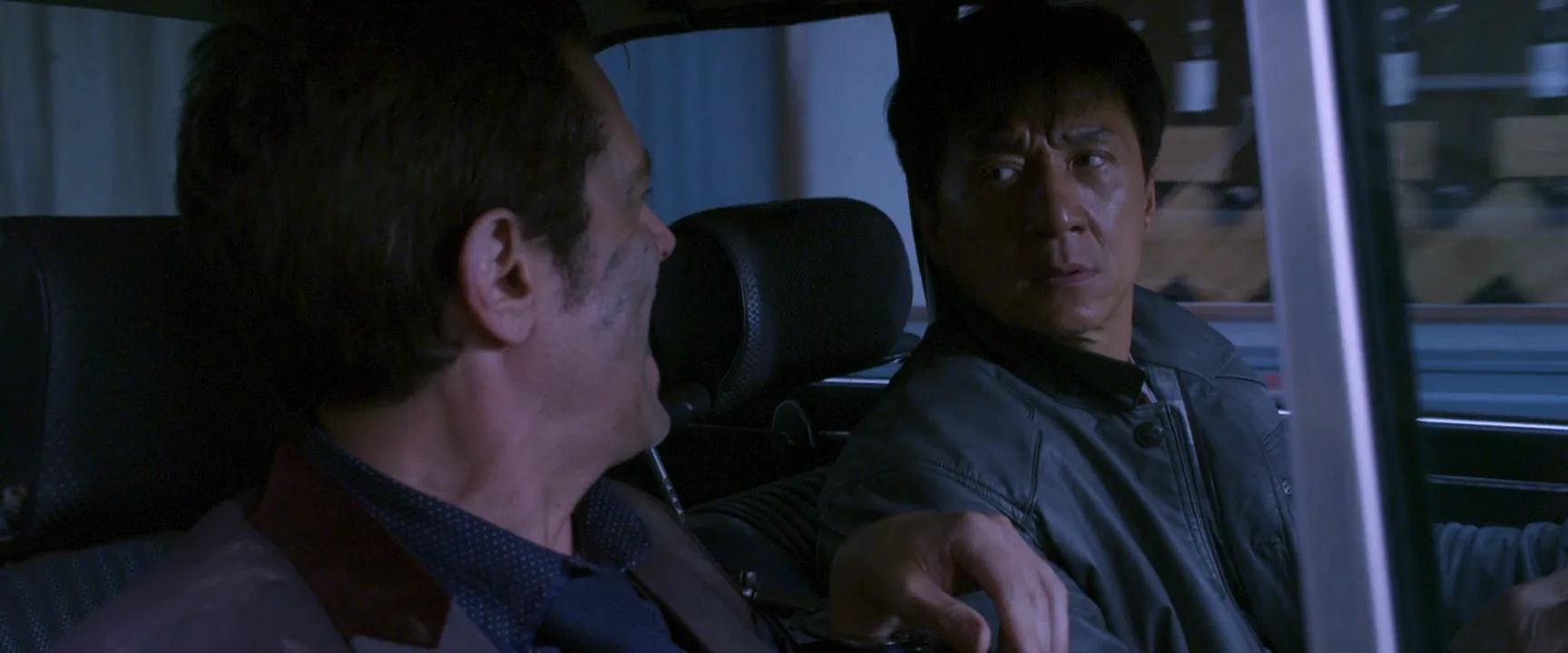
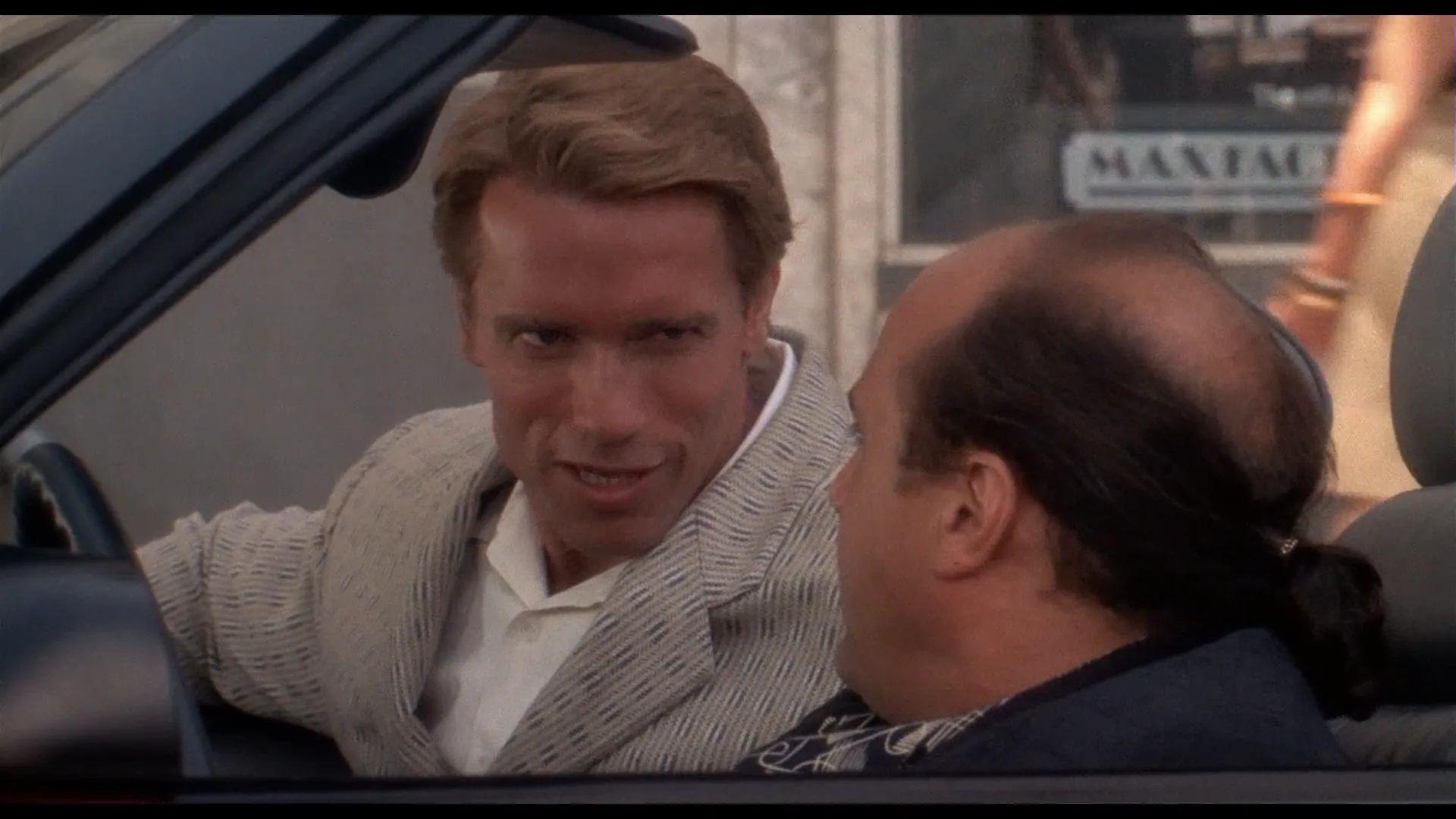
8 framesNotice how often the partners share one frame, and how costume and posture show the mismatch.
How to create a buddy cop film with AI
4 promptsImage models default to one hero, so the job is keeping two people in one frame and making them opposites at a glance. Describe each partner separately, then state the framing that holds them together. Keep partner references and takes on one FlashBoards board so every shot keeps the same duo. The fourth prompt re-shoots a real film shot from a text description alone, and the original plays next to the result so you can compare.
Medium two-shot through the windshield of a parked 1990s sedan at night, 35mm lens at dashboard height, both faces sharp. Driver's seat, frame right, behind the wheel: a lanky man in his fifties with a gray buzz cut, deep-set eyes and a rumpled brown corduroy blazer, holding a paper coffee cup, deadpan. Passenger seat, frame left: a compact woman in her late twenties with a copper-red braid, heavy freckles and a yellow bomber jacket, mid-sentence, hand raised. Orange streetlight from the right, blue dashboard glow, rain beads on the glass, film grain.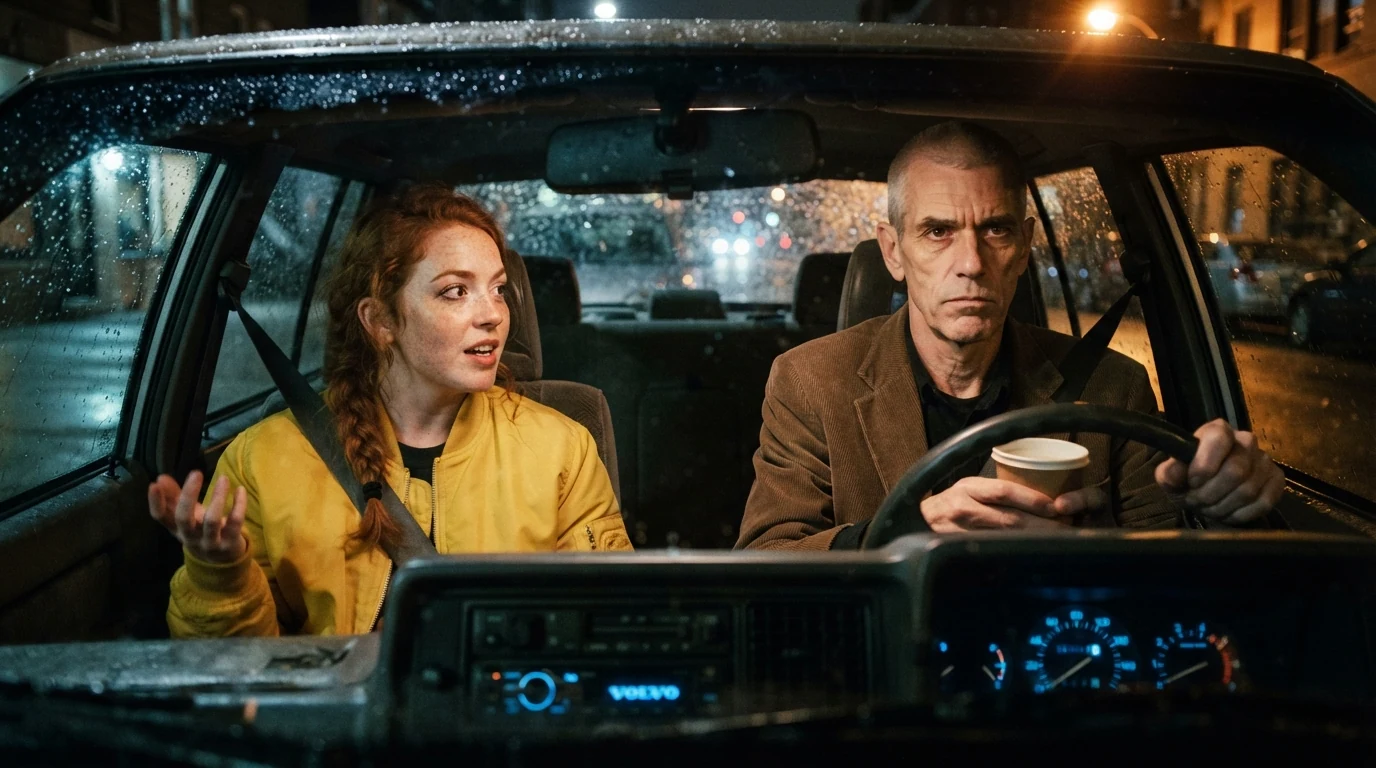
"Two-shot through the windshield" and "dashboard height" lock both partners into the genre's key setup; opposed age, stillness and color build the mismatch.
Open FlashBoardsLow-angle wide shot, camera at knee height, 24mm lens: two partners walk side by side toward the lens down a wet harbor pier at dawn. Left: a tall broad man in his forties with a shaved head, thick black beard and navy peacoat, striding calmly. Right: a slight man in his twenties with round wire glasses, curly blond hair and an oversized tan trench coat, half a step behind, hurrying. Smoke drifts from a burning cargo container behind them, gold backlight, long shadows.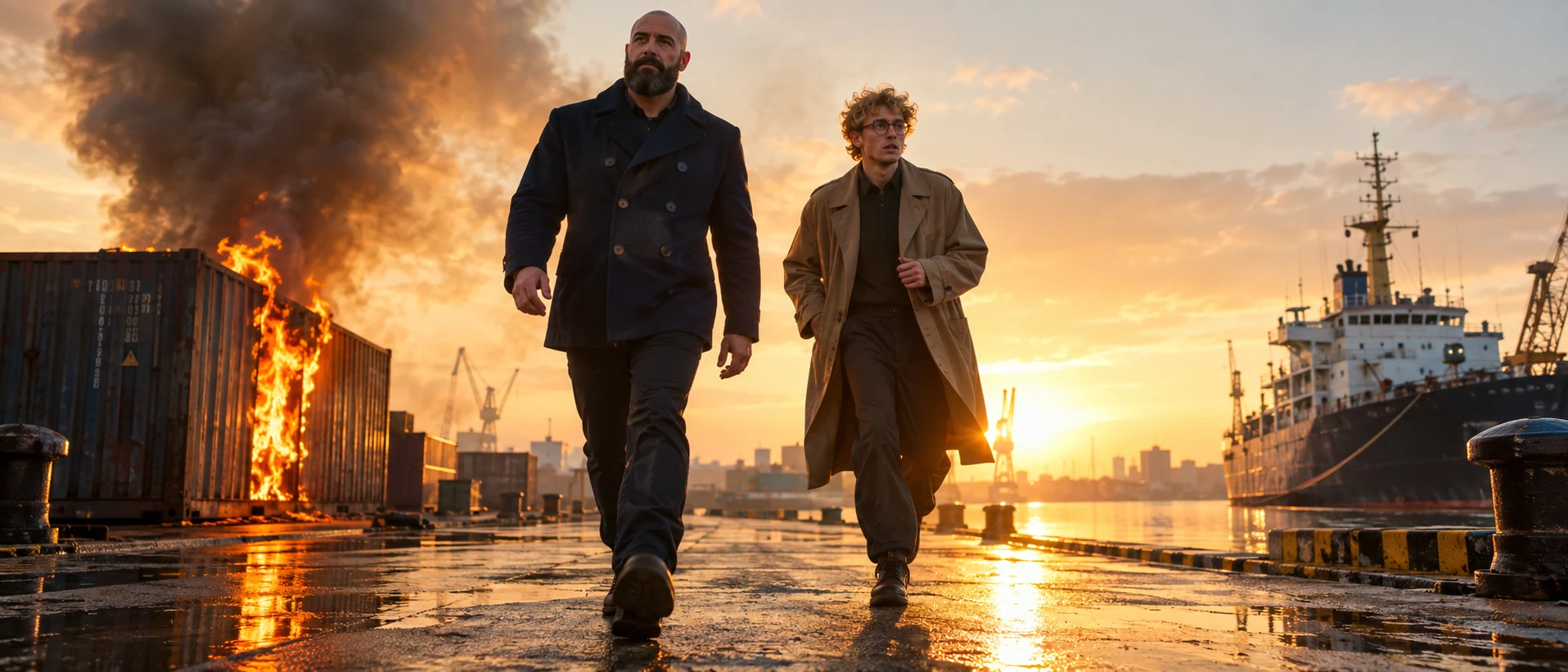
"Knee height" and "side by side toward the lens" give the earned hero shot; "half a step behind" writes the power imbalance into the blocking.
Open FlashBoardsCamera: a slow, steady push-in through the windshield from the medium two-shot to a tighter two-shot, both faces in frame throughout. Action: the woman in the yellow jacket is already talking fast, jabbing her finger at the dashboard. The gray-haired man sips his coffee without looking at her. Then he lowers the cup, turns toward her and raises one eyebrow, and she stops mid-word. Rain streaks down the windshield."Already talking fast" makes the shot alive from frame one. Rant, ignored, one look, silence: the buddy-cop joke in miniature, with a gentle move that keeps both partners in frame.
Open FlashBoards{
"output": "Full-screen live-action scene from Men in Black II (2002) from its very first frame: one continuous shot, no cuts. Glossy early-2000s 35mm studio comedy, bright midday sun, clear saturated blue sky, crisp warm skin tones, the dark gray-green interior of a parked delivery truck cab.",
"characters": {
"S1": {
"name": "Jay, played by Will Smith",
"look": "young Black man around thirty, short cropped black hair, slim black suit, white shirt, thin black tie",
"voice": "earnest, coaxing, half-pleading"
},
"S2": {
"name": "Kay, played by Tommy Lee Jones",
"look": "weathered man in his fifties, dark hair graying and swept back, deep lines on his cheek and neck, pale gray-blue work shirt with a collar",
"voice": "silence: he never speaks"
}
},
"shots": [
{
"shot": 1,
"camera": "static, locked-off, from inside the truck cab at seated eye level, slightly low toward the open side doorway, 40mm lens; over-the-shoulder two-shot: S2 large in the right foreground in right profile, facing screen left, his right ear and right cheek toward the lens, slightly soft; S1 in the left third, mid ground, sharp, framed in the doorway against the blue sky; the dark roof edge of the cab runs across the top of frame. Framing stays exactly the same to the end.",
"action": [
"BEGINNING: alive from the first frame, S1 is already leaning in through the doorway from outside, his left arm stretched along the edge of the door frame toward screen right, head tilted, eyes on S2's face, mid-sentence, brow knitted, mouth moving; S2 sits turned toward him, looking screen left straight at S1, face set, lips closed.",
"THEN: S1 keeps talking to S2, head bobbing slightly with his words, eyebrows rising and falling; S2 holds perfectly still, eyes on S1, jaw set, lips closed.",
"THEN: S1 pauses for a breath, then lifts his chin and rolls his eyes up toward the sky above screen left as he speaks again, a wistful look.",
"THEN: S1 brings his eyes back down to S2's face, leans a touch closer, brow furrowed, pleading.",
"END: S1 finishes his line still looking at S2, waiting for an answer; S2 stays turned to him, motionless, not a flicker on his face, lips closed."
],
"dialogue": [
{
"speaker": "S1",
"on_screen": true,
"when": "from the first frame, already mid-flow",
"delivery": "earnest, coaxing",
"line": "<d>[English] When you look at the stars, you get a feeling like you don't know who you are.</d>"
},
{
"speaker": "S1",
"on_screen": true,
"when": "after a short breath, as his eyes go up to the sky and come back down to S2",
"delivery": "wistful, then pleading",
"line": "<d>[English] Like you know more about out there than you do down here.</d>"
}
]
}
],
"sound": {
"ambience": "quiet midday small-town street heard from outside, a light breeze, the truck engine off",
"speech": "exactly these spoken phrases, each said once, in this order, all by S1; S2 says nothing",
"never_spoken": "no narration and no voice-over: the descriptions, performance notes and step words of this prompt are never spoken aloud",
"music": "a film score under the scene, always below the voices: soft wistful strings with a faint high celesta shimmer, gentle and warm",
"subtitles": "none"
}
}Remakes the mail-truck two-shot from Men in Black II (2002), where Jay leans through the doorway to talk to Kay. The prompt keeps the static over-the-shoulder framing, Jay's two lines word for word, his look up at the sky and Kay's stone-faced silence.
The camera block pins one over-the-shoulder frame for both partners. Jay gets the film's own two lines and one glance at the sky, while Kay is told to stay silent and still, so the joke lives in the listener.
Open FlashBoardsCommon mistakes
- Models drift toward one protagonist and crop the second. Say "two-shot" and "both faces sharp".
- Two generic cops come out as twins: vary age, build, hair and wardrobe color.
- Car interiors flip the driver: name the seats.
- In video, write the reaction as an action ("raises one eyebrow"), or both partners keep talking at once.
Keep the reference frames, prompts and every generated take side by side — images and video in one canvas.
FAQ
4 questionsWhat are the best buddy cop movies?
Frequently cited classics include In the Heat of the Night (1967), 48 Hrs. (1982), Lethal Weapon (1987), Bad Boys (1995), Rush Hour (1998), Hot Fuzz (2007) and 21 Jump Street (2012). Each rests on a clear mismatch, and most spawned sequels.
What was the first buddy cop movie?
There is no single first, but In the Heat of the Night (1967) is the usual starting point. Walter Hill's 48 Hrs. (1982), pairing a cop with a convict, set the modern action-comedy version that Lethal Weapon built on.
Is buddy cop a genre?
It is a subgenre of the crime or action film, often hybridized with comedy. Its defining convention is structural, not visual: two mismatched partners on one case, which lets it absorb sci-fi or high-school comedy.
Why are buddy cop movies usually comedies?
Because the premise produces comedy automatically. Two people with opposite methods, forced to share a car and a case, disagree about everything, and the action raises the stakes so the humor never feels weightless.
Related terms
4- ComedyGenres
Comedy is the genre built to make the audience laugh — through character, situation, wordplay or physical gags — and it usually bends toward a happy or reconciling ending.
- Character ArchetypeStorytelling
A character archetype is a recurring role that audiences recognize across cultures — the mentor, the trickster, the shadow, the herald — which writers adapt rather than copy.
- Hybrid GenreGenres
A hybrid genre film fuses the conventions of two or more genres — sci-fi horror, western musical, romantic comedy-thriller — so that each genre's expectations reshape the other's.
- Film GenresGenres
A film genre is a category of films that share recognizable conventions of story, setting, character and style — western, horror, musical, noir — letting audiences know what to expect and filmmakers play with it.
Further reading
Yvonne Tasker, Spectacular Bodies: Gender, Genre and the Action Cinema (Routledge, 1993). Philippa Gates, Detecting Men: Masculinity and the Hollywood Detective Film (SUNY Press, 2006).