 FlashBoards Learn
Genres · Film language
Hybrid Genre
Also called: genre hybrid, genre mashup, cross-genre
A hybrid genre film fuses the conventions of two or more genres, such as sci-fi horror, western musical or horror comedy, so that each set of expectations reshapes the other. The audience gets familiar signals from both sides, and the friction between them produces tension, laughs or surprise that neither genre delivers alone.
- What it does
- Combines two genre rulebooks so the audience reads every scene through both at once.
- Use it when
- One genre gives you the story engine and another gives you a fresher look, tone or threat.
- Watch out
- If neither genre commits fully, the film reads as confused instead of fused; play each side straight.
- Try this prompt
Wide desert shot at golden hour, lone cowboy on horseback, smoking crashed alien craft on the horizon, 35mm film still
What is a hybrid genre?
Every genre is a contract. A western promises open land, a code of honor and a showdown; a horror film promises a threat, isolation and fear. A hybrid genre film signs two contracts and honors both. Alien (1979) keeps the working spaceship, crew and hardware of science fiction, then runs the plot like a haunted-house movie: a monster, dark corridors, people picked off one by one.
The key word is fuse. A drama with one joke or an action film with a romantic subplot is not a hybrid. Both genres must carry structural weight. Test it by removing one side and asking which genre conventions the film loses: take the zombies out of Shaun of the Dead (2004) and the plot dies; take the comedy out and the point of view dies.
Other names: genre mashup, cross-genre, genre blending.
Why do filmmakers mix genres?
Freshness. Audiences know a pure genre's beats by heart; a second genre moves them. Blade Runner (1982) puts a hardboiled detective story, with the weary investigator, femme fatale and smoky interiors of film noir, inside a science-fiction city, and both genres look new.
Tone control. Comedy lowers the audience's guard, so the scare lands harder; fear raises the stakes, so the laugh releases more. The same logic drives tragicomedy.
Commentary. Get Out (2017) is paced as a thriller that slides into horror, while its dialogue plays as social satire.
The switch. From Dusk Till Dawn (1996) plays as a crime road movie for about half its running time, then turns into a vampire siege. The hinge is the film's biggest event.
Common hybrid genre combinations
- Sci-fi horror: technology builds the trap, horror supplies the monster (Alien, 1979; The Thing, 1982).
- Sci-fi noir: a detective plot and noir lighting in a future city (Blade Runner).
- Horror comedy: a real threat, ordinary and funny characters (Shaun of the Dead).
- Action comedy: mismatched leads, chases and one-liners, the backbone of the buddy cop film.
- Western musical: frontier settings and song numbers (Paint Your Wagon, 1969).
- High-school noir: hardboiled double-crosses among teenagers in sunlit suburbia (Brick, 2005).
How to shoot a hybrid genre film
Treat the two genres as two visual codes.
Pick a host look. One genre sets the baseline for lens, light and palette; the other arrives as an intruder. For sci-fi horror, light a lived-in industrial ship with practical fluorescents, steam and grime at a 2:1 key-to-fill ratio so it feels ordinary, then push to 8:1 low-key, hard top light and deep shadow when the creature appears. The audience reads the ratio change as a genre change.
Keep one constant. If everything shifts, the film breaks. Hold the lens family, grain or camera height across both modes and change light and color. A horror comedy can stay on wide 24–28mm lenses at eye level, with flat, bright light for jokes and one hard, cold source for scares.
Stage the collision in one frame. The strongest hybrid images hold both genres at once, like a cowboy silhouetted against a crashed spacecraft.
Mark the hinge. If the genre flips mid-film, change something the viewer feels: aspect ratio, color temperature (3200K tungsten to cold 5600K-plus), handheld vs. locked-off, or the score. One decisive shift beats many small ones.
Hybrid genre vs. subgenre and postmodern pastiche
A subgenre narrows one genre: the slasher is a kind of horror, the spaghetti western a kind of western. A hybrid merges two rulebooks of equal weight, so a zombie comedy is a subgenre of neither parent.
A pastiche in postmodern film quotes many genres at once and invites the viewer to spot the references. A hybrid can be completely sincere: Alien never winks. Pastiche plays with genre as style; a hybrid uses genre as machinery. The film genres hub covers the parent genres that combine most often.
How to create a hybrid genre with AI
3 promptsImage models default to one genre's look per prompt, so a hybrid prompt must name each genre's visual code and place both in one frame: the host setting and light first, then the intruder as a concrete, visible object. Keep the takes on one FlashBoards board beside your references to see which reads as both genres.
Wide establishing shot, camera at eye level, 40mm anamorphic lens: a flat red desert at golden hour, long shadows. A lone rider on a dappled gray horse in the left third: a weathered woman in her fifties, long gray braid, sunburned freckled face, scar across her chin, dusty duster coat, flat-brimmed black hat, lever-action rifle across the saddle. On the horizon at right, a huge crashed metallic spacecraft half-buried in sand, black smoke rising, faint blue lights blinking along its hull. Warm amber backlight on the rider, cool blue glow from the wreck. Western film still, 35mm grain.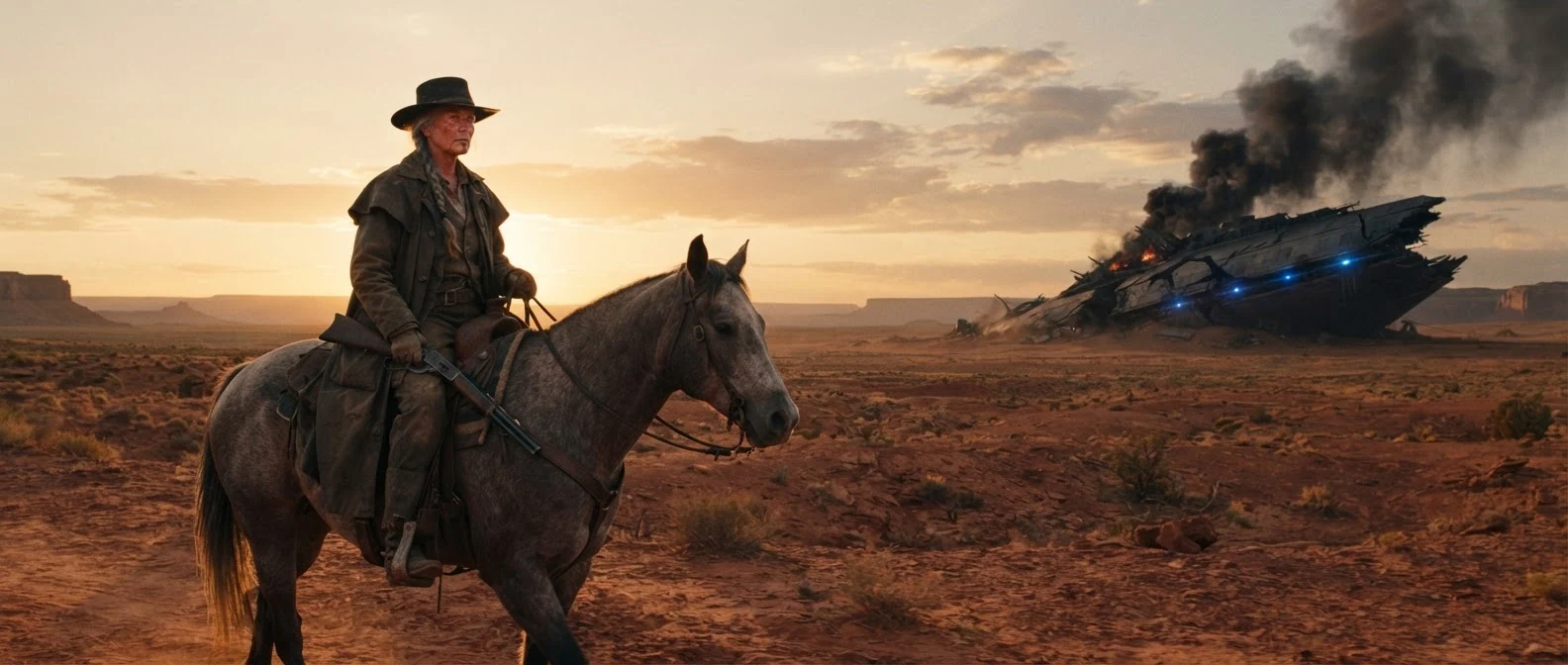
Lone rider, duster, lever-action rifle, golden hour lock in the western code; the crashed spacecraft and blue lights bring science fiction into the same frame, each genre owning its own color.
Open FlashBoardsMedium-wide shot, camera at chest height, 28mm lens: a cramped rented kitchen at night, flat bright overhead light, yellow cabinets, dishes piled in the sink. Two roommates in their twenties frozen side by side in mismatched pajamas: one lanky with a shaved head, round wire glasses and a striped robe, gripping a cricket bat; the other short and stocky with a red curly mullet and a dinosaur-print onesie, holding a frying pan like a tennis racket. Behind them, a gray hand pressed flat against the back door's frosted glass, lit cold blue from outside.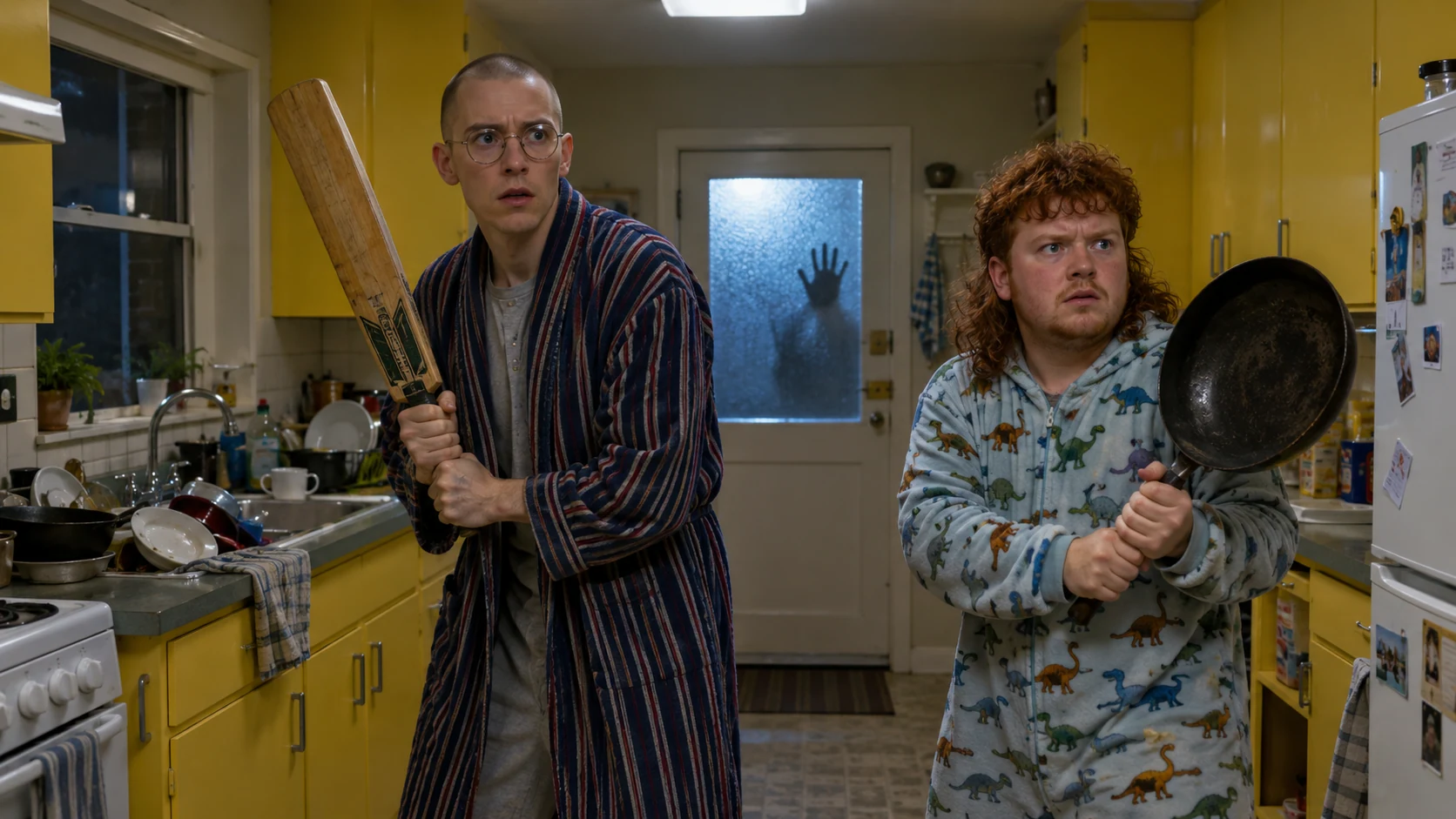
The light splits by genre: flat bright overhead for comedy, cold blue for horror, with the door glass as the border. Improvised weapons keep the roommates funny while the threat stays real.
Open FlashBoardsCamera: a slow, steady push-in toward the rider from the first frame, covering about a quarter of the distance, horizon level. Action: the gray horse is already walking forward, dust lifting from its hooves. The rider pulls the reins and the horse stops, tossing its head. She turns toward the smoking spacecraft as the blue lights on its hull blink faster, then lifts the rifle and rests it across her lap while the smoke drifts sideways.Motion starts immediately (already walking, dust lifting), so the model does not freeze on the still. Only elements from recipe 1 appear, and the blinking lights let the sci-fi side answer the rider's gesture.
Open FlashBoardsCommon mistakes
- One genre wins. Models average the prompt into the more common look. Name each genre's light separately ("warm amber on the rider, cold blue from the wreck").
- The intruder gets lost. Give the second genre's element a screen position and size ("huge, on the horizon at right").
- Comedy turns into horror. Words like monster darken the whole frame. Describe the bright setting first, the threat as one detail.
- Pastiche instead of fusion. Listing four genres yields a costume party. Stick to two codes.
Keep the reference frames, prompts and every generated take side by side — images and video in one canvas.
FAQ
5 questionsWhat is a hybrid genre in film?
A hybrid genre film combines the conventions of two or more genres so that both shape the story and style. Alien (1979) is science fiction in setting and horror in plot; Shaun of the Dead (2004) is a zombie film told as a comedy. Remove either genre and the film stops working, which separates a hybrid from a film that borrows a scene or two.
What are examples of genre hybrid films?
Well-known examples include Alien (sci-fi horror), Blade Runner (sci-fi noir), Shaun of the Dead (horror comedy), From Dusk Till Dawn (crime film turning into vampire horror), Get Out (horror thriller with social satire) and Brick (noir in a high school). Buddy cop films are a long-running action comedy hybrid.
Is a hybrid genre the same as a subgenre?
No. A subgenre narrows a single genre: the slasher is a type of horror. A hybrid merges two parent genres with roughly equal weight, drawing conventions from both. Over time a popular hybrid can harden into its own label, such as the zombie comedy or the space western, and start behaving like a subgenre.
How do you make a cross-genre film look coherent?
Choose one genre as the visual host and keep at least one element constant, such as lens family, grain or camera height. Let the second genre enter through changes in lighting ratio, color temperature or camera movement. Viewers accept big tonal swings when the image system stays recognizably the same.
Why are hybrid genres popular?
They give audiences familiar pleasures in an unfamiliar order. Each genre sets up expectations and the other bends them, so scenes feel recognizable and surprising at once. Hybrids also balance tone, using comedy to relieve horror, and reach fans of both parent genres.
Related terms
5- Genre ConventionsGenres
Genre conventions are the recurring settings, characters, plot moves, images and sounds an audience expects from a genre; filmmakers follow, bend or break them to meet or subvert those expectations.
- TragicomedyGenres
Tragicomedy blends tragic and comic modes in one story, so that laughter and grief sit side by side and color each other — Life Is Beautiful is a classic film example.
- Buddy Cop FilmGenres
A buddy cop film pairs two mismatched partners — by temperament, age, race or method — who must solve a case together; the friction between them drives the comedy and the action (48 Hrs., Lethal Weapon, Rush Hour).
- Postmodernism in FilmFilm Movements & Styles
Postmodern film mixes genres and high and low culture, quotes and remixes other films, breaks linear time and plays self-consciously with its own artifice — Pulp Fiction, Blade Runner, The Truman Show.
- Film GenresGenres
A film genre is a category of films that share recognizable conventions of story, setting, character and style — western, horror, musical, noir — letting audiences know what to expect and filmmakers play with it.
Further reading
Rick Altman, Film/Genre (BFI, 1999). Barry Keith Grant, Film Genre: From Iconography to Ideology (Wallflower, 2007).