 FlashBoards Learn
Genres · Film language
Comedy
Also called: comedy film, film comedy
Comedy is the film genre built to make the audience laugh, through character, situation, wordplay or physical gags, and it usually bends toward a happy or reconciling ending. On screen the laugh depends on craft as much as script: framing that shows the whole gag, timing that holds, and cuts that land on the reaction.
- What it does
- Releases tension through surprise and incongruity, and tells the audience it is safe to laugh.
- Use it when
- The story's conflict can be played for embarrassment, misunderstanding or absurdity rather than pain.
- Watch out
- Tight framing and fast cutting kill physical gags; let the audience see the setup and the payoff in one frame.
- Try this prompt
Wide locked-off shot, full body, a waiter mid-stumble with a tower of plates tilting, straight-faced diners watching, bright even high-key light, 28mm lens.
What is comedy in film?
Comedy is one of the oldest film genres: a story engineered to produce laughter, where conflict comes from misunderstanding, vanity, bad luck or a character who refuses to adapt, and where the ending tends to restore order. The stakes can be real, but the tone promises that nobody will be permanently broken.
The engine is incongruity. A joke plants an expectation, then breaks it the moment the audience has committed to it, which is why comedy lives on setup and payoff. Other genres borrow comedy for a scene; when it drives the whole film, it is comedy proper.
What are the types of comedy in film?
- Slapstick. Falls, chases and collisions with no lasting harm, from Chaplin and Keaton to Dumb and Dumber (1994).
- Screwball and romantic comedy. Fast talk between mismatched lovers: Bringing Up Baby (1938), His Girl Friday (1940).
- Satire. The laugh carries a critique; Dr. Strangelove (1964) turns nuclear policy into farce.
- Parody. Imitates a genre's clichés; Airplane! (1980) spoofs disaster movies.
- Black comedy. Laughs about death and crime, as in Fargo (1996).
- Hybrids. Shaun of the Dead (2004) plays a zombie film as slacker comedy.
Why do filmmakers use comedy?
Laughter is a physical release, and comedy decides when it happens. An audience that has laughed with a character trusts them and will follow them into sadder material later. Comedy also lets a film say things that would be unbearable straight, and it assigns status: the hero who jokes under fire seems in control, the pompous figure who slips on the stairs gets cut down to size.
An old line attributed to Chaplin holds that life is tragedy in close-up and comedy in long shot. For the camera, distance means seeing the whole absurd situation instead of feeling one person's pain.
How to shoot comedy: framing, timing and cutting
Frame wide for physical gags. Keep the full body and the object that causes trouble in one frame: a 24–35mm lens at eye or chest height, locked off, shows setup and payoff without a cut. Jacques Tati's Playtime (1967) hides several gags in one deep frame.
Hold, then cut to the reaction. Much comedy lives in the reaction shot: the straight character who stares, the pause before a reply. Cut late enough for the silence to register, and leave a few frames after a punchline so the next line is not lost under the laughter.
Pick one rhythm per scene. Wes Anderson's calm centered wides in The Grand Budapest Hotel (2014) make chaos funnier; Edgar Wright's rapid montages in Shaun of the Dead make the editing the joke.
Light for readability. Mainstream comedy favors bright, even, high-key light and saturated color so faces and props read instantly; low-key light pushes a scene toward black comedy or parody.
Comedy vs. drama: what is the difference?
Drama asks the audience to feel conflict from inside a character; comedy shows it from a slight distance. A man locked out of his house in his underwear is drama if we stay close on his humiliation, comedy if we frame him wide as neighbors walk past.
Drama tends toward realism and lasting consequences. Comedy exaggerates, repeats and resets: a running gag can return three times because nothing permanently breaks. Comedy-drama, or dramedy, keeps real stakes under a comic surface.
Comedy examples in film
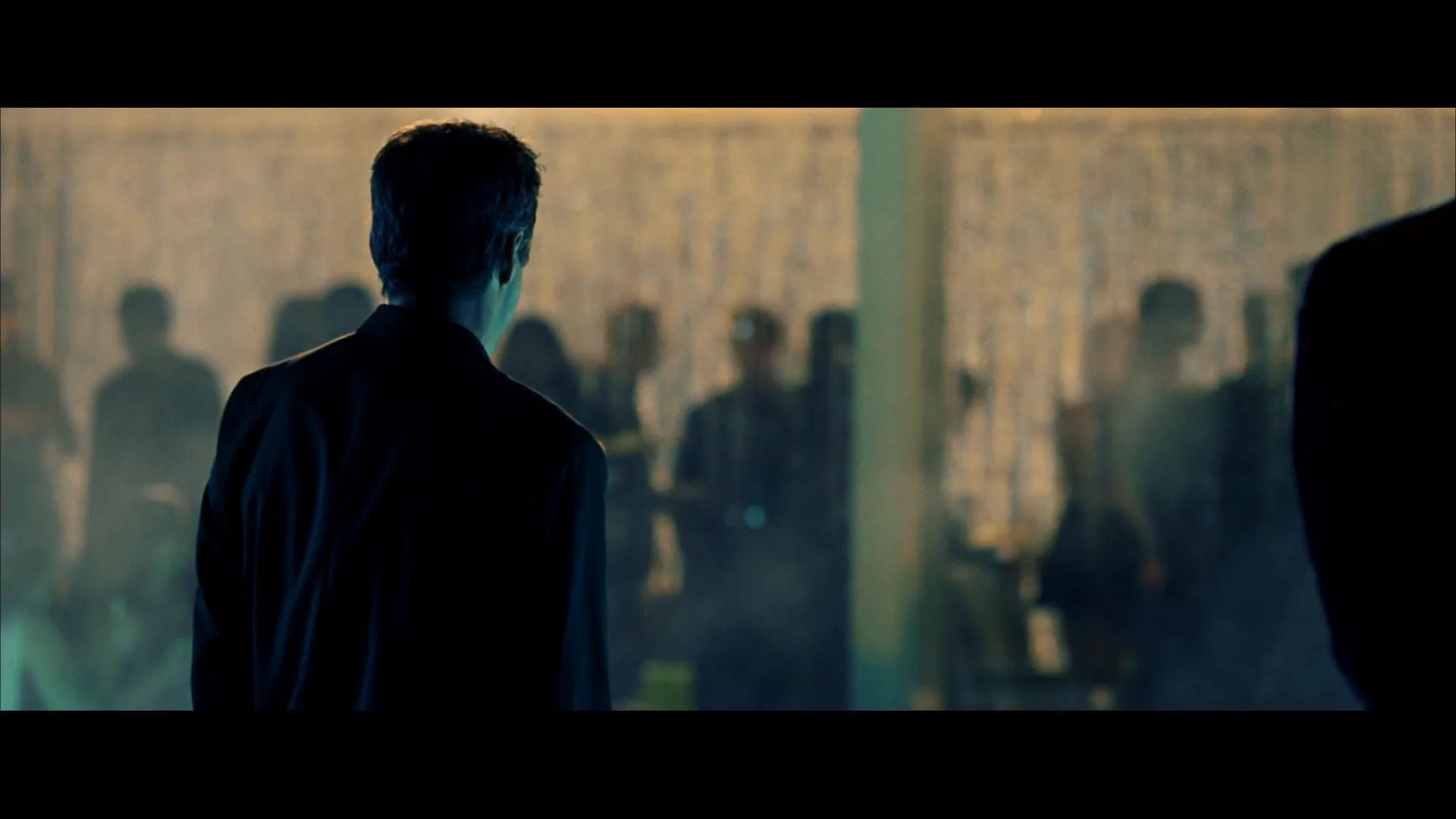
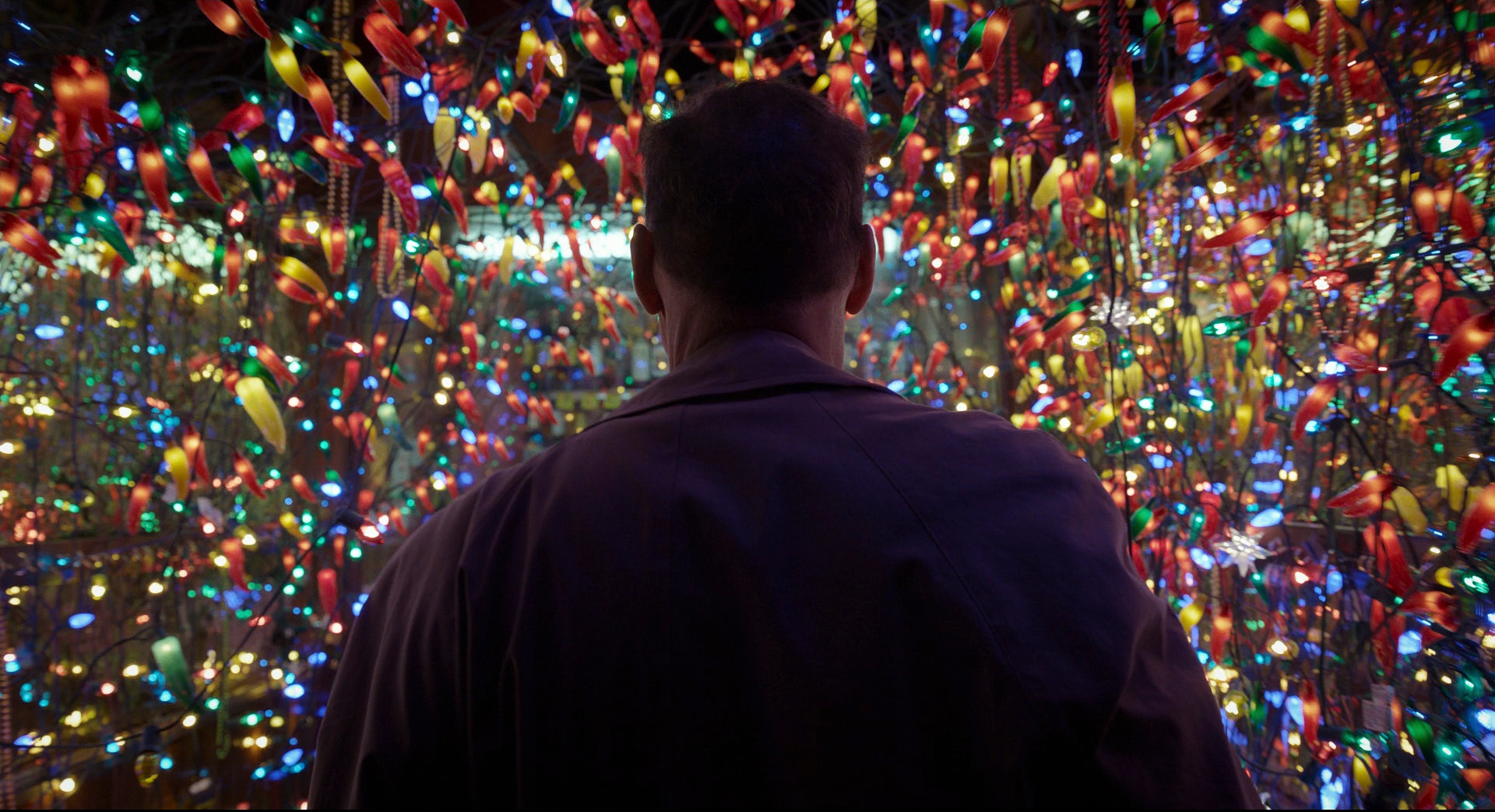
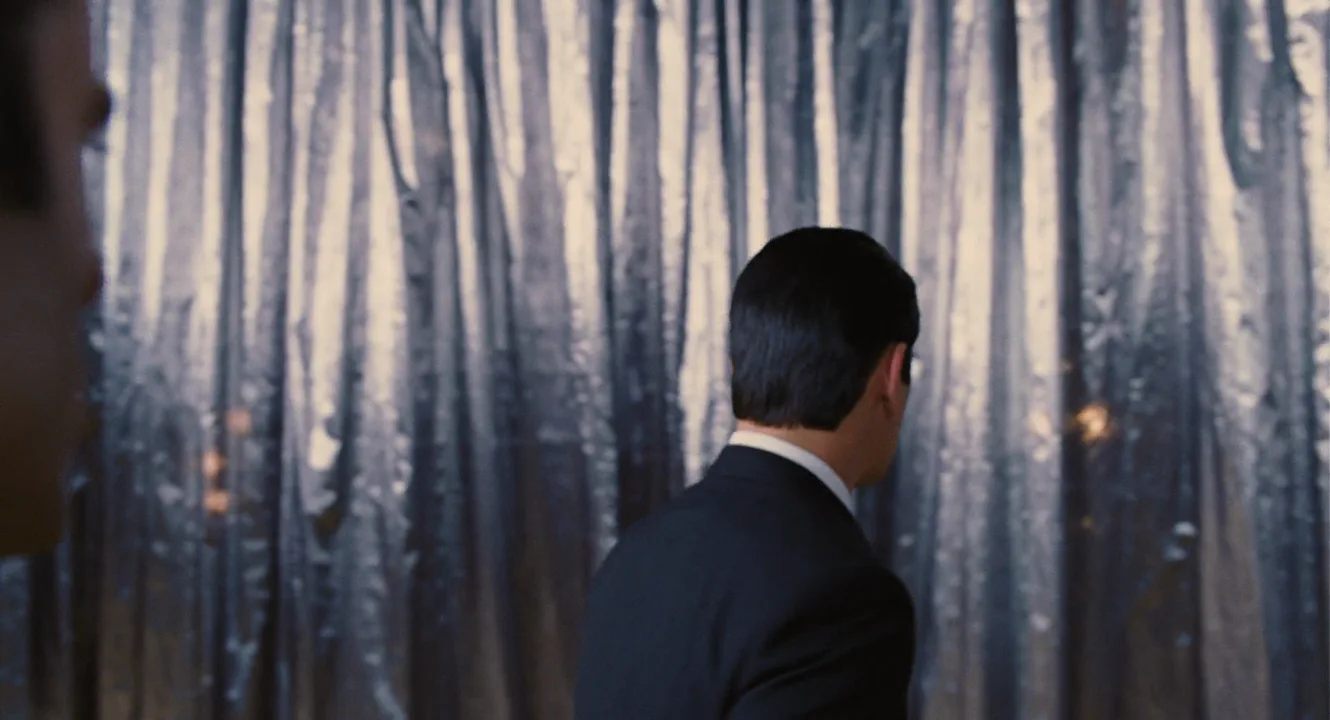
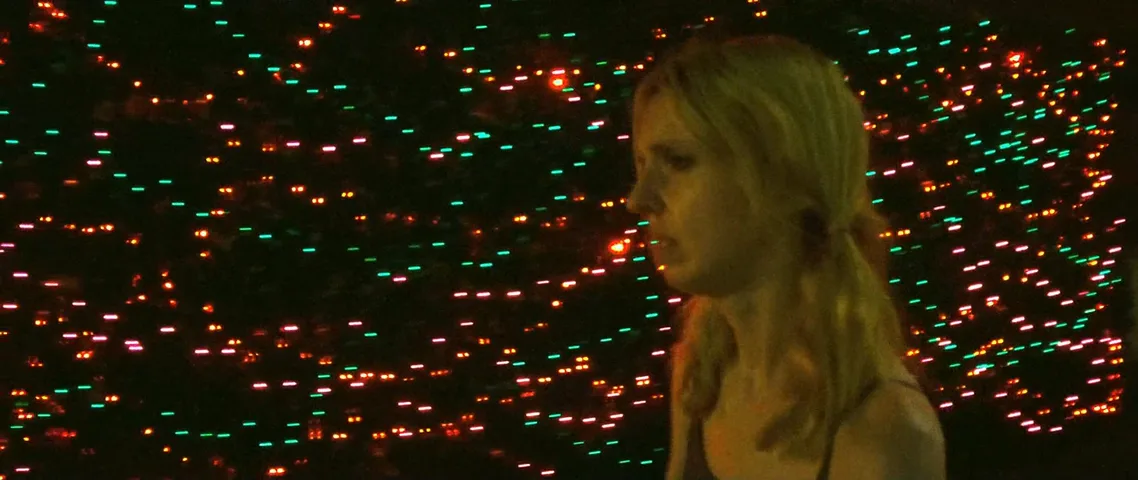
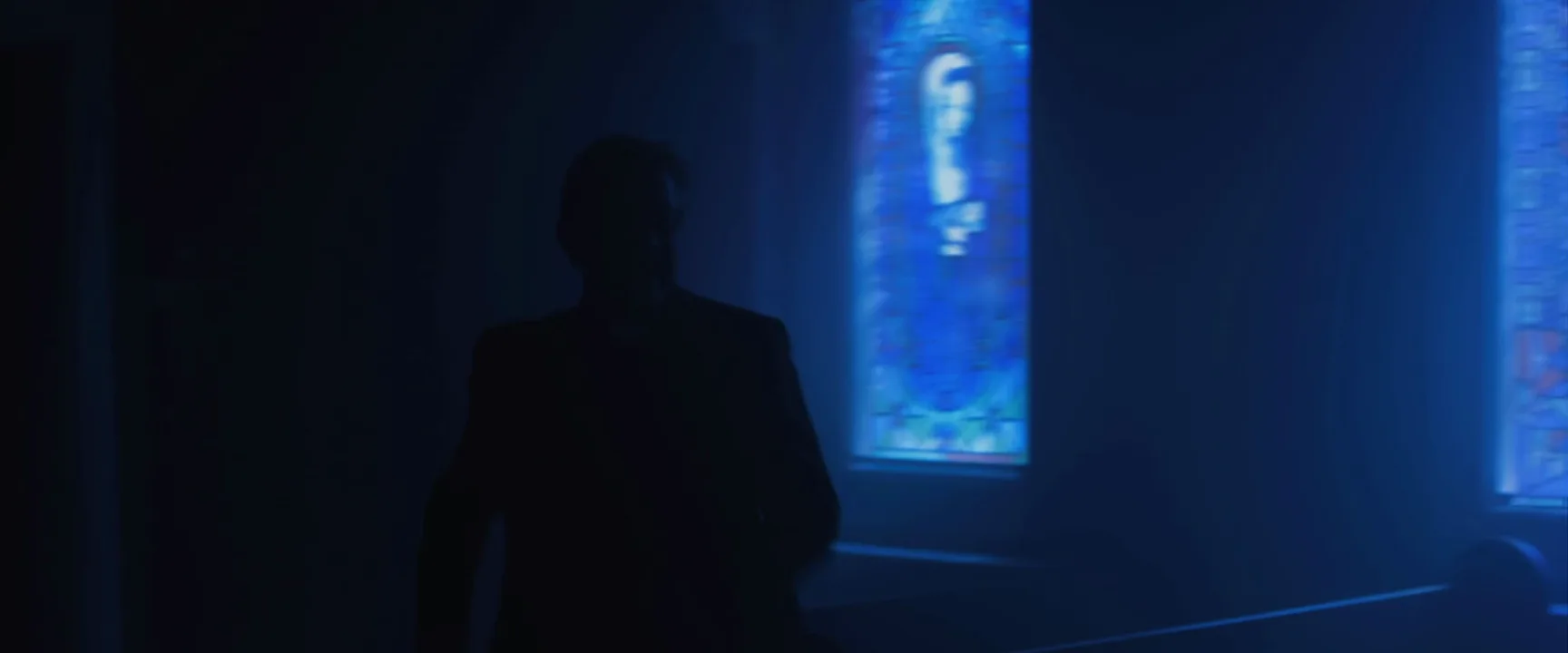
6 framesComedy is a genre, not a single shot, so these frames from comedies and comedy hybrids show how they handle light, faces and staging.
How to create a comedy with AI
4 promptsImage and video models can stage a gag, but they need the comic mechanics spelled out: full body in frame, the object that causes trouble, a straight face instead of a grin. In FlashBoards you keep comedy references, the start frame and its animated take on one board and compare timing side by side. The fourth prompt re-shoots a real film shot from a text description alone, and the original plays next to the result so you can compare.
Wide locked-off shot, full body, eye level, 28mm lens: a lanky baker in his 40s with a ginger handlebar mustache, flour-dusted orange apron and paper hat steps through a bakery's glass door balancing a tower of seven pastel cake boxes against his chin, the top box already sliding off; behind him three customers at the counter watch with straight faces. Bright even high-key daylight, saturated pastel colors.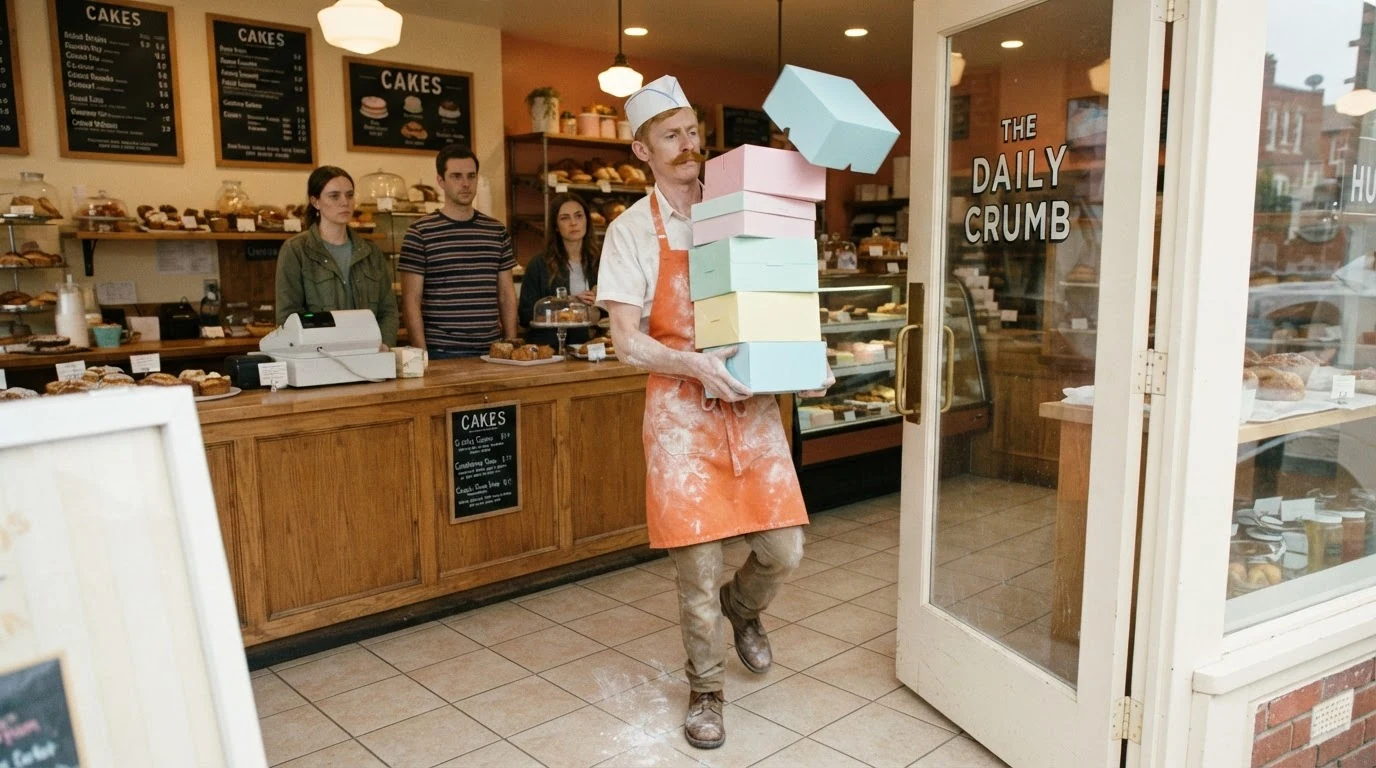
Wide locked-off, full body keeps setup and payoff in one frame; top box already sliding off starts the gag. Straight faces stops the model from making everyone laugh, and high-key, pastel sets the register.
Open FlashBoardsSymmetrical deadpan two-shot, centered, frontal, seated eye level: two office workers side by side at a mint-green desk, a stocky man in his 50s with a gray buzz cut and mustard cardigan, and a woman in her 30s with a short black bob and red cat-eye glasses, both looking into the lens with blank faces, mouths closed; between them a small potted cactus wears a tiny party hat. Flat soft front light, pastel wall, empty space on both sides.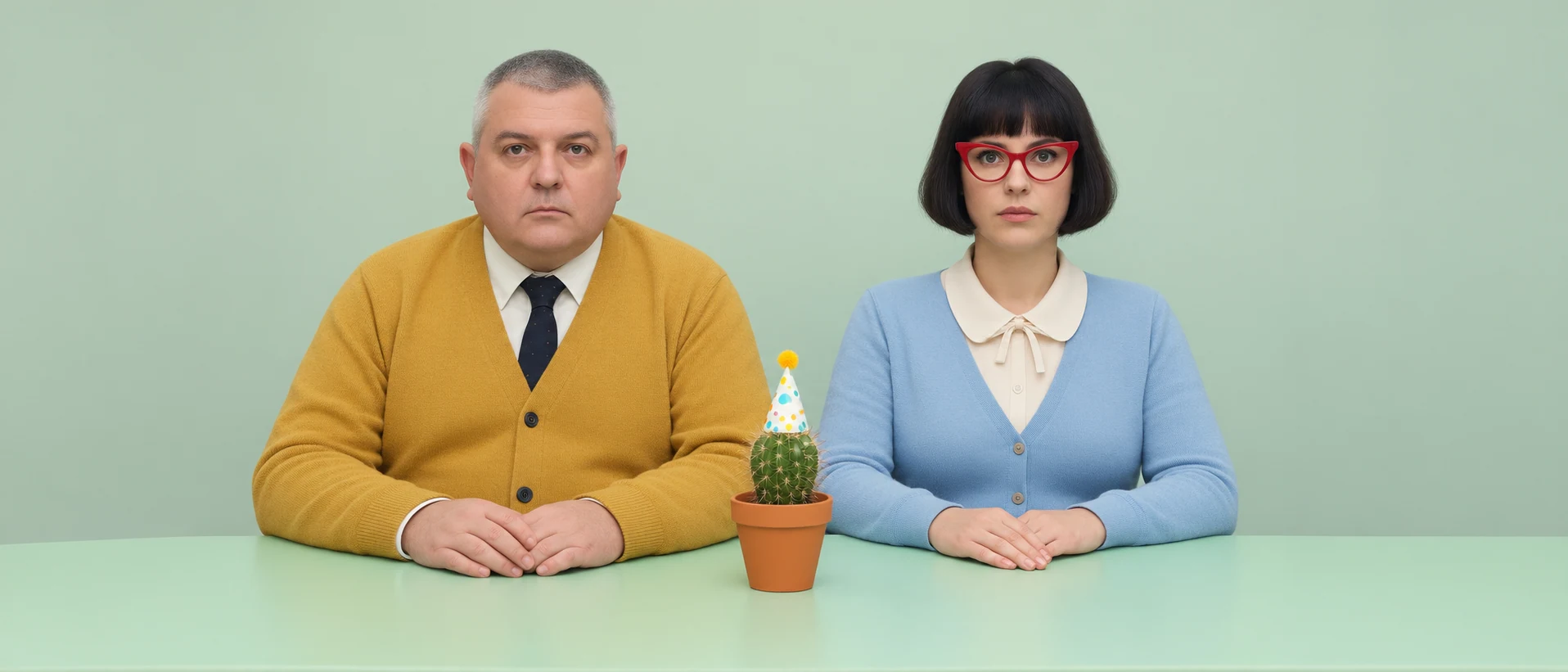
Comedy through stillness instead of action. Symmetrical, centered, frontal builds the rigid frame; blank faces, mouths closed states the deadpan positively; the absurd prop is the joke the faces ignore.
Open FlashBoardsCamera: locked-off wide shot, completely still. Action: the baker is already stepping through the door as the top cake box slides off. He lurches sideways and catches it on his raised knee, wobbling on one leg while the tower tilts the other way. He freezes, balanced, and looks at the customers with a straight face. The customers do not move.Alive from frame one (already stepping, slides off), written as three beats, setup, scramble and freeze, the way a physical gag is timed. Locked-off, completely still keeps the camera from pushing in on the wide.
Open FlashBoards{
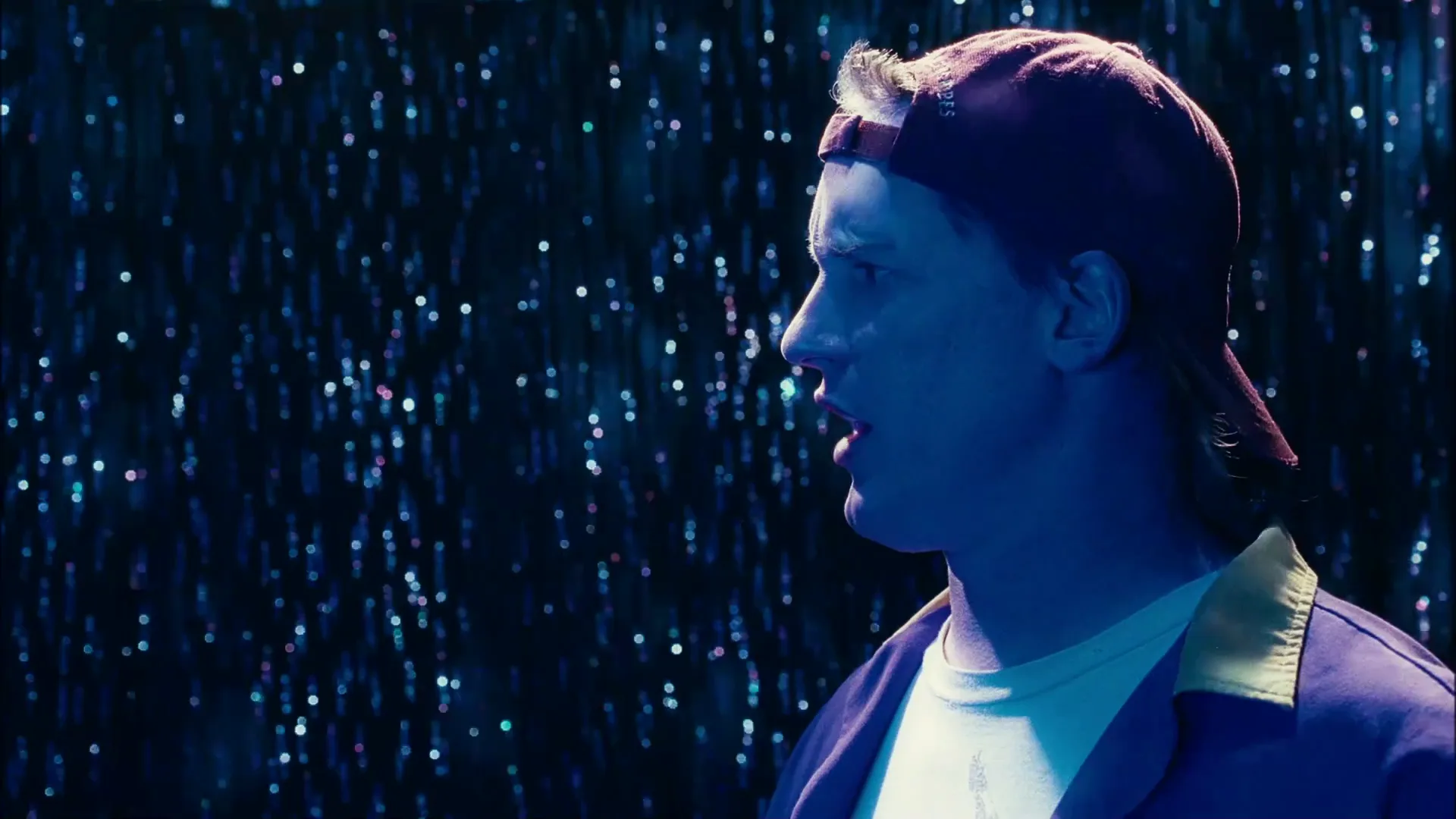
"output": "Full-screen live-action comedy scene from Clerks II (2006), from its very first frame: one continuous shot, no cuts. 2000s 35mm film grain, a dark room whose entire background is a floor-to-ceiling curtain of tiny twinkling blue-white lights, cold blue key light from the front left, deep shadows, palette of navy, electric blue and skin tones turned blue.",
"characters": {
"S1": {
"name": "Randal, played by Jeff Anderson",
"look": "stocky man around thirty, fair skin, reddish-brown hair to the collar, maroon baseball cap worn backwards, open royal-blue work jacket with a mustard collar and the words PORCH MONKEY in white tape letters across its back, pale T-shirt underneath",
"voice": "loud, cocky, carrying across the room"
},
"S2": {
"name": "Kelly, the bald man in the leather harness",
"look": "burly bald man in his forties, short dark goatee, a dark wraparound visor over his eyes, studded black leather collar, black leather harness straps crossing his bare chest and shoulders",
"voice": "deep, flat, matter-of-fact"
}
},
"shots": [
{
"shot": 1,
"camera": "static camera at chest height, normal lens, never moves or reframes; it opens as a medium shot of S1 from behind, and because S1 steps back toward the lens the same frame ends as a tight two-shot of both heads",
"action": [
"BEGINNING: alive from the first frame, S1 stands in the centre with his back to the camera, facing the wall of lights, the tape letters on his jacket readable, arms slightly away from his sides.",
"THEN: S1 turns to his right, over his right shoulder toward screen left, and steps back and to screen right, ending three-quarter facing the camera; his right hand, on screen left, comes up open at waist height in a loose gesture while he calls out toward someone off frame left, mouth wide.",
"THEN: his hand drops; he turns his head to profile, facing screen left, and stays in the right third of the frame, eyes up and off frame left, lips parted, waiting, body still; the left half of the frame shows only the twinkling lights.",
"THEN: S2 leans in from the left edge, bare shoulder first, then his bald head, and settles in the left third, facing screen right in profile, visor aimed at S1's face a head's length away; S1 keeps staring past him off frame left and does not notice.",
"THEN: S2 answers straight at S1's face, jaw moving, one fist rising at the lower-left frame edge; S1 stays frozen in profile.",
"END: S1 slowly turns his head toward the camera and drops his eyes to the floor, brow knitting, upper lip curling in a queasy grimace; S2 turns his visor briefly toward the lens, then back to S1, standing still at his shoulder."
],
"dialogue": [
{
"speaker": "S1",
"on_screen": true,
"when": "as he turns to face the camera, while his hand is raised",
"delivery": "loud, cocky, calling out across the room",
"line": "<d>[English] Yo, Freddie fucking Mercury, where's Kelly?</d>"
},
{
"speaker": "S2",
"on_screen": true,
"when": "after he has settled beside S1, facing him",
"delivery": "deep, flat, deadpan",
"line": "<d>[English] Right here.</d>"
}
]
}
],
"sound": {
"ambience": "a hushed dark room, faint muffled club bass heard from another room, the rustle of S1's jacket as he turns",
"speech": "exactly these spoken phrases, each said once, in this order",
"never_spoken": "no narration and no voice-over: the descriptions, performance notes and step words of this prompt are never spoken aloud",
"music": "a film score under the scene, always below the voices: a slow, sleazy lounge bass line with soft brushed drums",
"subtitles": "none"
}
}Remakes the static light-wall shot from Clerks II (2006), carrying over Randal's turn to camera, his exact question, Kelly leaning in from frame left with his deadpan answer, and the grimacing look down.
The gag is a reveal inside one held frame, so the camera field locks the tripod and lets the actors time it. The dialogue carries the setup question and the flat Right here., and the END phase lands the payoff on Randal's queasy downward look.
Open FlashBoardsCommon mistakes
- Everyone grins. Models read comedy as smiling. Describe the performance, straight face, mouth closed, and let the situation be funny.
- Framing too tight. Write full body, feet visible, wide shot and name the prop that causes trouble.
- Video drifts into a push-in. State locked-off, still and start the action in the first sentence.
Keep the reference frames, prompts and every generated take side by side — images and video in one canvas.
FAQ
5 questionsWhat is the comedy genre?
The comedy genre covers films designed mainly to make audiences laugh. Humor comes from character flaws, misunderstandings, wordplay, absurd situations or physical gags, and the story usually ends in reconciliation rather than loss. It mixes easily with other genres, producing romantic, action and horror comedies.
What are the main types of comedy in film?
The main types are slapstick (physical gags), screwball and romantic comedy (fast verbal sparring), satire (ridicule of real institutions), parody (imitating a genre's clichés), black comedy (laughs about death or crime), mockumentary and hybrids such as action or horror comedy. Many films combine two or three modes.
What makes a comedy film work visually?
Readability and timing. Physical comedy needs wide, stable frames so setup and payoff are visible together. Verbal comedy relies on two-shots and well-timed reaction shots. Bright, even light helps faces and props read, and editing gives the laugh room: a beat of silence after a punchline matters as much as the line.
What is the difference between comedy and drama?
Drama puts the audience inside a character's conflict and treats consequences as lasting; comedy views conflict from a slight distance, exaggerates it and usually resolves it happily. The same event can play either way depending on framing, performance and tone. Dramedy blends the two. It keeps real emotional stakes under a comic surface.
Is dark comedy the same as comedy?
Dark or black comedy is a subgenre of comedy, not a synonym. It plays subjects usually treated as tragic or taboo, such as death, violence or illness, for laughs, and often makes the audience uneasy about laughing. Fargo and Dr. Strangelove are comedies in structure, but their humor sits close to horror or despair.
Related terms
8- DramaGenres
Drama is the broad genre of serious stories about realistic characters in emotional or moral conflict, where the stakes are internal and relationships rather than spectacle.
- Black ComedyGenres
Black comedy finds laughs in subjects normally treated as taboo or tragic — death, violence, illness, war — and makes the audience uneasy about what it is laughing at.
- Slapstick ComedyGenres
Slapstick is physical comedy of exaggerated violence without real harm — pratfalls, chases, pies in the face — perfected in silent films by Chaplin, Keaton and Lloyd.
- ParodyGenres
A parody imitates the style, clichés and famous scenes of a specific work or genre and exaggerates them for comic effect — Airplane!, Young Frankenstein, Galaxy Quest.
- SatireGenres
Satire uses exaggeration, irony and ridicule to attack real institutions, politics or social behavior — the laugh carries a critique, as in Dr. Strangelove or Network.
- Comic ReliefStorytelling
Comic relief is a humorous character, line or scene placed inside a tense or dark story to release pressure before tension builds again.
- DeadpanActing & Casting
Deadpan is comic delivery with a blank face and flat voice: the actor plays absurd material with total seriousness, and the gap between content and expression is the joke.
- Film GenresGenres
A film genre is a category of films that share recognizable conventions of story, setting, character and style — western, horror, musical, noir — letting audiences know what to expect and filmmakers play with it.
Further reading
Gerald Mast, The Comic Mind: Comedy and the Movies (University of Chicago Press). Walter Kerr, The Silent Clowns (Knopf).