 FlashBoards Learn
Genres · Film language
Slapstick Comedy
Also called: slapstick, physical comedy, knockabout comedy
Slapstick comedy is physical comedy built on exaggerated violence that never really hurts: pratfalls, collisions, chases, pies in the face. The audience laughs because the body fails in a way it recognizes, and the victim gets up unharmed. Chaplin, Keaton and Lloyd perfected it in silent film.
- What it does
- Gets laughs from bodies, objects and gravity misbehaving, with pain implied and never shown.
- Use it when
- The joke can be seen with the sound off: a fall, a collision, a runaway object, a chase.
- Watch out
- If the hit looks like it truly hurts or the actor mugs for the camera, the laugh dies.
- Try this prompt
Wide full-body shot, lanky waiter slipping backward on a wet floor, tray of cream pies flying up, bright even light, 1960s comedy film still
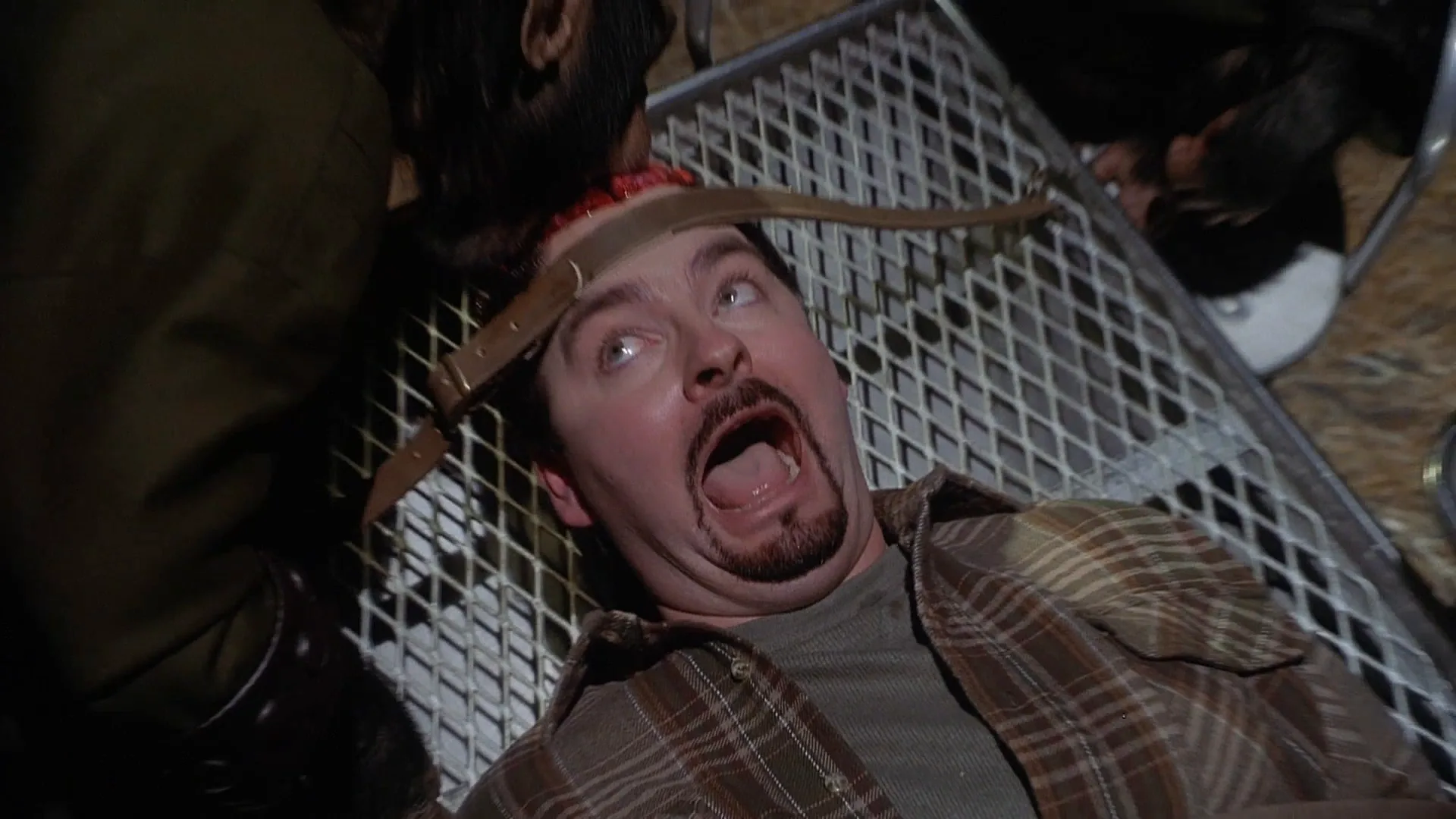
What is slapstick comedy?
Slapstick is the branch of comedy where the joke is physical: someone slips, gets hit or loses a fight with a ladder. Other names are physical comedy and knockabout comedy.
The word comes from a real prop, the Harlequin's paddle from commedia dell'arte: two thin wooden slats that crack loudly on impact while barely hurting the actor. That prop holds the genre's rule. Violence must sound and look big and do no lasting damage.
Slapstick can carry a whole silent two-reeler or live inside a family comedy, a spoof or an action film. On the film genres map it is comedy's most visual form.
Why does slapstick make audiences laugh?
Slapstick works on three reflexes.
- Recognition. Everyone has tripped or walked into a door; watching it happen bigger to someone else is a release.
- Safe superiority. The audience sees the banana peel first and laughs when the disaster lands and nobody is really hurt.
- Rhythm. Setup, delay, impact, reaction. Often the reaction gets the biggest laugh.
Silent film made slapstick the first great movie comedy because it needed no dialogue. Chaplin wrestles factory gears in Modern Times (1936). Harold Lloyd dangles from a clock in Safety Last! (1923). Buster Keaton stands still as a house front falls around him in Steamboat Bill, Jr. (1928), and his stone face shows what a deadpan reaction adds: the calmer the victim, the louder the laugh.
How to shoot slapstick comedy
Slapstick is choreography first. The camera's job is to prove the gag is real and let the timing play.
- Show the whole body. Wide or full shot on a 24–35mm lens, so feet, hands and the object read in one image. A close-up hides the mechanics of a fall.
- Lock it off and hold. A static camera and a long take show setup and payoff together. Keaton kept his biggest stunts wide and uncut so nobody could suspect a trick.
- Cut to the reaction. If you cut, go to the victim's face a beat after the hit.
- Speed it up slightly. Undercranking at 20–22 fps played at 24 makes chases snappier.
- Light for readability. Bright, even light keeps every limb visible.
- Build safety in. Breakaway furniture, sugar glass, foam props and crash mats, with a stunt performer doubling any real fall.
- Oversell the sound. A crisp crack or thud says the pain is cartoon pain.
Slapstick vs. farce: are they the same?
No, though they often travel together. Farce is a story form: mistaken identities, slamming doors, a plot spinning out of control; its engine is misunderstanding. Slapstick is a type of gag, the physical hit or fall; its engine is the body. A farce can be almost entirely verbal, and a slapstick routine can have no plot at all.
Slapstick vs. caricature
Caricature exaggerates who a character is: a few traits blown up in costume, makeup and posture. Slapstick exaggerates what happens to a body. Spoofs combine them: a caricatured character dropped into physical gags. On set, caricature is solved in costume before the take; slapstick in rehearsal, rigging and the edit.
Slapstick Comedy in motion
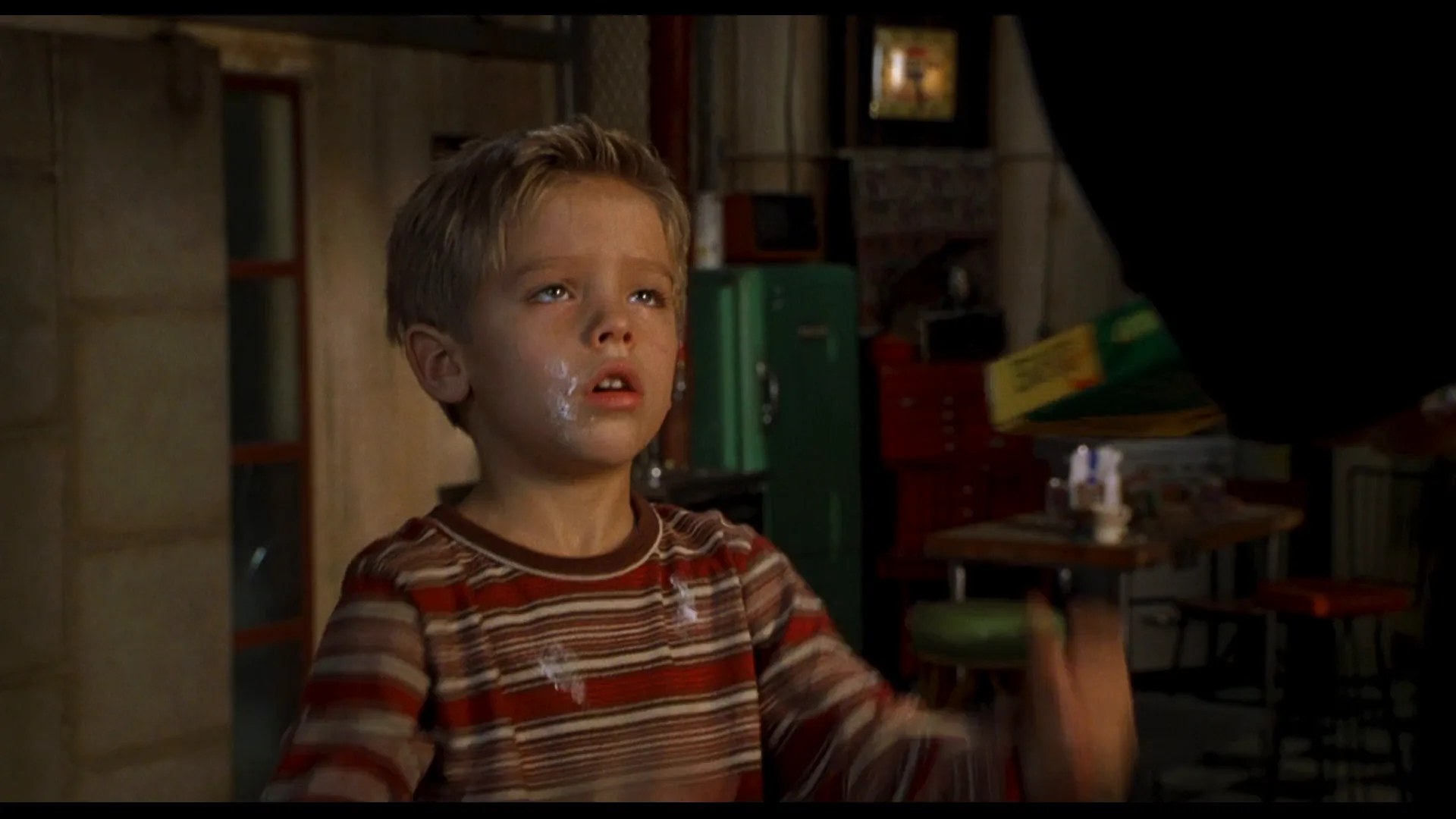
6 clipsWatch the body, not the face: each clip is a gag in motion, from a fall or a stumble to the recoil and the shock take that sell it. Notice how wide most of them stay.
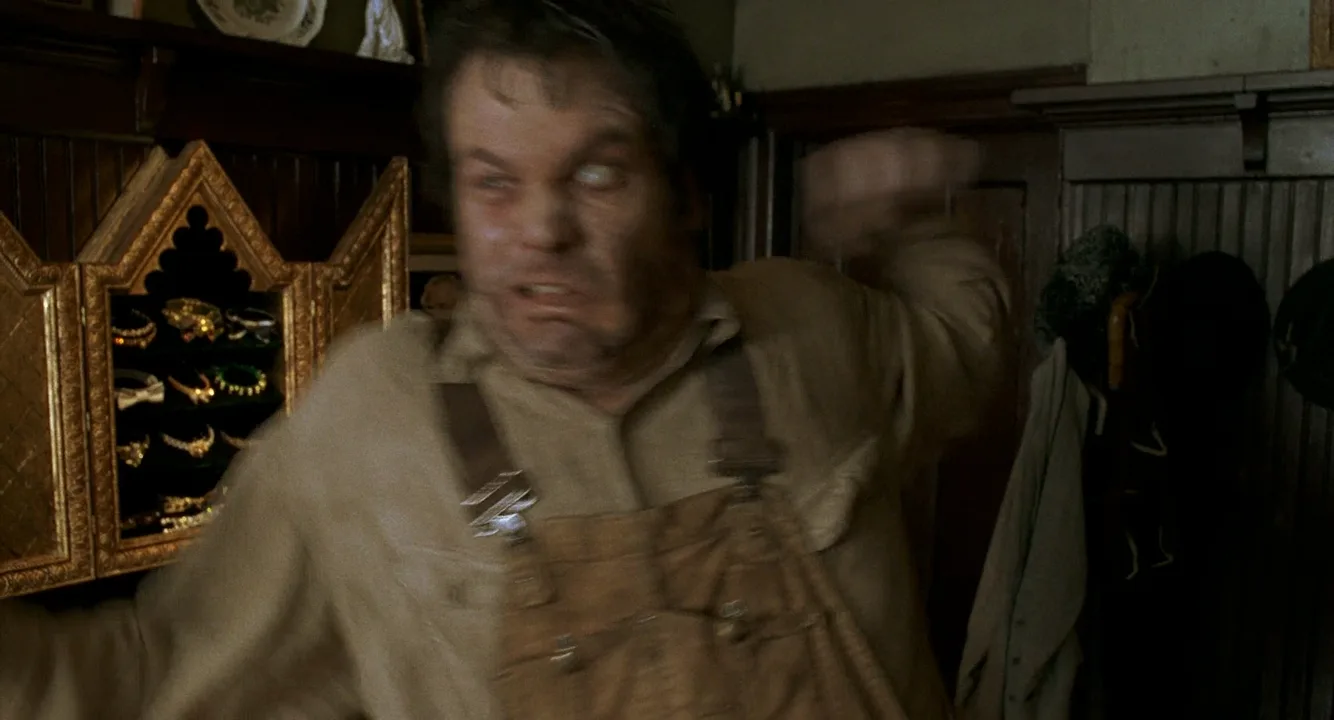
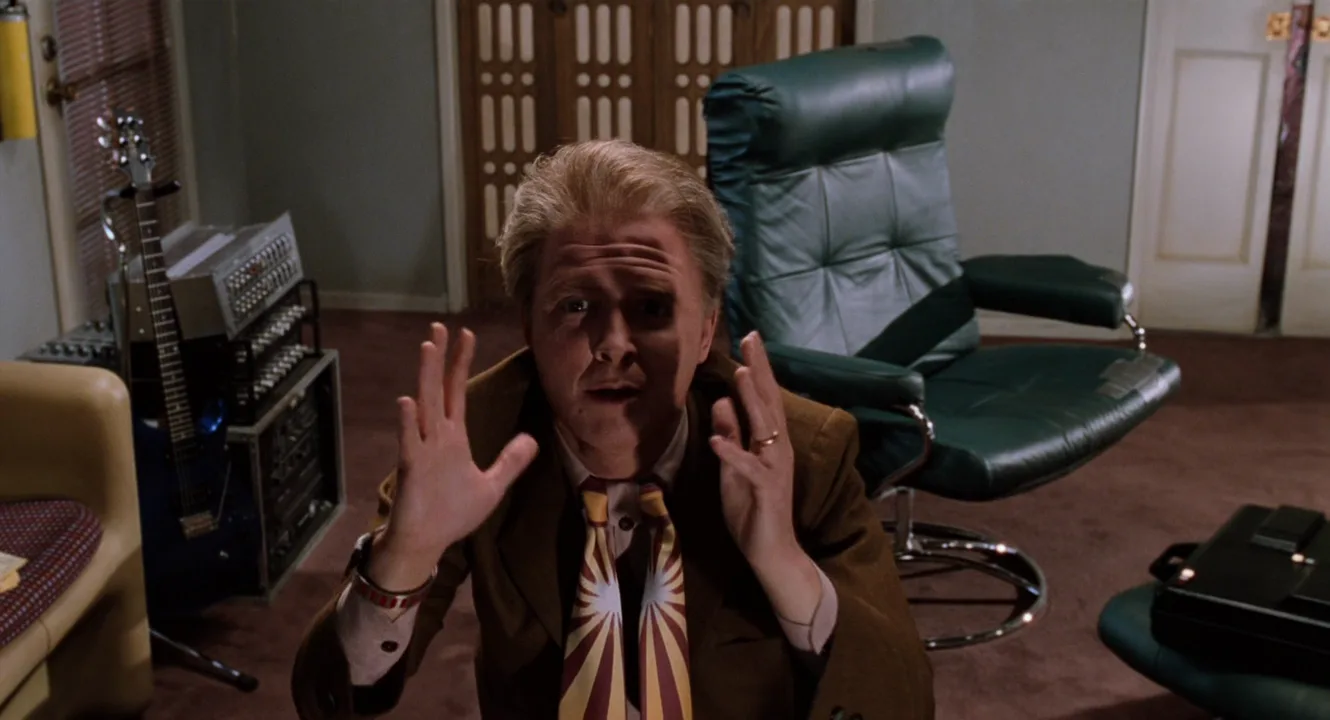
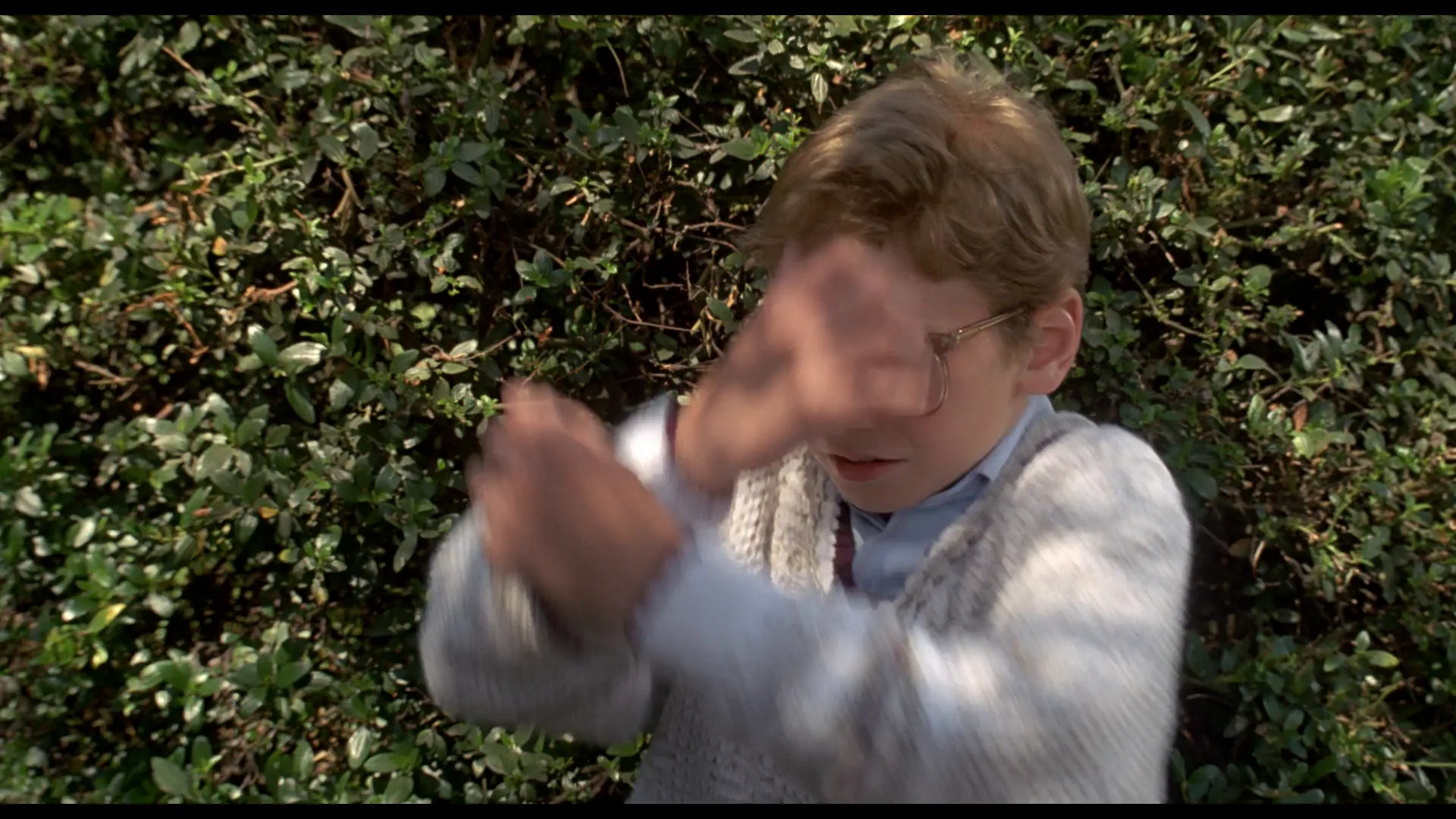
Slapstick Comedy stills
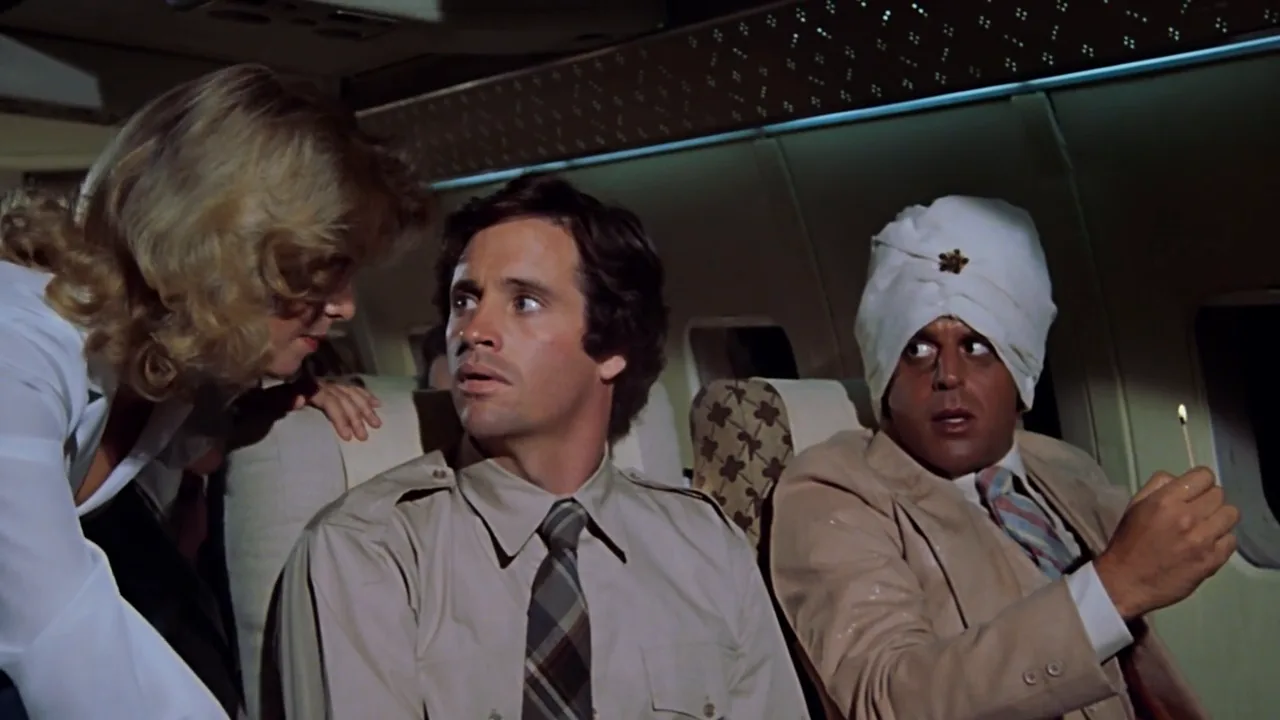
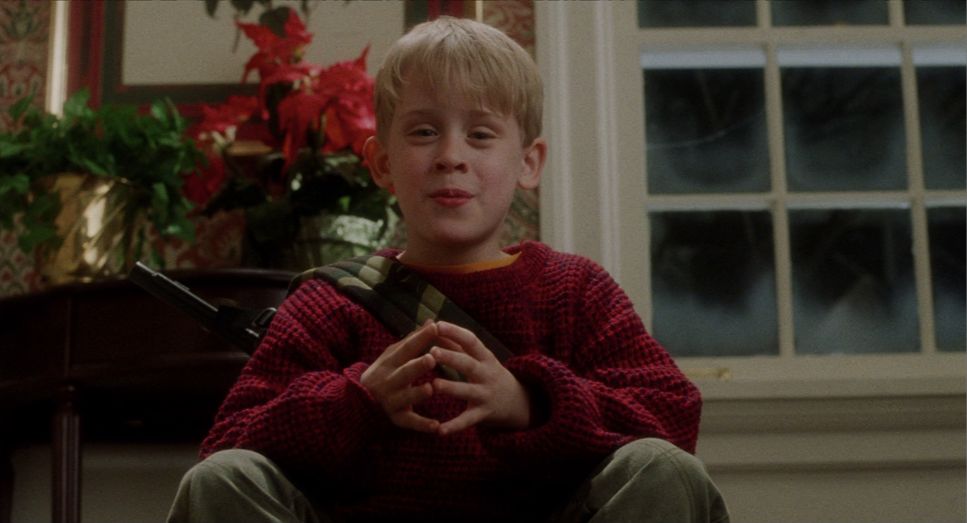
7 framesFrames from comedies where the body carries the joke: falls, recoils, messes and the faces that sell them.
How to create a slapstick comedy with AI
4 promptsImage models default to a posed smile for anything labeled comedy. Describe the exact physical moment instead: which foot slipped, where the object is in the air. Generate the peak of the gag as a still, animate the fall, and compare takes side by side on one FlashBoards board. The fourth prompt re-shoots a real film shot from a text description alone, and the original plays next to the result so you can compare.
Wide full-body shot, static camera at waist height, 28mm lens, deep focus: a bright 1960s diner with a checkered floor. A lanky waiter in his forties, ginger handlebar mustache, thick black eyebrows, oversized white jacket, is mid-slip on a wet patch, one leg kicked up to chest height, arms windmilling, body tilted backward at 45 degrees. Three cream pies fly up off his tray. A yellow mop bucket stands beside him. Two customers at the counter watch with calm faces. Bright even light, pastel colors, 35mm film still.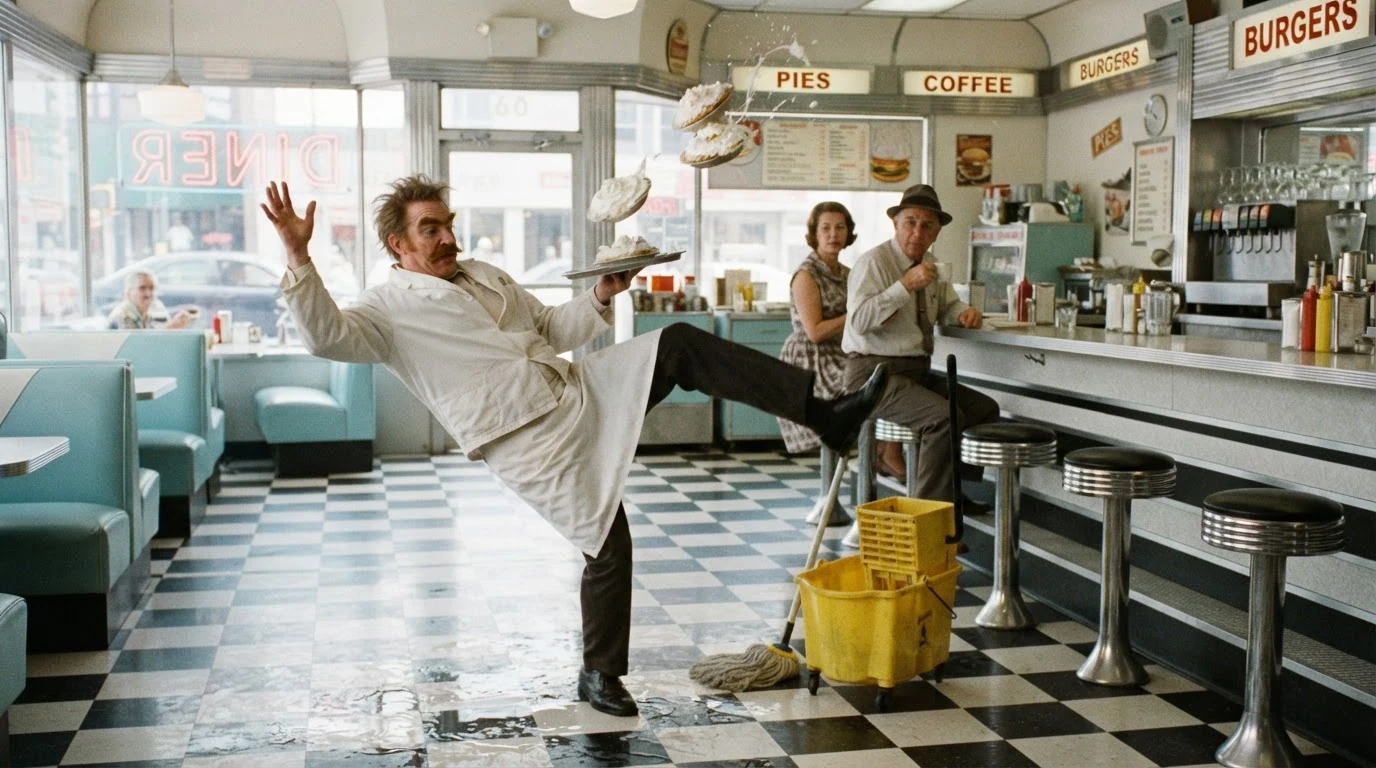
Mid-slip, leg kicked up and tilted backward freeze the peak of the fall instead of a posed stand. Wide full-body shot and deep focus keep feet, pies and bucket readable.
Open FlashBoardsBlack-and-white 1920s silent comedy film still, wide static shot at eye level, 32mm lens: a busy city sidewalk. A short, stout woman in her thirties with a black bob, round cheeks and a stiff straw boater carries a long wooden plank on her shoulder and has just turned left; the far end of the plank knocks a tall policeman's helmet high into the air as he stumbles back. She looks straight ahead, face blank and serious. Hard sunlight, film grain, soft vignette.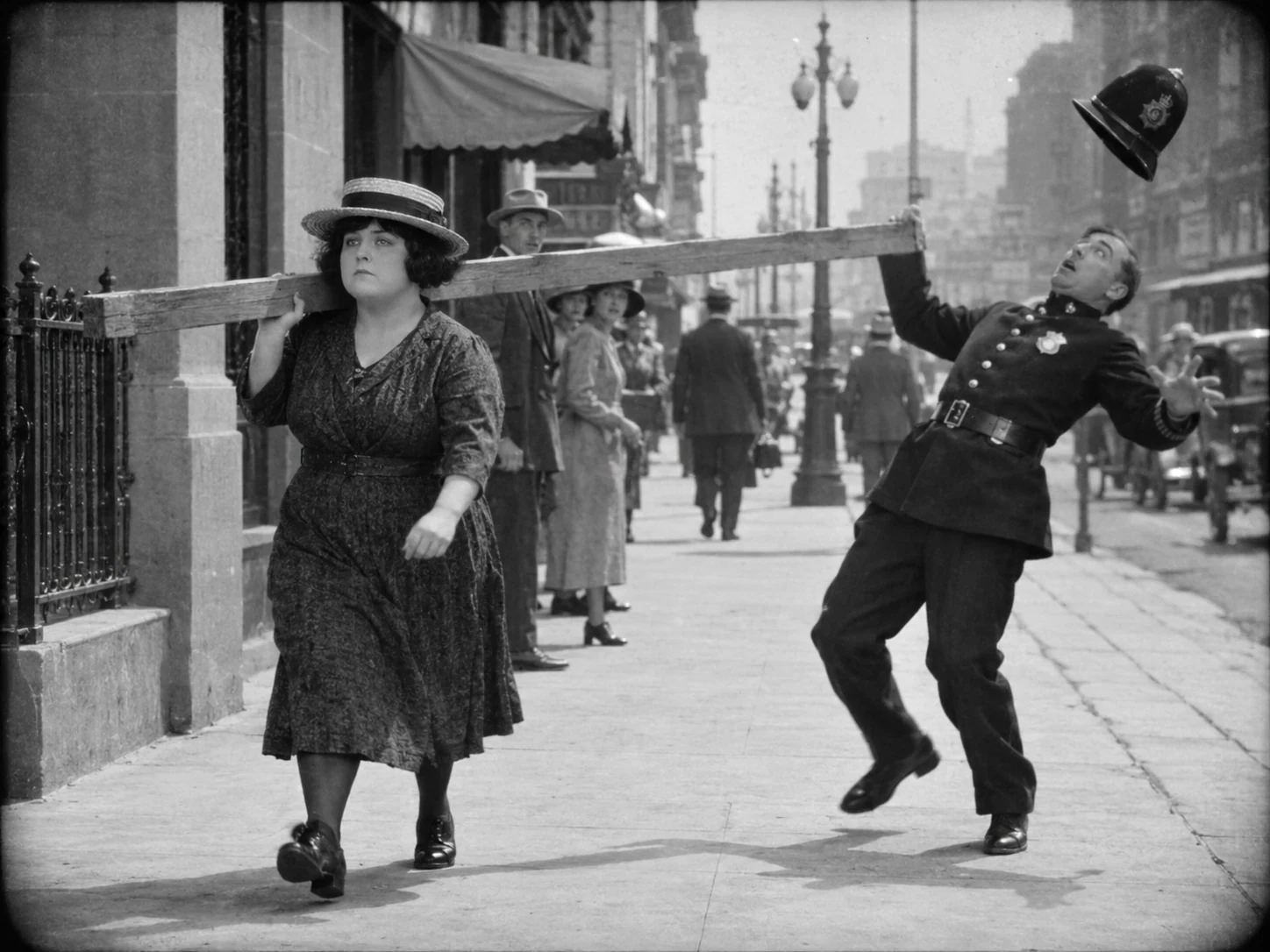
Cause and effect sit at opposite ends of one prop, so the wide 4:3 frame shows both. Face blank and serious keeps her deadpan; film grain and vignette set the era.
Open FlashBoardsCamera: locked-off wide shot, the camera stays perfectly still, the whole diner in frame from start to end. Action: the waiter is already slipping backward, legs flailing, as the shot begins. He lands flat on his back with a bounce. The three cream pies fall one after another; the last lands squarely on his face. He lies still, then slowly sits up, cream covering his face, and blinks. The two customers keep eating calmly.Already slipping makes the shot alive from frame one. The fall is written in beats (land, pies, pause, blink), which gives the gag its rhythm.
Open FlashBoards{
"output": "Full-screen live-action period film shot from It's a Wonderful Life (1946), alive from its very first frame: one continuous shot, no cuts. Grey winter afternoon, overcast soft daylight, a snowy hillside above a frozen pond edged with bare trees, muted Technicolor-style palette, 35mm film grain.",
"characters": {
"S1": {
"name": "Harry Bailey as a boy, the small brother",
"look": "boy of about eight, mustard-yellow knitted cap, dark navy wool coat, green trousers, brown mittens",
"voice": "high, cheeky child's voice"
},
"S2": {
"name": "George Bailey as a boy",
"look": "boy of about twelve in a red-and-grey plaid jacket and grey knitted cap, standing at the top of the slope",
"voice": "bright boy's voice, calling out"
}
},
"shots": [
{
"shot": 1,
"camera": "starts as a medium shot at child height on the top of the slope, then pans left and tilts down to follow the boy down the hill, ending on a wide high view of him small in the snow at the edge of the ice",
"action": [
"BEGINNING: alive from the first frame, S1 crouches at left of frame on a flat coal shovel at the lip of the slope, both hands gripping the long wooden handle, grinning, looking down the hill toward screen left; S2 stands at right edge, looking down at him",
"THEN: S1 pushes off; the shovel tips over the lip and he slides out of frame left, S2 left behind",
"THEN: the camera pans left and tilts down with him: he sits upright on the shovel racing down the snow, the handle across his lap, right hand on the handle, left arm out for balance, snow spraying past the lens",
"THEN: the shovel hits a bump, spins, and throws him sideways; he tumbles head over heels, cap tilting, both arms flung up, the shovel flipping away beside him",
"END: he lands sitting in deep snow at the pond's edge, small in a wide frame, both arms raised and waving, unhurt, the grey ice and bare trees behind him"
],
"dialogue": [
{
"speaker": "S1",
"on_screen": true,
"when": "from the first frame, while crouching on the shovel",
"delivery": "cocky, defiant",
"line": "<d>[English] I'm not scared.</d>"
},
{
"speaker": "S2",
"on_screen": false,
"when": "as S1 starts to slide",
"delivery": "called from the top of the hill",
"line": "<d>[English] Come on, Harry.</d>"
},
{
"speaker": "S2",
"on_screen": false,
"when": "during the tumble, from far above",
"delivery": "cheering, shouted",
"line": "<d>[English] Let's go, Harry!</d>"
}
]
}
],
"sound": {
"ambience": "open winter air, the scrape and hiss of a steel shovel on packed snow, a soft thump and powder spray when he lands, distant children shouting",
"speech": "exactly these spoken phrases, each said once, in this order",
"never_spoken": "no narration and no voice-over: the descriptions, performance notes and step words of this prompt are never spoken aloud",
"music": "a film score under the scene, always below the voices: playful 1940s orchestral strings and woodwinds, a bouncing comic scherzo",
"subtitles": "none"
}
}Remakes the shovel-sledding tumble from It's a Wonderful Life (1946), keeping the pan-and-tilt follow, the spin-out and the boy's lines from the film.
The fall is written as beats (push off, ride, bump, tumble, land waving), and the camera follows the whole body down the hill. Unhurt and arms raised keep it cartoon pain.
Open FlashBoardsCommon mistakes
- Posed comedy. "Funny waiter" gives a grin at the lens. Describe the physical state: mid-slip, arms windmilling.
- Cropped bodies. Write wide full-body shot and name the floor, or the feet get cut off.
- Real injury look. Crash or hurt bring blood and grimaces. Use soft props (pies, foam, water).
- Physics drift in video. Count objects (three pies) and say where each lands.
Keep the reference frames, prompts and every generated take side by side — images and video in one canvas.
FAQ
4 questionsWhat is slapstick comedy?
Slapstick comedy is physical comedy built on exaggerated, harmless violence: pratfalls, collisions, chases and pies in the face. The humor comes from the body failing in a recognizable way while the victim gets up unhurt. It peaked in silent films with Charlie Chaplin, Buster Keaton and Harold Lloyd and lives on in family comedies, spoofs and stunt comedy.
Why is it called slapstick?
The name comes from a prop Harlequin carried in commedia dell'arte: a paddle of two thin wooden slats. When it struck another actor, the slats clapped together with a loud crack while delivering little force. It sums up the genre's promise: violence that sounds and looks big but causes no real harm.
What are some classic slapstick comedy movies?
Start with the silent masters: The General (1926) and Steamboat Bill, Jr. (1928) with Buster Keaton, Safety Last! (1923) with Harold Lloyd, and Chaplin's Modern Times (1936). Later landmarks include Jacques Tati's Mr. Hulot's Holiday (1953), The Pink Panther series, Airplane! (1980), Home Alone (1990) and Jackie Chan's stunt comedies.
How do actors do slapstick without getting hurt?
Rehearsal, rigging and trickery. Falls are practiced on crash mats and doubled by a stunt performer when risky. Props are breakaway: balsa furniture, sugar-glass bottles, foam bricks. Hits are staged with distance and camera angle, then sold with a sharp sound effect. The reaction, not the force, makes the audience believe the impact.
Related terms
5- Silent FilmFilm History & Theory
Silent film is cinema without synchronized recorded dialogue, dominant until the late 1920s: stories were told through pantomime, intertitles, expressive lighting and live music in the theater.
- DeadpanActing & Casting
Deadpan is comic delivery with a blank face and flat voice: the actor plays absurd material with total seriousness, and the gap between content and expression is the joke.
- Stunt PerformerActing & Casting
A stunt performer executes dangerous physical action on camera — falls, fights, car hits, fire burns — often doubling for an actor under the stunt coordinator's direction.
- UndercrankingCameras & Capture
Undercranking shoots at a lower frame rate than playback — for example 12 fps played at 24 — so action runs faster than life on screen, used for slapstick, frantic chases and punchier action.
- ComedyGenres
Comedy is the genre built to make the audience laugh — through character, situation, wordplay or physical gags — and it usually bends toward a happy or reconciling ending.
Further reading
Walter Kerr, The Silent Clowns (Knopf, 1975). Buster Keaton with Charles Samuels, My Wonderful World of Slapstick (Doubleday, 1960).