 FlashBoards Learn
- Learn
- Acting & Casting
- Deadpan
Acting & Casting · Film language
Deadpan
Also called: deadpan delivery, dry humor, poker face
Deadpan is comic delivery with a blank face and a flat voice: the actor plays absurd material with complete seriousness and never signals that anything is funny. The laugh comes from the gap between what is happening and how little the character reacts, so the audience has to do the reacting.
- What it does
- Turns the audience into the one who reacts, by withholding every cue that a line or situation is funny.
- Use it when
- The material is already absurd, dark or awkward and needs no help from the face.
- Watch out
- A smirk, a wink or a pause for the laugh breaks it; so does a camera that fidgets.
- Try this prompt
Frontal medium shot, man at a motel desk, neutral face, mouth closed, brows level, looking into the lens while a goat chews a brochure beside him, locked-off, flat soft light.
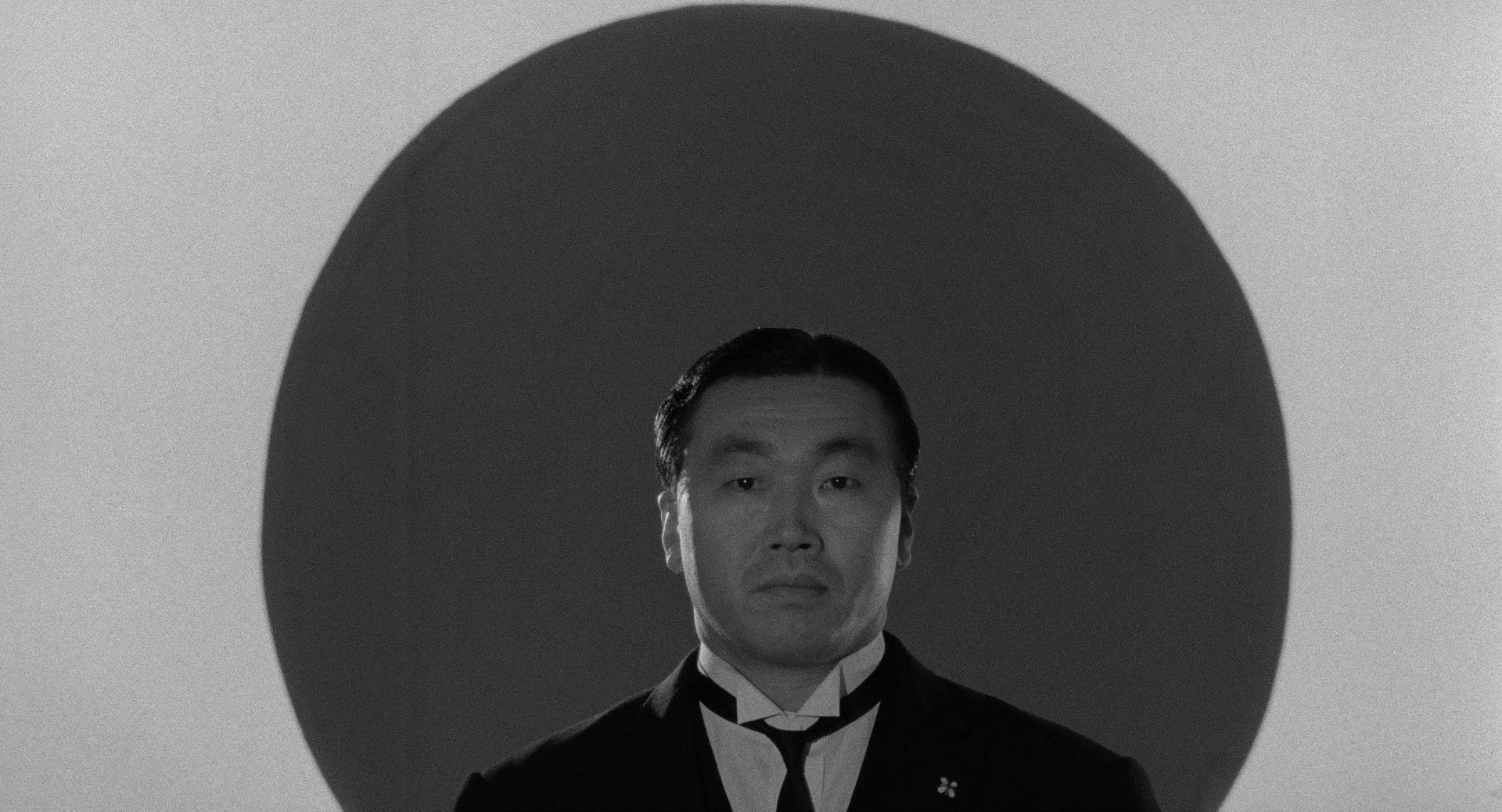
What is deadpan?
Deadpan is a performance choice, not a genre. The word comes from 1920s American slang, where pan meant face. It combines a still, neutral face, a level voice with no comic lift at the end of a line, and total commitment to the logic of the scene.
The character is not hiding a joke; they genuinely see nothing strange. That separates deadpan from sarcasm, where the speaker lets you hear the barb. Buster Keaton, "The Great Stone Face," is the reference point. Also called dry humor or a poker face, it is a core tool of screen performance: it lives in comedy but travels into drama, satire and horror.
Why does deadpan make people laugh?
Comedy runs on incongruity. Most comic acting points at the misfit with a double take or a raised eyebrow. Deadpan refuses to point: the audience looks to the character for confirmation, gets nothing back, and the laugh releases that tension.
It also plays with status. Someone calm while everything goes wrong seems either oblivious or in total control, and both are funny. That is why deadpan suits black comedy: death and bureaucracy played flat feel more absurd. Sustained across a film, as in Yorgos Lanthimos's The Lobster (2015), affectless delivery becomes the rule of the world.
Deadpan comedy examples in film and TV
- Buster Keaton. Huge physical set pieces, an unmoving face.
- ***Airplane! (1980).* Serious actors, Leslie Nielsen among them, play puns as if the crash were real.
- ***Stranger Than Paradise* (1984).** Jim Jarmusch's static single takes of people with nothing to say.
- Wes Anderson. From Rushmore (1998) to The Grand Budapest Hotel (2014), big feelings stated in a level voice inside frontal frames.
- TV. April Ludgate in Parks and Recreation, and the flat stare into the documentary camera in mockumentary sitcoms.
The thread: stillness in the performance matched by stillness in the camera.
How to direct and shoot deadpan
Actor. Never ask for "deadpan"; ask them to play the stakes as real. Cut any pause for a laugh, any glance that checks whether it landed, any smile at the end of a line. Blinks and breathing stay: a dead face is still a living person.
Framing. Frontal, eye-level, centered frames and symmetry make the world look orderly, so the disorder pops. A 35–50mm lens in a medium shot keeps the absurd object and the non-reaction in one frame, often funnier than cutting between them.
Camera and light. A locked-off static shot and soft, even light. A push-in or hard contrast adds the emotion the performance withholds.
Editing. Hold the reaction shot a second or two past comfortable and let room tone fill the silence.
Deadpan vs. slapstick: opposites or partners?
Slapstick is comedy of the body: falls, collisions, chases. Deadpan is comedy of the face held still. Keaton fused them: his body goes through a cyclone while his face stays level, and the contrast sharpens both. For a director, slapstick needs a wide frame and timing measured in frames; deadpan needs a camera that stays put and an edit that holds. Combine them by staging the chaos behind a calm face.
Deadpan examples in film
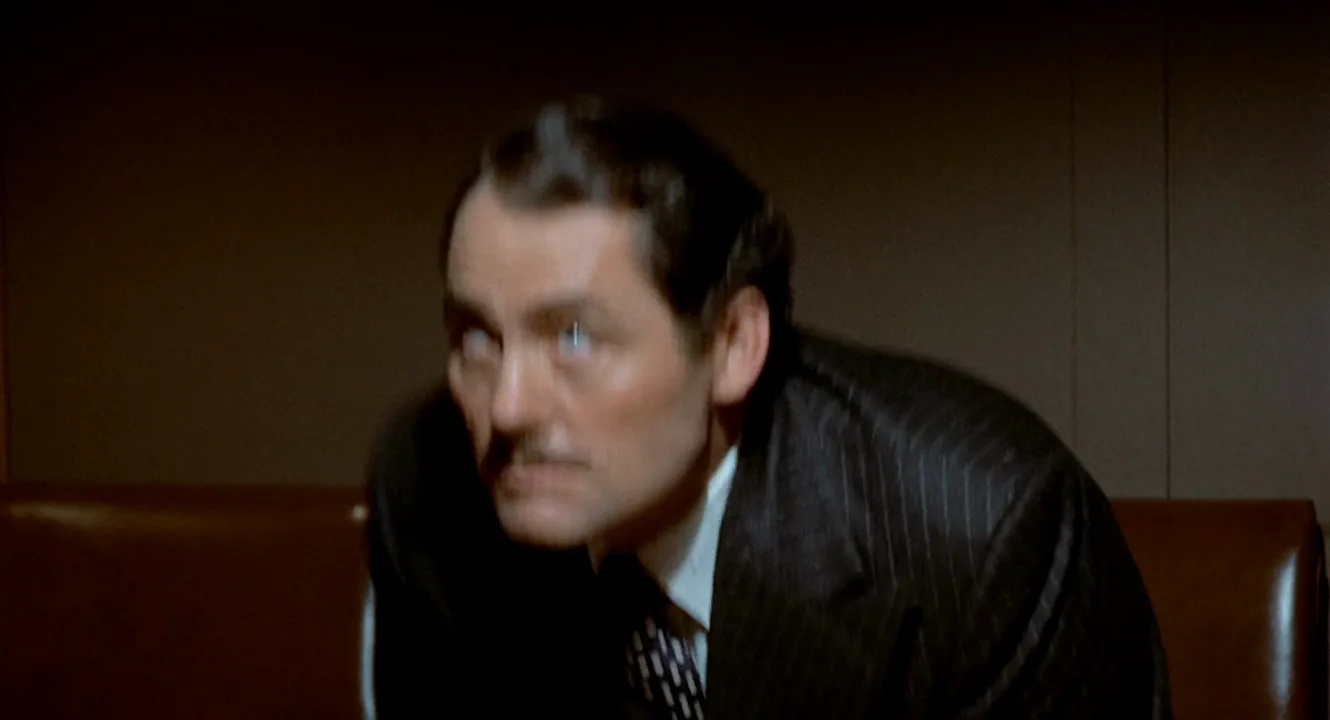
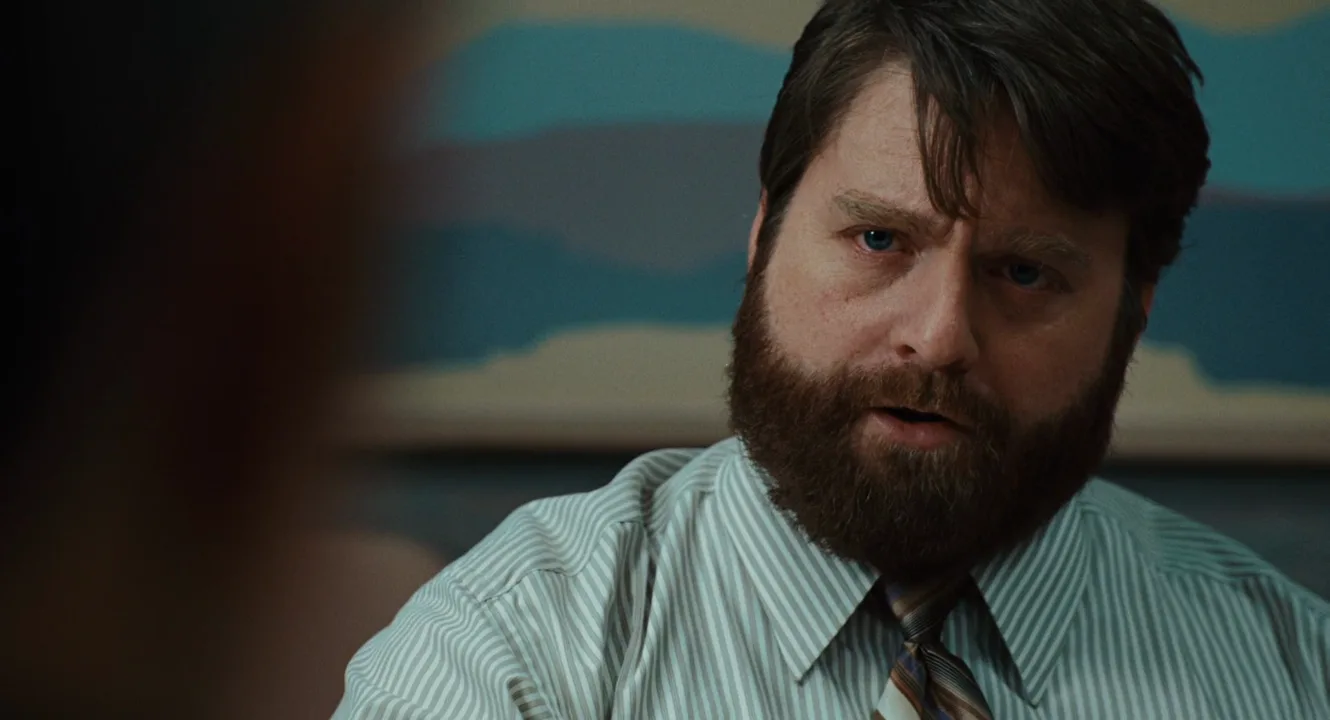
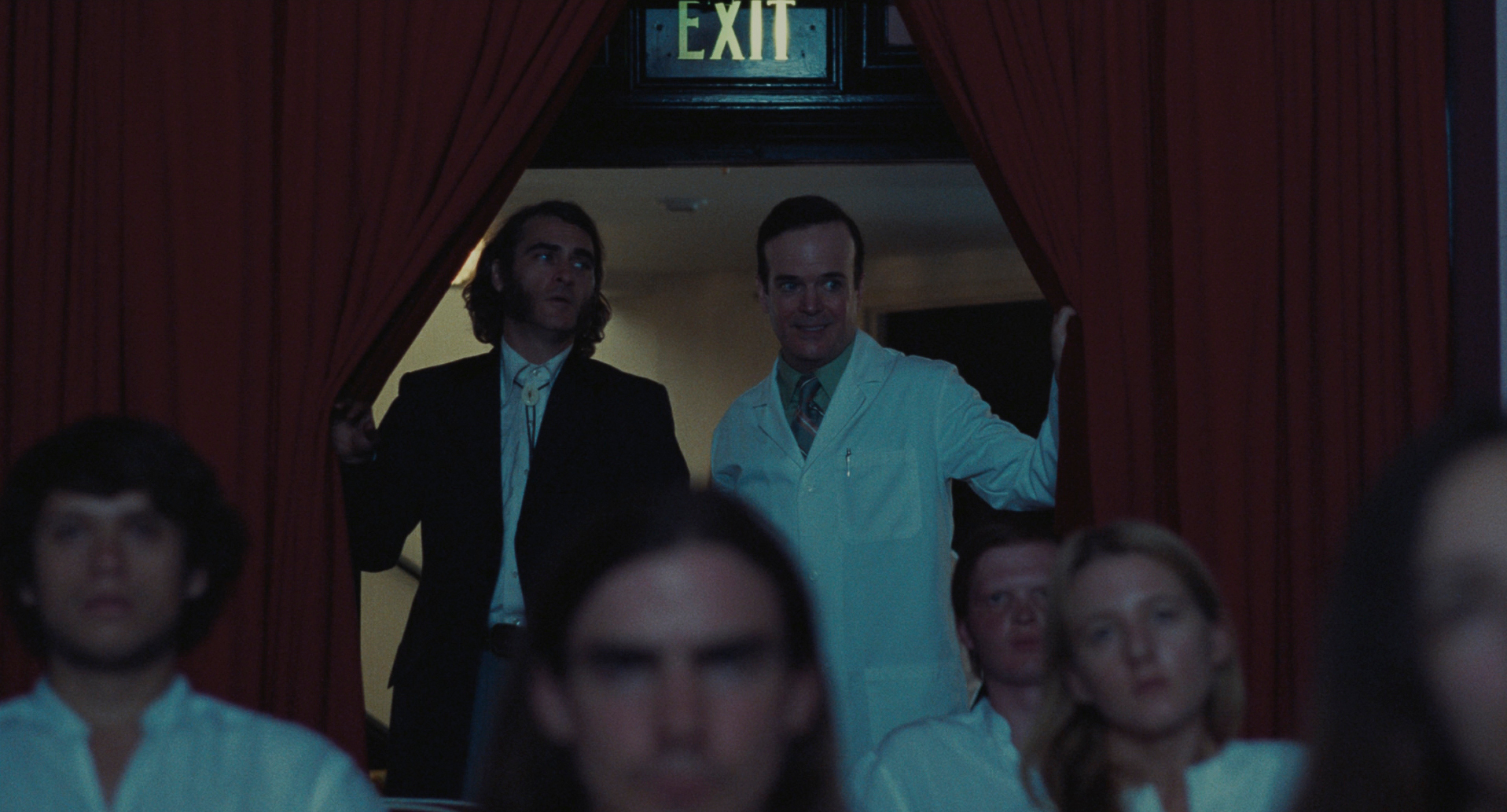
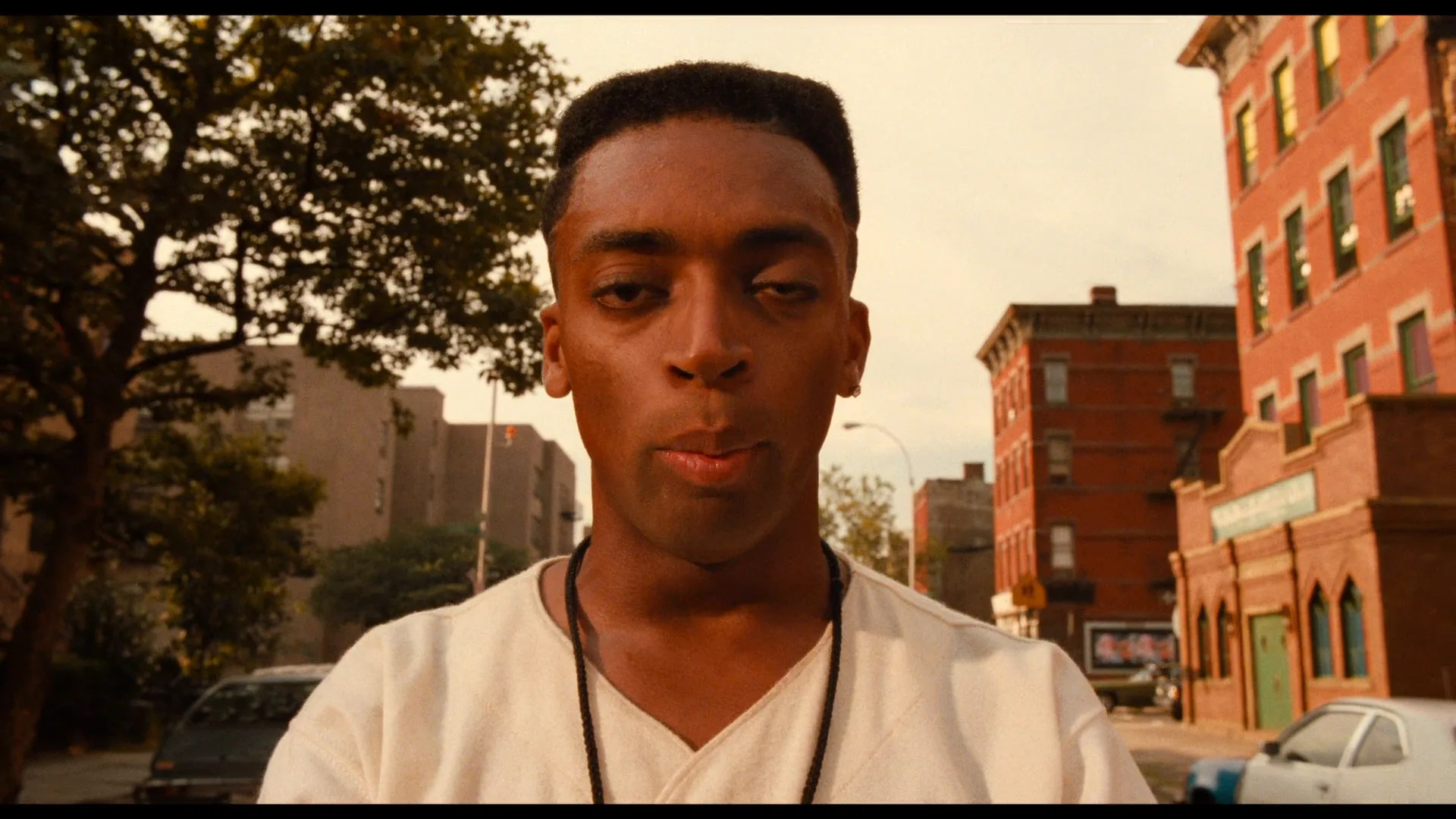
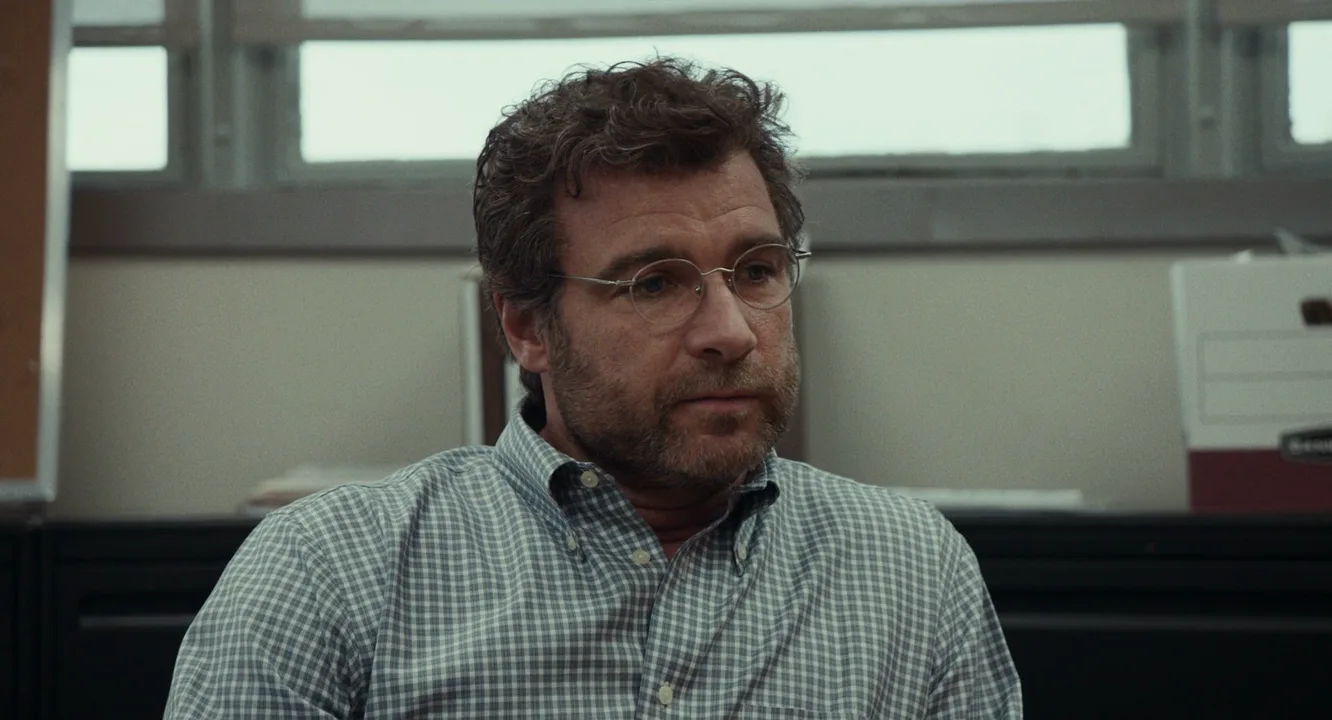
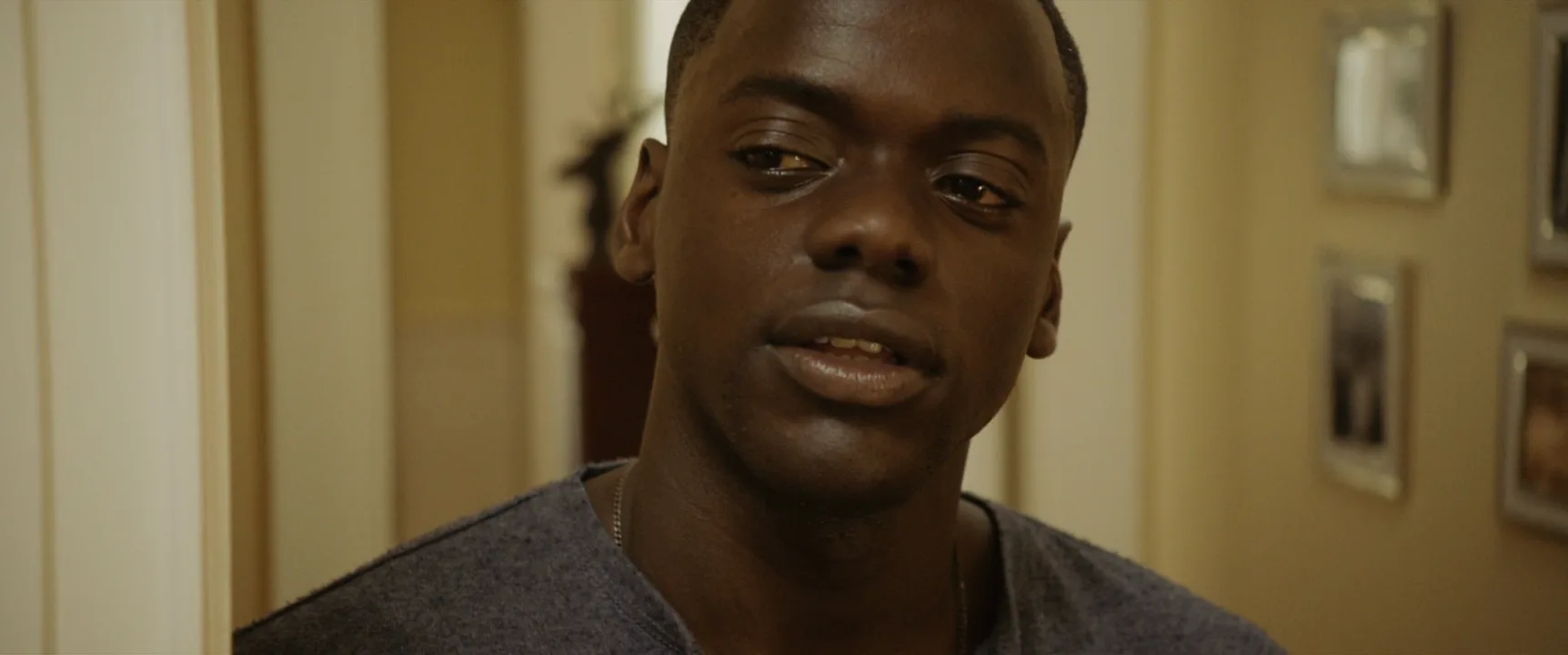
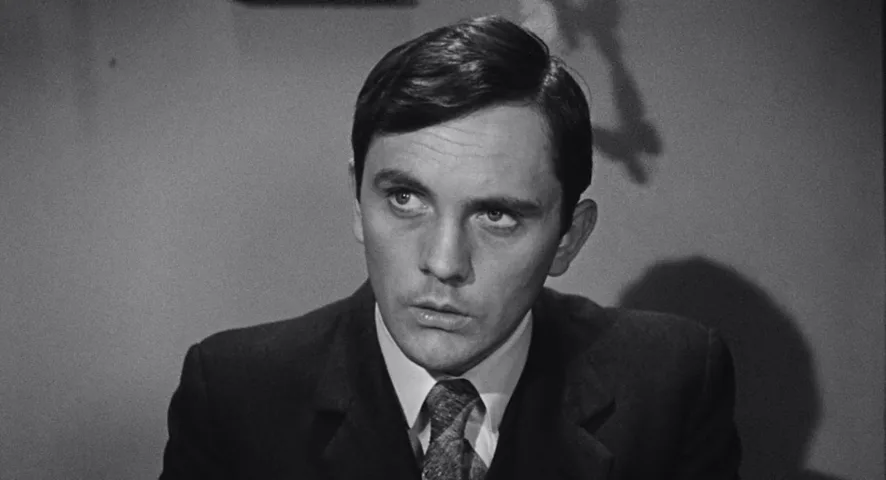
8 framesA neutral face, a frontal eyeline, a frame that refuses to editorialize. Some are comedies; some use the same blankness for menace or restraint.
How to create a deadpan with AI
4 promptsModels love to emote, so describe deadpan as physical facts: mouth closed, brows level, eyes steady, a locked-off frame and an absurd element the face ignores. Keep takes side by side on one FlashBoards board. The fourth prompt re-shoots a real film shot from a text description alone, and the original plays next to the result so you can compare.
Frontal, centered medium shot of a motel reception desk. A man in his fifties with a ginger walrus mustache, round wire glasses and a beige cardigan sits bolt upright, hands folded. Beside him on the desk a small white goat chews a paper brochure. He looks straight into the lens, calm neutral face, mouth closed, brows level. Mint wallpaper, wall clock above his head, symmetrical composition, 40mm lens at seated eye level, soft even daylight, 35mm film still.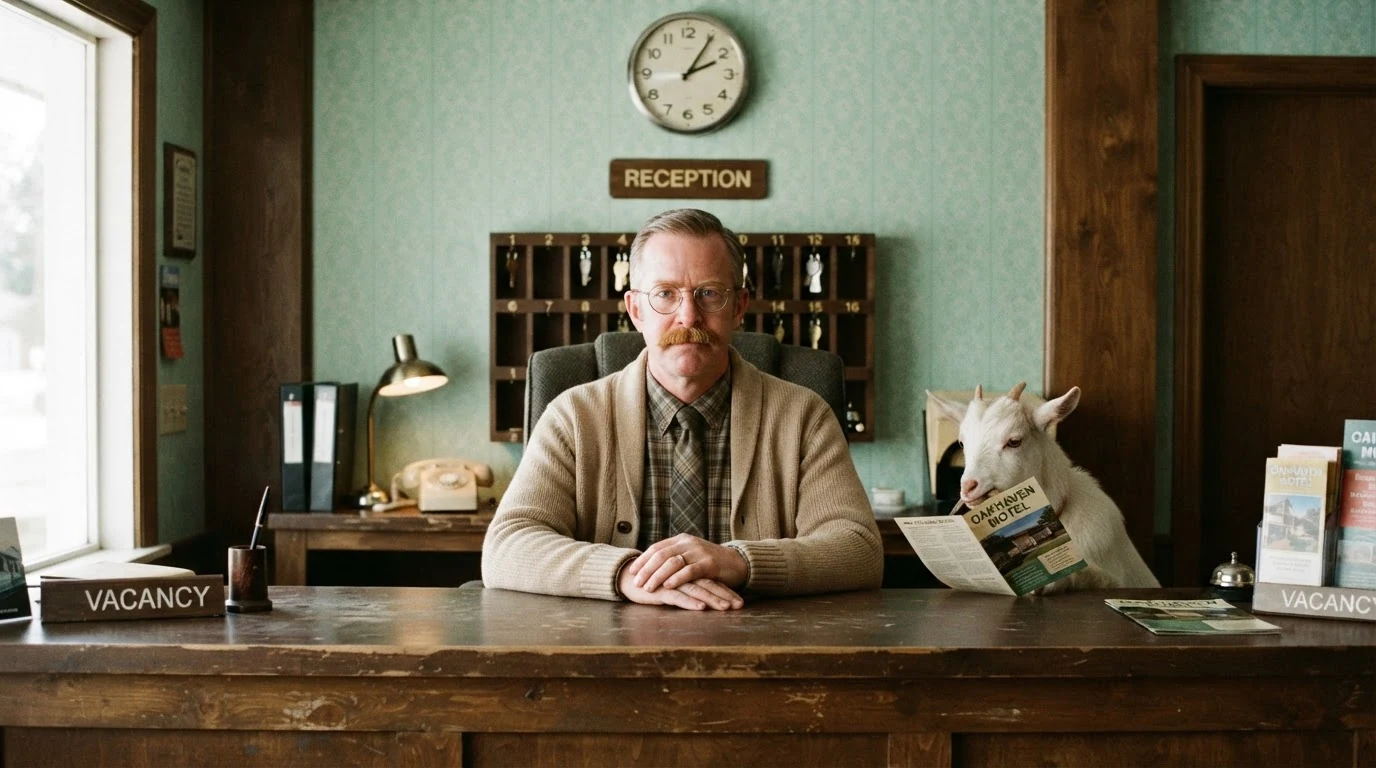
The goat and the non-reaction share one frame, so the joke reads without a cut. Calm neutral face, mouth closed, brows level describes deadpan physically and keeps the model from adding a smirk; symmetrical, soft even daylight supplies the orderly, flat look.
Open FlashBoardsWide static tableau in a rainy suburban backyard: three adult siblings in identical orange raincoats stand in a straight row at a tiny grave marked by a popsicle stick. A tall woman with a platinum bob, a stocky man with a shaved head and red beard holding an empty shoebox, a thin young man with curly black hair. Arms at their sides, faces composed, looking straight at camera. Symmetrical frame, 35mm lens at chest height, overcast flat light, dry black comedy film still.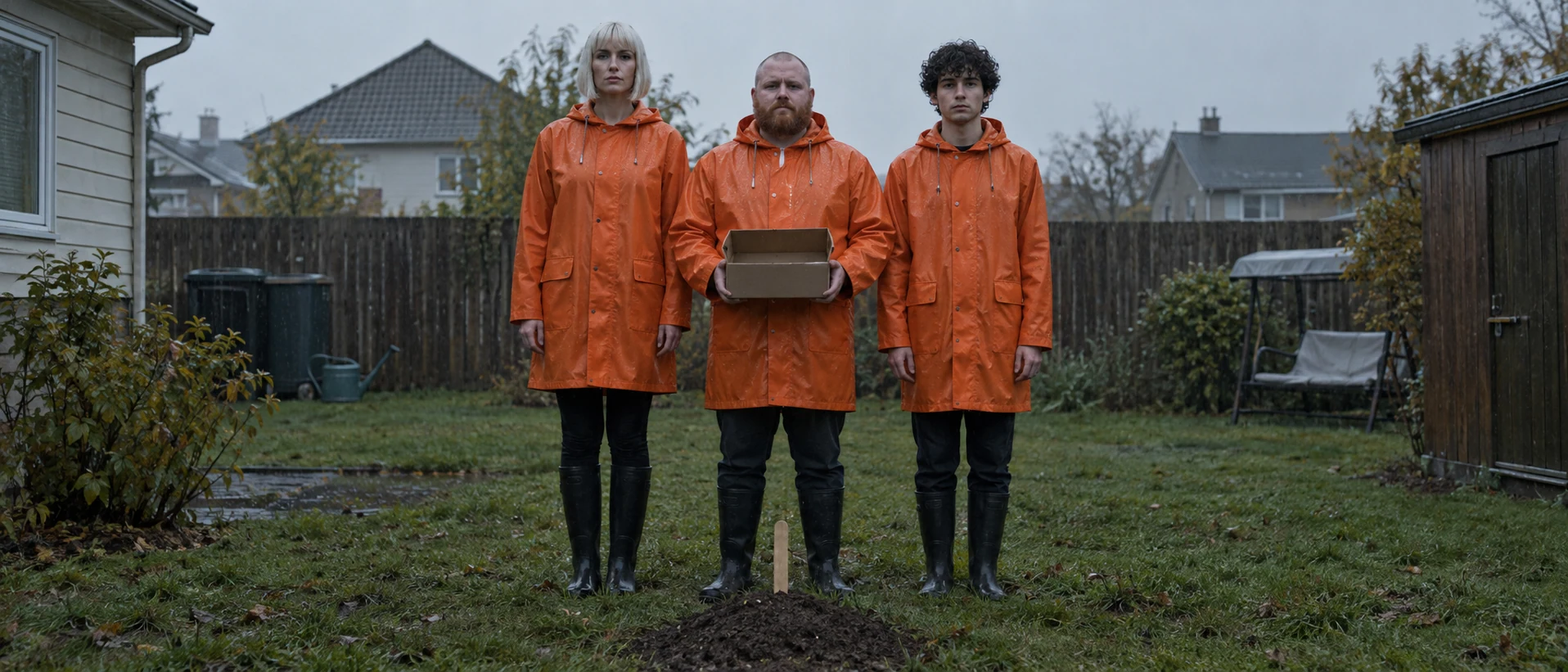
A group take with a darker premise: a pet funeral treated with full ceremony. Straight row, identical raincoats, arms at their sides builds uniform stillness; the 21:9 frame lets the empty yard hold the silence.
Open FlashBoardsCamera: completely static locked-off frame for the whole shot, centered on the man at the desk. Action: the goat is already chewing, the brochure shrinking. The man blinks once slowly, turns his head to look at the goat with the same calm neutral face, then turns back to the lens, straightens a pen parallel to the desk edge and folds his hands again. His face stays composed while the goat keeps chewing.The chewing goat makes the shot alive from the first frame, so the model doesn't drift into a push-in. Small precise actions and a repeated calm neutral face prevent a laugh or double take.
Open FlashBoards{
"output": "Full-screen live-action scene from The Collector (1965) from its very first frame: three shots joined by two hard cuts. True black-and-white 1960s 35mm film, fine grain, soft even overhead office light, a crowded London accounts office with wooden partitions and a frosted glass screen at the back.",
"characters": {
"S1": {
"name": "Freddie Clegg, played by Terence Stamp",
"look": "slim young man in his mid twenties, dark hair combed in a side parting, pale narrow face, dark wool suit, white shirt, patterned knitted tie",
"voice": "silent in this scene"
},
"S2": {
"name": "office clerks, Freddie's colleagues",
"look": "a broad dark-haired clerk in a dark suit in the centre-right foreground, a fair clerk at left, a round-faced clerk behind him, a young woman with a curled dark bob at centre, a bald older clerk at the back right, a dark-haired clerk at the right edge; rows of desks with big adding machines and open ledgers",
"voice": "open, loud laughter"
}
},
"shots": [
{
"shot": 1,
"camera": "locked-off, seated eye level, wide shot across the rows of desks, an adding machine and an open ledger in the left foreground",
"action": [
"BEGINNING: alive from the first frame, the broad S2 clerk in the centre-right foreground is twisted round in his chair toward the lens, his left hand resting on the desk edge, grinning; the fair clerk at left and the round-faced clerk behind him also turn toward the lens, smiling.",
"THEN: the young woman at centre looks toward the lens with a small smile; the clerks at the back lift their heads.",
"END: the foreground clerk laughs openly, shoulders shaking, still looking toward the lens."
],
"voice": "no words: only laughter",
"dialogue": []
},
{
"shot": 2,
"cut_at": "00:01.240",
"camera": "close-up of S1, chest up, centred, eye level, 50mm lens, plain pale gray wall behind him with his large soft shadow on the right; very slow tilt up",
"action": [
"BEGINNING: S1 sits with his head lowered and his eyes raised under his brows, mouth closed in a straight line, face still; his hands are out of frame.",
"THEN: his chin lifts slowly and his eyes roll upward and slightly toward screen right, as pale butterflies flutter across the top of the frame and their dark shadows flit over the wall on the right.",
"THEN: his eyes follow the butterflies, one slow blink; brows level, lips slightly parted, no smile, no nod.",
"END: he holds the same calm, blank, faraway look upward toward screen right, as if the room were empty."
],
"voice": "silence: nobody speaks in this shot, no voice at all",
"dialogue": []
},
{
"shot": 3,
"cut_at": "00:03.800",
"camera": "locked-off, the same wide shot of the office as shot 1",
"action": [
"BEGINNING: right after the cut, the whole room laughs harder toward the lens: the bald older clerk at the back right stands and laughs with his head back, the clerk at the right edge laughs with his mouth wide open.",
"THEN: the woman at centre raises one hand to her mouth, laughing.",
"END: the foreground clerk keeps grinning toward the lens, forearm on the back of his chair."
],
"voice": "no words: only laughter",
"dialogue": []
}
],
"sound": {
"ambience": "a large office: adding machines clattering, chairs creaking, papers shuffling",
"speech": "no words in this video; the only human sounds are the clerks' laughter, breaths and movement",
"never_spoken": "no narration and no voice-over: the descriptions, performance notes and step words of this prompt are never spoken aloud",
"music": "a film score under the scene, always below the voices: a quiet, dreamy celesta and string waltz with an eerie undertone",
"subtitles": "none"
}
}Remakes the office sequence from The Collector (1965): colleagues laugh at Freddie Clegg, his close-up stays blank as butterflies flutter past. Carried over: wide–close-up–wide, both cut times, the slow tilt up and the upward gaze.
The room laughs, the close-up stays blank while Clegg's eyes drift after the butterflies. cut_at pins both cuts, mouth closed in a straight line, no smile keeps the face flat, and the silent shot keeps the laughter off his side of the cut.
Common mistakes
- The smirk. "Funny" or even "deadpan" often yields a knowing half-smile; describe the face physically.
- Mannequin eyes. "Expressionless" can look dead; add blinks slowly and a task for the hands.
- Emotional light. Ask for soft or overcast flat light.
- Camera drift. State static locked-off frame and give something in the shot steady motion.
Keep the reference frames, prompts and every generated take side by side — images and video in one canvas.
FAQ
4 questionsWhat is deadpan humor?
Deadpan humor is comedy delivered with a blank face and a flat, even voice. The performer treats absurd or dark material as completely normal and never signals a joke. The gap between the situation and the missing reaction gets the laugh, as with Buster Keaton or Leslie Nielsen in Airplane!.
How do you do deadpan acting?
Play the situation as serious and ordinary for your character, and focus on the objective, not the joke. Keep the face relaxed, the voice level, and never pause for a laugh or glance to check it worked. Keep blinking and breathing: deadpan is a calm living person, not a statue.
Is deadpan the same as dry humor?
They overlap. Dry humor is the broader term for understated jokes without obvious signals, in writing or conversation. Deadpan names the performance: the blank face and flat delivery. Sarcasm differs, because the speaker lets you hear the opposite meaning; a deadpan character usually means exactly what they say.
Why is deadpan filmed with a static camera?
Camera movement tells the audience a moment matters, which contradicts a character who sees nothing unusual. A locked-off, frontal frame matches the performer's stillness and lets the viewer study the face and the absurd detail together. Holding the shot slightly too long turns the silence into part of the joke.
Related terms
5- ComedyGenres
Comedy is the genre built to make the audience laugh — through character, situation, wordplay or physical gags — and it usually bends toward a happy or reconciling ending.
- Black ComedyGenres
Black comedy finds laughs in subjects normally treated as taboo or tragic — death, violence, illness, war — and makes the audience uneasy about what it is laughing at.
- Slapstick ComedyGenres
Slapstick is physical comedy of exaggerated violence without real harm — pratfalls, chases, pies in the face — perfected in silent films by Chaplin, Keaton and Lloyd.
- Acting TechniquesActing & Casting
Acting techniques are the trained systems actors use to build a truthful performance — Stanislavski's system, the Method, Meisner, Chekhov, Adler and others — each with its own route to emotion, action and character.
- SymmetryComposition & Framing
Symmetry arranges the frame so its left and right halves mirror each other around a central axis — architecture, props and actors in matched positions — creating order, formality and sometimes an uncanny, controlled world.
Further reading
Buster Keaton with Charles Samuels, My Wonderful World of Slapstick (1960). Walter Kerr, The Silent Clowns (1975).