 FlashBoards Learn
- Learn
- Post-Production & VFX
- Infinite Zoom
Post-Production & VFX · Film language
Infinite Zoom
Also called: endless zoom, zoom-through effect, nested zoom
An infinite zoom is a composited effect in which the picture seems to zoom forever into or out of itself: a small detail in one image grows until it becomes the next full scene, which holds another detail, and so on. It is built in post from nested images, not with a zoom lens.
- What it does
- Turns a change of scale into one unbroken journey, from street to window to room to eye, or back out to the planet.
- Use it when
- Title sequences, transitions between worlds, or stories about things hidden inside other things.
- Watch out
- Every plate must share the same center point and light; a detail that sits off-center or changes color gives the seam away.
- Try this prompt
wide shot of a harbor at blue hour, one lit square window exactly in the center of the frame, locked-off symmetrical composition, 35mm

What is an infinite zoom?
An infinite zoom (also endless zoom, zoom-through or nested zoom) is a chain of images stacked inside one another at growing scale. The first frame holds a detail: a window, a pupil, a coin. The move pushes toward it, and when it fills the screen it has become a new image with its own detail at the center. Repeat, and the zoom never arrives.
Despite the name, it is not a zoom shot. It is a compositing construction: separate plates, photographs or generated frames scaled, aligned and blended so the joins are invisible, one of the core post-production illusions.
How does the infinite zoom effect work?
A shared center. Each image is composed so the next scene emerges from one point, usually the exact center of frame. An off-center portal forces a sideways drift that gives the handoff away.
Matched scale. The inner image sits inside the outer one at the size of the detail it replaces, often 1/4 to 1/10 of frame width. A feathered mask along a real edge, a window frame or an iris, hides the seam better than a crossfade.
Exponential speed. To feel constant, a zoom must grow by the same factor every second. A linear scale keyframe seems to slow down as it goes deeper, so animate scale on an exponential curve.
Why do filmmakers use an infinite zoom?

Because it makes scale a story. Charles and Ray Eames's short Powers of Ten (1977) moves out from a picnic by a factor of ten at a time to the edge of the known universe, then back in to a carbon atom. The opening of Contact (1997) pulls back from Earth through space and ends by emerging from a young girl's eye. The opening titles of Limitless (2011) push through Manhattan in one seemingly endless forward rush.
On the viewer it works as vertigo plus curiosity: each layer answers "what is inside that?" and asks it again.
How to make an infinite zoom video
- Plan the chain. List 4–8 levels (city, window, desk, photograph, face) and the portal detail of each.
- Lock off every plate. Tripod, same lens, portal dead center. Shoot at 6K or larger for room to scale.
- Match light and color, grain and contrast, so the inner plate looks like it was always inside the outer one.
- Composite in order. Nest each plate at the size of its portal, mask along real edges, drive all layers from one scale control.
- Keep the levels alive with traffic, blinking lights or a turning head.
- Close the loop. Make the last level contain the first, the way a seamless transition hides a cut inside motion.
Built from real push-ins instead of stills, the idea becomes an infinite dolly, with true parallax.
Infinite zoom vs. zoom shot
A zoom shot is optical: the camera stays put, the focal length changes, perspective holds, and the move ends when the lens runs out of range. An infinite zoom is compositional: every level is a new image, so it can travel any distance and change place along the way.
The tell is the destination. A zoom ends on a tighter view of the same scene; an infinite zoom arrives in a different scene hidden inside the first. Neither is a dolly zoom, which pairs a zoom with a camera move to warp the background.
Infinite Zoom in motion

6 clipsKeep your eye on the center of each loop. A small detail grows until it becomes the next full scene, often holding a smaller copy of what came before, and the best loops hide every seam so the move never seems to arrive.




How to create a infinite zoom with AI
3 promptsWith AI you generate the levels instead of shooting them. On a FlashBoards board you keep every level in order next to its reference and compare takes side by side before chaining them.
Eye-level wide shot of a small fishing harbor at blue hour, a red wooden boathouse at the exact center of the frame with one lit square window, the window glow is the brightest point, inside it a warm lamp-lit room with a wooden table, still water reflecting the window, symmetrical locked-off composition, 35mm lens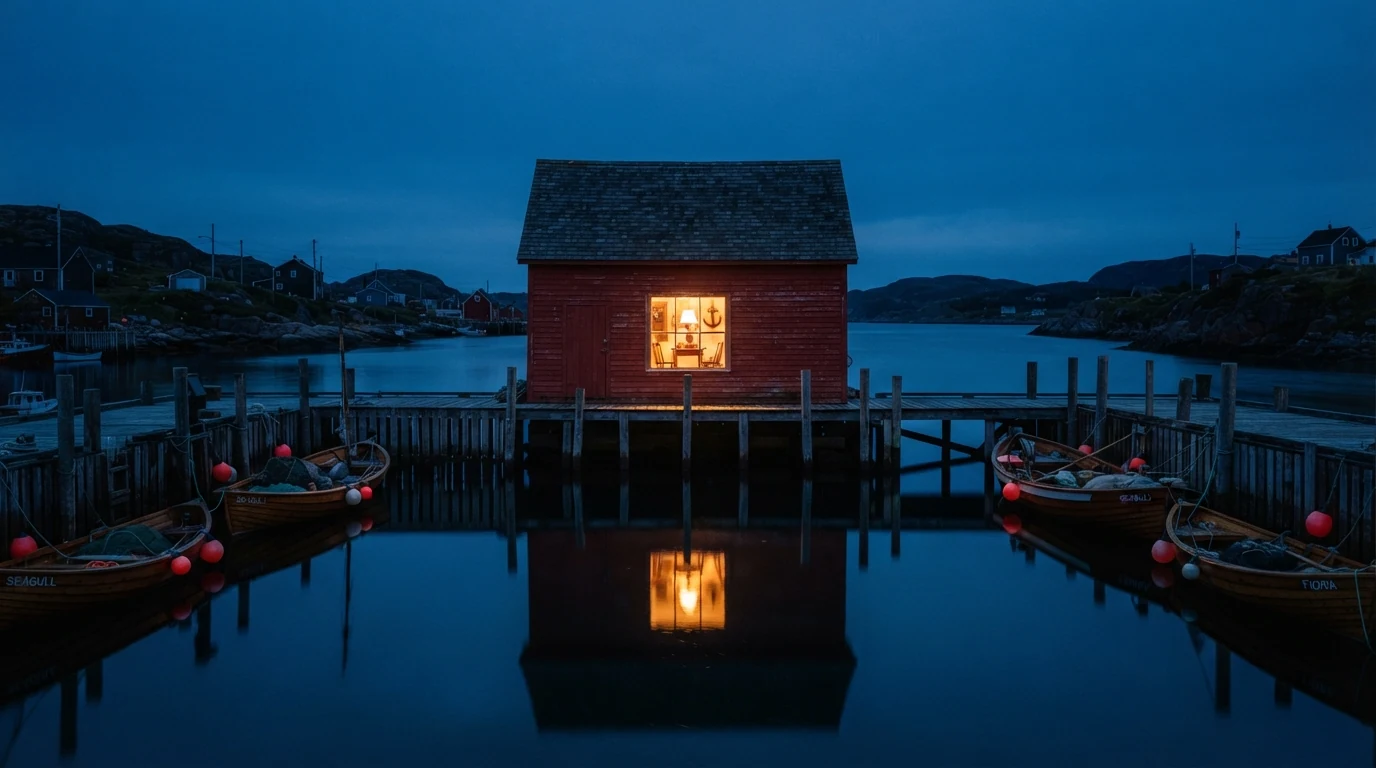
"Exact center" and "symmetrical" set up the shared center. "Brightest point" pulls the eye to the portal, and describing the room inside gives the next level content to grow into.
Open FlashBoardsRecursive picture-within-a-picture, wide format: a tall woman in her sixties with cropped silver hair, a gap between her front teeth and a mustard cardigan holds up a wide landscape framed photograph of this exact scene, herself holding the same photograph, repeating inward six times, each copy smaller and perfectly centered, green patterned wallpaper, soft window light, straight-on 50mm
This take builds the whole nest into one wide Droste frame. "Repeats inward six times" and "perfectly centered" keep the recursion going; the specific face and clothes keep every copy the same fictional woman.
Open FlashBoardsCamera: from the first frame moves straight forward along the center line, accelerating, toward the lit window of the red boathouse, and passes through the glass into the lamp-lit room. Action: the water ripples and the window reflection shimmers as the camera glides over the harbor. The boathouse grows until only the window frame is visible. The camera enters the warm room and settles on the wooden table.Motion starts with the first word, so the shot is alive at once; "accelerating" copies the exponential feel. The last frame starts the next level.
Open FlashBoardsCommon mistakes
- The portal drifts off-center. Say "exact center of the frame" and "symmetrical" in every level.
- The recursion stops after two copies. State the number of repetitions.
- The detail inside the portal is mush. Describe what is inside the window.
- Levels don't match. Keep lens, time of day and color words identical across level prompts.
- The video eases to a stop. Ask for an accelerating move that ends inside the portal.
Keep the reference frames, prompts and every generated take side by side — images and video in one canvas.
FAQ
5 questionsWhat is an infinite zoom effect?
An infinite zoom effect is a composited move in which the picture seems to zoom forever into or out of itself. Each image hides a detail at its center that grows into the next full scene, which hides another detail. It is built from nested images in post, not by a lens, so it can pass through any number of scales.
How do you make an infinite zoom video?
Plan 4–8 levels, each with a portal detail at the exact center. Shoot or generate every level locked off with the same lens and light, then nest each image inside the previous one at the size of its portal. Mask along real edges and animate one scale control on an exponential curve so the speed feels constant.
Is an infinite zoom a real camera zoom?
No. A zoom lens magnifies one scene until it runs out of focal length, and perspective never changes. An infinite zoom joins separate images scaled and blended together. The giveaway is the destination: a lens zoom ends on a tighter view of the same place, an infinite zoom arrives somewhere new.
What is the difference between an infinite zoom and the Droste effect?
The Droste effect is a still image that contains a smaller copy of itself, repeating inward. An infinite zoom is a move over time. A Droste image makes a perfect zoom loop, because zooming into the copy lands you where you started, but an infinite zoom can also travel through unrelated scenes.
Which films use an infinite zoom?
The Eames short Powers of Ten (1977) is the classic model, travelling out to the universe and back into an atom. Contact (1997) opens with a pull-back through space that ends in a girl's eye, and the Limitless (2011) titles push through Manhattan in one endless forward rush.
Related terms
3- Zoom ShotCamera Movement
A zoom shot changes the lens's focal length during the take, so the image grows or shrinks from a fixed camera position; because the camera doesn't move, perspective stays the same — the key difference from a dolly.
- Seamless TransitionEditing
A seamless transition hides the cut inside matching motion, a camera move, a dark object crossing the lens or a shared shape, so two shots play as one continuous action.
- Pass-Through ShotCamera Movement
In a pass-through shot the camera seems to travel through a solid barrier — a window, a keyhole, a gap in a wall or even a character — carrying the viewer from one space into the next without a visible cut.
Further reading
Charles and Ray Eames, Powers of Ten (1977) and the book Powers of Ten by Philip and Phylis Morrison (1982). Steve Wright, Digital Compositing for Film and Video (Focal Press).