 FlashBoards Learn
- Learn
- Screenwriting
- Monologue
Screenwriting · Film language
Monologue
Also called: speech, soliloquy
A monologue is an extended speech by one character, addressed to other people in the scene, that reveals what the speaker really thinks or turns the scene at a key moment. On screen it works when the listener changes because of it — the speech is an action, not a pause for information.
- What it does
- Hands one character the scene long enough to reveal, persuade or break something open.
- Use it when
- A character has been holding something back and the story needs it said, to someone, now.
- Watch out
- A speech with no listener at stake is exposition in costume; cut it or give someone a reason to interrupt.
- Try this prompt
Medium close-up of a gray-haired dock foreman speaking to a silent crew in a union hall, listeners' shoulders soft in the foreground, 50mm, warm tungsten light
What is a monologue?
A monologue is one character talking at length while others listen. The Greek root means "speaking alone," but on screen the speaker rarely is: the audience inside the scene is why the speech exists.
It is a special case of dialogue — instead of a volley, one player holds the ball for half a page or more. In screenwriting you'll meet a few related labels:
- Dramatic monologue — a speech to other characters: a confession, pitch, threat, eulogy or sermon.
- Soliloquy — thoughts spoken aloud by a character who is alone, like Hamlet's "To be or not to be."
- Direct address — a speech into the lens, breaking the fourth wall.
- Narration — a speech heard over images, recorded as voice-over.
Why do screenwriters use monologues?
A long speech breaks film's rhythm of short exchanges, so writers spend it where holding the floor is the drama:
- Revelation. In Jaws (1975), Quint's story of the USS Indianapolis explains his obsession with sharks.
- Domination. Blake's sales-meeting speech in Glengarry Glen Ross (1992) flattens a room; Howard Beale's "mad as hell" broadcast in Network (1976) turns a newsman into a prophet.
- Turning another character. Sean's park bench speech in Good Will Hunting (1997) dismantles Will's defenses; the father's speech to Elio in Call Me By Your Name (2017) reframes the whole summer.
The speaker wants something from the listener, and the scene ends somewhere new.
How to write a monologue
Start with the listener: who is in the room, what does the speaker need from them, and what happens if they don't get it?
- One objective. Confess, convince, wound or comfort — not all four.
- Turns inside it. Break it into 3–5 story beats: a shift in tactic, a memory, a loss of control.
- Specific images. A date, a smell, a name does more than an abstraction.
- Room for the listener. Write their silence, a look, an attempted interruption.
- Leave something unsaid. Good monologues still carry subtext.
- Earn the length. A page is about a minute of screen time; most film monologues run half a page to a page and a half.
How to stage and shoot a monologue
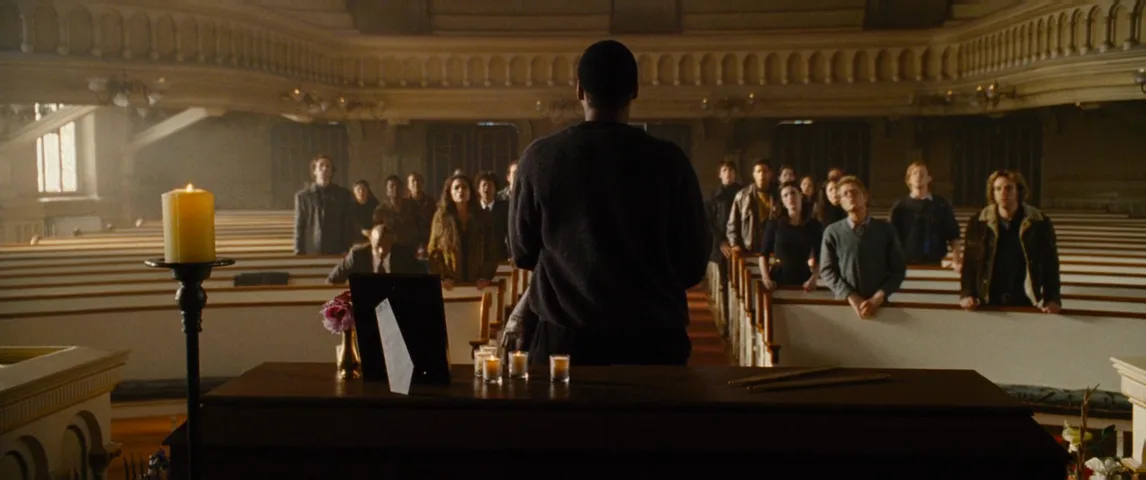
- Establish the audience first. A wide or over-the-shoulder shot of the listeners tells the viewer what is at stake.
- Let the performance run. Long takes on a 50–85mm close-up let the actor build; a slow push-in across the speech tightens attention without a cut.
- Cover the listeners. Reactions are how the audience measures the speech — plan them in your coverage.
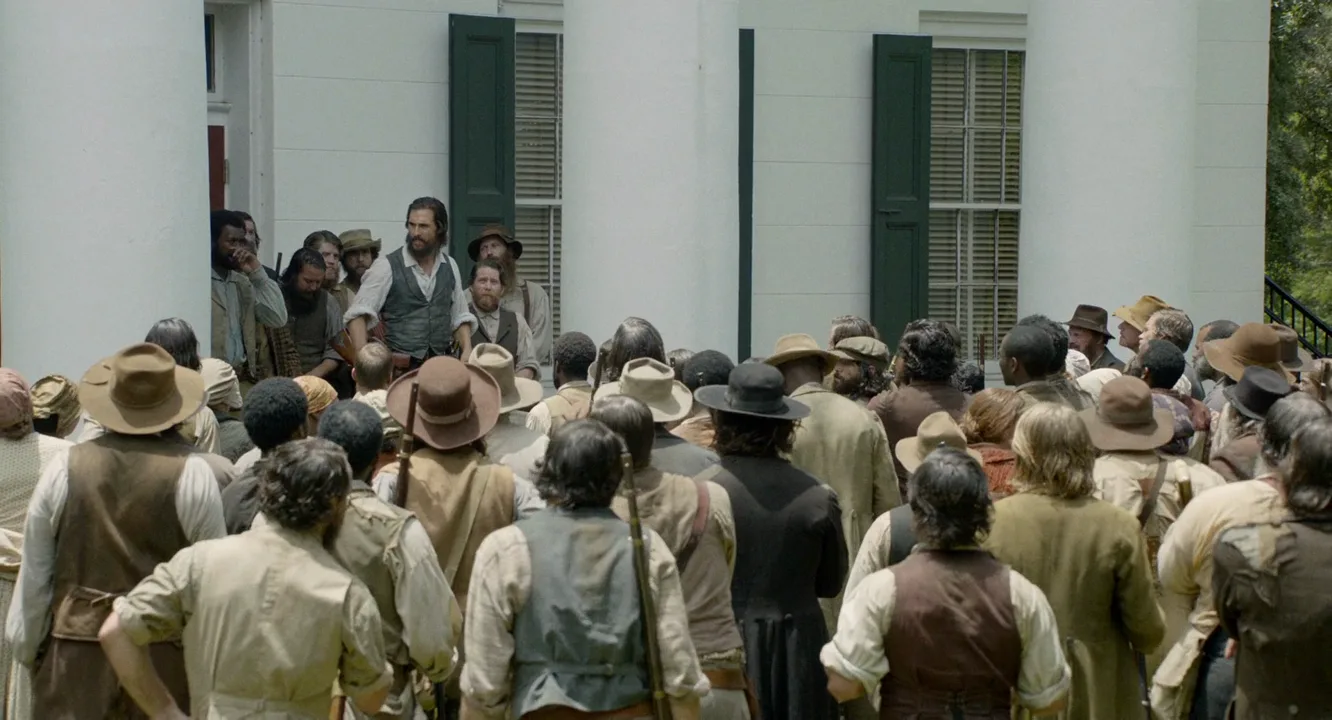
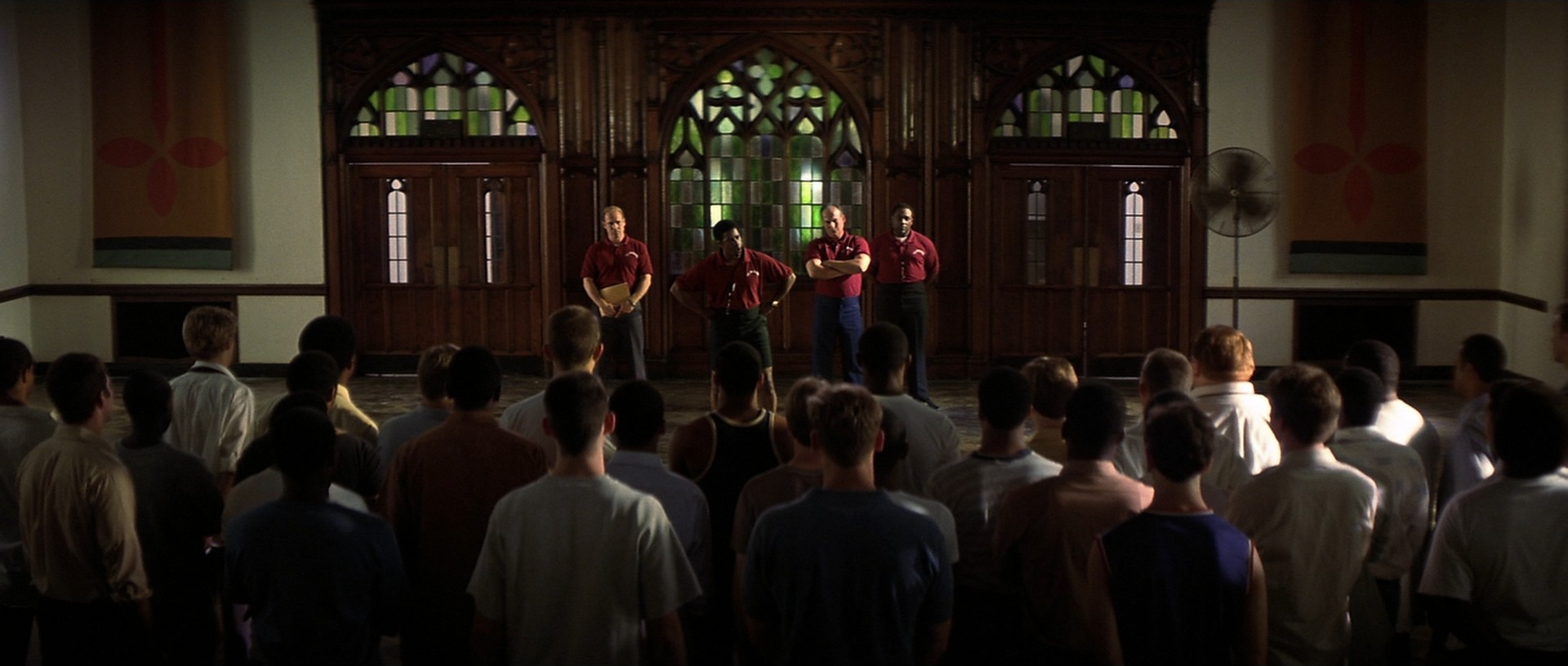
- Stage the power. A speaker standing while others sit, or raised on steps, owns the frame before saying a word.
In FlashBoards, keep the scene page, room references and test angles on one board, with speaker and listener shots side by side to decide where cuts fall.
Monologue vs. dialogue vs. internal dialogue
- Dialogue passes back and forth; power shifts line by line.
- A monologue is one voice holding the floor, heard by others in the scene.
- Internal dialogue is thought nobody in the scene hears, usually voice-over. Amy's "Cool Girl" speech in Gone Girl (2014) has a monologue's length but internal form.
- A soliloquy is spoken aloud, but alone: Travis Bickle's "You talkin' to me?" in Taxi Driver (1976) is aimed at a mirror.
- An aside is a brief remark to the audience that other characters don't hear.
Monologue examples in film
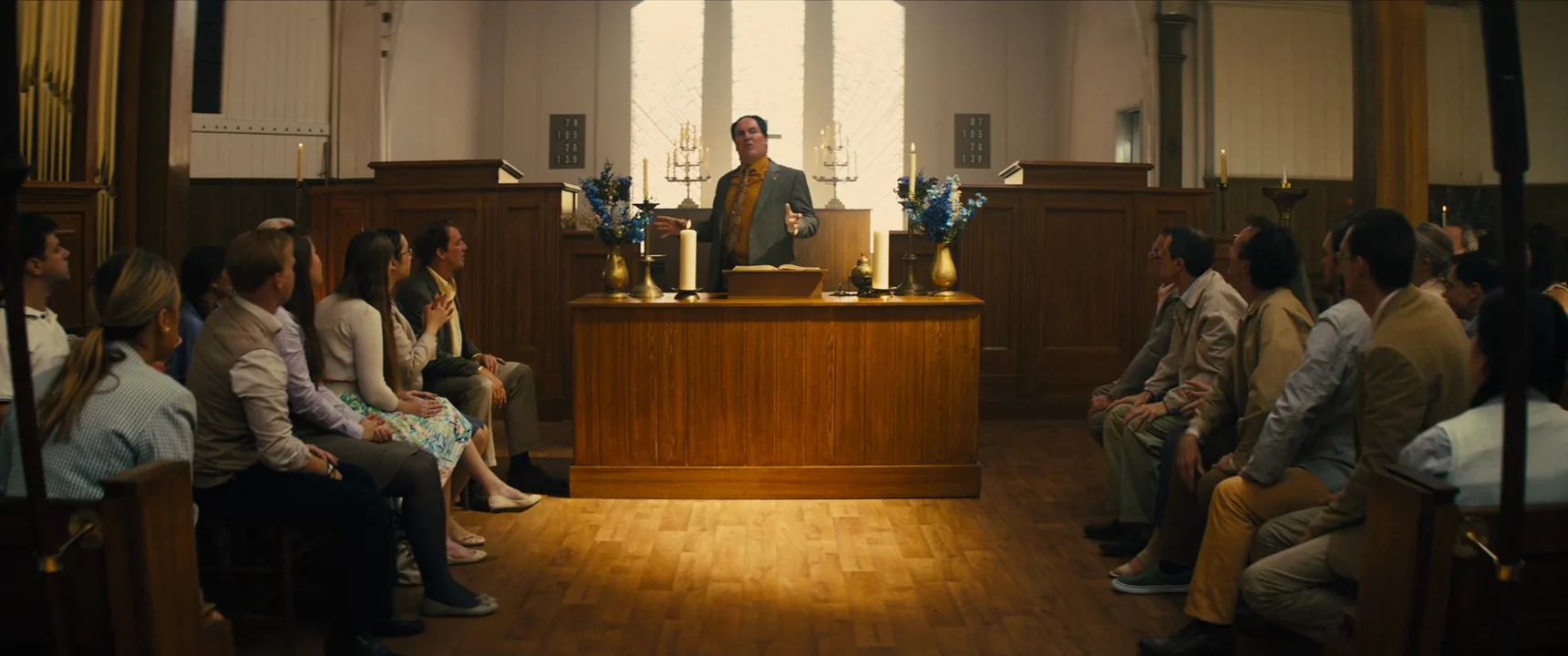
4 framesA monologue lives in how the speaker and the listeners share the frame.
How to create a monologue with AI
4 promptsA silent model can't write the speech, but it can find the staging: who stands, who listens, how close the lens gets. Generate the room, a tighter second angle and a push-in test, and keep them next to the script page on your FlashBoards board. The fourth prompt re-shoots a real film shot from a text description alone, and the original plays next to the result so you can compare.
Cinematic film still, medium shot in a worn union hall at night. A heavyset dock foreman in his sixties, gray crew cut, deep forehead lines, faded navy work jacket, stands at the front mid-speech, one hand raised, eyes on the room. Out-of-focus backs and shoulders of seated workers in knit caps frame him in the foreground. 50mm lens at standing eye height, warm tungsten practicals, cool window light behind, 35mm film grain.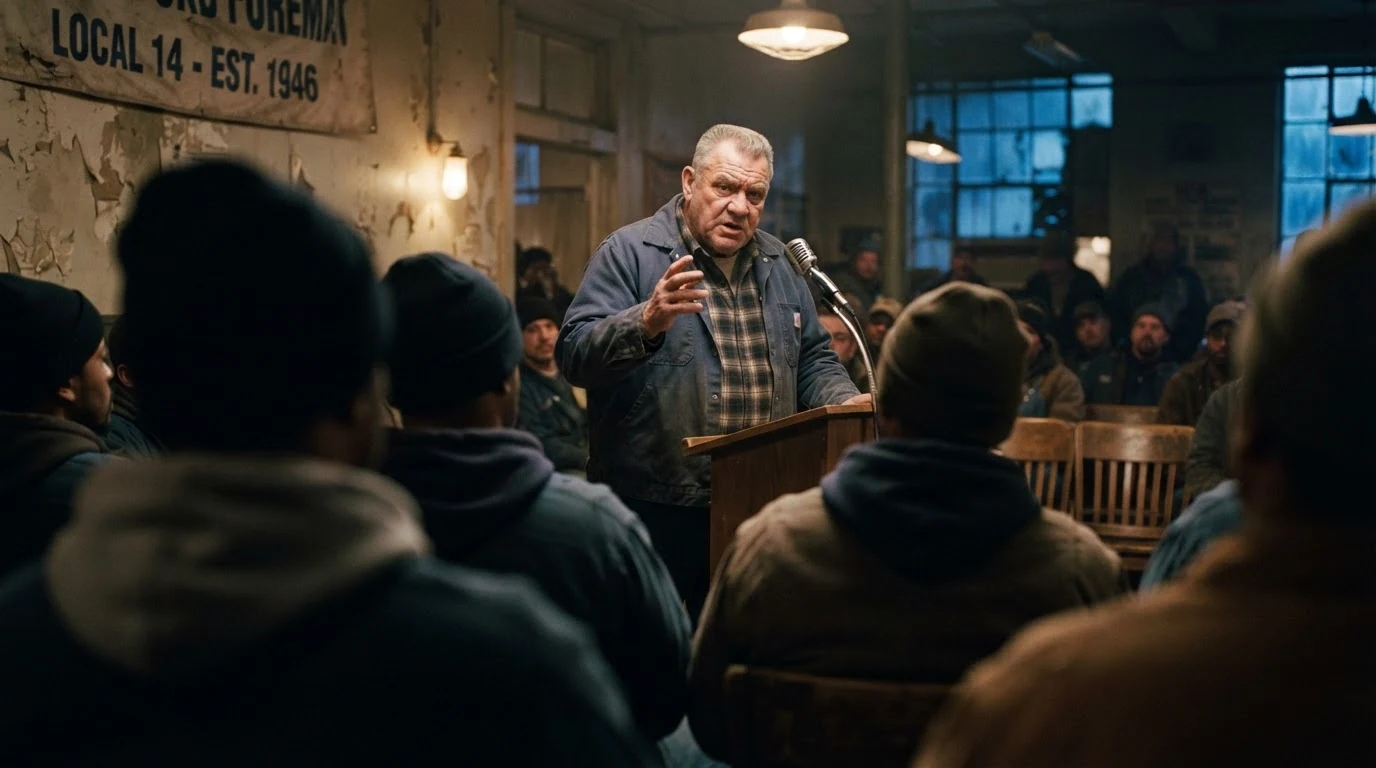
"Mid-speech, one hand raised" makes him the one talking; the blurred listeners in the foreground separate a monologue from a portrait.
Open FlashBoardsAnamorphic widescreen close-up, a woman in her forties with short copper hair, freckles and a chipped front tooth, seated at a kitchen table under one hanging lamp, speaking quietly, eyes wet but steady. The blurred shoulder of a young man listening fills the left third. 85mm lens, warm low-key light, film grain.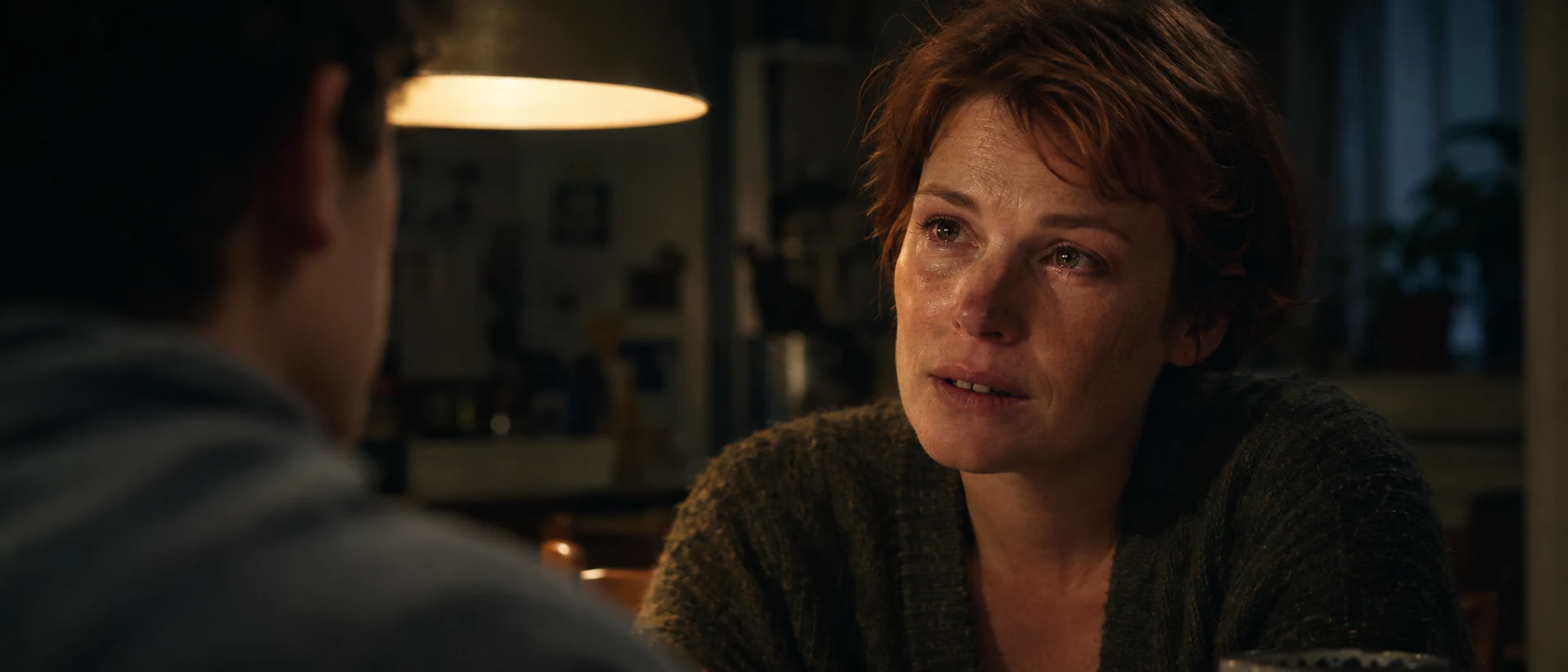
A private monologue instead of a public one. "Eyes wet but steady" sets the register; the listener's shoulder keeps the speech addressed to someone.
Open FlashBoardsCamera: slow, steady push-in from the medium shot to a close-up of the foreman's face, moving between the seated workers' shoulders. Action: the foreman is already talking, his raised hand cutting the air; midway he lowers it and leans forward; at the end he stops, jaw set, and looks at one worker in the front row, who turns his head toward the man beside him."Already talking" keeps the clip alive from the first frame; the push-in tightens attention, and the listener's small reaction shows the words landing.
Open FlashBoards{
"output": "Full-screen live-action scene from Kingsman: The Secret Service (2014), from its very first frame: one continuous shot, no cuts. Anamorphic 2.39 widescreen, 35mm film grain, a small wood-paneled small-town church in the American South on a summer morning, hard white daylight blooming through a tall frosted window behind the pulpit, a warm amber pool of light on the plank floor of the center aisle, honey-brown wood, cream walls, two tall black crosses on posts left and right of the aisle.",
"characters": {
"S1": {
"name": "the preacher",
"look": "heavy-set man in his fifties, dark slicked hair, fleshy face, grey-green suit, mustard shirt, patterned tie, standing behind a wide wooden altar table with an open Bible on a lectern, two white candles and two brass vases of blue flowers",
"voice": "big, booming, hoarse preacher's voice"
},
"S2": {
"name": "Harry Hart, played by Colin Firth",
"look": "slim man in a grey suit and dark-rimmed glasses, seated among the men at the aisle end of the right-hand front pews",
"voice": "silent"
},
"S3": {
"name": "Church Blonde Woman, played by Anne Wittman",
"look": "woman with long wavy blonde hair and a pale pink top, seated in a right-hand pew, seen from behind",
"voice": "silent"
},
"S4": {
"name": "congregation",
"look": "about forty townspeople in pale plain summer clothes, short-sleeved shirts, floral dresses, tan jackets, in wooden pews on both sides of the aisle, every body turned toward the pulpit",
"voice": "cheers and shouts of agreement"
}
},
"shots": [
{
"shot": 1,
"camera": "slow steady dolly in down the center aisle at seated eye height toward the pulpit, wide lens, symmetrical one-point perspective; starts as a deep wide shot with the backs of the rear pews dark in the lower corners and S1 small and centered under the bright window; ends as a medium-wide shot, the camera drifting to the right in the last beat so the altar table slides into the left third and the right-hand front pew of men fills the right half of frame",
"action": [
"BEGINNING: alive from the first frame, S1 already mid-sentence, standing centered behind the altar, hands low at the table; the congregation sits still, backs to the camera.",
"THEN: S1 throws both fists straight up above his head, shaking them, mouth wide open, shouting to the room.",
"THEN: S1 drops his arms; the congregation answers him, hands shooting up on both sides of the aisle, waving and cheering, heads bobbing.",
"THEN: the hands come down one by one and the room settles; S1 spreads both arms wide, palms open and up, and starts his next sentence.",
"THEN: S1 brings his hands together in front of his chest, fingers working, leaning slightly over the Bible, eyes sweeping from the left pews to the right pews; the listeners on the left sit upright, faces lifted to him, one woman clasping her hands in her lap.",
"END: S1 lifts his right hand, palm up, still preaching toward the right-hand pews; S2 sits motionless at the aisle end of the right front pew, gaze fixed on S1, hands still; the men beside him sit still, eyes on the pulpit."
],
"dialogue": [
{
"speaker": "S1",
"on_screen": true,
"when": "from the first frame, already mid-sentence, ending as his fists go up",
"delivery": "booming, accusing",
"line": "<d>[Russian] Но некоторые сомневаются в том, что это гнев Божий!</d>"
},
{
"speaker": "S1",
"on_screen": true,
"when": "as the cheering dies down and his arms spread wide, running to the last frame",
"delivery": "slower, hard, each word hammered",
"line": "<d>[Russian] Наше мерзкое правительство мирится с содомией, разводами, абортами!</d>"
}
]
}
],
"sound": {
"ambience": "large wooden room reverb, pews creaking, a short burst of cheering and clapping from the congregation after the first line that fades as they settle",
"speech": "exactly these spoken phrases, each said once, in this order",
"never_spoken": "no narration and no voice-over: the descriptions, performance notes and step words of this prompt are never spoken aloud",
"music": "a film score under the scene, always below the voices: low ominous strings with a slow, building pulse",
"subtitles": "none"
}
}Remakes the church dolly-in from Kingsman: The Secret Service (2014), dir. Matthew Vaughn, DP George Richmond: the push down the aisle, the preacher's raised fists, the congregation's answering hands and his two lines of the sermon, word for word.
The monologue is carried by the action phases: fists up, the room answers, then settles while he keeps talking. The two dialogue lines are the film's own, and the camera field keeps the corpus dolly in down the aisle.
Common mistakes
- Models turn a monologue into a portrait. Name the listeners and where they sit in the frame.
- "Speaking" alone often gives an open-mouthed shout; describe tone through the body — "leaning forward, voice dropping."
- If nothing happens, video drifts into a slow zoom on a frozen face; give the speaker a gesture that changes midway.
Keep the reference frames, prompts and every generated take side by side — images and video in one canvas.
FAQ
5 questionsWhat is a monologue in a movie?
A long, uninterrupted speech by one character to others in the scene, usually at a turning point: a confession, threat, eulogy or pitch. It works when it changes the listener or the situation, not when it only delivers backstory.
How long should a monologue be in a screenplay?
Usually half a page to a page and a half; one screenplay page is roughly a minute of screen time. Past a page, break it with action lines or listener reactions so the pacing reads.
What is the difference between a monologue and a soliloquy?
A monologue is addressed to characters who hear it; a soliloquy is spoken aloud by a character who is alone. Hamlet's "To be or not to be" is a soliloquy; a eulogy or pep talk is a monologue.
How do you write a good monologue?
Give the speaker one objective and a listener who matters. Build in beats. Use concrete images, leave room for reactions, keep something unsaid. If nothing changes between the first line and the last, it isn't a monologue yet.
What are some famous movie monologues?
Often cited: Quint's speech in Jaws (1975), Howard Beale's broadcast in Network (1976), Blake's sales speech in Glengarry Glen Ross (1992), Sean's park bench speech in Good Will Hunting (1997) and the father's speech in Call Me By Your Name (2017).
Related terms
2- DialogueScreenwriting
Dialogue is the spoken exchange between characters; good screen dialogue reveals character and conflict while leaving the most important things unsaid.
- SubtextStorytelling
Subtext is what characters mean but don't say — the real feelings or intentions beneath the dialogue, conveyed by performance, framing and context.
Further reading
Robert McKee, Story (1997); David Mamet, On Directing Film (1991).