 FlashBoards Learn
- Learn
- Screenwriting
- Story Beat
Screenwriting · Film language
Story Beat
Also called: beat, dramatic beat
A story beat is the smallest unit of dramatic change: one action, reaction or decision that shifts the direction of a scene. Beats stack into scenes, scenes into sequences and acts. In dialogue, the parenthetical (beat) means something narrower: a short pause before the next line.
- What it does
- Marks the exact moment something changes between characters, so every stretch of a scene has a reason to exist.
- Use it when
- Breaking down a scene before rewriting, rehearsing with actors, or planning shots and cuts.
- Watch out
- Two moments in a row with no change are one beat stretched out; a page of (beat) pauses is a directing habit, not writing.
- Try this prompt
Medium two-shot at a kitchen table at night, a woman slides a folded letter across to a man, his hand stops on his coffee cup, tension, 35mm film still
What is a beat in screenwriting?
The word does three jobs in screenwriting:
- The dramatic beat. The smallest unit of change inside a scene. One character acts (asks, threatens, lies, confesses), the other reacts, and the balance tips. When the tactic changes, a new beat starts. Robert McKee's Story frames it as an exchange of behavior in action and reaction.
- The structural beat. On a beat sheet, a beat is a major story event: the catalyst, the midpoint. The Save the Cat beat sheet uses the word at the scale of the whole film.
- The pause. Inside dialogue, (beat) tells the actor that a moment passes before the next line.
The first meaning is the one that makes scenes work; structural beats belong to story structure.
How beats build a scene
A scene is a unit of change: someone enters wanting something and leaves better or worse off. Beats are the steps of that change: trust to suspicion, calm to threat.
Take the rooftop meeting in Die Hard (1988). McClane runs into a man claiming to be an escaped hostage. The beats are easy to count: suspicion, the stranger's performance, McClane's test, the handoff of a pistol, and the gun turned on McClane with nothing in it. Each exchange shifts who holds power; the last one flips the scene.
Marriage Story (2019) builds its argument in Charlie's apartment the same way, only slower: a civil attempt to talk, a grievance, a counter-grievance, an insult, a wall punched, a line he can't take back, then a collapse with Nicole kneeling beside him. No two beats sit on the same step.
Beats make scenes, scenes make sequences, sequences make acts.
What does (beat) mean in a script?
Written as a parenthetical or between lines of action, (beat) means a short pause, a second or two, in which something happens: a thought lands, a decision forms.
JANE I sold the house. (beat) Yesterday.
Use it like salt: one can carry a turn no line could; five on a page read as the writer directing the actor. If the pause marks a real change, it is also a dramatic beat. If not, cut it.
How to find the beats in your script
A beat breakdown works on any draft:
- Name each character's objective in one verb: to get the keys, to stall, to confess.
- Name the value at stake and where it starts: trust, safety, status.
- Draw a line wherever a character changes tactic. Each segment is one beat.
- Label each beat in a short phrase: she pleads, he deflects, she threatens.
- Check the shape. Two beats in a row with the same label are one beat stretched out. If the value at the end equals the start, the scene needs a turn or a cut.
Actors play one objective per beat, and directors use beat changes as cues for blocking and new shot sizes. When the words and the beat differ, that gap is subtext.
Story beat vs. plot point
Every plot point is a beat, but few beats are plot points. The difference is scale.
- A beat changes the direction of a moment. Films contain hundreds, most of them small: a look, a refusal, a question that lands wrong.
- A plot point changes the direction of the whole story and pushes the protagonist into a situation they can't walk back from.
From beats to shots on the board
Storyboard at least one panel per beat: a beat with no distinct image is often one the audience won't feel.
In FlashBoards, lay the scene out left to right: beat labels as notes on top, a generated frame under each, reference stills beside them. Two panels that look the same usually mean two beats that play the same. That row becomes the first draft of the storyboard.
How to create a story beat with AI
4 promptsA frame can't hold a scene, but it can hold one beat: the instant around a change. Nano Banana 2 Lite stages the moment before the turn, GPT Image 2.5 lays out a three-beat board, and MiniMax H3 Max Turbo plays the beat from the first frame. Keep all three next to the beat labels on one FlashBoards board. The fourth prompt re-shoots a real film shot from a text description alone, and the original plays next to the result so you can compare.
Medium two-shot, 35mm lens, eye level, film still. A small kitchen at night, one warm pendant lamp over a wooden table. Left: a woman in her forties with a short gray-streaked bob, mustard cardigan and silver hoop earrings, fingertips on a folded white letter she has just slid to the middle of the table. Right: a lanky man in his fifties with a shaved head and dark beard, navy work shirt, coffee mug stopped halfway to his mouth, eyes on the letter. Dark window behind, amber and muted green, fine film grain.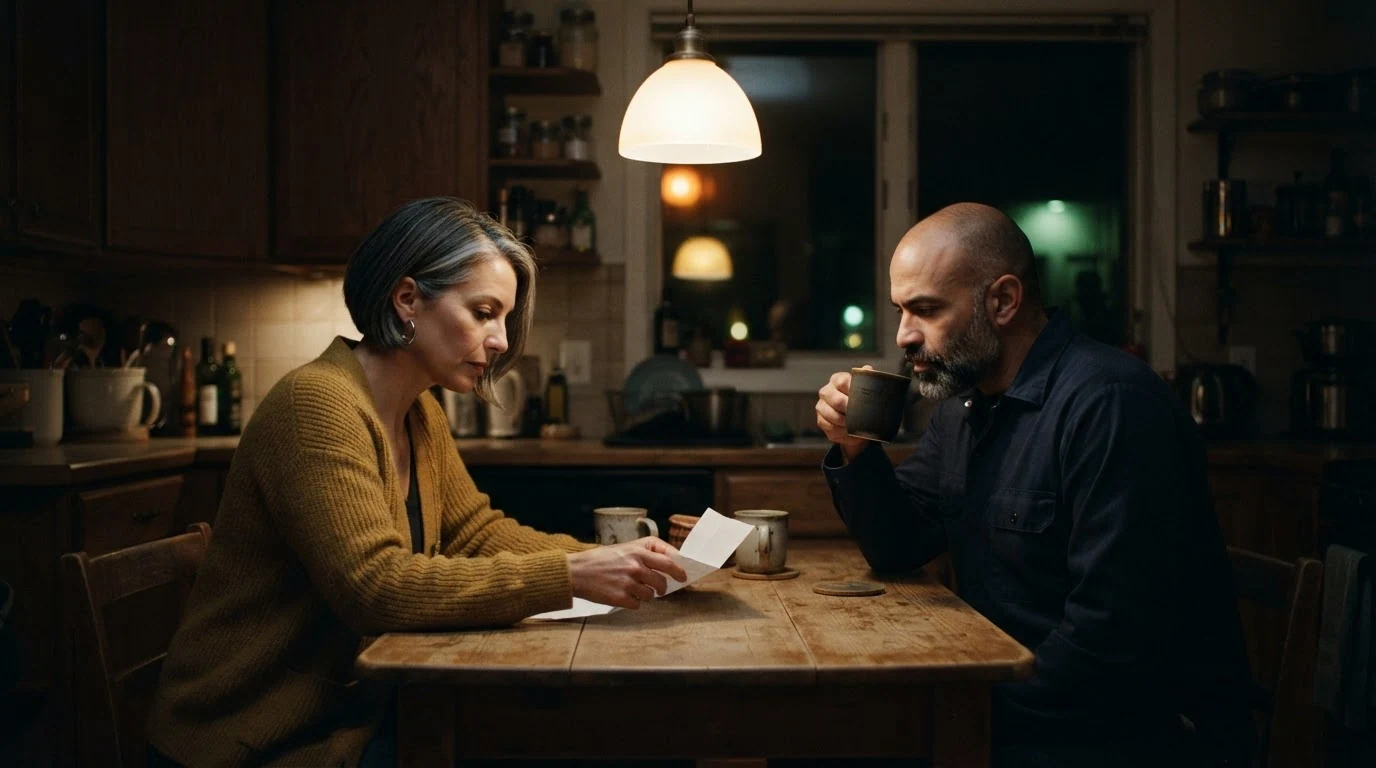
The beat lives in just slid and stopped halfway to his mouth: the action has happened, the reaction hasn't. The balanced medium two-shot keeps both faces readable.
Open FlashBoardsStoryboard strip, three panels side by side, thin black borders, loose pencil and gray marker, a handwritten label under each panel. Same two characters throughout: a woman in her forties with a short gray-streaked bob and a mustard cardigan, the only color accent; a lanky bearded man in his fifties with a shaved head. Panel 1 "she offers": medium two-shot at a kitchen table, she slides a folded letter to him. Panel 2 "he reads": close-up of his face, eyes down, jaw tight. Panel 3 "he pushes back": wide shot, he stands, chair pushed back, she stays seated.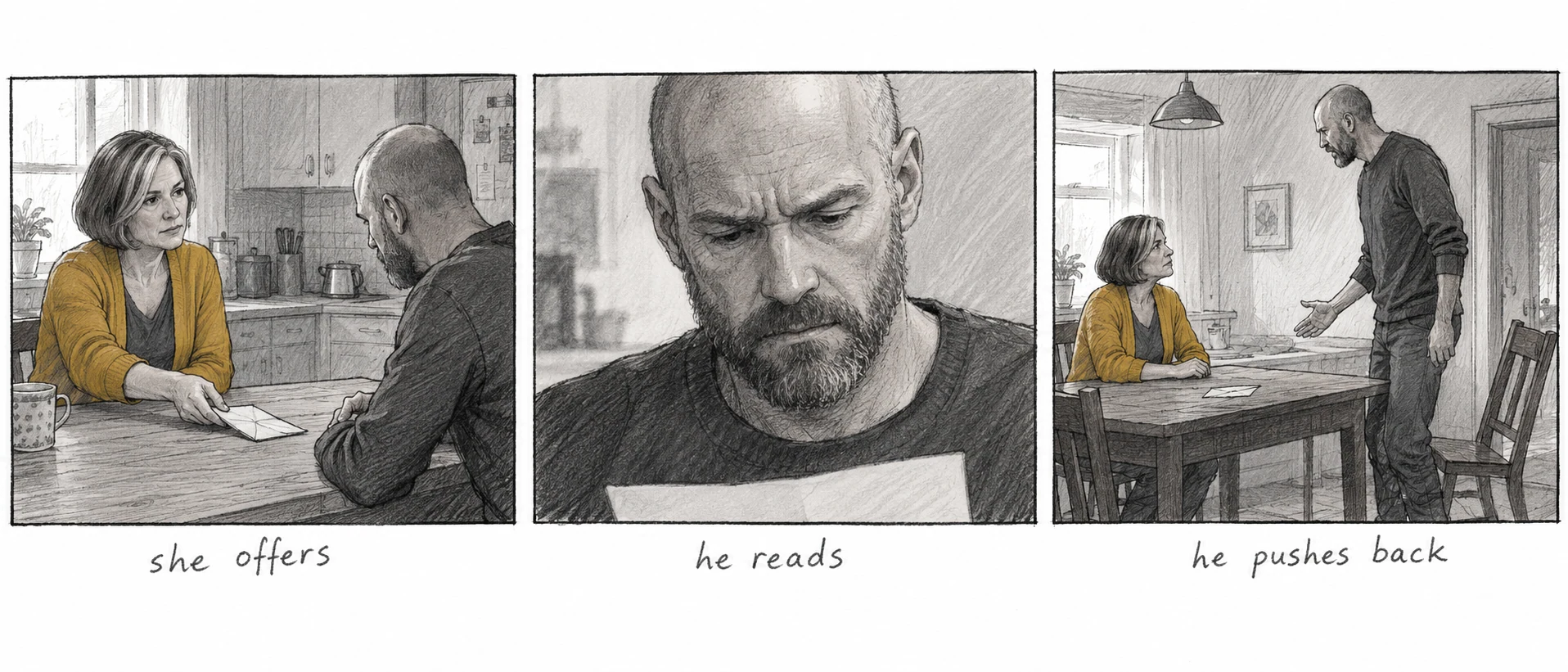
Three panels with a label under each turn the prompt into a beat breakdown. Shot size changes at each beat, where a director would cut; the single color accent keeps the woman consistent.
Open FlashBoardsCamera: locked-off medium two-shot at eye level, then a very slow push toward the man. Action: the man is already lowering his mug to the table. He picks up the letter and opens it while the woman watches, still. In the middle he reads and his jaw tightens. At the end he sets the letter down, looks up at her and leans back, away from the table.Already lowering his mug makes the shot alive from the first frame. The clip carries one clean shift, reading to recoil, and uses only what is in the start frame.
Open FlashBoards{
"output": "Full-screen live-action scene from Life As We Know It (2010), from its very first frame: one continuous shot, no cuts. Glossy 2010 35mm studio drama, anamorphic scope frame, dim warm interior, soft light from screen left, a plain gray-beige wall behind her falling into brown shadow on screen right, muted skin tones.",
"characters": {
"S1": {
"name": "Holly Berenson, played by Katherine Heigl",
"look": "woman in her early thirties, short tousled honey-blonde hair, heather-gray knit top, red-rimmed wet eyes",
"voice": "thin, cracked from crying, rising in disbelief"
},
"S2": {
"name": "Officer Young, played by L. Warren Young",
"look": "never seen: he stands off frame right, only his voice is heard",
"voice": "calm, low, matter-of-fact police officer"
}
},
"shots": [
{
"shot": 1,
"camera": "locked-off, eye level, long lens, tight close-up of S1 placed left of centre in the wide frame, empty shadowed wall filling the right half; shallow focus, no camera movement, same framing to the end",
"action": [
"BEGINNING: alive from the first frame, S1 already crying, her left hand (screen right) pressed flat over her nose and mouth, fingers spread, wet eyes fixed just off the lens toward screen right where the officer stands.",
"THEN: she drops the hand from her face in one move, down toward screen right, and her lips part as the word about the girl reaches her.",
"THEN: the same hand comes back up and settles with its knuckles under her chin, and stays there, still, for the rest of the shot.",
"THEN: she asks her short question, brow lifting, mouth open, eyes never leaving the officer off frame right.",
"THEN: she listens without moving: head still, no nod, knuckles still under her chin, lips parted and trembling, a tear line shining on her cheek, brow slowly knitting tighter as the explanation goes on.",
"THEN: near the end she blinks once, eyes closing for a beat, and her jaw sets.",
"END: she opens her eyes on the officer and throws his words back at him, stung, head held still, knuckles under her chin."
],
"dialogue": [
{
"speaker": "S2",
"on_screen": false,
"when": "from the first frame, while her hand still covers her mouth",
"delivery": "flat, reporting",
"line": "<d>[English] So the officers placed her with CPS for the night.</d>"
},
{
"speaker": "S2",
"on_screen": false,
"when": "right after, as she lowers her hand",
"delivery": "reassuring",
"line": "<d>[English] She's perfectly fine.</d>"
},
{
"speaker": "S1",
"on_screen": true,
"when": "as the hand settles under her chin",
"delivery": "barely voiced, alarmed",
"line": "<d>[English] CPS?</d>"
},
{
"speaker": "S2",
"on_screen": false,
"when": "right after her question",
"delivery": "patient",
"line": "<d>[English] Child Protective Services.</d>"
},
{
"speaker": "S2",
"on_screen": false,
"when": "while she listens without moving",
"delivery": "routine",
"line": "<d>[English] Where they take cases like this.</d>"
},
{
"speaker": "S1",
"on_screen": true,
"when": "at the very end, after her blink",
"delivery": "hurt, incredulous",
"line": "<d>[English] Cases like this?</d>"
}
]
}
],
"sound": {
"ambience": "quiet indoor room tone, faint hum of a light, her shaky breathing and one sniff",
"speech": "exactly these spoken phrases, each said once, in this order",
"never_spoken": "no narration and no voice-over: the descriptions, performance notes and step words of this prompt are never spoken aloud",
"music": "a film score under the scene, always below the voices: soft sustained piano and low strings, hushed and grieving",
"subtitles": "none"
}
}Remakes the static close-up of Holly (Katherine Heigl) hearing about CPS in Life As We Know It (2010), dir. Greg Berlanti, DP Andrew Dunn; the prompt carries over the corpus lines, the hand from mouth to chin and the blink before her reply.
The whole beat sits in one locked close-up: news lands, a question, a pause, and her own words thrown back. The THEN steps pin each hand and gaze change to a line, so the turn plays on her face, not in a cut.
Open FlashBoardsCommon mistakes
- Image models default to a posed, calm moment. Name the action in progress, or you get two people sitting, not a beat.
- Video models like to add a second event. Describe one change.
- Emotion words ("shocked") produce mugging faces. Describe the physical tell: a tightened jaw.
Keep the reference frames, prompts and every generated take side by side — images and video in one canvas.
FAQ
4 questionsWhat is a beat in screenwriting?
A beat is the smallest unit of dramatic change in a script: one action, reaction or decision that shifts a scene's direction. When a character changes tactic, a new beat begins. Beats build scenes, scenes build sequences and acts. The word also names major events on a beat sheet and, in dialogue, a short pause.
What does (beat) mean in a script?
Written as a parenthetical or between lines, (beat) means a brief pause of a second or two before the next line or action. It signals that something happens in the silence, such as a thought or a decision. Use it rarely: one well-placed pause can carry a turn, while several per page read as the writer directing the actor.
How many beats are in a scene?
There is no fixed number. A short transitional scene may hold one beat; a long dialogue scene can have ten or more. What matters is that each beat changes something and no two consecutive beats play the same way. If a scene ends where it started, it has no real beats and needs a turn or a cut.
Is a story beat the same as a plot point?
No. Every plot point is a beat, but most beats are small shifts inside a scene: a look, a refusal, a question. A plot point is a beat big enough to turn the whole story, such as the events that close the first and second acts. Beat-sheet beats sit in between, as named story events.
Related terms
6- Plot PointStorytelling
A plot point is a turning event that spins the story in a new direction; in the three-act model, plot point one and two close the first and second acts.
- Save the Cat Beat SheetScreenwriting
The Save the Cat beat sheet is Blake Snyder's 15-beat map of a feature, from Opening Image and Catalyst to Finale and Final Image, with page targets for each beat — a ready template for planning scenes and storyboards.
- Script OutlineScreenwriting
A script outline is a scene-by-scene plan of the story written before the draft, listing what happens and why in each scene so structure problems surface early.
- StoryboardFilmmaking Process & Crew
A storyboard is a sequence of drawn or generated panels, one per planned shot, showing framing, action and camera movement with notes — a visual draft of the film before anything is shot.
- ParentheticalScreenwriting
A parenthetical is a brief note in brackets under a character's name that tells how a line is said or to whom, used sparingly so it doesn't direct the actor.
- Story StructureStorytelling
Story structure is the order and shape of the events that carry a story from setup to resolution; models like the three-act structure, Freytag's pyramid, the hero's journey or Save the Cat are different maps of it.
Further reading
Robert McKee, Story: Substance, Structure, Style and the Principles of Screenwriting (1997). Blake Snyder, Save the Cat! (2005).