 FlashBoards Learn
- Learn
- Screenwriting
- Script Outline
Screenwriting · Film language
Script Outline
Also called: screenplay outline, step outline, beat outline
A script outline is a scene-by-scene plan of a screenplay, written before the draft. Each entry says what happens in the scene and why it matters to the story, so a gap in the structure, a sagging middle or an unearned ending shows up on three pages instead of in 110.
- What it does
- Lays out every scene in order with its purpose, so the structure can be fixed before any pages are written.
- Use it when
- After the logline and beat sheet, before the first draft, or when a draft stalls and you need to see its shape.
- Watch out
- Entries that list events without a change or a reason. An outline held together by "and then" hides a broken middle.
- Try this prompt
Corkboard wall of white index cards in rows, each card a loose pencil thumbnail of a film scene, warm desk lamp light
What is a script outline?
A script outline is the skeleton of a screenplay: a numbered list of scenes in story order, each described in a line or two. It skips dialogue, camera directions and description, and keeps sequence, cause and consequence.
In screenwriting the outline comes after the logline and a structural map such as the Save the Cat beat sheet, and before the first draft. The names overlap:
- Beat outline: the major turns only, often 15 to 40 lines.
- Step outline: one step per scene, a sentence or two each.
- Scene-by-scene outline: a fuller step outline with scene headings and each scene's purpose.
- Index cards: one scene per card, laid out so scenes can be moved.
In American television the episode outline is a formal step: the writer delivers it, gets notes, then goes to script.
Why outline a screenplay before writing it?
Structure is cheap to fix in an outline and expensive in a draft. Moving scene 23 ahead of scene 14 is a card on a wall; in a finished script it means rewriting both scenes and everything around them. A good outline answers three questions early:
- Does every scene change something? An entry with no turn, reveal or decision is a candidate to cut. The story beat is the unit you are checking for.
- Is it connected by cause? Scenes should link with because, but and so, not and then.
- Where does the middle sag? A second act that repeats one conflict three times is obvious on two pages.
The best-known example is the 1978 story conference for Raiders of the Lost Ark, where George Lucas, Steven Spielberg and Lawrence Kasdan talked through the set pieces and their order before Kasdan wrote the script. Writers who discover the story in a draft outline afterward: a reverse outline, one line per scene, shows what the draft really contains.
How to outline a screenplay, step by step
- Start from the logline and the ending.
- Place the anchors: inciting incident, break into act two, midpoint, crisis, climax.
- Fill the gaps scene by scene: a scene heading plus one to three present-tense sentences on who wants what and what changes.
- Tag each scene's purpose. If you can't write a note like "she breaks her rule", the scene has no job.
- Read for cause and effect, then check proportions: roughly a quarter of the scenes in act one, half in act two, a quarter in act three.
On a FlashBoards board each scene can be a note in a column per act, with reference stills and a rough key frame beside the scenes that carry the film. Moving notes is how you restructure, and the frames you keep become the first pass of the storyboard.
Script outline template and example
Template for each entry: #. SCENE HEADING, then what happens in one to three present-tense sentences, then Why: what changes or what it sets up. The first four entries for an invented feature, Cold Storage:
- INT. FISH PLANT, FREEZER HALL – NIGHT. RUTH (62), the night guard, logs temperatures on her round. A freezer door stands ajar; wet boot prints lead inside. Why: sets her rule: everything gets reported.
- INT. BLAST FREEZER – CONTINUOUS. Behind pallets of frozen cod she finds TOMAS (16), soaked and shaking. He begs her not to call anyone. Why: inciting incident; her rule meets a person.
- INT. GUARD OFFICE – NIGHT. She dials the police, hangs up and hands him her thermos. Why: her first choice against the rule.
- EXT. HARBOR – DAWN. Three trawler men sweep the docks with flashlights as Ruth watches. Why: someone is hunting him, and they are close.
Each scene ends in a different state than it began, and each causes the next. That is the test.
Script outline vs. treatment
Both follow the story scene by scene, but for different readers. An outline is for the writer: terse, numbered, built to be rearranged, with notes on purpose that never reach the script. A film treatment is for a reader: present-tense prose that carries tone, character and key images.
A synopsis is shorter than both: one or two pages of the story's spine, ending included. Typical order: logline, beat sheet, outline, treatment, draft.
How to create a script outline with AI
3 promptsAn outline's key scenes can be seen before the draft exists. Stage one entry as a frame, lay the outline out as picture cards, and animate the frame to check whether the scene plays silent, all beside your outline notes on one FlashBoards board.
Film still, medium wide shot, 35mm lens, eye level. Inside an industrial blast freezer at night: frost on steel walls, pallets of frozen fish boxes wrapped in plastic. Between two pallets crouches a skinny teenage boy with wet curly red hair, a soaked gray hoodie and scraped bare hands, breath visible, looking up into a flashlight beam. Out-of-focus foreground: the shoulder of a guard in a navy jacket holding the flashlight. Cold blue-white light, mist in the air, fine film grain.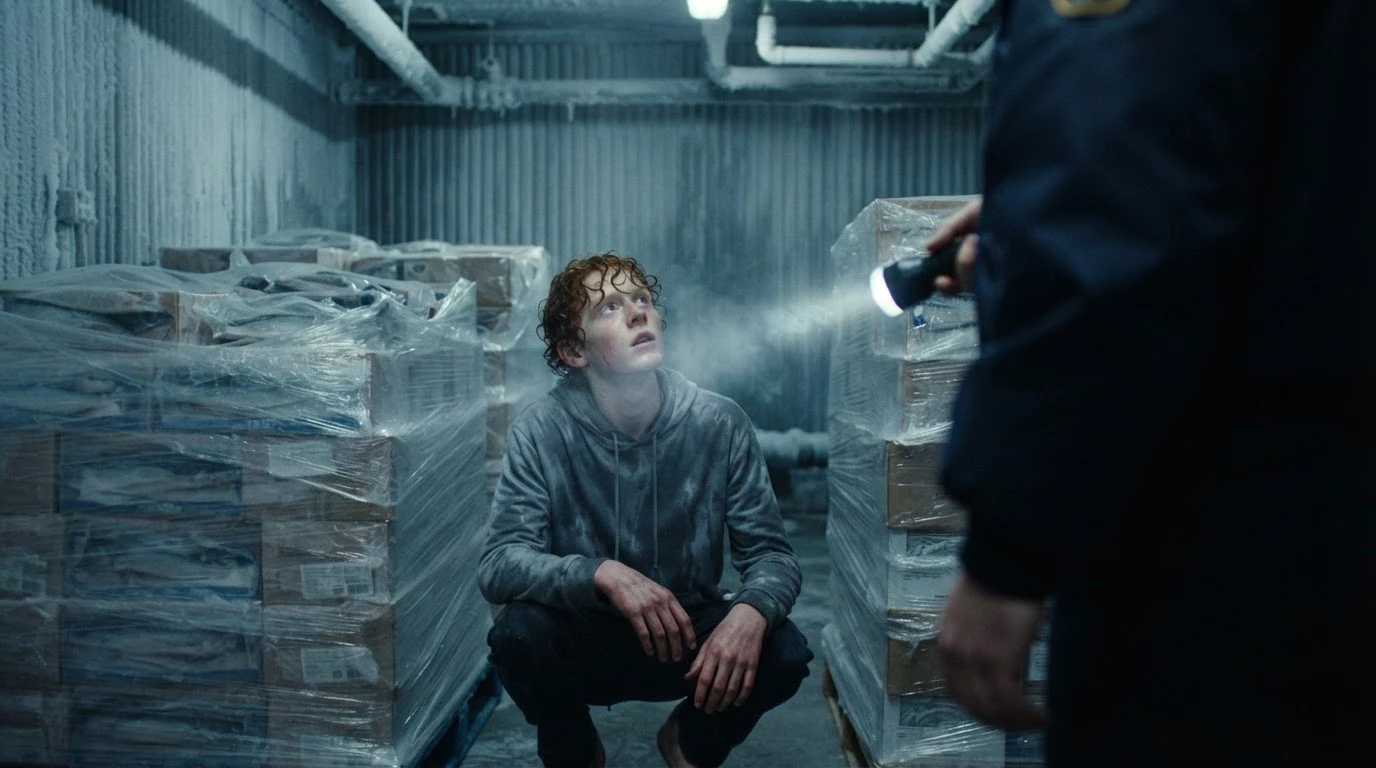
Entry 2 has one job, the rule meets a person: the boy in the light, the guard's shoulder standing in for the rule. Breath visible and soaked make "shaking" drawable.
Open FlashBoardsStraight-on photo of a corkboard wall with five white index cards in a row, red pushpins. Each card has a loose graphite pencil thumbnail sketch and a large handwritten number in the corner. Card 1: a flashlight beam in a freezer corridor. Card 2: a boy crouching between pallets. Card 3: a hand hanging up a desk phone beside a thermos. Card 4: three men with flashlights on a dock at dawn. Card 5: blank except for a question mark. Warm desk lamp light, paper texture.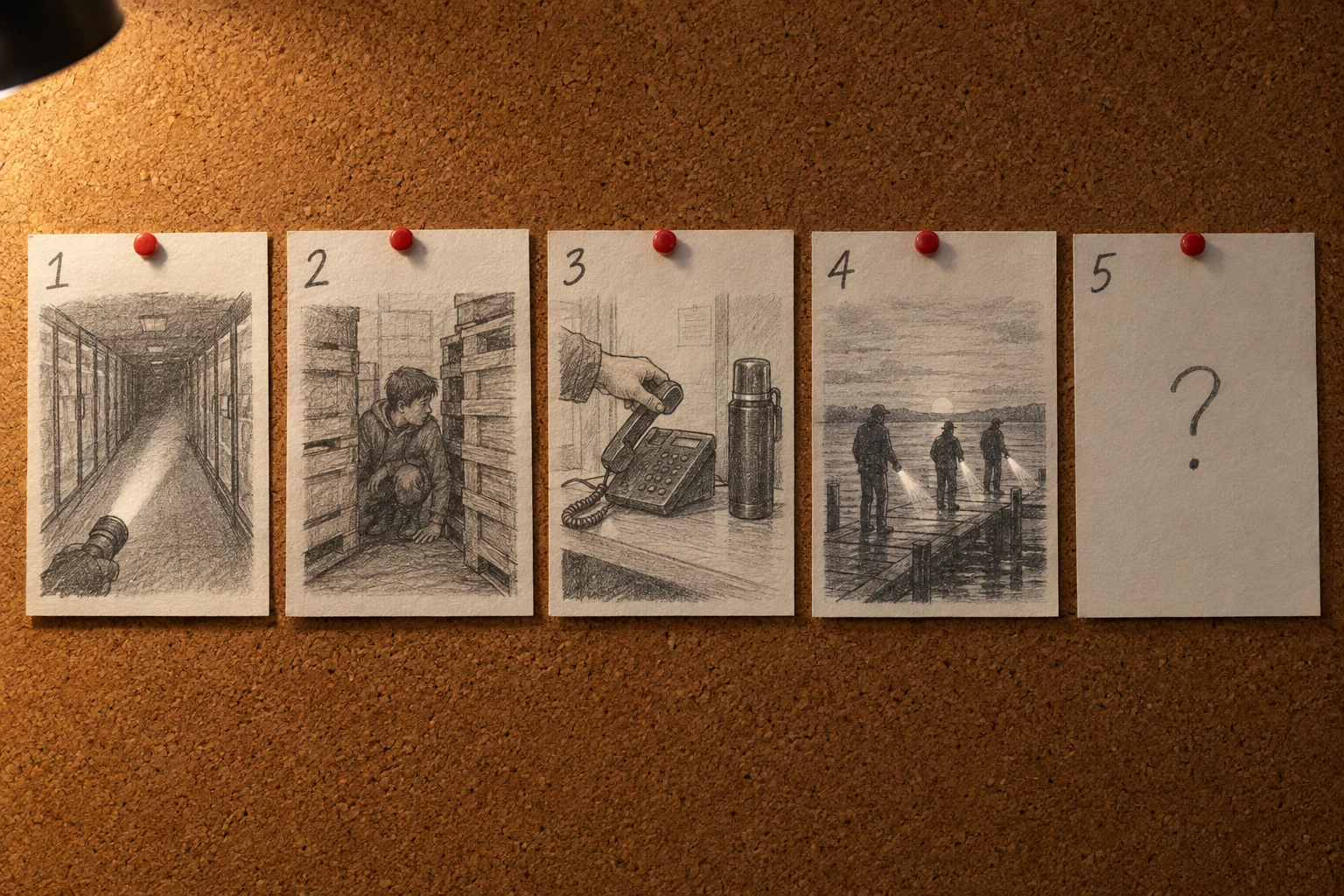
This take produces the outline itself as a card wall. Pencil thumbnail and a number per card keep it readable; long card text comes out garbled, so keep scene lines as notes on the board. The blank card is the next scene to solve.
Open FlashBoards{
"output": "Full-screen live-action film scene from its very first frame: one continuous shot inside an industrial blast freezer at night, frost on corrugated steel walls, pallets of fish boxes wrapped in plastic, mist hanging in the air, cold blue-white light, fine film grain.",
"characters": {
"S1": {
"name": "Tomas, the boy",
"look": "skinny 16-year-old with wet curly red hair, a soaked gray hoodie, dark trousers and scraped bare hands, crouching between two pallets in the centre of the frame"
},
"S2": {
"name": "Ruth, the night guard",
"look": "seen from behind as a soft, out-of-focus navy jacket shoulder filling the right third of the frame, one hand holding a small flashlight whose beam points left at S1"
}
},
"shots": [
{
"shot": 1,
"camera": "handheld medium wide shot at eye level, a slight steady drift, holding on S1 for the whole shot",
"action": [
"BEGINNING: alive from the first frame, mist already swirls through the flashlight beam and S1's breath clouds in fast, shaky puffs as he looks up at S2, toward the upper right of the frame",
"THEN: S1 raises his left hand, on the screen-right side nearer the light, palm out against the beam, and shakes his head twice while keeping his eyes on S2",
"THEN: S1 lowers the hand and wraps both arms around his knees, pulling them tighter to his chest",
"END: S2's hand slowly tilts the flashlight down until the beam lies on the floor, S1's face falls into cold blue shadow and he keeps watching S2 without moving"
],
"dialogue": [],
"voice": "silence: nobody speaks in this shot, no voice at all"
}
],
"sound": {
"ambience": "the low steady hum of freezer compressors, fans pushing cold air, the rustle of a wet hoodie",
"speech": "no words in this video; the only human sounds are breaths and movement",
"never_spoken": "no narration and no voice-over: the descriptions, performance notes and step words of this prompt are never spoken aloud",
"music": "a film score under the scene, always below the voices: a single low cello note with a slow, uneasy pulse",
"subtitles": "none"
}
}Swirling mist and fast breath keep the shot alive from frame one. The lowering beam plays Ruth's decision without showing her: if the scene reads silent, it will work in the draft.
Open FlashBoardsCommon mistakes
- Outline language in the prompt. "He begs her not to call" gives a model nothing to draw; describe pose, light and props.
- Garbled or photoreal cards. Keep cards to numbers and loose pencil thumbnails.
- Extra characters. Video models like to walk the guard into frame. Describe her only as the shoulder and the beam.
Keep the reference frames, prompts and every generated take side by side — images and video in one canvas.
FAQ
4 questionsWhat is a script outline?
A script outline is a numbered, scene-by-scene plan of a screenplay written before the first draft. Each entry names the scene, says what happens and notes why it matters, so structure and pacing can be tested on a few pages.
How long should a screenplay outline be?
There is no fixed length. A beat outline for a feature can fit on one or two pages; a detailed scene-by-scene outline usually runs 40 to 60 entries and 5 to 20 pages. Write enough to know every scene's purpose, no dialogue.
What is the difference between a step outline and a beat outline?
A beat outline lists only the major turns, often 15 to 40 lines, to test overall structure. A step outline goes one level down: one step per scene, in order, with a sentence or two each. Many writers expand the first into the second.
What should a screenplay outline template include?
For each scene: a number, a scene heading (interior or exterior, location, time of day), one to three present-tense sentences on what happens, and a short note on what changes. Group entries by act to check proportions at a glance.
Related terms
6- Film TreatmentScreenwriting
A treatment is a prose document, usually 2–10 pages written in present tense, that tells the whole story of a planned film scene by scene and conveys its tone before the screenplay is written.
- Story BeatScreenwriting
A beat is the smallest unit of dramatic change in a story: a moment where an action, reaction or decision shifts the scene's direction. In dialogue, a parenthetical (beat) also marks a short pause.
- Save the Cat Beat SheetScreenwriting
The Save the Cat beat sheet is Blake Snyder's 15-beat map of a feature, from Opening Image and Catalyst to Finale and Final Image, with page targets for each beat — a ready template for planning scenes and storyboards.
- SynopsisScreenwriting
A synopsis is a short prose summary of the whole film — setup, main characters, turning points and ending — written for producers, readers or grant committees.
- StoryboardFilmmaking Process & Crew
A storyboard is a sequence of drawn or generated panels, one per planned shot, showing framing, action and camera movement with notes — a visual draft of the film before anything is shot.
- ScreenwritingScreenwriting
Screenwriting is the craft of writing a film or series for the screen: turning an idea into structure, scenes and dialogue that can be shot, where everything the audience learns must be seen or heard.
Further reading
Syd Field, Screenplay: The Foundations of Screenwriting (1979). Blake Snyder, Save the Cat! (2005).