 FlashBoards Learn
- Learn
- Screenwriting
- Film Treatment
Screenwriting · Film language
Film Treatment
Also called: treatment, script treatment, movie treatment
A film treatment is a prose document, usually 2 to 10 pages in present tense, that tells the whole story of a planned film scene by scene before the screenplay exists. It carries the plot, the main characters, the ending and, above all, the tone, so a reader can feel how the movie will play.
- What it does
- Shows how the film will play, in story order and in its own voice, before anyone commits to a full draft.
- Use it when
- After the logline and outline, before the first draft, or whenever a producer asks to see the movie before the script.
- Watch out
- Camera directions, pages of dialogue and a vague second act turn a treatment into a weak half-script.
- Try this prompt
Wide film still at dawn, a rust-red truck alone on a white salt flat, a barefoot boy sitting on the trailer step, low sun, heat haze
What is a film treatment?
A treatment is the story of a film told the way you would tell it across a table: in prose, in present tense, in the order the audience will see it, ending included. Instead of scene headings and dialogue, it carries texture: the look of a place, the rhythm of a sequence, the image the film is built around.
In screenwriting it sits in the middle of the development ladder. The logline hooks, the synopsis proves the story works, and the treatment shows how it plays. A pitch treatment runs 2–5 pages; a detailed story treatment can reach 10–20. James Cameron's "scriptments" sit at the far end: prose drafts long enough to include dialogue.
In commercials and music videos, "treatment" means a director's image-heavy pitch for how they would shoot a brief. A feature treatment is a writer's document about story first.
Who reads a treatment and why?
Producers and executives ask for a treatment when they want to judge a project without reading, or paying for, a full screenplay. On development deals it is often a formal step: story in prose, notes, then the draft.
Funds request one alongside a synopsis because a committee needs to see tone as well as plot.
Writers use it as the last cheap place to fix a story. Rewriting six pages takes an afternoon; restructuring a draft takes a month. If the midpoint feels flat in prose, it will be flat on screen.
How to write a film treatment: format and steps
There is no single industry format, but most treatments share a layout: title page, logline, a short note on genre and tone, brief character sketches, then the story in plain paragraphs, in a readable 12-point font.
- Start from a working outline. A script outline gives the order of scenes; the treatment turns that list into flowing prose.
- Write in present tense, third person. "She opens the door" keeps the reader inside the moment.
- Introduce characters in CAPS with one telling detail.
- One paragraph per dramatic movement, linked by cause (because, but), not and then.
- Put the tone in the sentences. A thriller reads tight and short; a comedy lets rhythm land the jokes.
- Include two or three key images the audience will remember.
- Keep dialogue to a line or two that defines a character.
- Tell the ending. A treatment that hides the climax reads as unfinished.
In FlashBoards, paste each treatment paragraph as a note on the board, generate a key frame beside it and add reference stills as you find them. It becomes the first draft of a lookbook or storyboard.
Film treatment example
An excerpt from a treatment for an invented feature, Salt Road:
Dawn on the salt flats. The ground is so white it hurts to look at. IDA VOSS (50s), a long-haul trucker with an old burn scar across her right hand, sleeps in the cab of a rust-red rig parked a mile off the highway. A knock on the glass. A boy of about ten, barefoot and dusty to the knees, holds up a folded paper map with a town circled in pen. He doesn't speak. Ida has one rule, no riders, and she tells him so. By the time she has finished her coffee, he is sitting on the trailer step, and there is nothing on the horizon in any direction but heat.
It sets the place, gives the protagonist one physical detail, states a rule the story will break and closes on an image. The tone lives in short sentences, not adjectives.
Treatment vs. synopsis vs. outline
- Outline: a working list of scenes, often in fragments, written for the writer. It answers what happens, in what order.
- Synopsis: a short, plain summary of the story's spine for someone deciding whether to read further. It answers does the story hold together.
- Treatment: longer prose that follows the scenes and adds voice, atmosphere and key images. It answers what will this film feel like.
A synopsis can be accurate and flat; a flat treatment has failed at its job. Send whichever was requested; length is part of the brief.
How to create a film treatment with AI
3 promptsA treatment already describes pictures; image and video models make them visible. Turn each key paragraph into concrete framing, light and character detail, and keep text and frames together on one FlashBoards board. The recipes below stage the Salt Road excerpt.
Wide cinematic film still, 35mm lens, eye level. A rust-red semi truck with a silver trailer parked alone on a flat white salt plain at dawn. On the trailer step sits a barefoot boy of about ten with shaggy black hair and dusty knees, holding a folded paper map. In the open cab door, a woman in her fifties with a gray braid, sunburned face and faded denim shirt holds a steel coffee mug. Low sun from the left, long shadows, faint heat haze, bleached colors, film grain.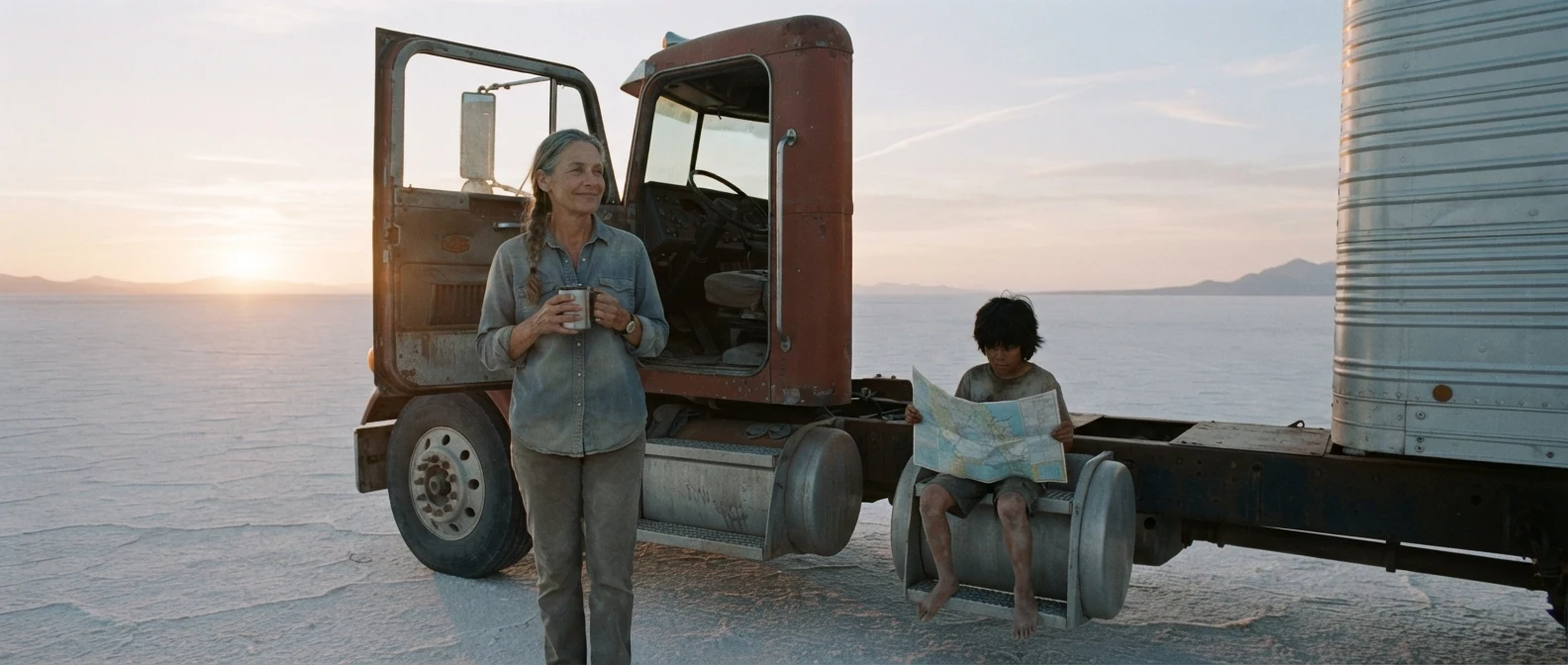
The prose becomes visible facts: "hurts to look at" turns into flat white salt plain and bleached colors, "nothing on the horizon" into parked alone, framed wide at 35mm, eye level.
Open FlashBoardsTreatment key frame sheet, three wide panels in a row with thin white borders, one consistent color grade. Panel 1: close-up of a knuckle knocking on a dusty truck window at dawn. Panel 2: medium shot through the windshield, a woman in her fifties with a gray braid and a scarred right hand shakes her head. Panel 3: extreme wide shot, a rust-red truck on a white salt flat, a small barefoot boy on the trailer step, heat haze, empty horizon.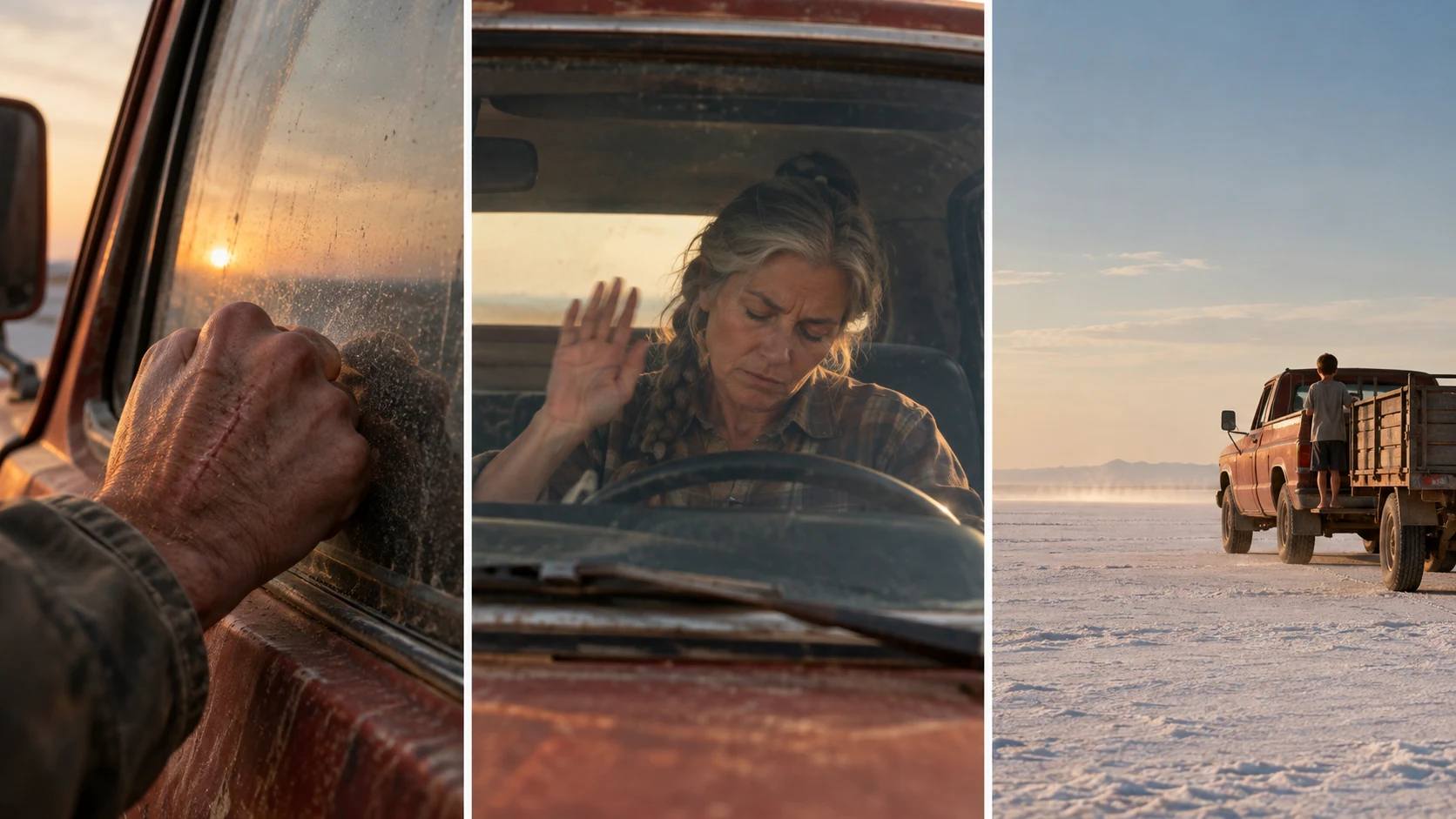
Key frame sheet and three wide panels in a row turn one paragraph into three beats; repeating the braid, the scar and the rust-red truck keeps continuity.
Open FlashBoardsCamera: locked-off wide shot, completely still, eye level. Action: heat haze already ripples along the horizon and wind drags fine salt dust across the ground. The boy swings his bare feet and unfolds the map on his knees. The woman steps down from the cab with the coffee mug and looks at him. At the end the boy looks up at her, and neither of them moves.Rippling haze and blowing dust in the first sentence keep a static shot alive from frame one; the action uses only what recipe 1 contains.
Open FlashBoardsCommon mistakes
- Abstract prose. "Tension hangs in the air" gives a model nothing to draw; rewrite it as light, weather and props.
- Garbled text. A circled town name on a map comes out as fake lettering; keep the map folded.
- Drifting characters. Restate the same two or three features in every panel prompt.
- Over-dressed frames. Empty horizons fill up with extra vehicles; state what is there ("flat white plain, empty sky").
Keep the reference frames, prompts and every generated take side by side — images and video in one canvas.
FAQ
4 questionsHow long should a film treatment be?
Most treatments run 2 to 10 pages. A pitch treatment for a producer or fund is often 2–5 pages; a detailed story treatment for a development deal can reach 10–20. If the reader set a limit, follow it.
What is the difference between a treatment and a script?
A treatment tells the story in present-tense prose, with little dialogue and no screenplay formatting. A script is the formatted blueprint for the shoot: scene headings, action lines, character names and all the dialogue. The treatment shows what the film will feel like; the script is what cast and crew work from.
Do you need a treatment to sell a screenplay?
Not always. A finished spec script usually goes out with a logline and synopsis. Treatments matter more when you pitch an idea before it is written or work under a deal where the treatment is a delivery step. Many writers still draft one privately to test the story.
What should a film treatment include?
A title page, a logline, a line on genre and tone, short character introductions and the full story in present tense from opening image to ending, with the key images that define the film. Leave out camera directions, long dialogue and backstory that never reaches the screen.
Related terms
6- SynopsisScreenwriting
A synopsis is a short prose summary of the whole film — setup, main characters, turning points and ending — written for producers, readers or grant committees.
- Script OutlineScreenwriting
A script outline is a scene-by-scene plan of the story written before the draft, listing what happens and why in each scene so structure problems surface early.
- LoglineScreenwriting
A logline sums up a film in one or two sentences: the protagonist, their goal, the obstacle and what's at stake — the hook that sells the script and, today, the seed for an AI storyboard.
- ScreenplayScreenwriting
A screenplay is the written blueprint of a film in a fixed format — scene headings, action lines, character names, dialogue and transitions — where one page roughly equals one minute of screen time.
- TV PitchFilmmaking Process & Crew
A TV pitch is a short verbal or deck presentation of a series idea — logline, world, characters, pilot story and season engines — aimed at getting producers or a network to buy or develop it.
- ScreenwritingScreenwriting
Screenwriting is the craft of writing a film or series for the screen: turning an idea into structure, scenes and dialogue that can be shot, where everything the audience learns must be seen or heard.
Further reading
Writers Guild of America, Minimum Basic Agreement (treatment as a defined literary material).