 FlashBoards Learn
- Learn
- Screenwriting
- Save the Cat Beat Sheet
Screenwriting · Film language
Save the Cat Beat Sheet
Also called: beat sheet, Blake Snyder beat sheet, BS2
The Save the Cat beat sheet is Blake Snyder's 15-beat map of a feature film, from Opening Image and Catalyst to Finale and Final Image, with a target page for each beat in a 110-page script. Writers use it as a fill-in template: plan the turns first, then build scenes and storyboards on top.
- What it does
- Breaks a feature into 15 named turning points with page targets, so you can see where the story sags before you write it.
- Use it when
- You are outlining a feature, diagnosing a draft that drags in the middle, or turning a script into a storyboard plan.
- Watch out
- Hitting page numbers is not the goal; each beat has to be a real change for the hero, or the film just feels mechanical.
- Try this prompt
Opening Image keyframe: empty night bus, lone driver lit by passing streetlights, wide from the back row, 16:9.
What is the Save the Cat beat sheet?
Blake Snyder was a working Hollywood spec writer who put his method into Save the Cat! The Last Book on Screenwriting You'll Ever Need (2005). The part of the book that took over the industry is one page: the Blake Snyder Beat Sheet, often shortened to BS2. It names 15 moments every commercial feature hits and says roughly where each one lands in a 110-page screenplay.
The beat sheet is a tool, not a theory. It sits on top of classic three-act structure and slices it finer, so a writer can fill in one line per beat before writing a single scene. A Snyder beat is bigger than the story beat inside a scene: it's a whole movement of the plot, sometimes one scene, sometimes twenty pages.
The name comes from Snyder's advice about likability. Early on, give the hero a moment where they do something decent, like saving a cat, so the audience wants to follow them. Aladdin (1992) does it within minutes, when the street thief shares his stolen bread with two hungry kids. Snyder died in 2009, but his books and spin-offs made the beat sheet the most widely used outlining template in American screenwriting.
The 15 beats of Save the Cat, with page numbers
Page targets assume a 110-page script at about a minute per page. The percentage column lets you scale the template to any length.
| # | Beat | Page (of 110) | Share | |---|---|---|---| | 1 | Opening Image | 1 | 0–1% | | 2 | Theme Stated | 5 | ~5% | | 3 | Set-Up | 1–10 | 0–10% | | 4 | Catalyst | 12 | ~10% | | 5 | Debate | 12–25 | 10–20% | | 6 | Break into Two | 25 | ~20–23% | | 7 | B Story | 30 | ~22–27% | | 8 | Fun and Games | 30–55 | ~27–50% | | 9 | Midpoint | 55 | 50% | | 10 | Bad Guys Close In | 55–75 | 50–68% | | 11 | All Is Lost | 75 | ~68–75% | | 12 | Dark Night of the Soul | 75–85 | 68–77% | | 13 | Break into Three | 85 | ~77–80% | | 14 | Finale | 85–110 | 77–99% | | 15 | Final Image | 110 | 100% |
Act One (the thesis).
- Opening Image: one picture of the hero's world before the story changes it.
- Theme Stated: someone, usually not the hero, says what the film is about. The hero doesn't get it yet. This is the seed of the theme.
- Set-Up: the ordinary world and the things in the hero's life that need fixing.
- Catalyst is the event that knocks that world over: the letter, the call, the death. It is Snyder's name for the inciting incident.
- Debate: the hero hesitates, and we see what's at risk.
Act Two (the antithesis).
- Break into Two: the hero chooses to step into the upside-down world of the story. It has to be an active decision, not something that just happens to them.
- B Story brings in a new relationship (a love interest, mentor or rival) that carries the theme.
- Fun and Games is "the promise of the premise": the set pieces a trailer is cut from, where the concept plays out.
- Midpoint raises the stakes with a false victory or a false defeat. The fun stops and the clock often starts.
- Bad Guys Close In: outside pressure builds while doubts pull the hero's team apart.
- All Is Lost is the lowest point, and it often carries a "whiff of death": a mentor dies, a relationship ends, an old life is gone for good.
- Dark Night of the Soul: the hero's despair, just before the lesson lands.
Act Three (the synthesis).
- Break into Three: A story and B story meet, and the hero finds the answer, often from what the B story taught them.
- Finale: the hero applies the lesson, beats the problem and builds a new world.
- Final Image mirrors the Opening Image and proves the change. The two work as bookends and show the hero's character arc in two frames.
Save the Cat beat sheet example: Parasite and The Matrix
Snyder's beats show up even in films whose writers never used the book. Here is Bong Joon-ho's Parasite (2019):
- Opening Image: the camera finds the Kim family's semi-basement apartment through its street-level window.
- Catalyst: Ki-woo's friend Min-hyuk brings a scholar's rock and hands him a tutoring job with a rich family.
- Break into Two: Ki-woo walks into the Park house with a forged university document.
- Fun and Games: the family cons its way in one member at a time, down to the peach-fuzz trick that gets the housekeeper fired.
- Midpoint: on a stormy night with the Parks away, the fired housekeeper rings the doorbell, and what she reveals in the basement turns the comedy into a thriller.
- All Is Lost / Dark Night: the Kims flee through the rain to find their apartment flooded with sewage.
- Finale: the birthday party in the garden, where every thread collides.
- Final Image: back in the semi-basement, looking through the same window. The mirror shows how little has changed.
The Matrix (1999) follows the same map. The Catalyst is the message telling Neo to follow the white rabbit, and Break into Two is the red pill: a choice, not an accident. Training is pure Fun and Games. All Is Lost comes with Cypher's betrayal, which kills crew members (the whiff of death) and gets Morpheus captured. Break into Three is Neo's decision to go back in for him.
How to use the beat sheet as a template
1. Start from the logline. If you can't say the story in a sentence, the beats won't hold. Write the logline first: hero, flaw, catalyst, goal, stakes.
2. Fill the five tent poles. Write one sentence each for Opening Image, Catalyst, Break into Two, Midpoint and All Is Lost. These are the plot points the rest hangs on. Then pair Opening and Final Image so they clearly mirror each other.
3. Fill the rest, one line per beat. A worked example for a fictional drama called Night Route:
- Opening Image: Ines, a night bus driver, drives an empty bus through a sleeping city.
- Catalyst: a notice says her route will be cut in a month.
- Break into Two: she starts collecting signatures from her night riders.
- B Story: a young nurse on the 3 a.m. run becomes her unlikely ally.
- Midpoint: the council grants a hearing, a false victory.
- All Is Lost: the route is cut anyway, and her bus is parked for good.
- Final Image: the same bus, every seat taken by riders she now knows by name.
4. Scale the pages. Use the percentages, not Snyder's numbers. In a 90-page script the Catalyst lands near page 9–10, Break into Two near 20, Midpoint at 45 and Break into Three near 70.
5. Expand to cards. Snyder's "Board" was a corkboard with four rows (Act One, the two halves of Act Two, Act Three) and about 40 index cards, one scene per card. That's the bridge from beat sheet to script outline.
6. Carry the beats into prep. Beats are also a visual plan. The Opening and Final Image become storyboard panels before a word of dialogue exists, and each tent pole gets its own storyboard sequence. In FlashBoards the Board becomes literal: lay out 15 beat columns on one canvas, pin reference frames and generated keyframes under each beat, and keep the Opening and Final Image side by side so the mirror is visible at a glance.
Save the Cat vs. three-act structure and the story circle
Save the Cat doesn't compete with the three-act structure. It is a three-act structure with more signposts. Break into Two and Break into Three are the classic act turning points. Where the three-act model says "confrontation" for a 55-page middle, Snyder splits it into Fun and Games, the Midpoint and Bad Guys Close In. That's why writers stuck in second-act sag reach for his sheet.
| | Three-act structure | Save the Cat | Dan Harmon story circle | |---|---|---|---| | Units | 3 acts, 2 turning points | 15 beats | 8 steps | | Page targets | Rough quarters | Specific pages | None | | Best for | Any length | Commercial features | Episodic TV, shorts |
The Dan Harmon story circle is a loop built from the hero's journey (you, need, go, search, find, take, return, change) and is easier to run once per episode. All three are maps of the terrain described in story structure. Use the one that exposes your draft's problem fastest.
The 10 Save the Cat genres
Snyder paired the beat sheet with ten genres, sorted by the machine the story runs on rather than by setting: Monster in the House (Jaws, 1975; Alien, 1979), Golden Fleece (a quest that changes the hero), Out of the Bottle (a wish or curse), Dude with a Problem (Die Hard, 1988), Rites of Passage (a life crisis), Buddy Love (two people who change each other), Whydunit (an investigation into people's dark side), The Fool Triumphant (an underdog beats the establishment), Institutionalized (a group and the price of belonging) and Superhero (an extraordinary person in an ordinary world).
The practical use is comparison. Put three films from your genre beside your outline and check where their Midpoint and All Is Lost actually land.
Is Save the Cat too formulaic? Common mistakes
The standard complaint is that Save the Cat made studio films feel the same. The problem is usually how it's used, not the template:
- Treating pages as law. A Catalyst on page 12 that changes nothing is worse than a strong one on page 18.
- Passive breaks. If the hero is pushed into Act Two instead of choosing it, the whole middle happens to them.
- A B Story with no theme. A romance that doesn't test the hero's flaw is just filler.
- Fake lows. All Is Lost needs a loss that comes out of the hero's own choices, or it won't carry the climax.
- Unmatched bookends. If the Final Image doesn't answer the Opening Image, the change never shows on screen.
The sheet works best as a diagnostic: outline the draft you have against the 15 beats, and the empty or overstuffed slots show what to rewrite.
How to create a save the cat beat sheet with AI
3 promptsA beat sheet is words, but the beats that sell a film are pictures: the Opening Image, the Final Image that mirrors it, and the tent poles between them. In FlashBoards you can generate those keyframes next to your beat notes and compare the bookends side by side on one board. The recipes use the fictional Night Route outline above.
Opening Image of a feature film. Wide shot from the last row of an empty city night bus, looking straight down the aisle to the driver: Ines, a woman in her late forties with a shaved head, a small silver hoop in her left ear and a faded navy uniform jacket, alone at the wheel. Rows of empty blue seats on both sides, bands of orange sodium streetlight across the ceiling, cold fluorescent strip lights, rain-streaked windows, a dark empty street through the windshield. Camera at seated eye height, 28mm lens, deep focus, symmetrical framing, lonely and still, muted teal and sodium-orange palette, 35mm film grain.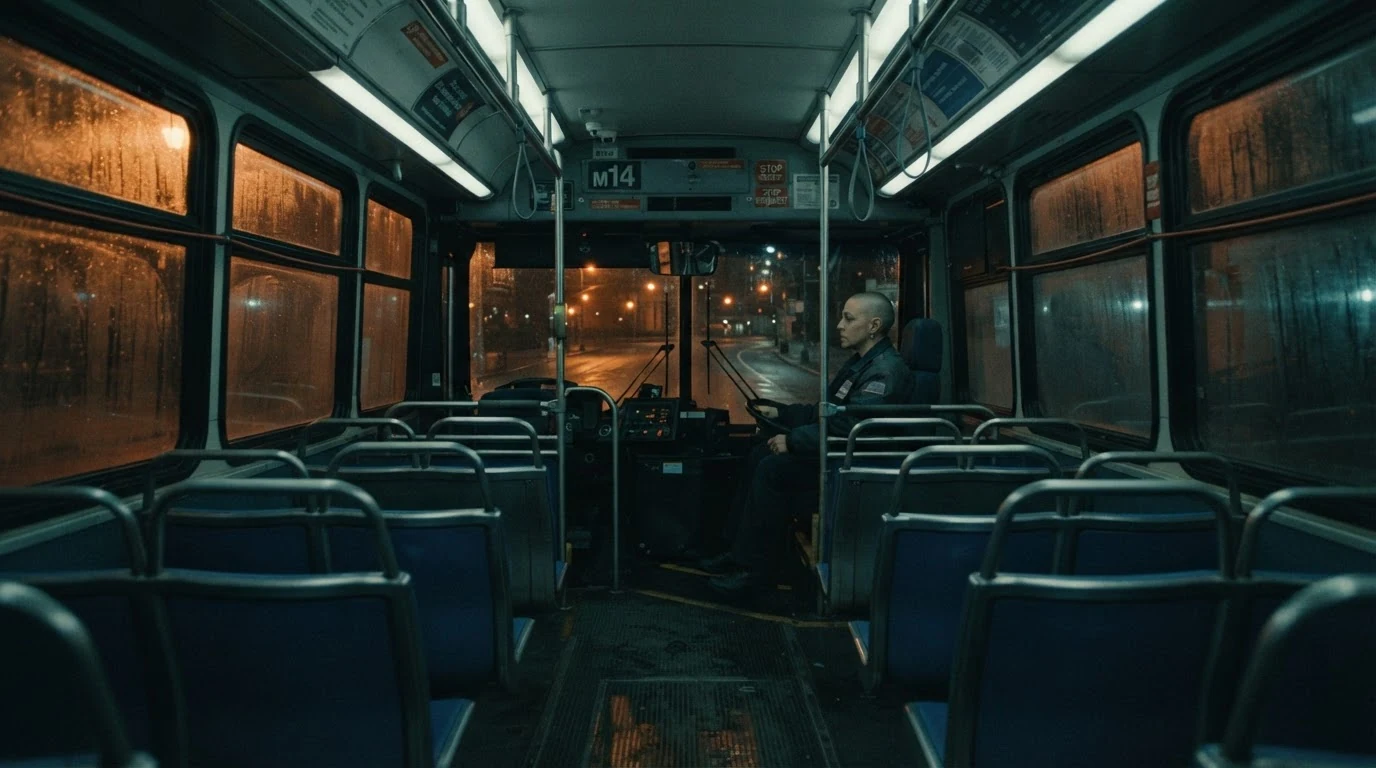
"Opening Image", "empty" and "alone at the wheel" put the hero's problem, isolation, into the frame. "From the last row, looking straight down the aisle" and "symmetrical framing" fix a composition you can repeat exactly for the Final Image. The specific features keep Ines clearly fictional and consistent across takes.
Open FlashBoardsA storyboard beat board for a feature film: six panels in a grid of three columns and two rows on white paper, loose graphite pencil with gray marker wash, consistent style. The same character in every panel: Ines, a woman in her late forties with a shaved head, a silver hoop in her left ear and a navy bus driver's jacket. A short hand-lettered caption in capitals under each panel. Panel 1 CATALYST: close-up of Ines reading a paper notice taped inside the bus door. Panel 2 BREAK INTO TWO: medium shot, she hands a clipboard to a sleepy passenger. Panel 3 MIDPOINT: wide shot of a crowded council hall applauding as she stands at a microphone. Panel 4 ALL IS LOST: her bus parked in a dark depot, a chain looped through the door handles. Panel 5 DARK NIGHT: high angle, she sits alone on the depot curb under one lamp. Panel 6 FINAL IMAGE: the bus interior from the back row, every seat taken by smiling passengers, Ines at the wheel.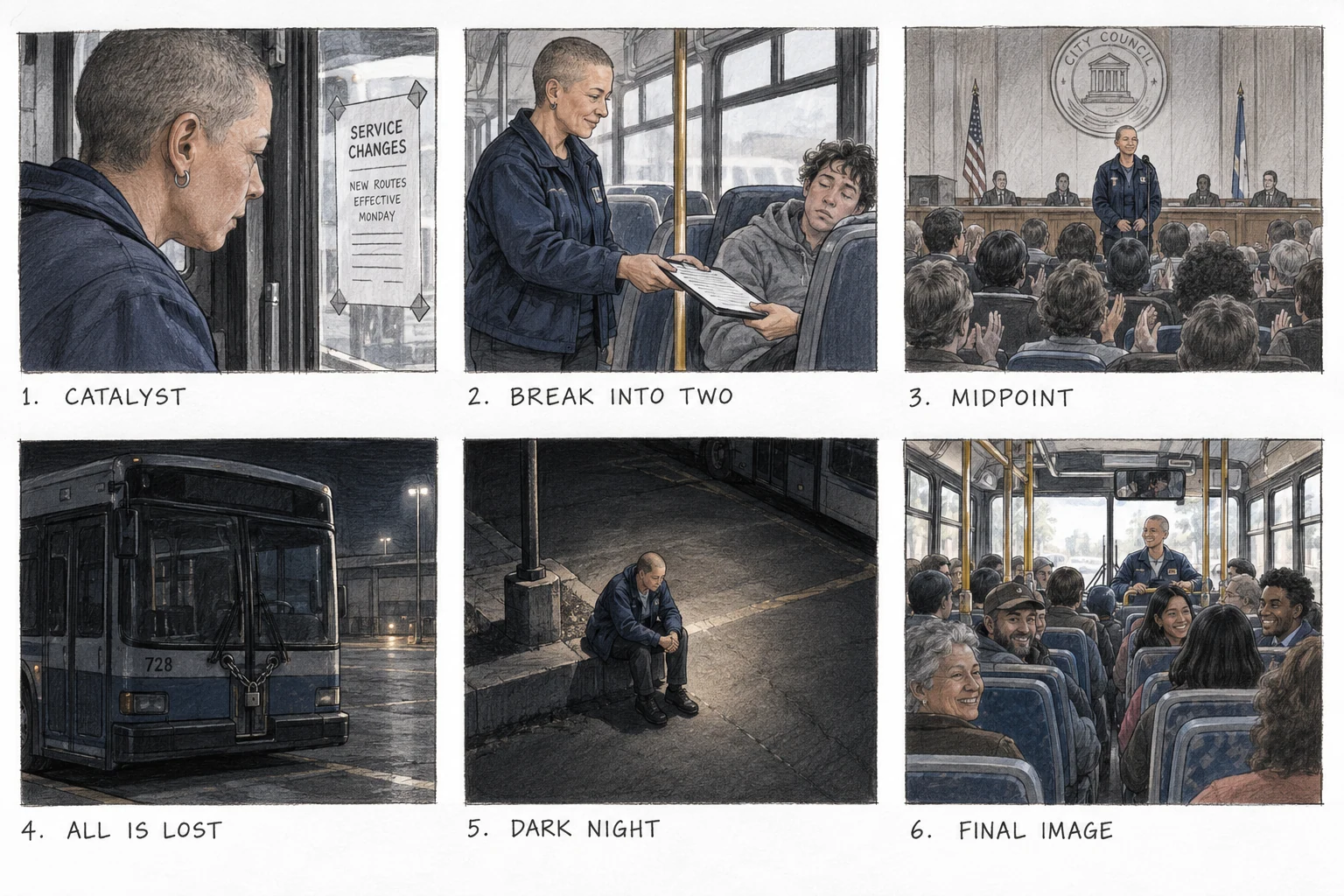
This take produces the planning artifact itself: tent-pole beats as storyboard panels. The capitalized beat name under each panel ties the image to the sheet. Different shot sizes make the board read as a sequence, and "same character in every panel" keeps Ines on model. Panel 6 reuses the opening framing so the mirror shows.
Open FlashBoardsCamera: locked-off static shot from the back row of the bus, the view holds steady down the aisle to the driver for the whole shot. Action: The bus is already moving. Orange streetlight bands slide steadily along the ceiling and across the empty seats from front to back, one after another. Ines keeps both hands on the wheel, glances up at the rear-view mirror toward the empty rows, holds the look for a moment, then turns her eyes back to the dark road. Raindrops tremble on the windows as the light keeps sweeping past."Already moving" and the sliding light bands make the shot alive from the first frame. The glance at the empty rows is the whole Opening Image beat in one gesture. The prompt describes only what's already in recipe 1's frame, so nothing new gets drawn in.
Open FlashBoardsCommon mistakes
- Empty spaces get filled. Say "bus" and models add passengers. Describe what's there ("rows of empty blue seats"). A negative like "no passengers" tends to bring them in.
- Bookends that don't match. Copy the Opening Image's framing sentence word for word into the Final Image and change only the content.
- Character drift across panels. Keep one fixed description, or keep the Opening Image on the board as the look reference.
- Garbled captions. Keep labels to one to three words in capitals, or add them later as board notes.
- Too many beats at once. Fifteen panels in one image turns to mush. Work in groups of five or six.
Keep the reference frames, prompts and every generated take side by side — images and video in one canvas.
FAQ
5 questionsWhat are the 15 beats of Save the Cat?
In order: Opening Image, Theme Stated, Set-Up, Catalyst, Debate, Break into Two, B Story, Fun and Games, Midpoint, Bad Guys Close In, All Is Lost, Dark Night of the Soul, Break into Three, Finale and Final Image. In a 110-page script the key targets are Catalyst on page 12, Break into Two on 25, Midpoint on 55, All Is Lost on 75 and Break into Three on 85.
Why is it called Save the Cat?
The title comes from Snyder's advice about sympathy: early in the film, the hero should do something that makes the audience like them, like saving a cat. It isn't one of the 15 beats. It's a principle that runs through the Set-Up, because viewers will only follow the hero through every beat if they care what happens to them.
Is the Save the Cat beat sheet the same as three-act structure?
It's a finer version of it. Break into Two and Break into Three match the classic act turning points, and the Midpoint splits the long second act in half. The difference is detail. Save the Cat names 15 beats with page targets and ties them to the hero's change, while three-act structure only marks setup, confrontation and resolution.
Does Save the Cat work for short films and TV?
Yes, if you scale it by percentage instead of pages. Keep the Catalyst near the 10% mark, the Midpoint at half, and matching Opening and Final Images. Short films usually merge Debate into the Catalyst and cut Fun and Games to a scene or two. TV writers often use a condensed sheet per episode, or the story circle for tighter episodic loops.
How do I make a Save the Cat beat sheet template?
List the 15 beats in a column, add each beat's page or percentage target for your script length, and write one sentence per beat about what changes for the hero. Fill the tent poles first: Opening Image, Catalyst, Break into Two, Midpoint and All Is Lost. Then expand each beat into scene cards and, later, storyboard panels.
Related terms
6- Three-Act StructureStorytelling
The three-act structure splits a story into setup, confrontation and resolution, turned by plot points at roughly the quarter and three-quarter marks — the default blueprint of feature screenwriting.
- Dan Harmon Story CircleStorytelling
Dan Harmon's story circle is an eight-step, simplified hero's journey — you, need, go, search, find, take, return, change — used to structure episodes and features.
- Story BeatScreenwriting
A beat is the smallest unit of dramatic change in a story: a moment where an action, reaction or decision shifts the scene's direction. In dialogue, a parenthetical (beat) also marks a short pause.
- Story StructureStorytelling
Story structure is the order and shape of the events that carry a story from setup to resolution; models like the three-act structure, Freytag's pyramid, the hero's journey or Save the Cat are different maps of it.
- Inciting IncidentStorytelling
The inciting incident is the event that upsets the protagonist's normal life and sets the main conflict in motion — the moment the story truly begins.
- Script OutlineScreenwriting
A script outline is a scene-by-scene plan of the story written before the draft, listing what happens and why in each scene so structure problems surface early.
Further reading
Blake Snyder, Save the Cat! The Last Book on Screenwriting You'll Ever Need (Michael Wiese Productions, 2005). Blake Snyder, Save the Cat! Goes to the Movies (2007). Jessica Brody, Save the Cat! Writes a Novel (2018).