 FlashBoards Learn
- Learn
- Screenwriting
- Scene Heading
Screenwriting · Film language
Scene Heading
Also called: slugline, slug line, master scene heading
A scene heading, or slugline, is the all-caps line that opens every scene in a screenplay: INT. or EXT., the location, and the time of day, as in INT. BUS DEPOT - NIGHT. It tells the reader where they are, and it is the line production breaks down, schedules and storyboards from.
- What it does
- Places the reader in one location at one time of day before a single word of action.
- Use it when
- The story moves to a new place or a new time; each change gets its own heading.
- Watch out
- Vague locations and fancy times (DUSKISH, 4:12 PM) break the schedule and the breakdown.
- Try this prompt
Wide shot, interior of a small all-night laundromat at night, fluorescent tubes, rows of washers, one woman folding towels
What is a scene heading?
A scene heading is the first line of every scene in a screenplay. In capitals, it answers three questions in order: inside or outside, where, and day or night.
`` INT. HOSPITAL CORRIDOR - NIGHT ``
The industry calls it a slugline, after the old newspaper label line. A heading with all three parts is a master scene heading; a shorter line inside a scene, such as KITCHEN when a character walks into the next room, is a secondary heading.
A new scene starts with a change of place or a change of time. It is the first formatting rule anyone learning screenwriting meets and it maps onto the shot, scene and sequence structure of the edit.
The three parts of a slugline
1. Interior or exterior. INT. means inside, EXT. outside. When a scene crosses a threshold, or plays in a car where we see both driver and road, write INT./EXT. The prefix tells production whether a day needs a stage or a permit.
2. Location. Go from general to specific: EXT. FARMHOUSE - PORCH, INT. POLICE STATION - INTERROGATION ROOM. Use the same name every time the story returns. If the kitchen is MARA'S KITCHEN on page 3, it cannot become THE KITCHEN on page 40, or the breakdown will count two sets.
3. Time of day. DAY and NIGHT cover most scripts. DAWN or DUSK are fine when the light matters: a dusk scene may mean a short window around golden hour. CONTINUOUS means the action flows straight from the previous scene; LATER marks a time jump in the same place. Clock times belong in the action lines.
How to write a scene heading, step by step
- Start a new scene whenever location or time changes.
- Type
INT.,EXT.orINT./EXT. - Name the location broad to narrow.
- Add a hyphen and the time of day.
- Keep it in capitals, on one line.
- Put weather, mood and looks in the scene description underneath.
`` EXT. HARBOR ROAD - NIGHT INT. ALL-NIGHT LAUNDROMAT - CONTINUOUS INT. ALL-NIGHT LAUNDROMAT - LATER EXT. ALL-NIGHT LAUNDROMAT - DAWN ``
Common mistakes: adjectives in the slugline (INT. DARK, CREEPY BASEMENT), camera directions, and renaming a location midway. In a spec script, leave scene numbers off; they arrive with the shooting script.
Secondary headings, flashbacks and intercuts
After INT. MARA'S HOUSE - NIGHT, a short HALLWAY on its own line moves the reader to the next room without a full heading, as long as time stays continuous. Other standard variations:
- Flashbacks:
INT. SCHOOL GYM - DAY (FLASHBACK), closed later withEND FLASHBACK. - Period:
EXT. DOCKYARD - DAY (1974)when the year matters. - Intercut: give both ends of a phone call their headings once, then write
INTERCUT - MARA / DETECTIVEand continue the dialogue. - Montage:
MONTAGE - MARA SEARCHES THE CITY, followed by short beats.
How one scene hands over to the next is a separate device: screenplay transitions.
Why the slugline matters once the film is in production
Once a script is greenlit, the slugline becomes data. The script breakdown sorts scenes by heading: every EXT. HARBOR ROAD - NIGHT scene is shot together. Night exteriors cost more, so thirty of them are a budget signal. Each heading then gets a locked scene number that follows it to the call sheet, slate and edit.
For the camera team the slugline is the first line of a storyboard: EXT. FARMHOUSE - DUSK already implies the light, a likely establishing shot and a short window. In FlashBoards you can paste each slugline onto the board as a note, generate a frame for it and keep location references beside it, so every scene in one place sits side by side before a scout.
Scene heading vs. scene description
The heading says where and when; the description says what we see and hear. INT. BASEMENT - NIGHT followed by Water ankle-deep. A single bulb swings. works for every department. INT. FLOODED BASEMENT WITH SWINGING BULB - NIGHT makes the location name useless for scheduling.
How to create a scene heading with AI
3 promptsA slugline is half a prompt already: inside or outside, a place, a light condition. In FlashBoards, turn each heading into a frame, pin it under the scene's slugline and compare the same location at night and at dawn before anyone scouts it.
Film still, wide shot from the entrance, interior of a small all-night laundromat at night, cold fluorescent tubes, a row of steel front-loading washers on the left, a folding table on the right, a woman in her sixties with cropped silver hair and a mustard cardigan folding white towels, front window on the far wall showing a wet dark street, 28mm lens at eye level, quiet late-night mood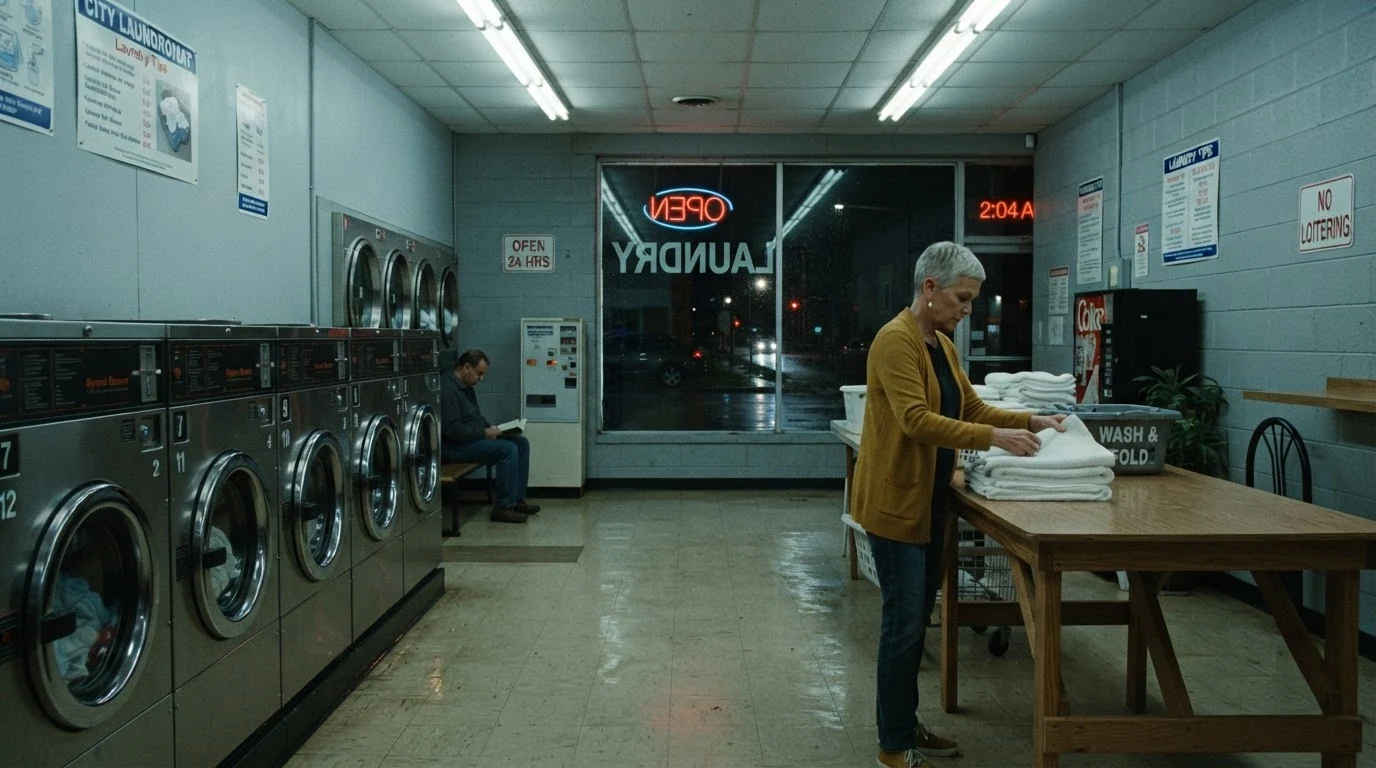
Interior, night, fluorescent tubes and wet dark street turn the three slugline parts into light and space. The window gives the video a real background to animate.
Open FlashBoardsFilm still, exterior of a small corner laundromat seen from across the street at dawn, pale blue sky light, fluorescent glow still visible through the front window, wet pavement reflecting the sky, a young man with a shaved head and an orange delivery jacket locking a bicycle to a lamppost, empty street, 40mm lens at eye level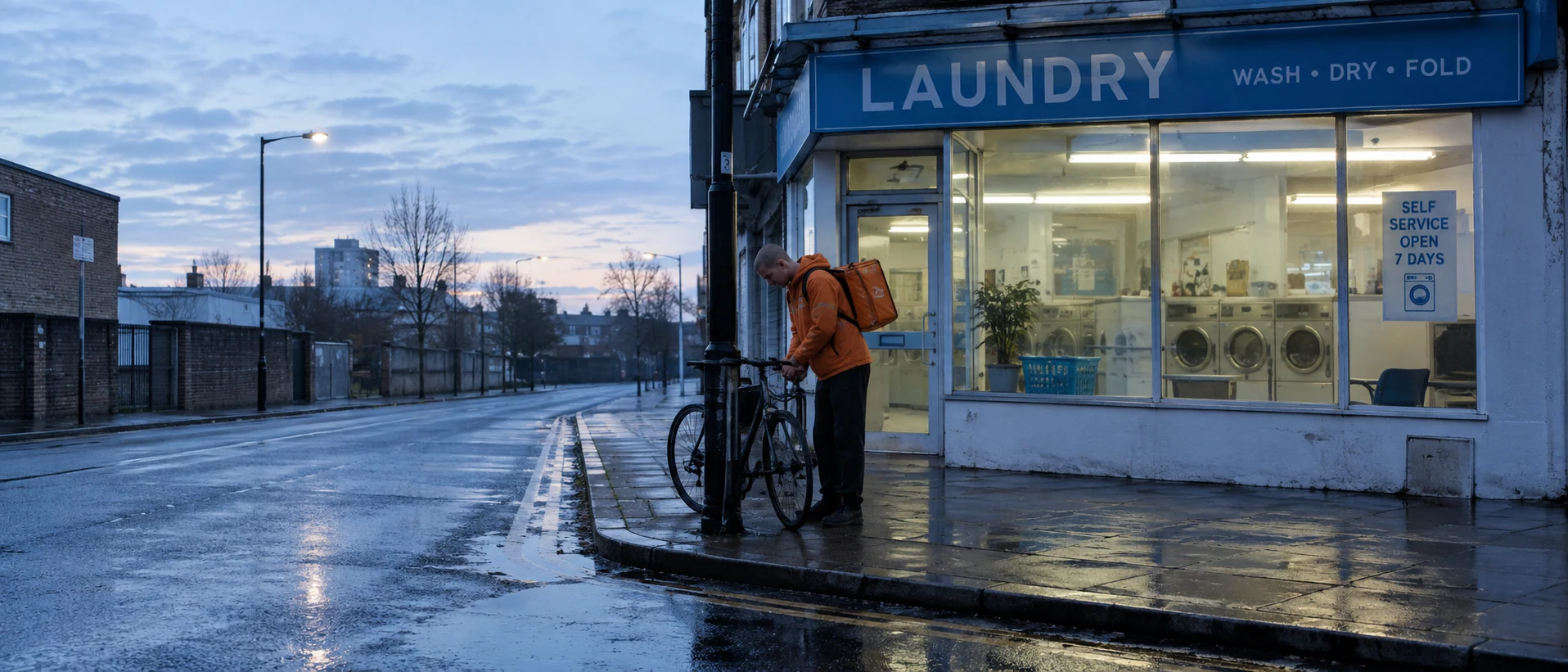
Same place, other prefix and time: exterior, across the street and dawn flip INT. NIGHT to EXT. DAWN, while the window glow ties both takes to one set.
Open FlashBoardsCamera: a slow steady push forward from the entrance along the row of washers, ending at the folding table. Action: the washer drums are already spinning. The woman snaps a white towel open and folds it in half. She looks up toward the front window as rain streaks down the glass, then goes back to folding.Spinning drums and the towel snap make the shot alive from the first frame; the push has an end point, and the action uses only what the frame contains.
Open FlashBoardsCommon mistakes
- A bare slugline in capitals can come back printed as a sign; describe the place in plain words instead.
NIGHTalone gives a generic blue look; name the light sources.INT./EXT.car scenes need both spaces described: driver inside, road through the windshield.- Locations drift between takes; reuse the first frame's wording for every scene with that slugline.
Keep the reference frames, prompts and every generated take side by side — images and video in one canvas.
FAQ
5 questionsWhat is a slugline in a screenplay?
A slugline is another name for a scene heading: the capitalized line opening each scene that states interior or exterior, location and time of day, for example EXT. TRAIN PLATFORM - NIGHT. It orients the reader instantly and gives production the data to schedule and budget the scene.
What does INT. and EXT. mean in a script?
INT. stands for interior and EXT. for exterior: the scene plays inside a building or vehicle, or outdoors. That drives lighting, permits, weather plans and whether it can be shot on a stage. When a scene crosses between inside and outside, such as a moving car, writers use INT./EXT.
How do you write a scene heading correctly?
Write it in caps on its own line: INT., EXT. or INT./EXT., then the location from general to specific, then a hyphen and the time of day, as in INT. POLICE STATION - INTERROGATION ROOM - NIGHT. Keep location names identical throughout, and put mood and visual detail in the action lines.
When do you need a new scene heading?
Whenever the location or the time changes. Moving from the kitchen to the street is a new scene; staying in the kitchen but jumping an hour ahead calls for LATER. Moving between rooms of one house in continuous time can use a short secondary heading such as HALLWAY.
Can you put a specific time like 3 PM in a slugline?
Better not. The time slot is for the crew, and DAY, NIGHT, DAWN or DUSK tell them what light to plan. If the exact hour matters to the plot, show it in the action lines, such as a wall clock reading 3:02, or in dialogue. That keeps headings consistent for the breakdown.
Related terms
5- Scene DescriptionScreenwriting
Scene description, or action lines, is the prose under a scene heading that tells what we see and hear, in present tense and in short visual paragraphs that read like shots.
- Screenplay TransitionScreenwriting
A screenplay transition is a right-aligned cue such as CUT TO:, DISSOLVE TO: or SMASH CUT TO: that tells how one scene hands over to the next; modern specs use them only when the cut itself carries meaning.
- Script BreakdownFilmmaking Process & Crew
A script breakdown goes through the screenplay scene by scene and tags every production element — cast, extras, props, wardrobe, vehicles, effects, locations — so it can be budgeted and scheduled.
- Shot, Scene and SequenceEditing
A shot is one uninterrupted run of the camera, a scene is a continuous action in one place and time built from shots, and a sequence is a group of scenes forming one dramatic unit — the three building blocks of film structure.
- ScreenplayScreenwriting
A screenplay is the written blueprint of a film in a fixed format — scene headings, action lines, character names, dialogue and transitions — where one page roughly equals one minute of screen time.
Further reading
David Trottier, The Screenwriter's Bible (Silman-James Press). Christopher Riley, The Hollywood Standard: The Complete and Authoritative Guide to Script Format and Style (Michael Wiese Productions).