 FlashBoards Learn
- Learn
- Screenwriting
- TV Script Format
Screenwriting · Film language
TV Script Format
Also called: teleplay, TV screenplay
TV script format is how a television episode is laid out on the page. One-hour dramas and single-camera comedies use standard screenplay format divided into a teaser and acts; multi-camera sitcoms use their own layout, with double-spaced dialogue, action in capitals and lettered scenes. The format tells the whole production how the episode will be shot and timed.
- What it does
- Splits an episode into a teaser and acts on the page and signals whether it will be shot single- or multi-camera.
- Use it when
- Writing a pilot, a spec episode of an existing show, or any script meant for a series with commercial or story breaks.
- Watch out
- Using feature page counts: a multi-cam sitcom runs 45+ pages for 22 minutes because its dialogue is double-spaced.
- Try this prompt
Cinematic film still at dawn, a vast cracked dry reservoir, a deputy in a wide-brim hat walking toward a church steeple sticking out of the mud
What is TV script format?
A TV script, or teleplay, is the written episode of a series: the script of a television program, not a filmed stage play. Most of it follows the rules of a feature screenplay: 12-point Courier, scene headings, present-tense action, centered character cues. What changes is the structure, which depends on how the show is produced.
Screenwriting for television uses three layouts:
- One-hour drama (Breaking Bad): screenplay format plus a teaser and labeled acts.
- Single-camera half-hour comedy (Barry): the same format, shorter, usually a cold open, two or three acts and sometimes a tag, a short closing scene after the last act.
- Multi-camera sitcom (Seinfeld, The Big Bang Theory): a separate layout for shows taped on a stage with several cameras and a studio audience.
The title page adds the series title and the episode title (a first episode is often just "Pilot"). On a staffed show the showrunner sets small house rules on top.
How is a one-hour drama script formatted?
An hour-long drama is a screenplay with the act breaks written in. It opens with a teaser, a short sequence before the main titles, the page version of a cold open. Breaking Bad made its teasers a signature, often opening on an image that only made sense later.
Each act starts on a new page with a centered, underlined header and ends with a closing line:
``` TEASER
EXT. DRY RESERVOIR - DAWN
A cracked lake bed. A church steeple pokes out of the mud. JUNE ACHTERBERG (40s, deputy, sunburned neck) walks toward it. At its base, something glints: a car roof.
JUNE (into radio) Dispatch, I need the county.
END OF TEASER ```
Network dramas were long written as a teaser plus four acts; many moved to five or six shorter acts to fit more breaks. Streaming scripts often drop the headers, but writers still end each movement on a turn.
How is a multi-camera sitcom script formatted?
Multi-cam shows are staged like theater for three or four cameras and taped in long runs, often before a live audience. The page is formatted for that floor:
- Dialogue is double-spaced, leaving room for rewrites during rehearsal week.
- Action lines are in ALL CAPS, so description never reads as speech.
- Entrances and exits are underlined, because camera blocking depends on who is in the room.
- Scenes are lettered (SCENE A, SCENE B), each starting on a new page, with the scene's characters listed under the heading.
``` SCENE A
INT. CORNER DINER - MORNING (DAY 1) (Rosa, Theo)
ROSA WIPES THE COUNTER. THEO ENTERS WITH A HUGE BOX.
ROSA
What is that?
THEO
Our new business model. ```
Details vary by show, so staff writers follow the show's own template.
How long is a TV script?
The feature rule of one page per minute holds for single-camera formats and breaks for multi-cam:
| Format | Screen time | Typical pages | |---|---|---| | Single-camera half-hour comedy | 21–30 min | 22–35 | | Multi-camera sitcom | 21–23 min | 45–55 | | One-hour network drama | 42–44 min | 45–60 | | One-hour cable or streaming drama | 45–65 min | 50–65 |
Double spacing roughly halves the minutes per page in a multi-cam script. A pilot episode may run a few pages over, but a spec script of an existing show should match that show's usual length.
TV script vs. feature screenplay
The elements are the same; the job is different:
- Act breaks are part of the text. A feature's structure is implied; a teleplay labels it.
- It serves a series. An episode has to fit an existing voice, cast and standing sets.
- It is revised on a production schedule, moving quickly toward a shooting script with colored revision pages.
- Multi-cam is its own format. No feature is written in it.
In FlashBoards, a writer can paste each act of a pilot as a note, generate a key frame for the teaser and each act-out, and keep series references beside them, so the episode's shape is visible on one board.
How to create a TV script format with AI
3 promptsA teaser and its act-outs are the images a series is sold on. Nano Banana 2 Lite turns the sample teaser into a start frame, GPT Image 2.5 shows the stage a multi-cam page is written for, and MiniMax H3 Max Turbo plays the teaser as a shot. Keep pages and takes on one FlashBoards board.
Cinematic film still at dawn, wide shot, 24mm lens at eye level. A vast cracked dry reservoir bed. In the middle distance a white wooden church steeple rises out of the mud, a rusty car roof at its base catching the low sun. In the foreground a woman in her forties walks away from camera toward it: tan deputy shirt, sunburned neck, dark blonde braid pinned under a brown wide-brim hat. Long shadows, pale pink sky, dust haze, film grain.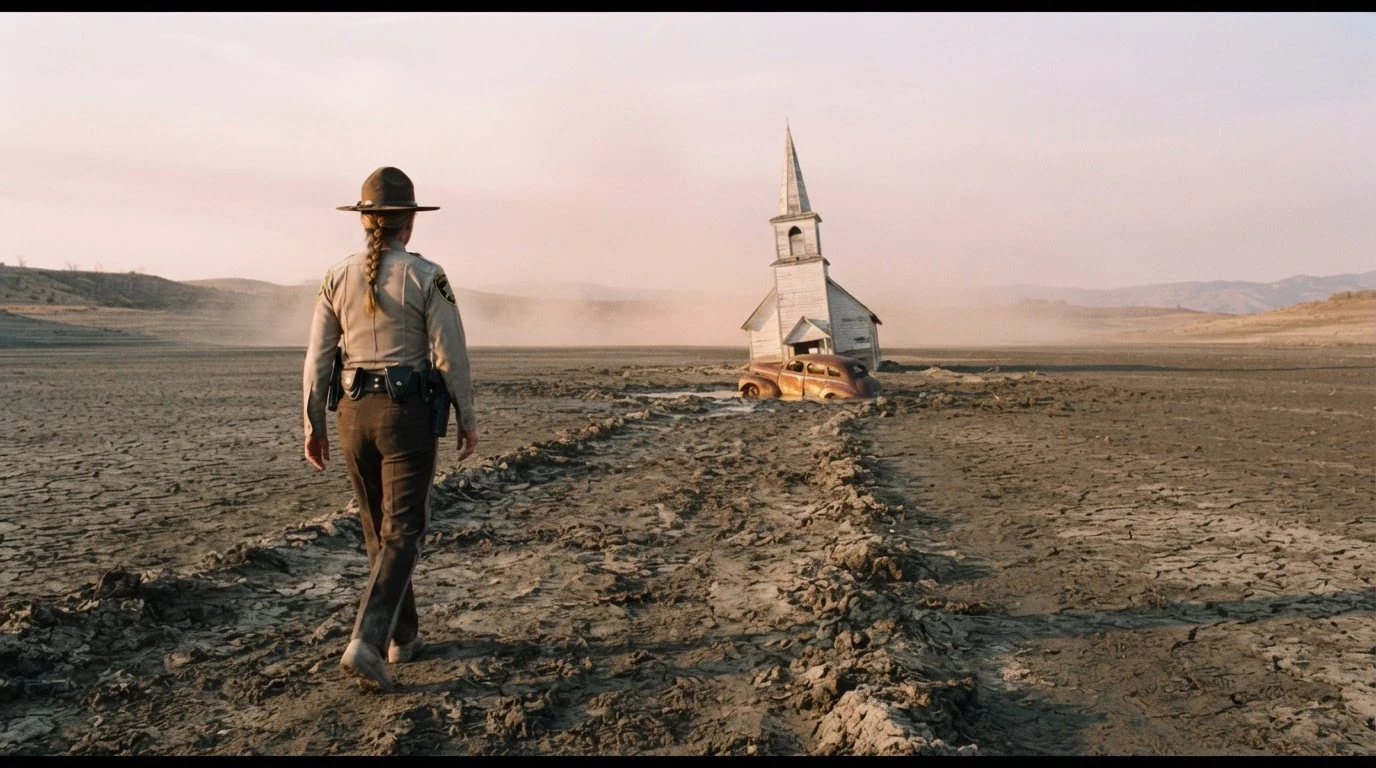
The prompt reads the page: EXT. DRY RESERVOIR - DAWN becomes place and light, June's introduction becomes her features, and the glint becomes a rusty car roof catching the low sun, the teaser's hook placed in front of her.
Open FlashBoardsWide behind-the-scenes photograph of a multi-camera sitcom soundstage. A brightly lit three-walled diner set with a counter and red vinyl stools. The open fourth side faces four pedestal studio cameras, a boom microphone above, audience bleachers in the dark foreground. Flat high-key light from an overhead grid. At the counter, a woman in her thirties with a short black bob and a mustard apron, and a lanky red-haired man in his twenties holding a large cardboard box.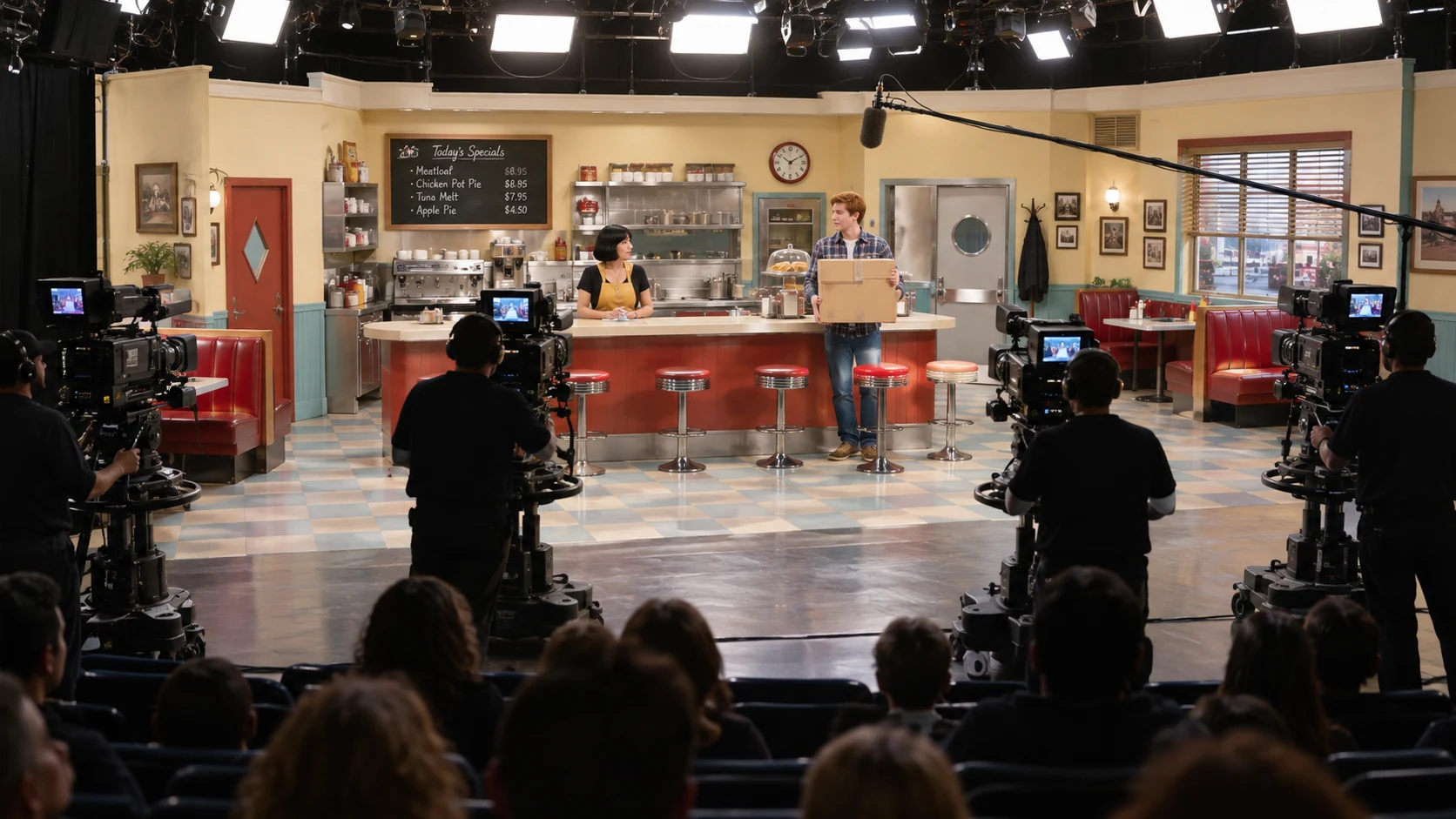
Three-walled set, open fourth side, studio cameras and bleachers describe the production the multi-cam page serves; flat high-key light lets any camera cut at any moment. The actors restage Scene A.
Open FlashBoardsCamera: slow, steady tracking shot following the woman from behind at walking pace, keeping the same distance. Action: she is already walking, boots cracking the dry mud, dust lifting at her heels. In the middle she slows as the steeple grows larger and the car roof flashes in the sun. At the end she stops, lifts the radio on her shoulder to her mouth and speaks.Walking and dust in the first sentence make the shot alive from the first frame; the action follows the teaser in order and ends on its last beat, the radio call.
Open FlashBoardsCommon mistakes
- Pasting script text as the prompt.
TEASER,EXT.and cues get drawn as lettering. Translate the heading into place and light. - The hook gets lost. Name the one detail the page reveals and where it sits in frame.
- A sitcom stage that looks like a closed room. State the three-walled set and the open fourth side.
- A frozen video. Begin with motion already happening.
Keep the reference frames, prompts and every generated take side by side — images and video in one canvas.
FAQ
4 questionsWhat is the difference between a teleplay and a screenplay?
A teleplay is the script of a television episode; a screenplay usually means a feature film script. Dramas and single-camera comedies use the feature layout with a teaser and labeled acts added. Multi-camera sitcoms use their own format, with double-spaced dialogue, action in capitals and lettered scenes.
How do you format a sitcom script?
A single-camera sitcom uses standard screenplay format with a cold open, two or three acts and sometimes a tag. A multi-camera sitcom uses a separate layout: double-spaced dialogue, action in all caps, underlined entrances and exits, and lettered scenes that each begin on a new page.
How many pages is a TV pilot script?
A half-hour single-camera pilot usually runs 25 to 35 pages, a multi-camera pilot 45 to 55 because of double spacing, and an hour-long drama pilot 50 to 65. Pilots can run slightly long because they introduce the world, but a draft far past these ranges reads as unedited.
What is a teaser in a TV script?
A teaser is the short opening sequence before the main titles, labeled TEASER or COLD OPEN at the top of page one and closed with END OF TEASER. It usually runs one to five pages and hooks the viewer with a mystery, a joke or a sharp turn before the episode proper begins.
Related terms
4- ScreenplayScreenwriting
A screenplay is the written blueprint of a film in a fixed format — scene headings, action lines, character names, dialogue and transitions — where one page roughly equals one minute of screen time.
- Pilot EpisodeFormats & Exhibition
A pilot episode is the first episode of a proposed series, made to sell the show to a network or platform — it must establish the world, characters, tone and the engine that will generate future episodes.
- Cold OpenStorytelling
A cold open drops the audience straight into a scene before the title card or opening credits, usually to hook them with a mystery, a joke or a jolt of action.
- ShowrunnerFilmmaking Process & Crew
A showrunner is the top creative and managerial authority on a TV series — usually the head writer and an executive producer — running the writers' room, casting, directors, edits and budget.
Further reading
Christopher Riley, The Hollywood Standard. David Trottier, The Screenwriter's Bible. Ellen Sandler, The TV Writer's Workbook.