 FlashBoards Learn
- Learn
- Storytelling
- Cold Open
Storytelling · Film language
Cold Open
Also called: teaser, pre-title sequence
A cold open is a scene that plays before the title card or opening credits, dropping the audience into the story with no lead-in. It exists to hook: a mystery, a joke or a jolt of danger that makes the viewer stay through the titles.
- What it does
- Buys attention in the first minutes by asking a question the episode or film promises to answer.
- Use it when
- Opening a TV episode, a pilot or a feature whose first act starts slow and needs a promise up front.
- Watch out
- A cold open that only delivers exposition is a prologue in disguise; it has to end on a hook, a reveal or a laugh.
- Try this prompt
Wide shot at dawn, empty two-lane desert road, a yellow school bus stopped at an angle with every door open, hazard lights on, lunchboxes scattered on the asphalt, 35mm film still
What is a cold open?
A cold open is the stretch of an episode or film that runs before the title sequence. The viewer comes in "cold": no credits, no theme music, no setup. In a TV script it is usually labeled TEASER and sits ahead of Act One, which is why the two words are interchangeable in TV script format. In features the same device is called a pre-title sequence.
Length runs from a ten-second gag to a five-minute scene. What defines it is position and function: it comes first, it ends on a turn, and then the title hits.
Within story structure, a cold open is a promise rather than a stage. It can show the inciting incident, a moment from later in the story, or something that seems unrelated until the third act.
Why do shows and films use a cold open?
Broadcast television made the cold open a habit: a viewer flipping channels had to be caught before the credits gave them an excuse to leave.
- The procedural hook. Law & Order opens with ordinary people stumbling onto a crime; House M.D. opens with the patient of the week collapsing.
- The threat. The first episode of Stranger Things (2016) follows Will Byers riding home through the woods until he vanishes. The title lands only after the mystery is set.
- The jump ahead. The Breaking Bad pilot (2008) opens on a man in underwear and a gas mask driving an RV off a desert road, then cuts back to how he got there. Season 2 opens episodes with black-and-white glimpses of a pink teddy bear in a pool, a flash-forward the season pays off.
- The comedy bit. The Office runs a self-contained joke before the theme; Saturday Night Live ends its cold open with "Live from New York, it's Saturday night!"
- The set piece. Bond films have opened with a pre-title action sequence since the 1960s.
How to write and stage a cold open
Start on an image that asks a question. Hold the answer back.
Cut the lead-in. Enter late and skip establishing dialogue. Save names and backstory for Act One.
Build to one turn. Every cold open needs a button: a reveal, a scream, a punchline. Put it on the last shot and smash cut to the title.
Keep it tight. Dramas often run two to four minutes, comedies under one. If the teaser needs its own subplot, it is too big.
Board what is withheld. Cold opens depend on what the audience is not shown, so plan them shot by shot. In FlashBoards, lay the teaser's panels in a row with the title card after them and the first frame of Act One after that, so the jump from hook to story is visible before anything is shot.
Cold open vs. prologue vs. in medias res
A cold open is defined by position: it plays before the titles, whatever it contains.
A prologue is defined by separation: it is set apart from the main story. A prologue becomes a cold open when it plays before the credits, but most cold opens are not prologues; in Law & Order the teaser is the main story starting.
In medias res is defined by entry point: the story starts mid-action and fills in the past later. The Breaking Bad pilot is both at once, an in medias res opening delivered as a cold open.
Cold opens in pilots and series
In a pilot episode, the cold open has to sell the tone and engine of the whole series in a few minutes. Later episodes can play with learned expectations: hand the open to a minor character or resolve a cliffhanger before the theme. More devices like this live in the storytelling hub.
How to create a cold open with AI
3 promptsA cold open lives on its first image and its last beat, so board those first. Nano Banana 2 Lite gives the opening mystery frame, GPT Image 2.5 an insert that deepens the question, and MiniMax H3 Max Turbo animates the first frame. Keep all three on one FlashBoards board next to the title card.
Wide shot, 28mm lens, eye level, an empty two-lane desert road at dawn. A yellow school bus stopped at an angle on the shoulder, every door open, amber hazard lights on, exhaust drifting in the cold air. Lunchboxes and a single red sneaker scattered on the asphalt. In the foreground, back three-quarters to camera, a sheriff's deputy in her late forties with a gray-streaked black braid and a tan uniform walks toward the bus, one hand on her radio. Low pink sunrise light, long shadows, 35mm film still.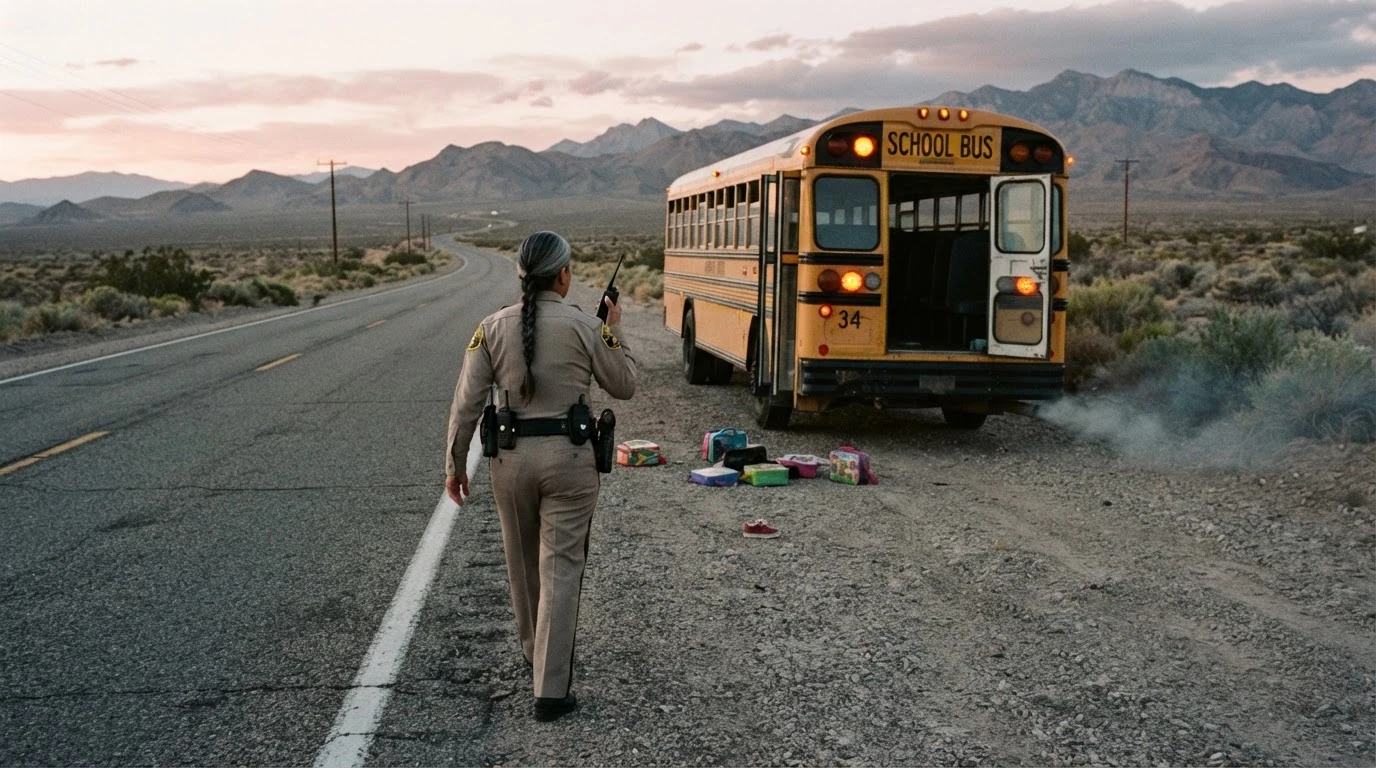
The hook is built from contradictions: every door open, exhaust (it was just running) and lunchboxes scattered with no children in frame. The deputy walks in with her back to camera, so we share her not-knowing.
Open FlashBoardsClose-up insert, 50mm lens, from the aisle of an empty yellow school bus toward the driver's seat at dawn. The seat is empty, a paper coffee cup in the holder with a thin wisp of steam, the radio handset swaying on its cord, keys in the ignition. Pink sunrise through the windshield, dust in the air, shallow depth of field, 35mm film still.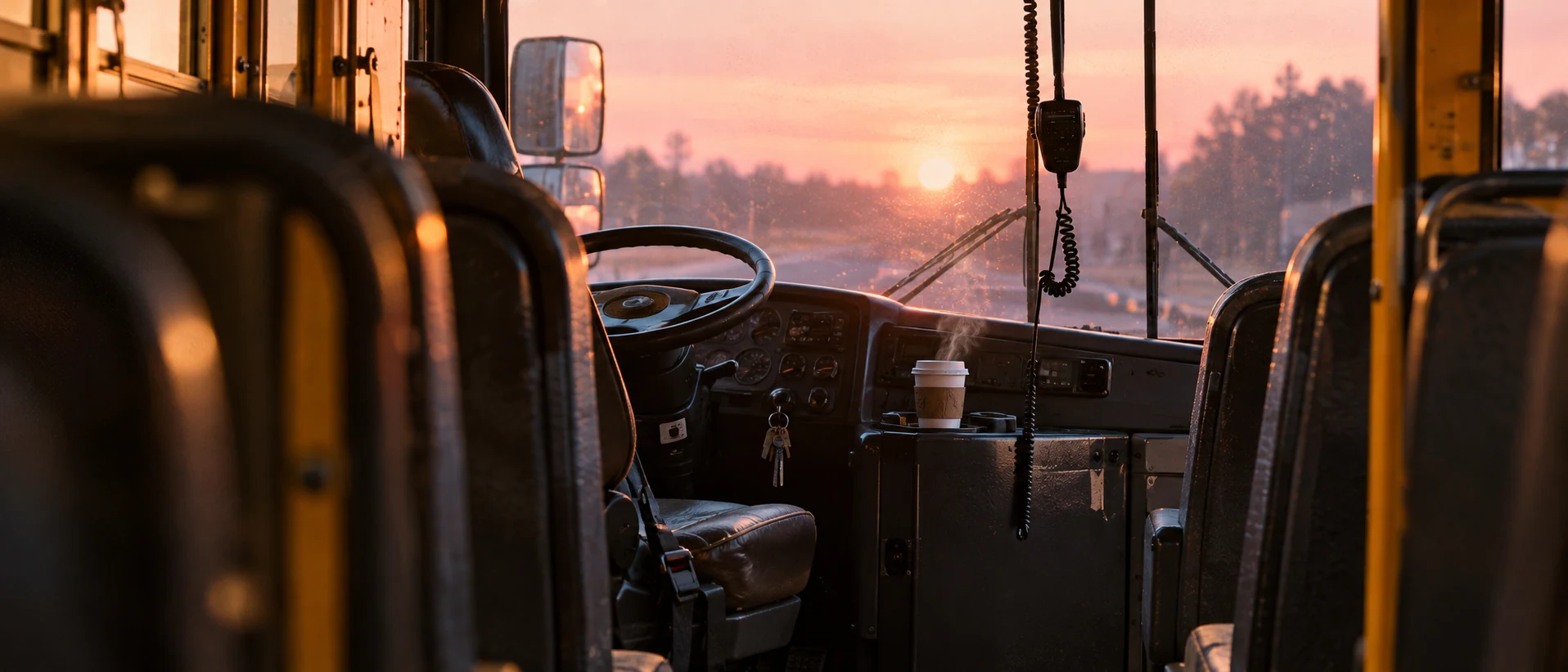
The second beat sharpens the question: steam and keys in the ignition say someone was here seconds ago. The 21:9 frame and shallow depth of field isolate each clue.
Open FlashBoardsCamera: a slow, steady push-in behind the deputy, following her to the open front door of the bus and ending in a medium shot of the doorway. Action: The hazard lights are already blinking and exhaust drifts across the road. The deputy keeps walking, steps around a lunchbox, stops at the door and lifts her radio. She leans forward and looks up into the bus.Already blinking and keeps walking make the clip move from the first frame. Staying behind the deputy keeps the bus interior hidden, so the shot ends where a cold open cuts to the title.
Open FlashBoardsCommon mistakes
- Models like to answer the mystery. Describe what is present (empty seat, keys in the ignition) and hide the answer with camera position, not a negative.
- Image models center and flatten-light the subject. Name placement and light.
- Video models add a second event. Stop the clip at the threshold, where you would cut to the title.
Keep the reference frames, prompts and every generated take side by side — images and video in one canvas.
FAQ
5 questionsWhat is a cold open in TV?
A cold open is the scene or short sequence that plays before a TV episode's opening credits or title card. It starts with no introduction and ends on a hook, such as a mystery, a reveal or a joke, so viewers stay through the titles. In scripts it is labeled the teaser and comes before Act One.
Why is it called a cold open?
Because the audience is dropped in cold: no credits, theme music or setup warm them up first. The scene simply starts, often mid-action, and the title arrives only after the hook has landed. The habit comes from broadcast TV, where the first minute had to stop viewers from changing the channel.
What are some famous cold open examples?
The Breaking Bad pilot opens on an RV careening through the desert, driven by a man in a gas mask. Stranger Things opens with a boy vanishing on his way home. Law & Order and House M.D. open with the case of the week, while The Office and Saturday Night Live use comic cold opens.
Is a cold open the same as a teaser?
In screenwriting, yes: TV scripts label the cold open TEASER and place it before Act One. Outside the script, a teaser can also mean a short promotional trailer, which is a different thing. In feature films the same device is usually called a pre-title sequence.
How long should a cold open be?
There is no fixed rule. Comedy cold opens often run under a minute, one-hour dramas commonly two to four minutes, and some pilots go longer. The test is function, not duration: end the cold open the moment its hook lands, and move anything that needs more setup into Act One.
Related terms
5- PrologueStorytelling
A prologue is an opening section set apart from the main story — often in another time or place — that establishes backstory, tone or a mystery the film will pay off.
- In Medias ResStorytelling
In medias res (Latin for 'into the middle of things') opens the story mid-action, then fills in how we got there through dialogue or flashback.
- Pilot EpisodeFormats & Exhibition
A pilot episode is the first episode of a proposed series, made to sell the show to a network or platform — it must establish the world, characters, tone and the engine that will generate future episodes.
- TV Script FormatScreenwriting
TV script format is how episodes are laid out on the page: one-hour dramas follow screenplay format split into acts or a teaser, while multi-camera sitcoms use double-spaced dialogue and capitalized action.
- Story StructureStorytelling
Story structure is the order and shape of the events that carry a story from setup to resolution; models like the three-act structure, Freytag's pyramid, the hero's journey or Save the Cat are different maps of it.
Further reading
Syd Field, Screenplay: The Foundations of Screenwriting. Ellen Sandler, The TV Writer's Workbook.