 FlashBoards Learn
- Learn
- Storytelling
- Comic Relief
Storytelling · Film language
Comic Relief
Also called: comic relief character
Comic relief is a humorous character, line or scene placed inside a tense or dark story to release pressure before the tension builds again. It gives the audience a breath, makes the characters feel human and, when it is timed well, makes the next serious moment hit harder rather than softer.
- What it does
- Lets the audience exhale for a moment so the story can tighten the screw again without numbing them.
- Use it when
- Tension has been held for a long stretch, or right after a shock, before the next escalation.
- Watch out
- A joke that denies the danger, or comes from outside the world of the story, deflates the stakes instead of resetting them.
- Try this prompt
Three fugitives crouched in a dark cellar, flashlight beams through the floorboards above, the youngest trying not to sneeze while the others stare at him in horror, film still.
What is comic relief?
Comic relief is a change of key: for a moment, a serious story lets the audience laugh. The humor can come from a character, a line, a scene or a visual gag, but the job is the same: release the pressure the story has built so the audience can take more of it.
The device comes from the stage. The classic case is the drunken Porter in Shakespeare's Macbeth, who jokes about keeping the gate of hell right after Duncan's murder, while the knocking at the gate keeps the dread alive under the laughter.
Why do filmmakers use comic relief?
- Tension needs a reset. An audience held at full pressure goes numb. A laugh drops the level so the next escalation has somewhere to climb from; that rise and fall is the heart of pacing.
- Contrast sharpens the dark. A laugh lowers the audience's guard, so a sudden turn afterward lands harder. Suspense often works best right after people have relaxed.
- Humor humanizes. People joke in hospitals and at funerals. A character who jokes to avoid cracking feels more real than one who stays solemn.
Types of comic relief: character, line, scene
The character. A recurring figure who lightens the story: C-3PO and R2-D2 in Star Wars (1977), Donkey in Shrek (2001), Olaf in Frozen (2013). Often a sidekick bouncing off the hero's seriousness. The best ones have their own wants and fears, not just jokes.
The line. One wisecrack that punctures a tense moment. "You're gonna need a bigger boat" in Jaws (1975) is a laugh and a jolt of fear at once.
The situation. Circumstances turn absurd without anyone telling a joke: a plan falls apart, an object won't cooperate.
The visual gag. A prop, a gesture, a bad fit. It needs no dialogue, so it is the easiest kind to storyboard.
Comic relief examples in film
Jojo Rabbit (2019) builds its first half on comic relief: a boy in Nazi Germany whose imaginary friend is a buffoonish Adolf, played by writer-director Taika Waititi. The laughs lower the audience's defenses, so the tragic turn arrives without warning.
Manchester by the Sea (2016) finds humor inside grief: paramedics struggle to fold a stretcher into an ambulance in the middle of a disaster, awkward and funny the way real crises are.
Ex Machina (2015) plays it sideways: Nathan's sudden dance routine with Kyoko is funny and unsettling at once.
The Dark Knight (2008) shows the reverse. The Joker's jokes raise tension instead of releasing it; a laugh from a villain is menace, not relief.
How to write and stage comic relief
- Place it after a peak, not during one. Relief works right after a shock or a narrow escape, then tension climbs again. A joke inside the climax usually punctures it.
- Keep it in the world. Humor should come from the characters and the situation; a wink at the audience breaks the spell.
- Don't deny the danger. The best comic relief admits the stakes: the character jokes because they are scared.
- Play it straight on camera. Hold a reaction shot on the person who is not laughing, and frame physical gags wide enough to read in one shot.
On a FlashBoards board, lay the sequence out left to right and mark each tension peak and each laugh: two jokes side by side, or a long stretch with none, show up before the shoot.
Comic relief vs. tragicomedy and black comedy
Comic relief is a device inside a serious story: short, placed and temporary. The film stays a drama, a thriller or a horror film.
Tragicomedy blends both modes through the whole work, so laughter and grief share scenes instead of taking turns. Black comedy finds the humor in death and taboo themselves. A quick test: cut the jokes. If the film still stands as a drama, they were comic relief. More devices in the storytelling hub.
How to create a comic relief with AI
4 promptsShow comic relief as a funny beat inside a visibly tense scene: the prompt needs the danger and the gag in the same frame. In FlashBoards, keep the comic frame beside the grim shots around it to judge the tone. The fourth prompt re-shoots a real film shot from a text description alone, and the original plays next to the result so you can compare.
A dark root cellar at night. Three fugitives crouch among potato sacks. Thin white flashlight beams stab down through gaps in the floorboards above. In the center, a lanky young man with very large ears, a knitted orange hat and a thin mustache pinches his nose, eyes watering, face scrunched, about to sneeze. Beside him, a stern gray-haired woman with a long braid and a broad bald man with a chin scar stare at him in wide-eyed horror. Medium wide shot, 35mm lens, eye level. Cold blue light from above, deep shadows. Cinematic film still.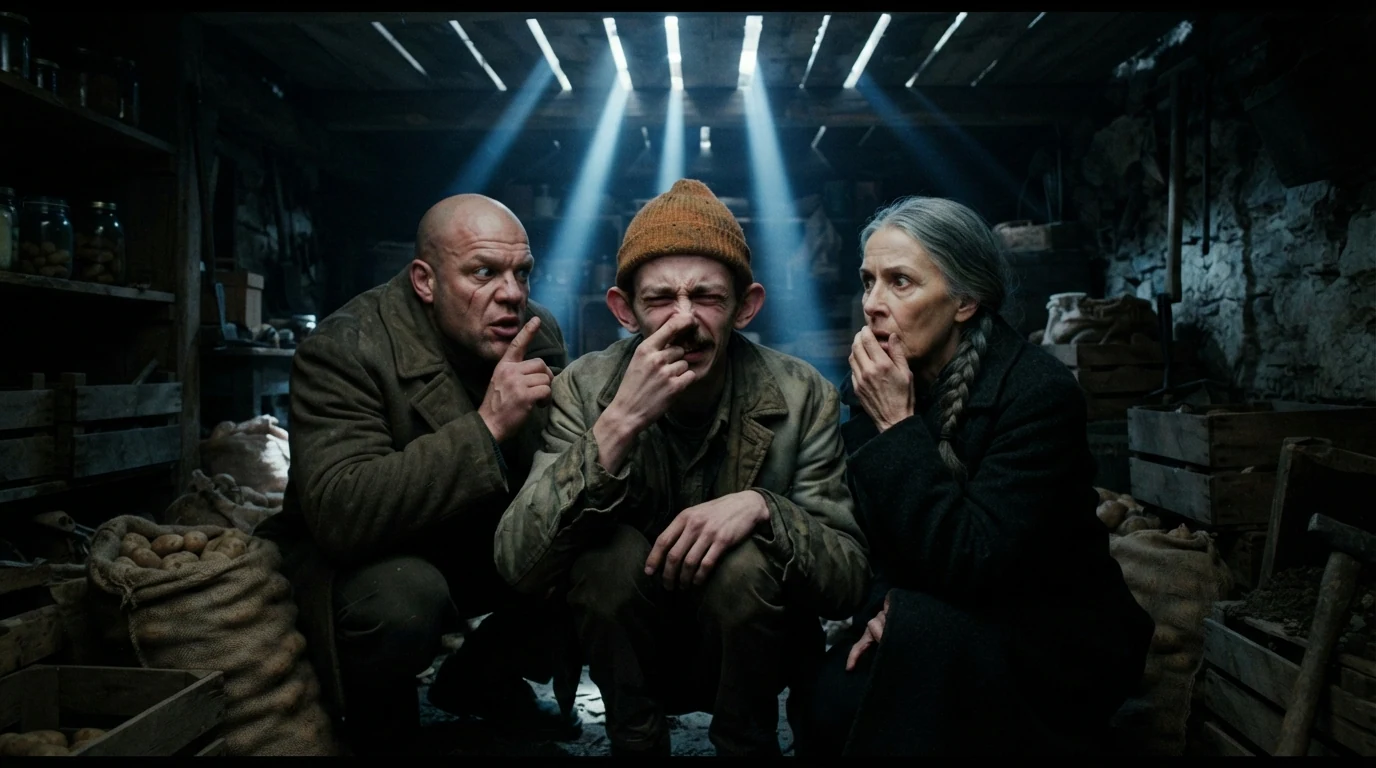
The danger ("flashlight beams through the floorboards") and the gag ("about to sneeze") share one frame; the horrified faces are the straight men. Start frame for the video.
Open FlashBoardsA narrow stone stairwell in an old apartment building, overcast window light. Six pallbearers in black suits carry a wooden coffin that is jammed diagonally at the turn of the stairs. A short, sweaty pallbearer with a comb-over is pinned flat against the wall under one end, cheeks puffed. On the landing below, a thin priest with round glasses waits, hands folded, perfectly straight face. Wide shot, 28mm lens, camera below the landing looking up. Muted colors, cinematic film still.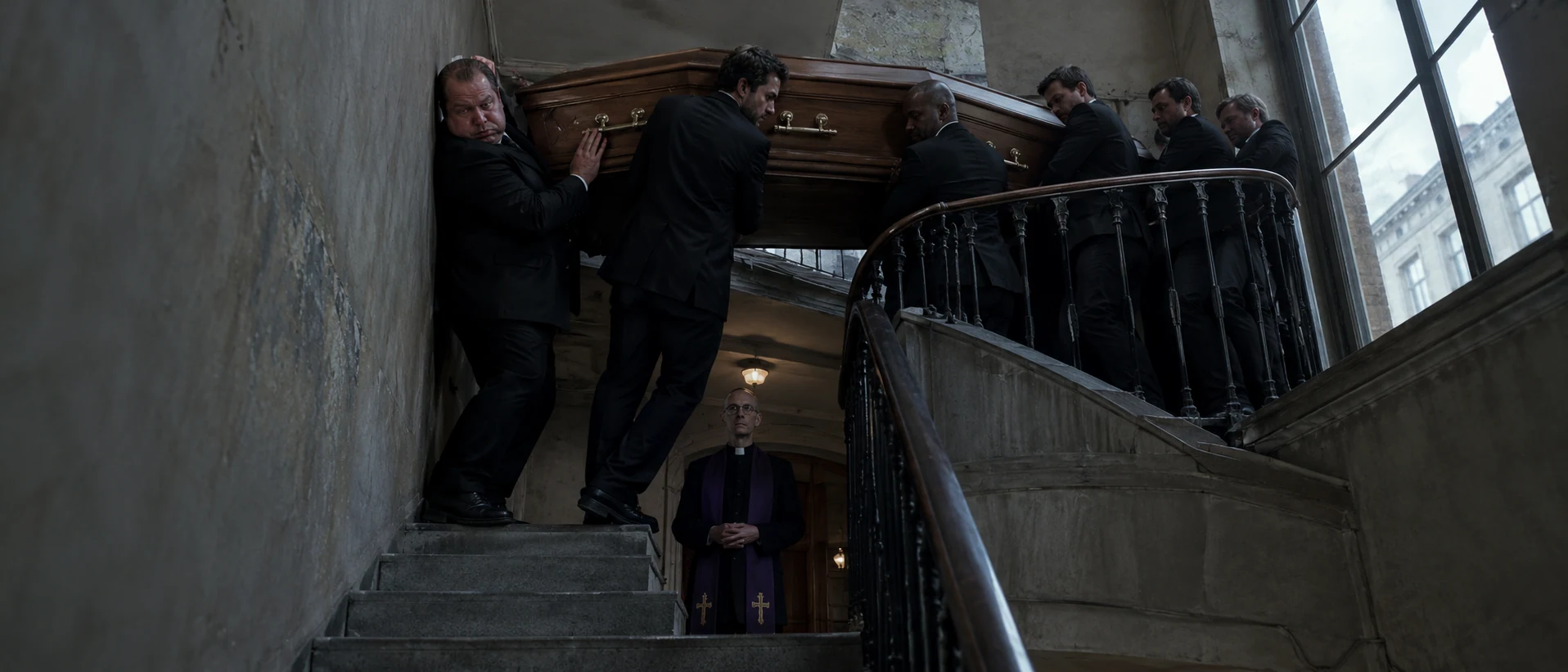
Situational comic relief: nobody jokes, the circumstances do. "Jammed diagonally" gives the gag; the priest's "perfectly straight face" keeps the grief.
Open FlashBoardsCamera: static, then a slow push in on the three faces. Action: from the first frame the flashlight beams sweep across the floorboards and dust drifts down. The young man's face scrunches harder. The gray-haired woman clamps her hand over his mouth, he sneezes silently into her palm, and all three freeze. The beams move away. She slowly wipes her hand on his sleeve, disgusted.Sweeping beams and dust make the shot alive from the first frame; the action runs tension, gag, freeze, release.
Open FlashBoards{
"output": "Full-screen live-action scene from A Serious Man (2009) from its very first frame: one continuous shot, no cuts. 35mm film, 1960s Minnesota suburban kitchen at night, warm amber tungsten light from one round glass globe lamp hanging over the table, dark wood cabinets, cream floral wallpaper, ruffled cream curtains, deadpan comedy staged with complete seriousness.",
"characters": {
"S1": {
"name": "Sussman, the dentist",
"look": "man in his fifties, grey hair, black-rimmed glasses, dark plaid short-sleeved shirt, dark trousers",
"voice": "silent: he never speaks and his lips never move"
},
"S2": {
"name": "Sussman's wife",
"look": "woman in her fifties, dark curly bobbed hair, patterned short-sleeved blouse",
"voice": "silent: she only chews"
},
"S3": {
"name": "Rabbi Nachtner, played by George Wyner",
"look": "never seen: only his voice is heard, off screen",
"voice": "calm, dry, unhurried storyteller's voice of an elderly rabbi"
}
},
"shots": [
{
"shot": 1,
"camera": "slow dolly in along the kitchen from behind the counter, eye level, wide medium shot of the dining table in the middle distance; a dark blurred refrigerator edge fills the right edge of the foreground, the kitchen counter with a rotary telephone runs along the lower left with a streak of lamp light on its edge; the empty green leaf-patterned chair back stands in the centre foreground; the frame tightens only slightly by the end",
"action": [
"BEGINNING: alive from the first frame, the camera already creeping forward. S1 sits in the left third at the near end of the table, in three-quarter profile facing screen right, both forearms resting on the table edge, hands folded together beside an untouched plate, staring straight ahead past his wife into empty space. S2 sits in the right third at the far side of the table, leaning low over her plate, fork in the hand nearer the camera.",
"THEN: S2 lifts a forkful to her mouth and chews, head still bowed. S1 does not move: no blink of reaction, no nod, hands still folded on the table.",
"THEN: S2 straightens up and turns her head toward S1 at screen left, chewing, fork held above her plate.",
"THEN: S2 looks back down and cuts at her food. S1 keeps staring ahead at nothing, glasses catching the lamp light, mouth closed, perfectly still.",
"END: S2 takes another small bite and glances toward S1; S1 still sits frozen with his food untouched, the camera has drifted a little closer."
],
"dialogue": [
{
"speaker": "S3",
"on_screen": false,
"when": "shortly after the first frame, while S2 is bent over her plate",
"delivery": "flat, matter-of-fact storyteller's tone",
"line": "<d>[English] Sussman goes home.</d>"
},
{
"speaker": "S3",
"on_screen": false,
"when": "after S2 has straightened up and looked at S1, running to the end of the shot",
"delivery": "dry, a small pause between the question and the answer",
"line": "<d>[English] Can Sussman eat? Sussman can't eat.</d>"
}
]
}
],
"sound": {
"ambience": "quiet kitchen at night: a soft clink of fork on plate, a faint refrigerator hum",
"speech": "exactly these spoken phrases, each said once, in this order, all in Rabbi Nachtner's voice from off screen; nobody in the frame moves their lips",
"never_spoken": "no narration and no voice-over apart from Rabbi Nachtner's two lines: the descriptions, performance notes and step words of this prompt are never spoken aloud",
"music": "a film score under the scene, always below the voices: a sparse, wry solo clarinet over soft low strings",
"subtitles": "none"
}
}Remakes the slow dolly toward Sussman's kitchen table in A Serious Man (2009), carrying over the framing, the frozen husband, the eating wife and Rabbi Nachtner's two off-screen lines verbatim.
The joke lives in the contrast: Rabbi Nachtner's deadpan voice from off screen against a dentist frozen over an untouched plate while his wife keeps eating. The prompt keeps the man perfectly still and gives every beat to the wife, so the stillness itself reads as the punchline.
Open FlashBoardsCommon mistakes
- Models make the whole image cheerful. State the danger concretely: beams, shadows, cold light, stern faces.
- Everyone ends up laughing. Say who is not laughing; the straight face carries the joke.
- Gags turn cartoonish. Ask for a cinematic film still with realistic light.
Keep the reference frames, prompts and every generated take side by side — images and video in one canvas.
FAQ
5 questionsWhat is comic relief?
Comic relief is humor placed inside a serious or tense story to release pressure for a moment. It can be a character, a line, a scene or a visual gag. The laugh lets the audience breathe, humanizes the characters and resets tension so the next dramatic beat lands harder. The classic example is the drunken Porter in Shakespeare's Macbeth.
What is a comic relief character?
A comic relief character is a recurring figure who partly exists to lighten a serious story, often the hero's sidekick, a servant, a droid or an animal companion. C-3PO and R2-D2 in Star Wars, Donkey in Shrek and Olaf in Frozen are familiar examples. The strongest ones have their own goals and fears, so the humor comes from character.
What are some examples of comic relief in movies?
Familiar examples include "You're gonna need a bigger boat" in Jaws (1975), the droids in Star Wars (1977), Olaf in Frozen (2013) and the imaginary Adolf in Jojo Rabbit (2019). Manchester by the Sea (2016) shows a subtler kind: awkward humor in the middle of grief.
Can comic relief ruin a serious scene?
Yes, when it is misplaced. A joke in the middle of a climax, or one that tells the audience the danger does not matter, deflates the stakes. Comic relief works best after a peak of tension, grounded in the characters, and followed by a return to seriousness. Constant quipping has the same effect as none: the audience stops feeling.
What is the difference between comic relief and tragicomedy?
Comic relief is a short, placed device inside a serious story; remove it and the story remains a drama. Tragicomedy blends tragic and comic modes throughout the work, so humor and grief share the same scenes and color each other. Comic relief takes turns with tension; tragicomedy lets them happen at once.
Related terms
2- TragicomedyGenres
Tragicomedy blends tragic and comic modes in one story, so that laughter and grief sit side by side and color each other — Life Is Beautiful is a classic film example.
- PacingStorytelling
Pacing is how fast the story feels as it moves — set in the script by scene length, how quickly events escalate and where the quiet moments fall, then fine-tuned in the edit.
Further reading
William Shakespeare, Macbeth, Act 2, Scene 3 (the Porter scene). Thomas De Quincey, "On the Knocking at the Gate in Macbeth" (1823).