 FlashBoards Learn
- Learn
- Camera Shots
- Reaction Shot
Camera Shots · Film language
Reaction Shot
Also called: reaction, reaction close-up
A reaction shot cuts away from a line or an action to show how another character takes it, usually in a close-up of their face. The audience reads the moment through the listener: surprise, fear or a joke landing registers on the face that receives it, not the one that delivers it.
- What it does
- Moves the meaning of a moment onto the face of the person hearing or seeing it.
- Use it when
- What a line or event does to someone matters more than the line or event itself.
- Watch out
- The eyeline must point at the speaker or the event, and one reaction too many turns drama into mugging.
- Try this prompt
Close-up reaction shot, 75mm lens at eye level, a woman listening in silence, eyes fixed just left of camera, stunned, soft window light
What is a reaction shot?
A reaction shot is defined by its job in the edit, not its size. It shows a character responding to something: a line, a sound, a sight, another character's action. Most are a close-up or medium close-up of a face, but a wide shot of a room going silent is a reaction shot too.
In the camera shots vocabulary it needs a partner: the shot before shows the cause, the reaction shows the effect. A line read flat becomes a threat or a joke depending on the face we cut to next, which is the core of the Kuleshov effect.
Why do filmmakers use reaction shots?
Emotion lands on the listener. The speaker knows what they are about to say; the listener does not. Surprise happens on their face, so editors often cut to them before the line ends.
The audience borrows a point of view. Rear Window (1954) is built on Jeffries watching his neighbors; his reactions tell us how to read what we saw. In Jaws (1975), Brody's face on the beach, caught in a dolly zoom, is when the danger becomes real.
Tension without showing everything. In the coin toss scene of No Country for Old Men (2007), the gas station owner's growing unease makes Chigurh's calm questions frightening.
Comedy and control. A deadpan look after an absurd line is often the actual joke. Reactions also let the editor trim dialogue.
How to shoot a reaction shot
Size and lens. A close-up or medium close-up on 50–85mm (Super 35) keeps the face natural and the background soft. Match the speaker's coverage size.
Eyeline. The listener looks just past the lens, on the speaker's side, respecting the 180-degree rule. An eyeline match makes the reaction read as aimed at the right person.
Give the actor something real. Shoot while the other actor reads lines off camera, and keep rolling through pauses. The editor needs the listening, the reaction and the settle after it.
Dirty or clean. A soft shoulder in the foreground, as in an over-the-shoulder shot, ties the reaction to the conversation; a clean single makes it private.
Light and timing. Keep a catchlight in the eyes. Hold the cut until the thought visibly changes on the face.
Reaction shot vs. cutaway shot
A cutaway shot leaves the main action for something else: a detail, a clock, a bystander. A reaction shot is a cut away whose content is a response. If the shot adds information about the world, it is a cutaway; if it shows how someone feels about what just happened, it is a reaction.
It also differs from shot reverse shot, the pattern of alternating setups in a conversation; the reaction is the beat inside that pattern where we stay on the listener. An epiphany shot is a reaction held on the moment a character understands something, often with a push-in.
Reaction Shot in motion
8 clipsIn these clips the meaning of each moment shows up on the face that receives it. Watch where the cut goes, usually from the speaker to the listener and sometimes from a face to its cause, and how long the editor stays on the reaction.
How to create a reaction shot with AI
4 promptsA reaction shot needs a cause: an eyeline aimed at someone off camera and an emotion caught mid-change. Name where the character looks, what they just heard and the beat of the expression. Nano Banana 2 Lite builds the start frame, GPT Image 2.5 a dirty-single second take, and MiniMax H3 Max Turbo animates the reaction. Keep the speaker's shot and every reaction take side by side on one FlashBoards board. The fourth prompt re-shoots a real film shot from a text description alone, and the original plays next to the result so you can compare.
Close-up reaction shot at eye level, 75mm lens, cinematic film still. A man in his fifties with a gray buzz cut, a thin white scar through his left eyebrow and a navy wool coat sits at a diner counter, listening to someone just off camera left. Eyes fixed just left of the lens, brows lifting, lips parted: the first second of disbelief. Soft window light from the left, catchlights in both eyes, blurred warm diner background, film grain.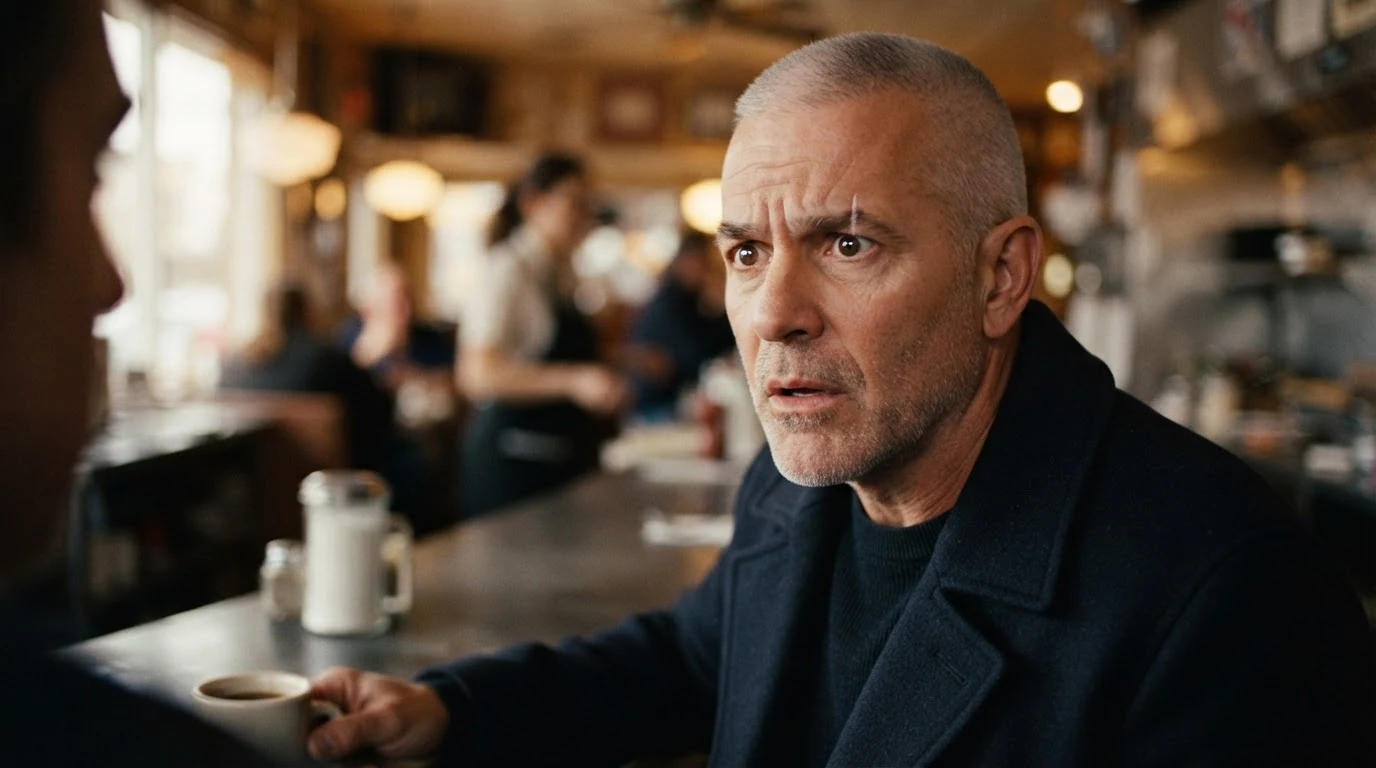
Listening to someone just off camera left and eyes fixed just left of the lens stop a portrait stare into the camera. The first second of disbelief asks for an expression in motion, not a posed emotion.
Open FlashBoardsDirty single reaction shot, 85mm lens, eye level, wide cinematic frame. Out-of-focus left foreground: the shoulder and back of the head of a person in a yellow raincoat. Sharp on the right third: a young woman with a shaved head, dark freckles and silver hoop earrings faces that person, hearing bad news: jaw tight, eyes glassy, holding back tears. Rainy night at a bus shelter, cold blue streetlight on her face.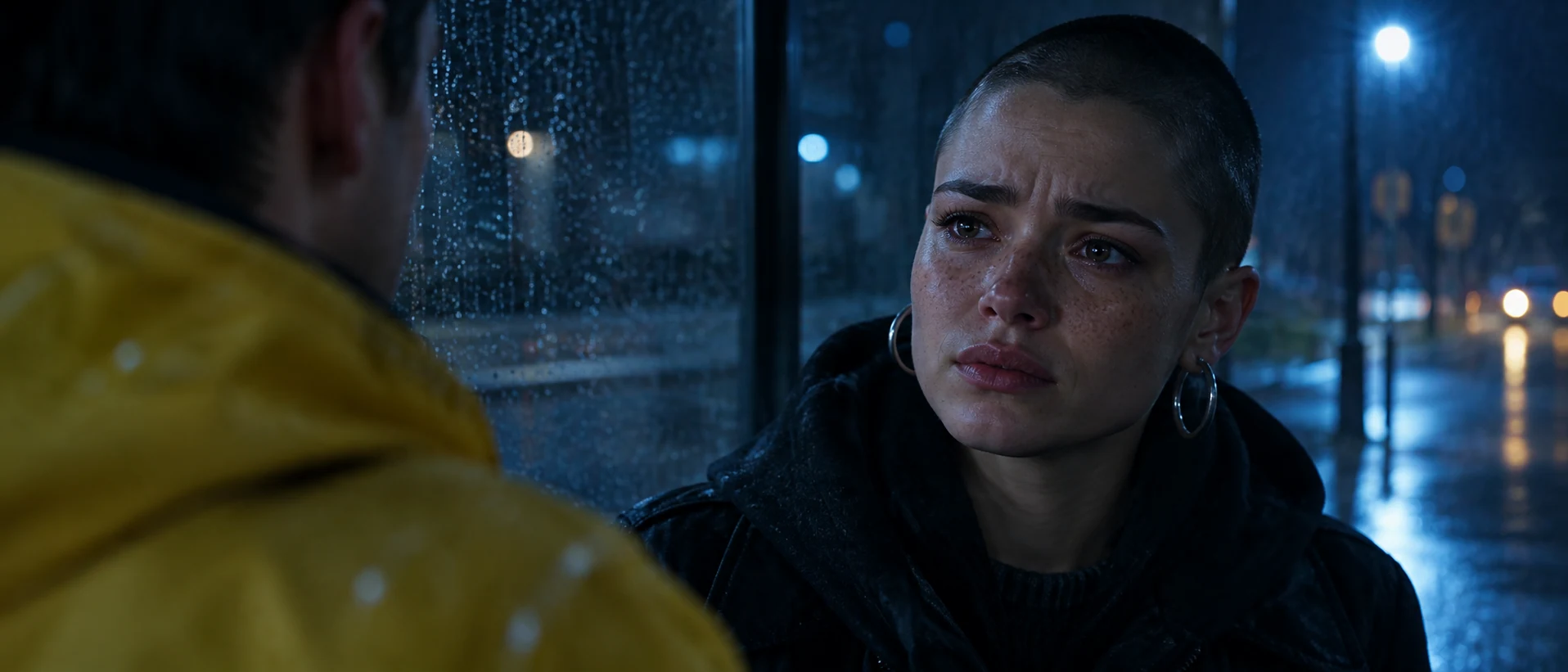
Dirty single and the blurred shoulder make the reaction part of a conversation. Hearing bad news plus three physical cues gives a specific response instead of generic sadness.
Open FlashBoardsCamera: static close-up at eye level, locked off, with a very slow push-in of a few centimeters over the whole shot. Action: he is already listening, eyes on the person just off camera left, brows rising in disbelief. In the middle he blinks, glances down at the counter and swallows. At the end he looks back up to the left, shakes his head once and lets out a short, silent laugh.Already listening and the rising brows make the shot alive from the first frame; the beginning, middle and end give the reaction a shape an editor can cut.
Open FlashBoards{
"output": "Full-screen live-action scene from True Romance (1993) from its very first frame: two shots joined by one hard cut. Anamorphic widescreen, grainy 1990s 35mm, overcast winter afternoon in a freight yard, soft flat gray daylight from above, cold desaturated palette with one saturated red hood.",
"characters": {
"S1": {
"name": "Clarence Worley, played by Christian Slater",
"look": "young man, late twenties, dark slicked-back hair, red hooded top under a dark jacket, plaid shirt collar",
"voice": "tight, cutting, holding back anger"
},
"S2": {
"name": "Cliff, played by Dennis Hopper",
"look": "man in his late fifties, lined face, dark fur-lined trapper hat with the ear flaps down, dark navy security-guard uniform jacket with a shoulder patch, light blue shirt, dark tie",
"voice": "dry, hoarse, bitter disbelief"
}
},
"shots": [
{
"shot": 1,
"camera": "locked-off, eye level, long lens, medium close-up of S1 in the left-centre of frame; the blurred dark shoulder and fur hat of S2, seen from behind, fill the right edge of frame in the foreground; behind S1 the side of a dark maroon freight car with large white stencilled letters",
"action": [
"BEGINNING: alive from the first frame, S1 is already mid-sentence, head turned three-quarters to screen right, eyes locked on S2's face just off the right edge, brow knitted, teeth showing.",
"THEN: he pushes the last words out hard, chin jutting slightly toward S2; his head and shoulders stay otherwise still.",
"END: he holds the glare on S2, mouth closing, jaw tight."
],
"dialogue": [
{
"speaker": "S1",
"on_screen": true,
"when": "from the first frame, finished before the cut",
"delivery": "clipped, accusing",
"line": "<d>[English] Because I'm your son.</d>"
}
]
},
{
"shot": 2,
"cut_at": "00:01.380",
"camera": "locked-off, eye level, long lens, reverse angle: over S1's shoulder, the back of S1's dark head and his red hood fill the left foreground out of focus; medium close-up of S2 in the centre-right of frame, sharp; behind S2 a pale gray corrugated metal wall",
"action": [
"BEGINNING: right after the cut, S2 is frozen, facing screen left toward S1, eyes wide, brows raised, mouth slightly open, stunned by what he just heard; he does not blink.",
"THEN: he answers, eyebrows lifting further in bitter disbelief, head giving one small tilt; his eyes never leave S1's face.",
"THEN: a puff of breath vapour shows in the cold air in front of his mouth; his jaw sets and he narrows his eyes a little, still staring at S1.",
"THEN: he goes on, lips pressed thin between words, head leaning a little forward toward S1.",
"END: S1 turns his head from screen right toward the camera, his blurred face swinging into the left of frame and looking down; S2, eyes wide and mouth open, keeps staring at S1."
],
"dialogue": [
{
"speaker": "S2",
"on_screen": true,
"when": "shortly after the cut, never before the cut",
"delivery": "hoarse, mocking disbelief",
"line": "<d>[English] Oh, you're my son.</d>"
},
{
"speaker": "S2",
"on_screen": true,
"when": "after the breath vapour, in the middle of the shot",
"delivery": "bitter, sarcastic",
"line": "<d>[English] Oh, you got it all worked out.</d>"
},
{
"speaker": "S2",
"on_screen": true,
"when": "as S1 turns his head toward the camera",
"delivery": "sharp jab",
"line": "<d>[English] Don't you?</d>"
},
{
"speaker": "S1",
"on_screen": true,
"when": "in the last moment, while his blurred face is turned toward the camera",
"delivery": "flat, defiant",
"line": "<d>[English] Oh, yeah.</d>"
}
]
}
],
"sound": {
"ambience": "cold wind across an open freight yard, a distant metal clank heard from far away, the rustle of jacket fabric",
"speech": "exactly these spoken phrases, each said once, in this order",
"never_spoken": "no narration and no voice-over: the descriptions, performance notes and step words of this prompt are never spoken aloud",
"music": "a film score under the scene, always below the voices: low tense strings holding one dark note with a slow pulse",
"subtitles": "none"
}
}Remakes the cut in True Romance (1993) from Clarence's line "Because I'm your son" to Cliff's stunned face, keeping the locked-off long lens, the reverse angle past the blurred red hood and the freeze-then-answer beat.
The prompt is structured JSON: each shot gets its own camera, action beats and the film's real lines, the listener is described as carefully as the speaker, and the only timing is the cut_at of the cut, so the reaction arrives exactly where the original's does.
Common mistakes
- The actor looks into the lens. State who is off camera and where the eyes point.
- A posed emotion. "Surprised man" gives a stock face; describe what they heard and the physical beats.
- The off-camera speaker appears. Say just off camera, or show only a soft shoulder.
- Video without change. Write how the expression moves from beginning to end.
Keep the reference frames, prompts and every generated take side by side — images and video in one canvas.
FAQ
5 questionsWhat is a reaction shot in film?
A reaction shot, usually a close-up of a face, shows how a character responds to a line, an action or something they see. It follows the cause in the edit, so the audience understands the moment through the listener. Surprise, fear, grief and comedy often land on the reaction rather than on the line itself.
Why are reaction shots important?
They tell the audience how to feel about what just happened: a neutral line becomes a threat or a joke depending on the face we cut to. Reactions also let editors control pace, trim dialogue and hide cuts, and they build tension by showing a response before its cause.
What is the difference between a reaction shot and a cutaway?
A cutaway leaves the main action to show something else: an object, a bystander, another place. A reaction shot is a cut away whose content is a character's response. New information about the world means cutaway; how someone feels about what just happened means reaction shot.
How do you film a good reaction shot?
Frame a close-up or medium close-up on a 50–85mm lens, place the eyeline just beside the lens toward the speaker, and keep the eyes lit. Have the other actor read lines off camera so the reaction is real, and keep rolling through pauses.
What is a reaction close-up?
A reaction close-up is the most common form of reaction shot: the listener's face framed tightly, chin to forehead or with the top of the shoulders. At that size small changes in the eyes and mouth read clearly, and that is where most of the response happens.
Related terms
4- Cutaway ShotEditing
A cutaway briefly leaves the main action for something else — a detail, a bystander, an object elsewhere — then returns, adding information, a joke or a way to hide a cut.
- Shot Reverse ShotCamera Shots
Shot reverse shot alternates between two opposing camera setups — one on each character, typically over-the-shoulder shots or singles from the same side of the axis — so a conversation plays as a rhythmic back-and-forth.
- Close-Up ShotCamera Shots
A close-up frames a subject tightly — for a person, usually the face from chin to forehead or the head with the top of the shoulders — so emotion, micro-expressions and small details dominate the screen.
- Kuleshov EffectEditing
The Kuleshov effect is the finding that viewers read the same neutral face differently depending on the shot cut next to it — food, a coffin, a child — so meaning comes from the edit, not the single shot.
Further reading
Walter Murch, In the Blink of an Eye (1995). Steven D. Katz, Film Directing Shot by Shot (1991).