 FlashBoards Learn
- Learn
- Storytelling
- Pacing
Storytelling · Film language
Pacing
Also called: narrative pacing, story pace
Pacing is how fast a story feels as it moves. The writer sets it in the script through scene length, how quickly events escalate and where the quiet moments fall; the editor fine-tunes it later. Good pacing is not speed: it is the right alternation of pressure and release, so the audience never drifts and never goes numb.
- What it does
- Controls how long the audience sits with each moment, so tension builds, releases and builds higher.
- Use it when
- Outlining, rewriting a sagging middle, or deciding which scenes to compress, cut or let breathe.
- Watch out
- Nonstop speed flattens into monotony; a slow film still needs every scene to change something.
- Try this prompt
Quiet breather after a rooftop chase, two exhausted fictional characters resting against a water tank at dusk, static wide shot, 35mm film still.
What is pacing in a story?
Pacing is the felt speed of a story: not how many minutes pass, but how quickly the audience experiences change. A four-minute argument where the power shifts three times feels fast; a four-minute scene that restates what we already know feels endless.
Writers control pace with three levers:
- Scene length. Short scenes push forward; long ones ask the audience to settle in.
- Rate of escalation. How often a new obstacle or reversal arrives, and how much the stakes rise each time. This is the engine of the rising action.
- Placement of quiet moments. Breathers, jokes and reflective beats that let tension drain before it climbs again.
Pacing sits on top of story structure: structure decides which events happen and in what order, pacing decides how much time and weight each one gets.
How is pacing controlled on the page?
A screenplay page runs roughly a minute of screen time, so the page itself is a pacing tool:
- Enter late, leave early. Start after the greetings, cut out before the goodbyes.
- Count the beats. A scene with no story beat where something shifts is a pacing leak.
- Vary scene length on purpose. A run of half-page scenes feels urgent; a five-page scene after them lands as a deliberate stop.
- Dose the exposition. Information delivered while characters want something moves; a lecture stops the story.
- Cut away with a subplot to leave a tense thread hanging or give the audience a rest without losing momentum.
When a draft sags in the middle, the usual fix is a midpoint reversal or merging two scenes that deliver the same beat.
Fast vs. slow pacing: when to use each
The pace should match what the story asks the audience to feel.
Fast pacing suits thrillers and chases. The Bourne Identity (2002) keeps its amnesiac hero reacting: each answer opens a new threat, so the story rarely pauses to reflect.
Slow pacing builds dread, intimacy or a state of mind. Taxi Driver (1976) drifts through Travis Bickle's nights, and the slowness makes his isolation feel lived in until violence breaks the pattern. Before Sunset (2004) plays out close to real time; little happens in plot terms, yet the conversation escalates and Jesse's flight keeps a clock on every scene.
Controlled delay mixes both. Jurassic Park (1993) builds the T. rex attack slowly, from the tour stalling in the rain to the rippling cup of water, so the release hits harder.
Tension and release: pacing across the whole story
Across a feature, good pacing works like breathing. Set pieces rise in intensity, and each is followed by a valley where characters and audience absorb what happened. In a three-act structure the valleys usually shrink as the climax approaches.
The Lord of the Rings: The Fellowship of the Ring (2001) sets a long council scene in Rivendell between flights and battles, letting the story reset its goal. The Return of the King (2003) shows the opposite risk: it is often criticized for ending several times over.
In FlashBoards, lay the story out left to right as a pace map: one frame or note card per scene, set pieces placed high and breathers low, page count on each card. A long run of same-height cards flags a monotonous stretch before anyone reads the draft.
Story pacing vs. pacing in film editing
Story pacing is decided in the script: which events exist, in what order, and how much space each gets. Pacing in film is what the viewer experiences, shaped in the edit by shot length and how long a moment is held. Editing can tighten a scene with fast cutting or compress weeks into a montage, but it rarely rescues twenty pages where nothing escalates. Fix the story pace first; the cut refines it. More devices are in the storytelling hub.
How to create a pacing with AI
4 promptsPacing lives in a sequence, not a single frame, so direct it as beats: a peak, a breather, and the durations between them. In FlashBoards, generate the breather next to the set piece it follows and arrange the beat strip on the board to read the rhythm at a glance. The fourth prompt re-shoots a real film shot from a text description alone, and the original plays next to the result so you can compare.
Quiet aftermath of a rooftop chase at blue hour. A courier in her late twenties with a shaved head, a small gold hoop in her left eyebrow and a torn orange windbreaker sits against a rusted water tank, catching her breath. Beside her a lanky man in his forties with a grey ponytail and round wire glasses rests his head back, eyes closed. A dropped canvas backpack lies between them on the gravel roof. Static wide shot, 35mm lens, eye level, large empty dusk sky, cool blue light, one warm window glow below. Cinematic film still, film grain.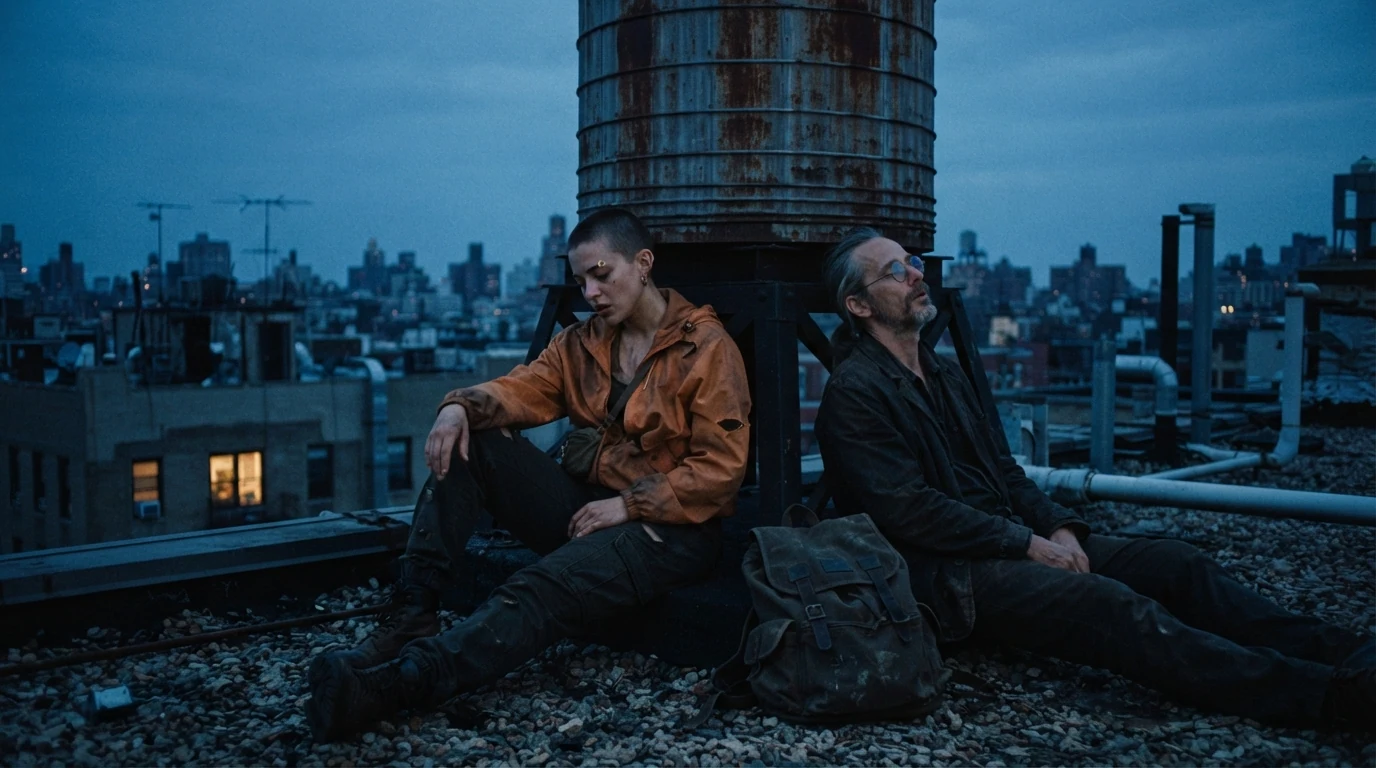
"Quiet aftermath" and "catching her breath" place the frame in a valley right after a peak; the static wide with empty sky gives the beat room to breathe. Start frame for the video.
Open FlashBoardsA storyboard pacing strip: six numbered panels in one row, graphite pencil and grey wash on off-white paper. The same courier in every panel, a woman with a shaved head and a torn orange windbreaker. Panels 1 to 3: tight, tilted action close-ups in a crowded night market (a blurred bicycle wheel, her hand on a handlebar, her face shouting). Panel 4: a wide, calm shot of her alone on an empty rooftop at dusk. Panel 5: medium shot, she reads a phone. Panel 6: extreme close-up of her eyes widening. Under each panel a handwritten duration: 1s, 1s, 2s, 8s, 4s, 2s.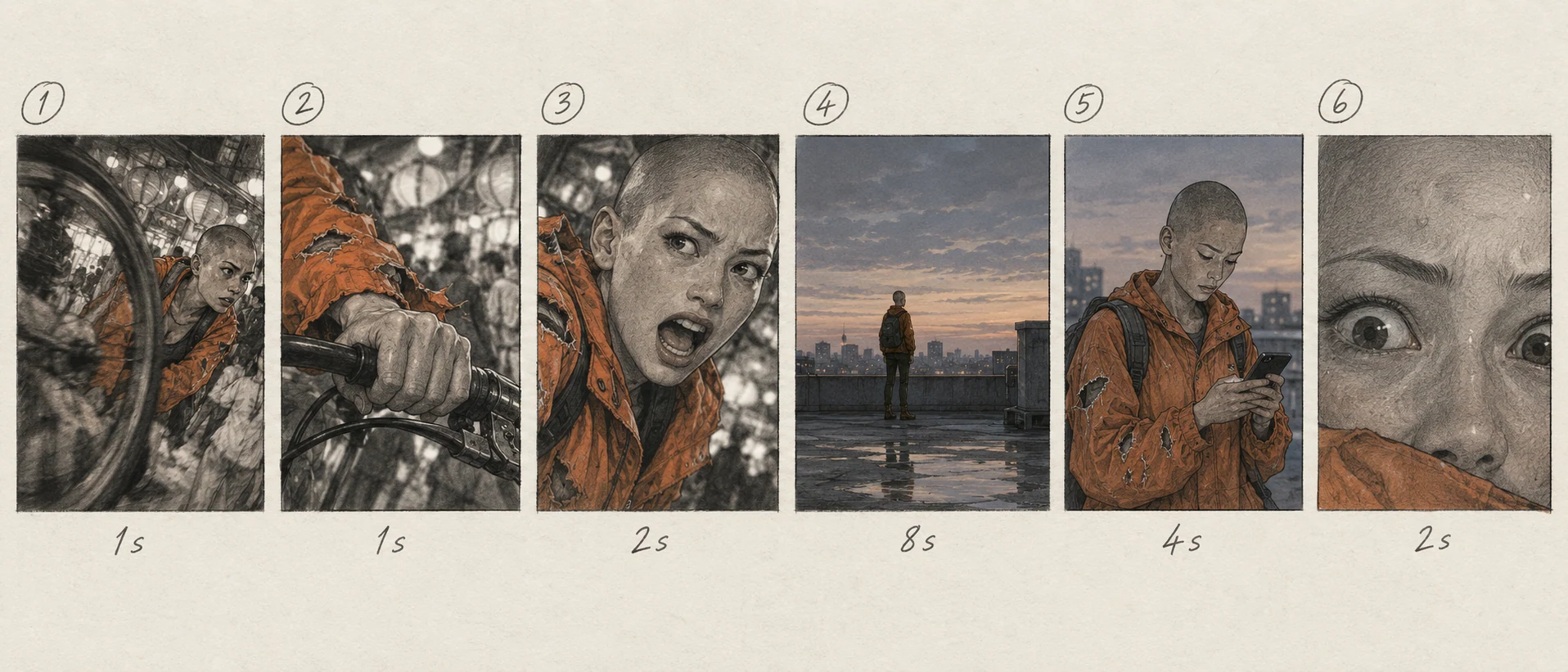
This take produces the planning artifact: the handwritten durations and the jump from tight close-ups to one wide panel make the pace visible. The 21:9 strip reads like a timeline.
Open FlashBoardsCamera: static, locked-off wide shot that holds for the whole clip. Action: from the first frame the courier's chest rises and falls fast and her windbreaker flaps in the wind. Her breathing slowly settles and she wipes her forehead with her sleeve. The man with the grey ponytail opens his eyes and turns his head toward her. She lets out a short laugh and leans back against the water tank.Fast breathing and the flapping jacket keep the shot alive from the first frame; the locked-off camera stops the model adding drama. The beat moves from exhaustion to relief.
Open FlashBoards{
"output": "Full-screen live-action scene from The Lord of the Rings: The Fellowship of the Ring (2001), from its very first frame: one continuous shot, no cuts. Early-2000s 35mm anamorphic scope film, soft grain; an open-air elven council courtyard in Rivendell in autumn: carved pale stone arches and a dark arched doorway behind the ring of chairs, golden autumn leaves on the branches overhead, warm late-afternoon light falling from upper left, the right side in soft brown shade; amber, gold, brown and deep wine-red palette.",
"characters": {
"S1": {
"name": "Elrond, played by Hugo Weaving",
"look": "tall elf lord standing, long straight dark hair, a thin silver circlet across his brow, floor-length dark wine-red velvet robe trimmed with fur, long sleeves hiding his hands; seen three-quarters from behind, face mostly turned away from camera",
"voice": "deep, grave, measured, carrying across the silent circle"
},
"S2": {
"name": "Legolas, played by Orlando Bloom",
"look": "young elf with long straight pale-blond hair and small braids at the temples, grey-green tunic; seated among the fair-haired elves on the far-left curve of the ring, small in the frame, profile turned toward the centre",
"voice": "silence"
},
"CROWD": {
"name": "the council",
"look": "about twenty people seated in carved wooden chairs around the ring: fair-haired elves in grey-green robes on the far-left curve; an old wizard with long grey hair and grey robes in the left foreground, back to camera, a tall gnarled wooden staff held upright in his right hand; a small curly-haired hobbit in a brown jacket in the chair beside him, back to camera; dwarves with thick braided beards, one bright red-orange, in mail and fur in the back row left of centre; a white-bearded old man, a dark-haired warrior in a leather and dark velvet doublet and a long-haired bearded lord in a black robe with a pale stole in the back row centre; a bearded man in a dark green robe behind S1; a dark-haired elf standing at the far right beside a tall carved chair; a dark-haired man in a dark cloak seated in the right foreground, back to camera",
"voice": "silence"
}
},
"shots": [
{
"shot": 1,
"camera": "static locked-off extreme wide shot from the edge of the courtyard, slightly above eye level, wide lens, deep focus; a dark stone statue of a robed woman holding up a round dish fills the left edge of the frame in the foreground; a massive dark tree trunk and a pale carved wooden arch curve down the right edge; the ring of chairs sweeps across the middle of the frame around a paved floor with a round golden sunburst mosaic, a carved stone pedestal right of centre; no camera movement, the same framing to the end",
"action": [
"BEGINNING: alive from the first frame, the whole council already seated in the ring, everyone facing the centre; S1 stands right of centre in front of his tall carved chair, mid-ground, back three-quarters to camera, head turned toward the left side of the ring where the dwarves and the men sit; the dark-cloaked man sits in the right foreground just in front of S1, back to camera, facing him.",
"THEN: S1 begins to speak to the circle, head held high toward the left side of the ring, both arms hanging at his sides inside the long sleeves, his robe hanging still.",
"THEN: the listeners stay motionless while he speaks: no nods, no turning heads, hands resting on knees and chair arms, the wizard's staff upright in his right hand, the hobbit's head turned toward S1.",
"THEN: still speaking, S1 slowly turns his head from screen left to screen right, sweeping his gaze along the ring to the men seated at his own side and the elf standing at the right edge.",
"END: S1 finishes the line looking toward the right side of the ring; everyone else is still motionless, the light unchanged, the frame unchanged."
],
"dialogue": [
{
"speaker": "S1",
"on_screen": true,
"when": "just after the first frame, while he faces the left side of the ring, ending as his head turns to the right",
"delivery": "grave, slow, every word weighed, no raised voice",
"line": "<d>[English] Middle-earth stands upon the brink of destruction. None can escape it.</d>"
}
]
}
],
"sound": {
"ambience": "a hushed open-air courtyard: a faint breeze in the leaves, distant birdsong heard from far off, the soft rustle of a robe",
"speech": "exactly these spoken phrases, each said once, in this order; nobody else says a word",
"never_spoken": "no narration and no voice-over: the descriptions, performance notes and step words of this prompt are never spoken aloud",
"music": "a film score under the scene, always below the voices: low, solemn sustained strings with a faint ominous choir hum and a slow pulse",
"subtitles": "none"
}
}Remakes the static wide of the Council of Elrond from The Lord of the Rings: The Fellowship of the Ring (2001), dir. Peter Jackson, DP Andrew Lesnie, carrying over Elrond's corpus line, the still ring of listeners, his head turn from left to right and a quiet score.
This is the Rivendell breather the article cites: after the chases, one static locked-off extreme wide and one voice. The JSON pins Elrond's exact line, spells out that the listeners stay motionless, and keeps a single event, his slow head turn from left to right, so the scene rests instead of racing.
Open FlashBoardsCommon mistakes
- Models make every frame a peak. For a breather, name the state ("catching her breath", "eyes closed") and ask for a static wide with empty space.
- In video, a quiet shot turns into a slow push-in. Write "static, locked-off" and give the characters small physical actions.
- One image cannot show pace: generate peak and valley as separate beats and order them on the board with durations.
Keep the reference frames, prompts and every generated take side by side — images and video in one canvas.
FAQ
4 questionsWhat is pacing in writing?
Pacing in writing is the speed at which a story feels like it moves. Writers control it through the length of scenes and chapters, how often new complications arrive, how much exposition slows the reader, and where quiet moments let tension drop. Good pacing alternates pressure and release.
What is pacing in film?
In film, pacing is how fast the movie feels to the viewer. It starts in the screenplay, with scene lengths, escalation and breathers, and is refined in the edit through shot length and how long moments are held. A slow film can still be well paced if every scene changes something.
How do you speed up the pacing of a story?
Enter scenes later and leave them earlier, cut scenes that repeat a beat, and make sure each scene turns the situation. Deliver exposition inside conflict rather than as explanation, shorten action lines, and move reversals closer together.
How do you slow down pacing without boring the audience?
Slow the plot, not the change. Let a scene run long but keep something shifting inside it: a relationship, a power balance, a growing dread. Place slow scenes right after a peak, where the audience wants to absorb what happened, and give them a clear question or ticking clock.
Related terms
4- Pacing in FilmEditing
Pacing is how fast a film feels to the viewer — set by shot length, how much happens per scene and how long the edit lets moments breathe.
- Rising ActionStorytelling
Rising action is the chain of complications between the inciting incident and the climax, where obstacles pile up and stakes rise.
- SubplotStorytelling
A subplot is a secondary storyline — often a relationship or a side character's goal — that runs alongside the main plot and comments on its theme.
- Story StructureStorytelling
Story structure is the order and shape of the events that carry a story from setup to resolution; models like the three-act structure, Freytag's pyramid, the hero's journey or Save the Cat are different maps of it.
Further reading
Robert McKee, Story (1997), on scene design and progression. Syd Field, Screenplay (1979), on page count and structure.