 FlashBoards Learn
- Learn
- Storytelling
- Suspense
Storytelling · Film language
Suspense
Also called: suspense technique, tension
Suspense is the tension of waiting for something the audience knows or fears is coming. Hitchcock's example says it all: show a bomb under a table, and two people chatting about baseball becomes unbearable. Suspense comes from information the viewer holds, stakes they care about and a delay the film makes them sit through.
- What it does
- Turns the viewer's knowledge into dread, so even a quiet scene feels dangerous.
- Use it when
- The audience can see a threat coming and the story can afford to make them wait for it.
- Watch out
- Suspense dies if the stakes are unclear or the wait runs past the point where the threat still feels real.
- Try this prompt
Floor-level shot under a café table, a brown paper parcel with an alarm clock taped to it in sharp focus, two diners' legs relaxed behind it, warm window light, 16:9
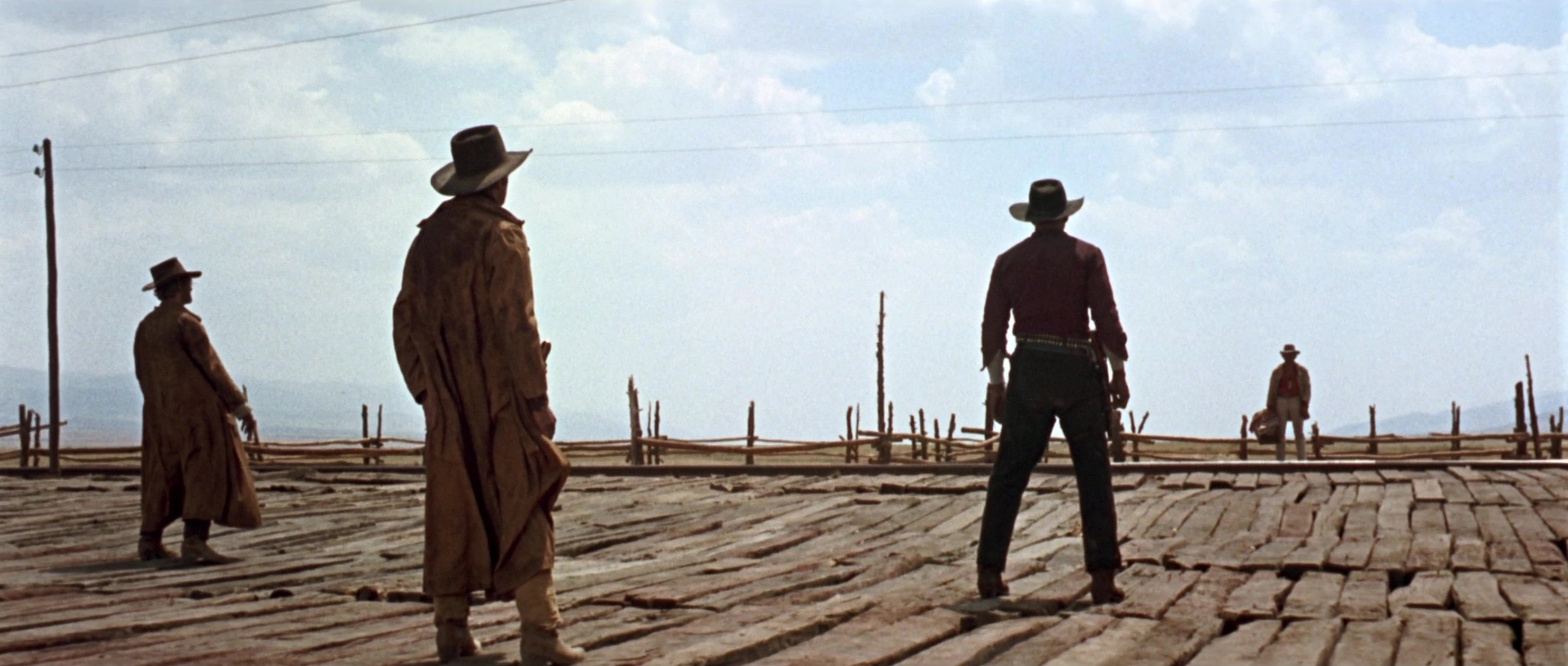
What is suspense in film?
Suspense is anticipation: the viewer knows or fears what might happen and has to wait for the answer. It is one of the core narrative techniques, and it works on an audience that is ahead of the story.
It needs three things. Information: the audience sees the danger. Stakes: someone they care about can lose something. Time: the film stretches the gap between knowing and finding out. Remove one and the scene goes flat.
That is why suspense so often rides on dramatic irony: we know what the character doesn't, so every ordinary gesture looks like a mistake.
Suspense vs. surprise: Hitchcock's bomb under the table
In Hitchcock/Truffaut (1966), Hitchcock put it this way: two people talk at a table and a bomb under it goes off. That buys a few seconds of shock. Show the bomb first, with a clock on the wall, and the same small talk becomes fifteen minutes of agony, because the viewer wants to warn them and can't.
- Surprise withholds information and pays off in a moment.
- Suspense gives it away early and pays off across the whole scene.
A plot twist is the surprise side of that trade: it hides a fact so the reveal can recolor the story. Hitchcock later called the bus bomb in Sabotage (1936) a mistake: the audience got the wait but no release.
The elements of suspense, with examples
A visible threat. Touch of Evil (1958) opens with a bomb placed in a car trunk, then follows the car through a border town in one long take.
The audience knows more. Inglourious Basterds (2009) sinks the camera below the floorboards to show the family hidden under the farmhouse during the interrogation. Parasite (2019) puts its family under a living-room table a few feet from the homeowners.
A clock. The Ring (2002) gives its heroine seven days.
A threat that builds. In The Birds (1963) crows gather on the jungle gym behind a woman waiting outside a school.
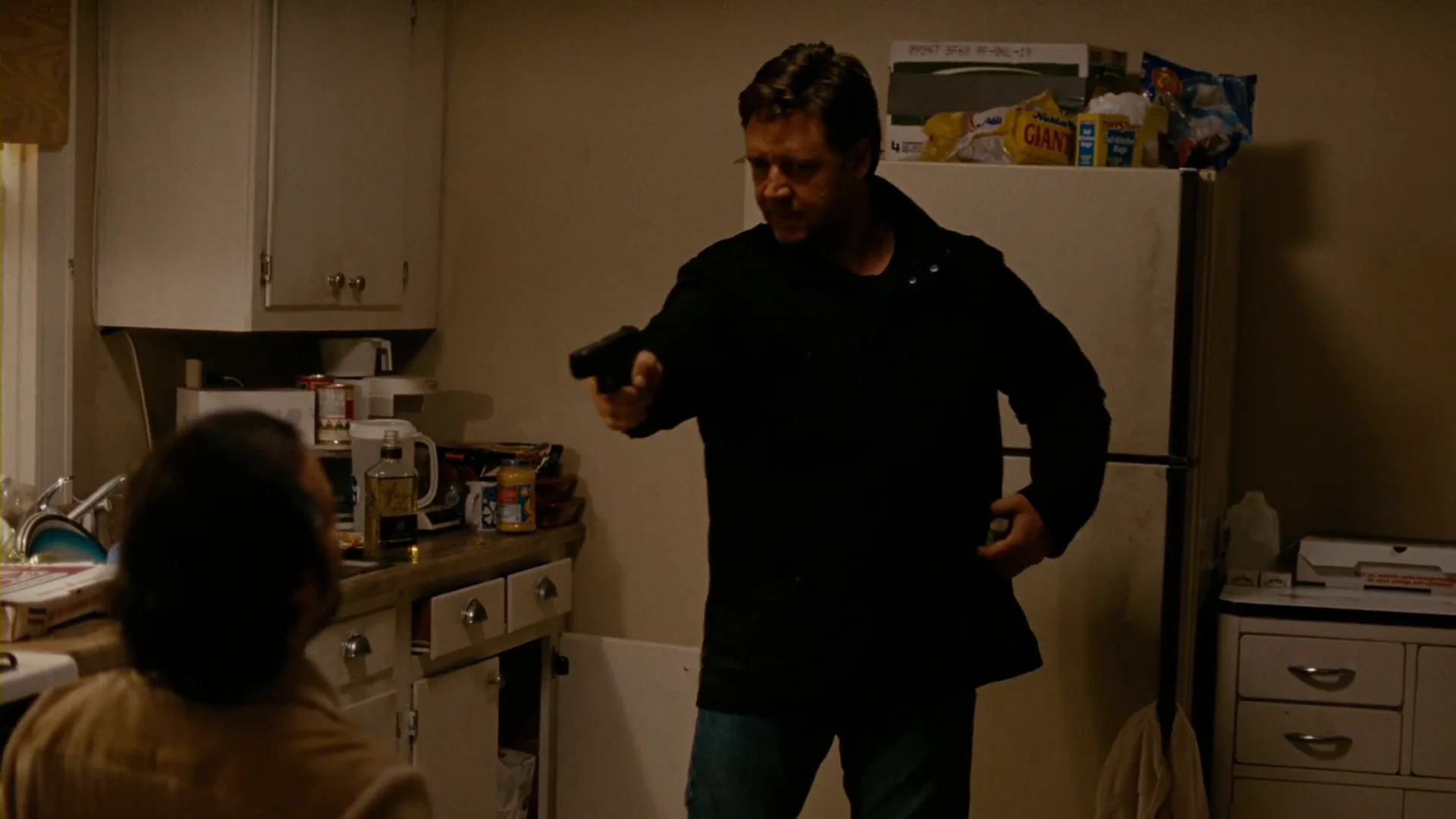
Silence. No Country for Old Men (2007) builds its motel standoff from a beeping transponder and a shadow under a door, with almost no score.
Setups like these are planted early, which is where suspense meets foreshadowing.
How to create suspense in a scene
Show the threat clearly. Give it its own insert shot: the timer, the gun, the figure in the doorway.
Put threat and victim in one frame. Deep focus or a wide lens lets the viewer's eye travel between them. Keep the characters relaxed; if they look scared, it becomes ordinary peril.
Stretch time in the edit. Suspense is a pacing decision: hold shots longer than the action needs, add small inserts, or use cross-cutting between the danger and the unaware victim.
Take sound away. Drop the score, let one repeating sound carry the scene, then cut it hard at the payoff.
Pay off honestly by the rules you set.
In FlashBoards, lay the setup, build and payoff frames side by side on one board with a note on who knows what at each beat, so you see where the information gap opens and closes.
Suspense examples in film
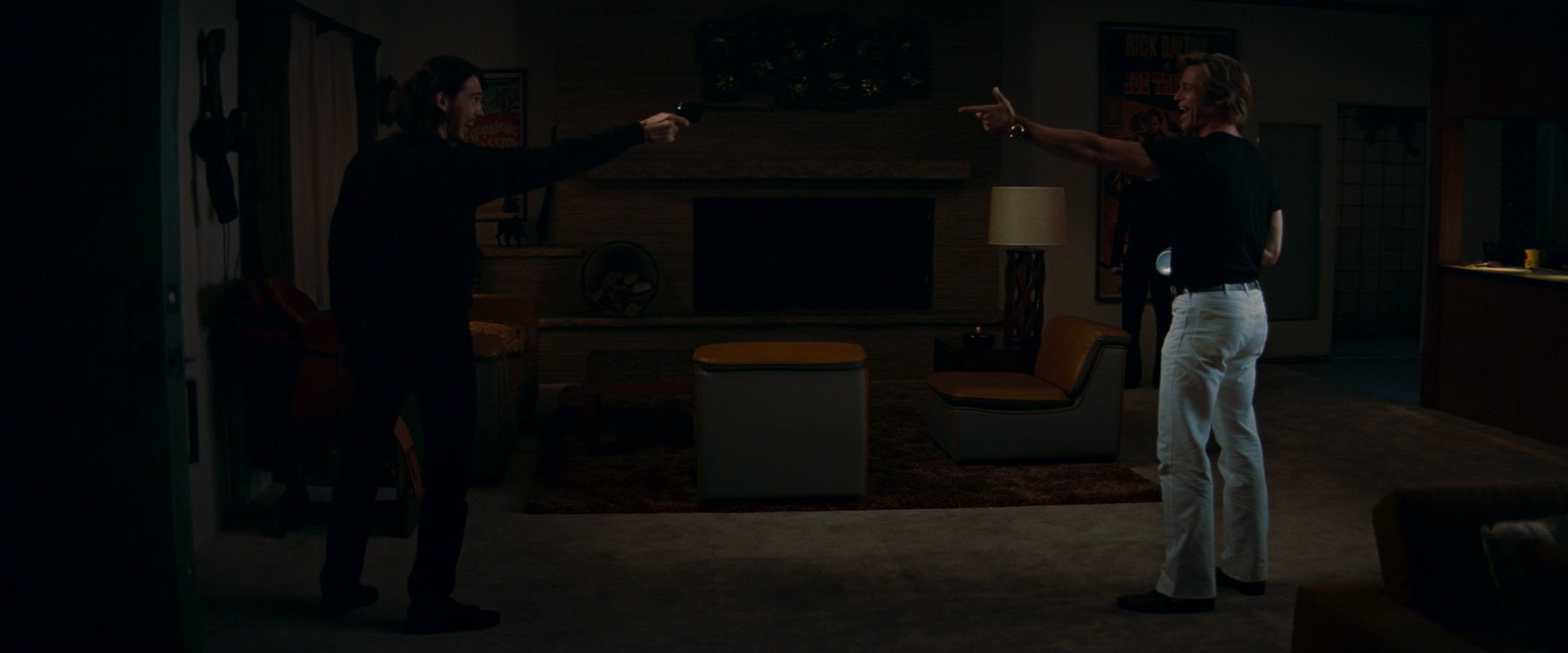
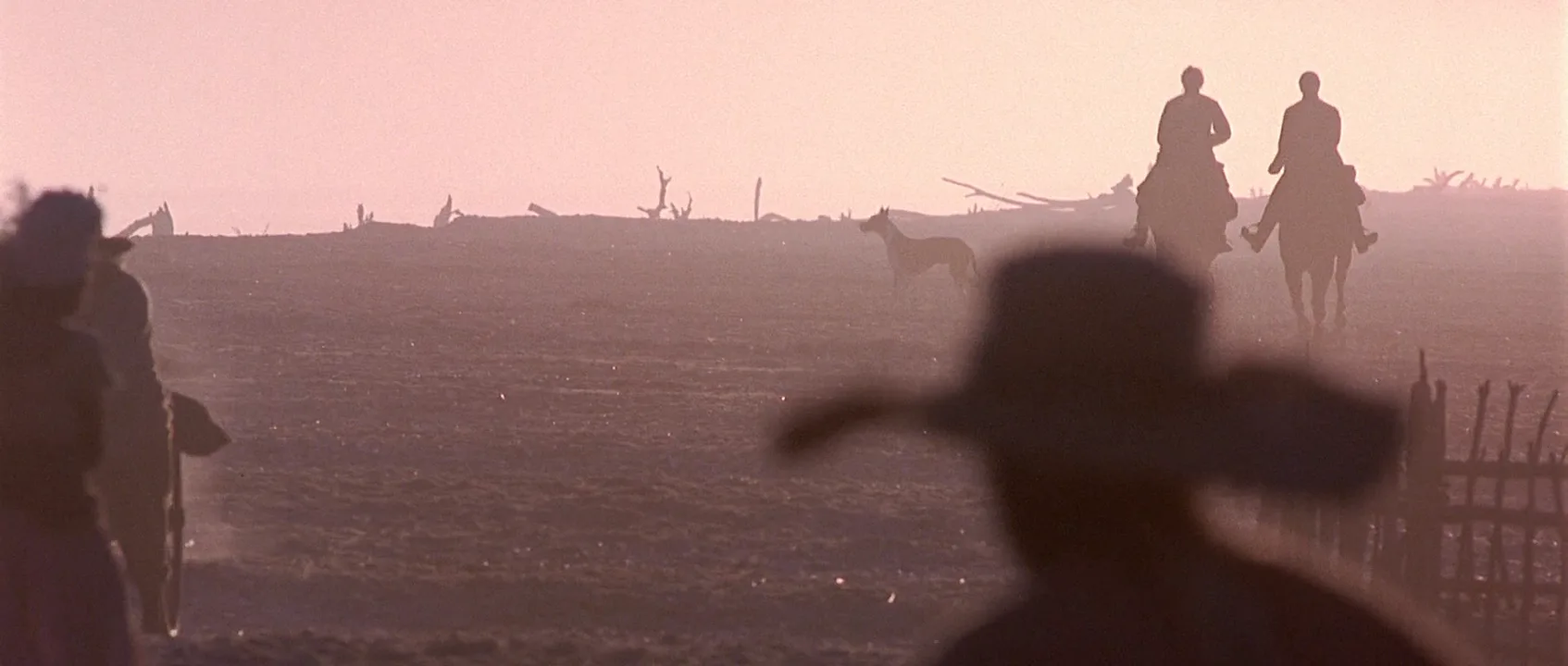
5 framesThreat and waiting person share the frame; the answer stays off screen.
How to create a suspense with AI
4 promptsSuspense fits in one shot when the frame holds both the threat and the people who don't know about it. Build the setup frame, try a second staging, then animate the wait; compare takes on one FlashBoards board beside your beat notes. The fourth prompt re-shoots a real film shot from a text description alone, and the original plays next to the result so you can compare.
Floor-level shot under a small café table in a 1970s diner: a brown paper parcel with a wind-up alarm clock taped to it sits on the checkered floor in sharp focus in the foreground; behind it, soft focus, the relaxed legs of two diners, a man in corduroy trousers and scuffed brown boots, a woman in a green dress and red flats with ankles crossed; warm window light, 35mm lens, cinematic still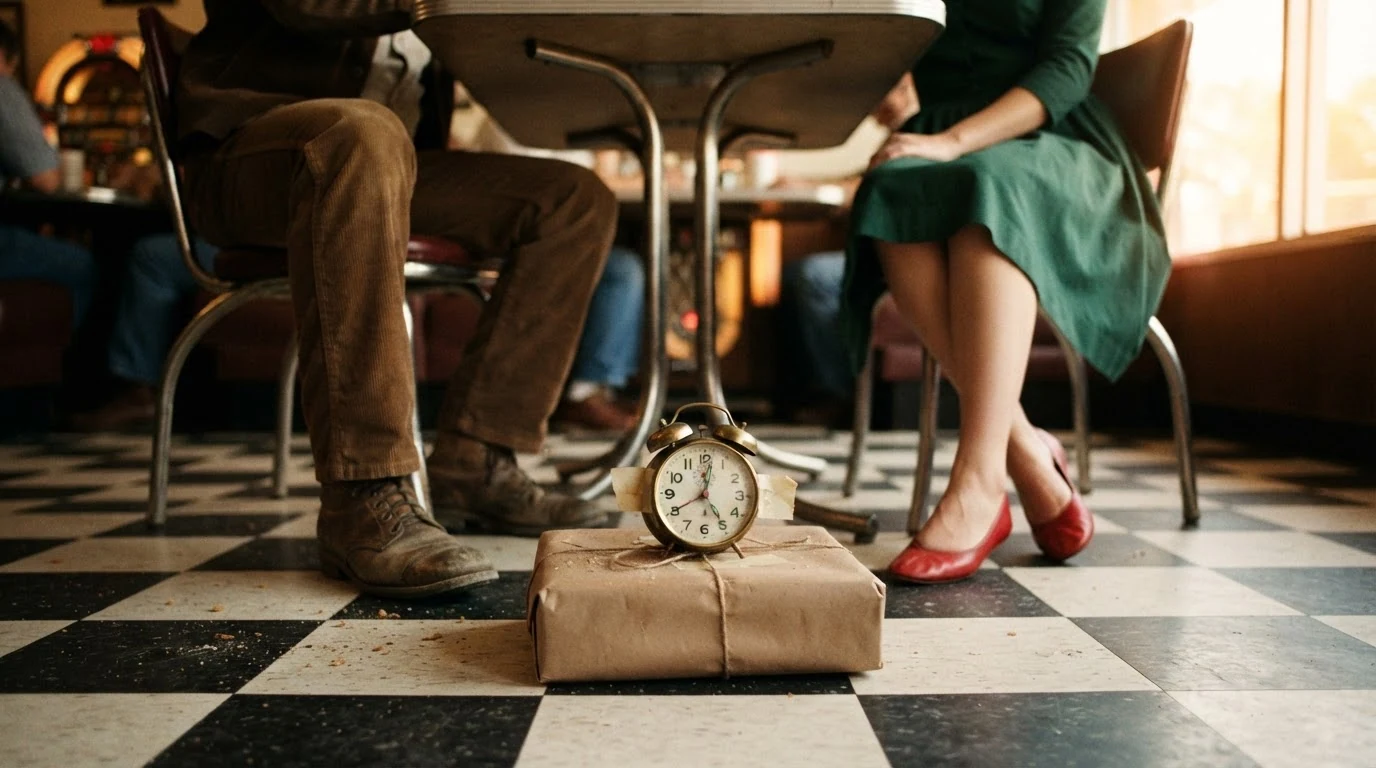
Hitchcock's bomb as one image. Floor-level and sharp focus in the foreground make the parcel read first, relaxed legs show the diners don't know, and the alarm clock gives a countdown without on-screen digits, which models garble.
Open FlashBoardsWide night interior of a farmhouse kitchen, deep focus, locked-off camera: in the right foreground a young woman with short bleached hair and a silver hoop earring calmly washes dishes, facing the dark window; on the left, through an open doorway, a tall figure in a dark raincoat stands motionless in the unlit hallway, watching her; single bare bulb over the sink, cold blue moonlight in the hall, 27mm lens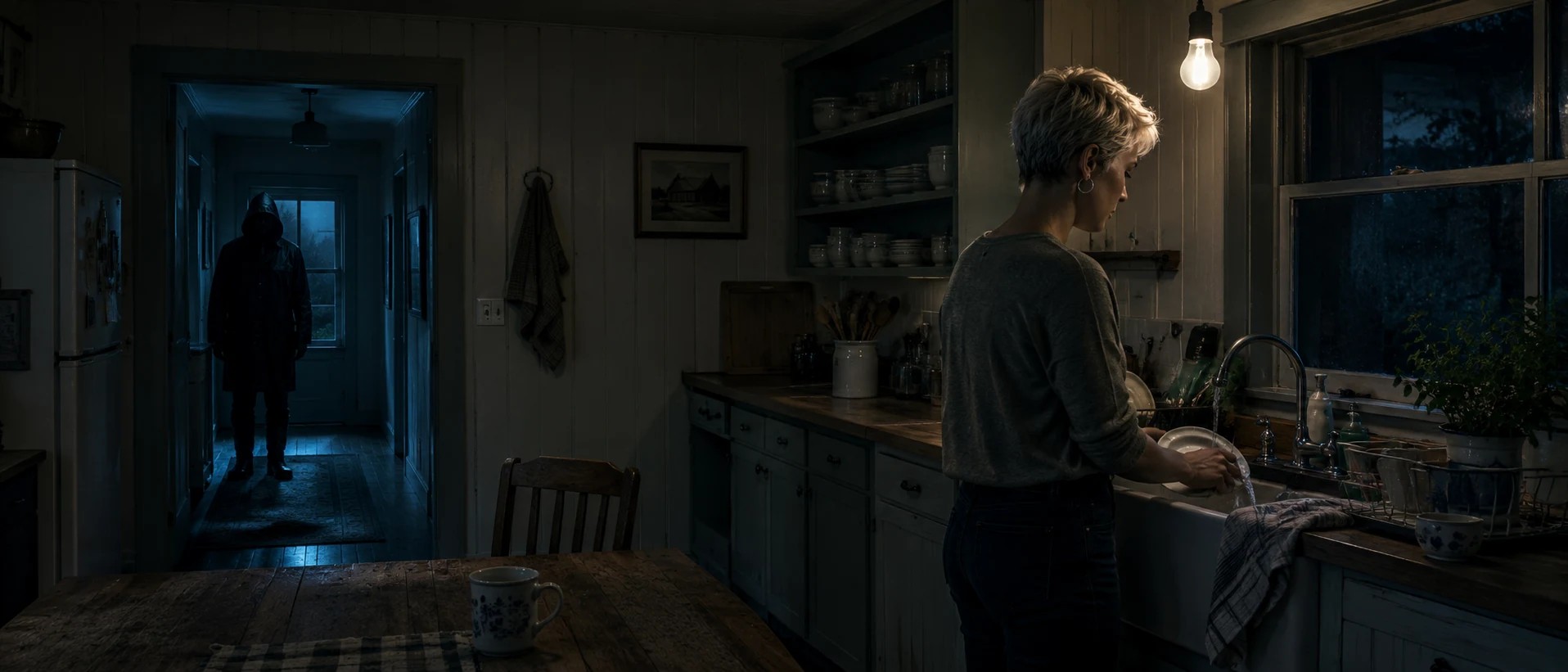
Threat and victim in one frame. Deep focus keeps both sharp, calmly and facing the dark window keep her unaware, and warm bulb against cold hallway separates her space from the threat's.
Open FlashBoardsCamera: a very slow push in along the floor toward the parcel, starting at once and moving steadily for the whole shot, ending close on the alarm clock. Action: The clock's second hand sweeps around the dial from the first frame while the man's boot taps and the woman swings her crossed foot. Midway his boot slides back and stops a few inches from the parcel. The parcel stays still on the floor, the second hand keeps moving, and the tapping starts again.The second hand and tapping boot make the shot alive from the first frame. The very slow push in stretches time, and the boot stopping near the parcel is a near miss that resolves nothing.
Open FlashBoards{
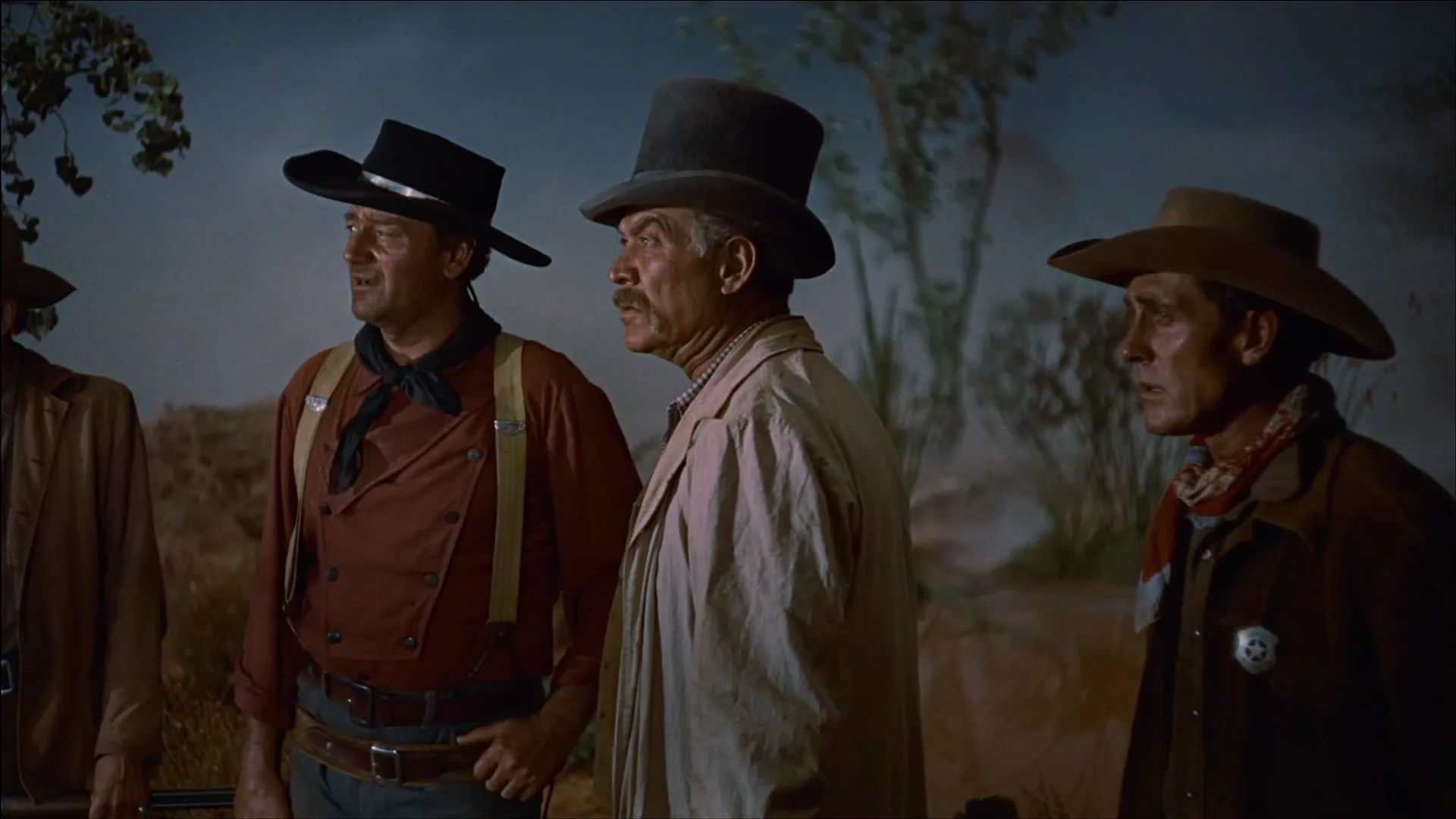
"output": "Full-screen live-action scene from The Searchers (1956), from its very first frame: one single continuous shot. 1956 Technicolor VistaVision look, rich saturated reds and browns, fine film grain; a dim studio prairie after sundown: a dark slate-blue painted sky with only a faint pale glow low on the horizon, thin bare trees behind the men, a leafy branch in the top-left corner, dry grass and red earth sinking into shadow; low-key light, a warm low key from the front left on the faces against the dark blue sky, deep shadows, a dark and uneasy image.",
"characters": {
"S1": {
"name": "Ethan Edwards, played by John Wayne",
"look": "big broad-shouldered man in his late forties, black wide-brimmed flat-crowned hat with a silver band, rust-red double-breasted bib-front shirt with two rows of buttons, black neckerchief, cream suspenders, heavy brown gun belt",
"voice": "slow, dry, low drawl"
},
"S2": {
"name": "Rev. Capt. Samuel Johnston Clayton, played by Ward Bond",
"look": "heavy-set older man, gray walrus moustache, tall dusty gray top hat, long cream linen duster coat over a checked shirt",
"voice": "silent in this shot"
},
"S3": {
"name": "Charlie McCorry, played by Ken Curtis",
"look": "lean man with a long face, tan wide-brimmed cowboy hat, red patterned bandana, dark brown jacket with a silver star badge on the chest",
"voice": "silent in this shot"
}
},
"shots": [
{
"shot": 1,
"camera": "locked-off static camera at eye level, 40mm lens, tight medium three-shot, hat crowns close to the top edge of frame, bodies cut at the upper thigh; S1 stands left of center, S2 in the center just beside him, S3 at frame right, all three facing frame right; the brown coat of a fourth rider is cut by the left frame edge; the framing stays exactly the same to the end",
"action": [
"BEGINNING: alive from the first frame, S1 stands with his head bowed, the hat brim hiding his eyes, looking at the ground; S2 has his back to the camera, head bowed; S3 already stares off past frame right, motionless, lips parted.",
"THEN: S2 turns around to his left until he faces frame right and lifts his head; S1 raises his head and looks far off past frame right, eyes narrowed.",
"THEN: S1 rests his left hand on his gun belt and speaks toward the horizon with a grim, set face, lips tight between words, eyes fixed on the far distance past frame right, his head held three-quarters toward frame right; S2 and S3 stand frozen, staring the same way past frame right, faces tense, waiting.",
"THEN: a short still pause; only the grass stirs, all three keep their eyes on the empty horizon past frame right.",
"END: S1 turns his face toward the camera and cuts his eyes sideways to S2 with a hard, sardonic look, mouth still grim, hand still on his belt; S2 turns his head toward S1 and meets his eyes without a word; S3 never moves, still staring off past frame right."
],
"dialogue": [
{
"speaker": "S1",
"on_screen": true,
"when": "from the first frame, while his head is still bowed",
"delivery": "flat, grim",
"line": "<d>[English] Well, they was here.</d>"
},
{
"speaker": "S1",
"on_screen": true,
"when": "as he raises his head and looks out",
"delivery": "low, certain",
"line": "<d>[English] Sure. They was here.</d>"
},
{
"speaker": "S1",
"on_screen": true,
"when": "while he stares at the horizon, with a pause in the middle",
"delivery": "slow, quiet, ominous",
"line": "<d>[English] And now they're out there... Waitin' to jump us.</d>"
},
{
"speaker": "S1",
"on_screen": true,
"when": "right after he turns his eyes to S2, near the end of the shot",
"delivery": "dry, cutting, unsmiling",
"line": "<d>[English] Any more orders, \"Captain\"?</d>"
}
]
}
],
"sound": {
"ambience": "a dry prairie wind in the grass, a horse snorting and shifting its hooves off screen, the creak of saddle leather",
"speech": "exactly these spoken phrases, each said once, in this order",
"never_spoken": "no narration and no voice-over: the descriptions, performance notes and step words of this prompt are never spoken aloud",
"music": "a film score under the scene, always below the voices: low sustained strings with a slow, uneasy pulse",
"subtitles": "none"
}
}Remakes the static three-shot of Ethan, Clayton and Charlie McCorry from The Searchers (1956), dir. John Ford, DP Winton Hoch: bowed heads lifting to the horizon, Ethan's four lines word for word, the frozen wait and his sidelong look at the Captain.
The threat never appears on screen. The camera field locks a three-shot with every face turned past frame right, Ethan's lines say what waits out there, and the short still pause in action makes the viewer search the empty horizon with the men. Grim, set face and unsmiling stop the model from playing the lines as banter.
Common mistakes
- Scared faces. Models make everyone look afraid. Suspense needs unaware characters: write relaxed, calm, facing away.
- The threat gets lost. Name its position and focus: sharp focus in the foreground, in the doorway on the left.
- Horror clichés. Sinister or creepy pull in fog and red light; describe ordinary light instead.
- Resolved videos. End the prompt on the ongoing wait, not the attack.
Keep the reference frames, prompts and every generated take side by side — images and video in one canvas.
FAQ
4 questionsWhat is suspense in film?
Suspense is the tension of waiting for something the viewer knows or fears is about to happen. It needs information about a threat, a character with something to lose, and a delayed outcome, as in Hitchcock's bomb under a table: once we see it, small talk becomes agonizing.
What is the difference between suspense and surprise, according to Hitchcock?
Surprise hides information: an unseen bomb explodes and the audience gets a few seconds of shock. Suspense reveals it: the audience sees the bomb and the clock and spends the whole scene waiting. Hitchcock preferred suspense because it holds the viewer for minutes instead of seconds.
How do you create suspense in a scene?
Show the threat before the characters know about it, keep them relaxed, and put threat and victim in one frame or cross-cut between them. Stretch time with longer shots and small inserts, strip the score back, and release the tension with a payoff that follows your own rules.
Is suspense the same as tension?
Not quite. Tension is any strain in a scene, from an argument to an awkward silence. Suspense is tension built on anticipation of an outcome the audience can foresee. Every suspense scene is tense, but not every tense scene is suspense.
Related terms
7- Plot TwistStorytelling
A plot twist is a revelation that overturns what the audience believed about the story or a character; a good one is prepared by fair clues and recolors everything seen before.
- Dramatic IronyStorytelling
Dramatic irony is when the audience knows something a character doesn't — the bomb under the table, the killer in the house — turning every line and choice into suspense.
- Cross-CuttingEditing
Cross-cutting alternates between two or more lines of action happening in different places, usually at the same time, so each strand builds tension or meaning against the other.
- ForeshadowingStorytelling
Foreshadowing plants hints — an object, a line, an image — that prepare the audience for what comes later, so the payoff feels both surprising and inevitable. Chekhov's gun is its strictest form.
- CliffhangerStorytelling
A cliffhanger ends an episode, act or film at a moment of unresolved danger or revelation, so the audience has to come back to find out what happens.
- Horror FilmGenres
Horror is the genre designed to frighten — through threat, the uncanny and the grotesque — and it relies on darkness, negative space, sound and withheld information as much as on monsters.
- Pacing in FilmEditing
Pacing is how fast a film feels to the viewer — set by shot length, how much happens per scene and how long the edit lets moments breathe.
Further reading
François Truffaut, Hitchcock/Truffaut (1966). Noël Carroll, 'Toward a Theory of Film Suspense' (1984), in Theorizing the Moving Image.