 FlashBoards Learn
- Learn
- Filmmaking Process & Crew
- Mood Board
Filmmaking Process & Crew · Film language
Mood Board
Also called: moodboard, mood board for film, inspiration board, visual reference board
A mood board is a loose collage of images, colors, textures and film frames that captures the emotional tone of a project before its look is locked. It is the first visual conversation of pre-production: fast, unpolished and open, it gives the director, DP and designers a shared feeling to argue about and refine.
- What it does
- Turns a vague feeling about a film into pictures the whole team can point at.
- Use it when
- Before the lookbook, storyboard or any AI generation, while the look is still open.
- Watch out
- Forty great images with no common thread describe forty films; cut until the board says one thing.
- Try this prompt
Film mood board collage, nine photos of a foggy harbor town at dusk, palette strip of slate, rust and sodium orange, off-white background
What is a mood board in film?
A mood board is a single surface — a corkboard, a wall of printouts, a slide, an infinite digital canvas — covered with references that together describe how a film should feel. It borrows the idea from design and fashion studios, where boards of clippings have long been the fastest way to agree on a direction before anyone commits to a sketch.
In the filmmaking process the board sits at the very start of pre-production, often before there is a final script. Typical material:
- Film frames from other movies that share the light, color or distance you want.
- Paintings and photographs — often more useful than frames, because they show a mood without a borrowed story attached.
- Color swatches that hint at the future color palette.
- Textures and materials: rusted metal, wet asphalt, wool, cracked paint, skin in hard sun.
- Places and weather: a kind of street, a season, fog, glare, dusk.
- Single words: damp, brittle, overexposed, tender.
What makes it a mood board rather than a folder of nice pictures is intent. Every image is there to answer one question — what does this film feel like? — and nothing on it is final. It is deliberately looser than a lookbook, which is a curated, sequenced document, and a long way from a storyboard, which plans actual shots.
Why do filmmakers make mood boards?
Words fail at tone. "Gritty", "dreamy" or "cold" mean something different to every head of department; one picture of sodium light on wet concrete ends the discussion in a second. A mood board does four jobs.
It aligns the team early. The director, cinematographer, production designer and costume designer look at the same wall and react to it. Disagreements surface when changing them costs a printout, not a rebuilt set or a reshoot.
It finds the atmosphere before the shots. Mood comes first and framing later. A board tells you the film is overcast, low-contrast and quiet long before you decide where the camera goes.
It gives departments a common source. Production design pulls materials and wall colors from it, costume pulls fabrics and silhouettes, the DP pulls light quality and contrast. Each department then builds its own, more detailed board from the shared one.
It sells the idea. Producers and financiers read images faster than treatments. A tight board is often the seed of the pitch deck.
The habit is old and well documented. Stanley Kubrick and DP John Alcott built the look of Barry Lyndon (1975) on 18th-century English painting, and Ridley Scott has often cited Edward Hopper's Nighthawks as a touchstone for the night streets of Blade Runner (1982). Neither film copies its sources frame for frame; the paintings set the temperature, and the crew found the film inside it. That is exactly the job of a mood board.
What should a film mood board include?
Sort the board into zones so it can be read, not just admired. A useful film board usually covers these layers:
- Tone images (3–5). The emotional core — the images you'd keep if everything else burned. Put them biggest, top left.
- Light. Hard or soft, high or low contrast, the time of day, practical sources in frame. Reference frames showing low-key lighting, window light or haze tell the DP more than any adjective.
- Color. Five to seven swatches pulled from the images, plus a note about color temperature — warm interiors against a blue exterior, or everything drained toward gray.
- Texture and grain. Film grain or clean digital, soft halation or crisp edges, and the physical surfaces of the world.
- Places. Architecture, landscape, interiors, the scale of rooms.
- People. Wardrobe silhouettes, faces, how bodies sit in space — never casting choices, just the type of presence.
- Words. Three to five adjectives, and one line on what the film must never look like.
Some teams add sound: a link to a piece of music or an ambient recording pinned next to the images, because a mood is never only visual.
What to leave off: plot beats, specific shot designs and anything that pins the look down too early. If an image is there only because it's beautiful, it's decoration. If it's there because it shows the exact damp gray of the town, it's a reference.
How to make a mood board for a film, step by step
1. Write the feeling in one sentence. Before collecting anything, write what the audience should feel: a small town that has run out of summer and pretends it hasn't. This sentence is the filter for every image.
2. Collect wide and fast. Gather 40–80 images in an hour or two without judging: film frames, photography books, paintings, your own phone pictures of real places, fabric in your closet. Your own photos of real locations are the most valuable references you can have — they show light that actually exists.
3. Cut hard. Lay everything out and remove anything that argues with the sentence. A strong final board has 12–25 images. When two images say the same thing, keep the one that says it more quietly.
4. Arrange by weight, not by grid. Put the tone images largest. Cluster light, color, texture and places. Leave empty space around the core — a crowded board reads as noise.
5. Pull the palette. Sample five to seven colors from the images themselves and place them as a strip along an edge. This is the bridge to color theory decisions later.
6. Annotate lightly. One line per cluster: "light always from the side, never from above", "no clean surfaces anywhere". Notes turn a collage into instructions.
7. Show it and listen. Walk the director or the team through it without explaining too much first. What they point at, and what they skip, tells you whether the board works.
8. Version it. Date each version. Boards change as the script and locations change, and an old board circulating after the look has moved on causes real confusion.
On FlashBoards the whole process lives on one infinite board: pasted film frames, location photos, AI-generated tone frames and notes sit side by side, and the same board later grows the lookbook, the shot list and storyboard panels next to the references they came from.
Mood board examples for three kinds of films
The same method produces very different boards. Here is how three hypothetical projects might be built.
A coastal thriller in November. Tone sentence: cold, wet, nobody says what they know. Tone images: a fishing harbor under fog, a single sodium lamp on a wet pier, a kitchen lit only by a fridge. Palette: slate, bottle green, rust, one sodium orange. Textures: oilskin, salt-crusted rope, peeling paint. Words: damp, patient, closed. Never: blue sky.
A coming-of-age summer film. Tone sentence: the last week before everything changes. Tone images: overexposed backyard pools, kids backlit in tall grass, a car interior in late afternoon sun. Palette: faded chlorine blue, straw, sunburn pink, off-white. Textures: heavy grain, lens flare, cracked vinyl seats. Words: warm, lazy, slightly sad. Never: crisp digital sharpness.
A near-future science fiction drama. Tone sentence: a clean world that feels like a waiting room. Tone images: empty airport terminals at night, brutalist housing blocks, a hospital corridor. Palette: pale mint, concrete gray, one saturated red used only for warnings. Textures: frosted glass, brushed steel, fluorescent flicker. Words: hushed, symmetrical, lonely. Never: neon.
Notice what every example shares: a single sentence, a short palette, physical textures and a "never" line. The "never" is often the most useful line on the board, because it tells every department what to reject.
Mood board vs. lookbook vs. storyboard
The three documents are often confused because they all use pictures, but they sit at different points of pre-production and answer different questions.
| | Mood board | Lookbook | Storyboard | |---|---|---|---| | Question | What does it feel like? | What will this film look like? | What are the shots? | | When | First, often before the final script | After the mood is agreed; for pitching and prep | After the script and shot design | | Form | Loose collage, one surface | Curated, sequenced pages with short text | Panels in shot order with notes | | Audience | The core creative team | Producers, financiers, heads of department | Director, DP, AD, VFX, editor | | Specificity | Open, suggestive | Specific to this film's world and characters | Specific to each shot |
In practice they form a chain. The mood board is raw material; the lookbook edits that material into a persuasive, film-specific argument, often as part of a proof of concept or a pitch; the storyboard translates the agreed look into individual frames. Skipping the mood board usually shows: the lookbook becomes a stack of borrowed movie stills with no point of view.
One practical note: a private mood board can use any image as inspiration, but a lookbook or deck that is shown publicly is a different matter. Before a board becomes a public document, check the copyright status of what's on it, or replace borrowed images with your own photos or generated frames.
How to create a mood board with AI
3 promptsA mood board is exactly the kind of planning document AI image models are good at: they can produce tone frames for a world that doesn't exist yet, and they can lay out the board itself. Start with one tone frame in Nano Banana 2 Lite, build the full collage with palette strip in GPT Image 2.5, then let MiniMax H3 Max Turbo bring the tone frame to life as a short mood loop. Keep all three on one FlashBoards board next to your real references and cut them like any other image.
Cinematic tone frame for a film mood board, wide shot of a small fishing harbor at dusk in late November. Low fog lies over black water. A single sodium streetlamp throws warm orange light across a wet concrete pier. On the pier, a stocky man in his sixties with a thick gray beard, a knitted navy watch cap and a worn yellow oilskin jacket coils a heavy blue rope beside an overturned wooden rowboat with peeling white paint. Behind him, three small fishing boats sit still at their moorings. Cold blue-gray ambient light, muted palette of slate, rust and sodium orange, soft haze, fine film grain, 35mm lens at eye height, quiet and lonely mood.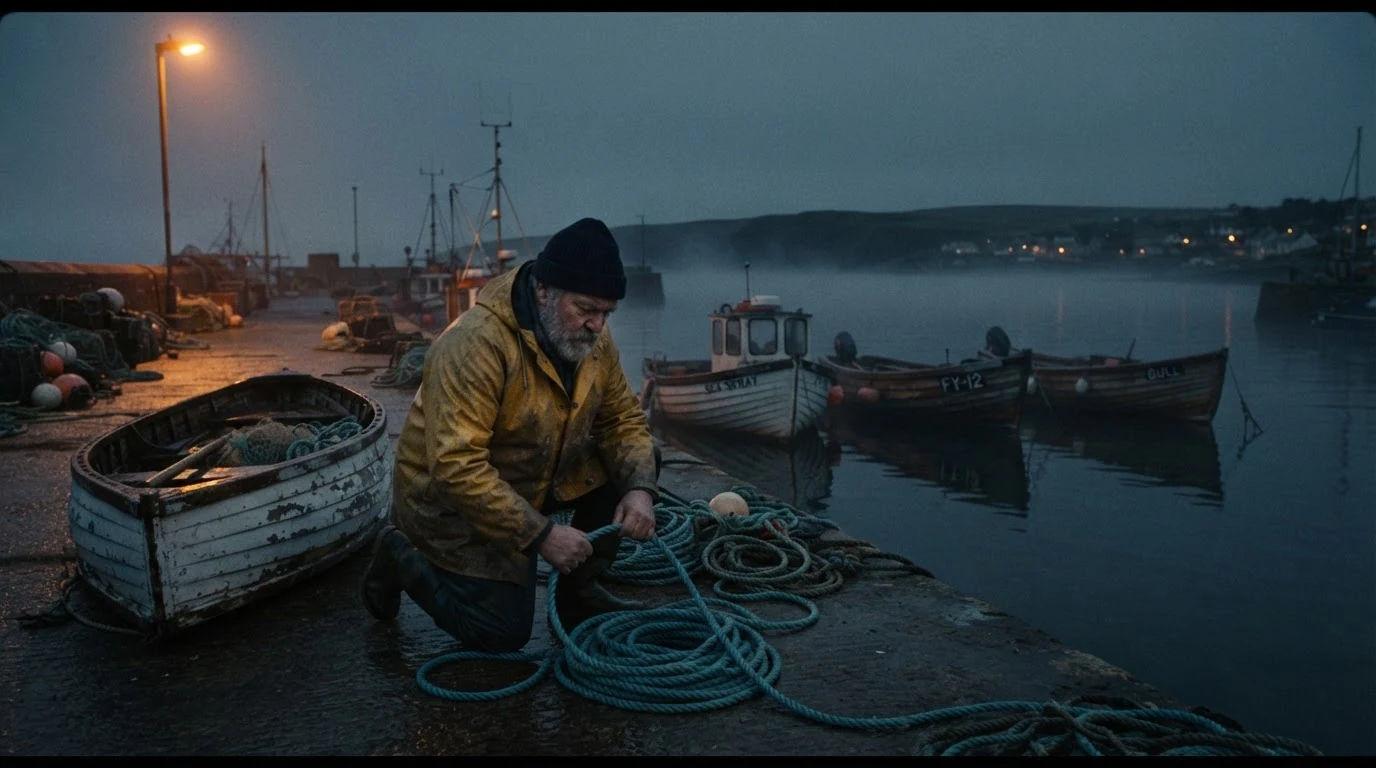
Tone frame for a film mood board sets the purpose: an atmosphere image, not a hero poster. The mood is carried by concrete sources, not adjectives — low fog, a single sodium streetlamp, wet concrete, cold blue-gray ambient light — because models render light they can locate. The muted palette of slate, rust and sodium orange is the palette you'll repeat in every later prompt, and fine film grain plus 35mm at eye height keep it looking photographed rather than illustrated.
Open FlashBoardsA film mood board laid out as a clean collage on an off-white paper background. Left half: one large photograph of a foggy fishing harbor at dusk lit by a single sodium streetlamp. Right half: eight smaller photographs in an uneven grid with thin white gaps — a close-up of salt-crusted blue rope, peeling white paint on a wooden boat hull, a dim kitchen lit only by an open fridge, rain on a dark window, a yellow oilskin jacket hanging on a hook, a gray pebble beach under low cloud, a rusted iron bollard, a lighthouse beam in fog. Along the bottom edge, a strip of six flat color swatches: slate gray, bottle green, rust, bone white, deep navy, sodium orange. Small clean sans-serif labels: the title "SALT — MOOD BOARD" in the top left corner and the words "DAMP · PATIENT · CLOSED" under the swatches. Photographic images, muted cold palette, even flat lighting on the board itself.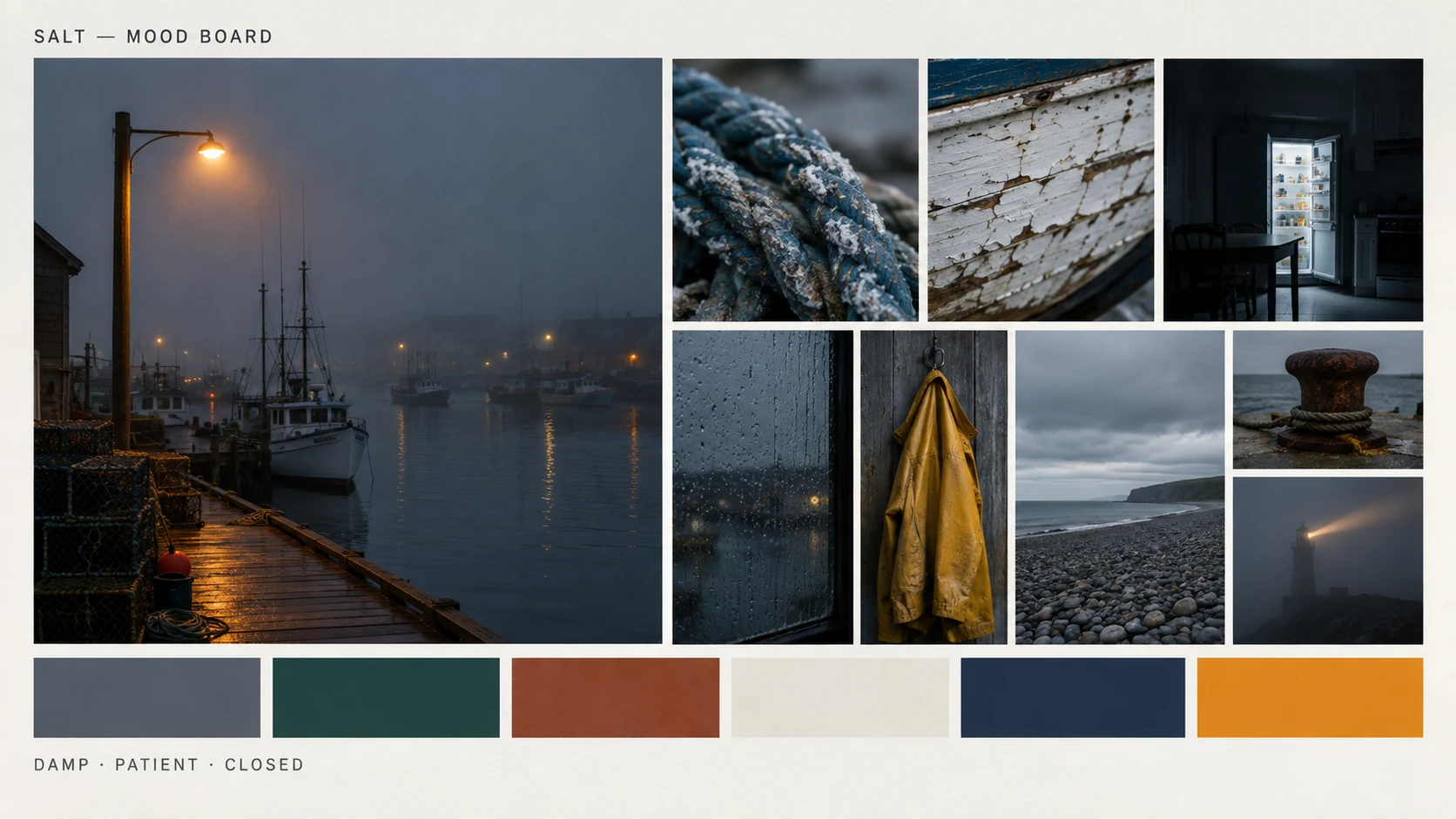
Mood board laid out as a clean collage and off-white paper background produce the document rather than a single scene. Giving the layout in plain geometry — one large image on the left, eight smaller ones in an uneven grid, a swatch strip along the bottom — keeps the hierarchy a real board needs. Each small photograph is one texture or detail from the same world, and naming the six swatch colors makes the palette explicit. Short labels in quotes render reliably; long paragraphs of text do not.
Open FlashBoardsCamera: locked off at eye height, static for the whole shot, the framing never changes. Action: the fog is already drifting slowly from left to right across the black water, and the man is already coiling the blue rope in steady loops over his arm. Small ripples move under the moored boats, and the sodium streetlamp flickers once. In the middle of the shot he pulls the last length of rope in and lifts the coil. At the end he sets the coil down on the upturned rowboat and turns his head toward the water while the fog keeps moving.A mood loop needs motion that is ambient, not dramatic. Locked off and the framing never changes stop the model from pushing in on the still. Already drifting and already coiling make the shot alive from the first frame. Every moving element — fog, rope, ripples, lamp — is already in recipe 1's image, so nothing new gets invented, and a single small action gives the clip a beginning, middle and end.
Open FlashBoardsCommon mistakes
- Tone frames come out as glossy posters. Words like epic, stunning or dramatic push toward high contrast and saturated color. Describe the actual light sources and a muted palette instead.
- The collage turns into one blended image. Say collage, give the layout in positions (left half, right half, bottom strip) and ask for thin white gaps between photographs.
- The palette drifts between generations. Name the same five or six colors, in the same order, in every prompt for the board.
- Swatch labels and titles are garbled. Keep on-image text to a few short words in quotes; write longer notes on the FlashBoards canvas next to the image instead.
- Every image looks like the same shot. A board needs range: ask separately for close-up textures, empty places and interiors, not only wide shots with a figure.
- The mood loop becomes a slow zoom. If the video creeps in, restate that the camera is locked off and put an action in the first sentence.
Keep the reference frames, prompts and every generated take side by side — images and video in one canvas.
FAQ
5 questionsWhat is a mood board in film?
A film mood board is a collage of reference images — film frames, paintings, photographs, textures and color swatches — that shows the emotional tone a film should have before its look is decided. Directors, cinematographers and designers use it early in pre-production to agree on light, color and atmosphere, and it later feeds the lookbook, the storyboard and department-specific boards.
How do you make a mood board for a film?
Write one sentence describing what the audience should feel, then collect 40–80 images quickly from films, photography, paintings and your own location photos. Cut down to 12–25 images that all support the sentence, put the strongest tone images largest, group the rest by light, color, texture and place, add a five-to-seven-color palette strip and a few short notes.
What is the difference between a mood board and a lookbook?
A mood board is loose and exploratory: a single collage that captures a feeling, made for the core creative team. A lookbook is a curated, sequenced document with short text that shows how this specific film will look, usually made after the mood is agreed and used to pitch the project to producers, financiers and heads of department.
How many images should a mood board have?
For a film, 12–25 images is a practical range for the main board. Fewer can work if every image is strong; more usually means the board hasn't been edited and says several different things at once. Departments often build their own, larger boards afterward — costume, locations, lighting — each drawn from the shared one.
Can you make a mood board with AI?
Yes. Image models can generate tone frames for a world that doesn't exist yet — a specific town, season or light — and can lay out a full collage with a palette strip. The best boards mix generated frames with real references and your own location photos, and keep the same palette words in every prompt so the images read as one world.
Related terms
5- LookbookFilmmaking Process & Crew
A film lookbook is a curated document of reference images, frames, palettes and short text that shows how a specific film will look and feel — used to pitch the project and to align the director, DP and designers.
- StoryboardFilmmaking Process & Crew
A storyboard is a sequence of drawn or generated panels, one per planned shot, showing framing, action and camera movement with notes — a visual draft of the film before anything is shot.
- Color PaletteColor
A film's color palette is the limited set of colors that dominates its images — in sets, costumes, light and grade — chosen to give the film a coherent look and emotional temperature.
- AtmosphereDirecting & Staging
Atmosphere is the sensory mood of a film's world — built from light, weather, color, sound design, pacing and production design — that the audience feels before it understands the story.
- Pre-ProductionFilmmaking Process & Crew
Pre-production is the planning phase between greenlight and the first shoot day: casting, crewing, location scouting, design, storyboards and shot lists, breakdown, schedule and budget are locked here.
Further reading
Bruce Block, The Visual Story: Creating the Visual Structure of Film, TV, and Digital Media. Christopher Frayling, Ken Adam and the Art of Production Design (2005).