 FlashBoards Learn
- Learn
- Storytelling
- Story Structure
Storytelling · Film language
Story Structure
Also called: plot structure, narrative structure, dramatic structure
Story structure is the order and shape of the events that carry a story from setup to resolution. Three-act structure, Freytag's pyramid, the hero's journey and Save the Cat are different maps of the same thing: where the story starts, where it turns, where it peaks and how it ends.
- What it does
- Decides when the audience learns what, so tension builds, turns and pays off instead of drifting.
- Use it when
- You outline a script, cut a first assembly that sags, or storyboard a film and need to know which scenes carry the story.
- Watch out
- A model is a map, not the film. Hitting beats on the right page does not make the events cause each other.
- Try this prompt
Opening image of a feature film: a lone lighthouse keeper with a grey braid repaints a rusted door at dawn, wide shot, 35mm film still.
What is story structure?
A narrative is a chain of events linked by cause and effect. Structure is the architecture of that chain: which event opens the film, which one breaks the protagonist's routine, where the story turns, where it peaks and how long it stays after the peak.
Under almost every model sits the same skeleton:
- Setup. The world, the protagonist, what they want or lack.
- Disruption. An inciting incident poses the dramatic question.
- Escalation. The rising action: complications and rising stakes.
- Climax. The central conflict is faced and the question answered.
- Resolution. The new normal, and what the change cost.
Structure is the backbone of storytelling, but it is not the plot. The plot is what happens; structure is the order you tell it in and the proportions you give each part. The same plot told from the ending is a different structure.
Types of story structure
The models overlap more than their diagrams suggest.
Freytag's pyramid
Gustav Freytag drew it in Technique of the Drama (1863) for five-act plays: exposition, rising action, climax, falling action, catastrophe. His climax is the turning point in the middle, not the final showdown.
Three-act structure
The screenwriting default, popularized by Syd Field's Screenplay (1979): setup, confrontation, resolution, turned by plot points near the quarter and three-quarter marks. See three-act structure.
The hero's journey
Joseph Campbell's monomyth from The Hero with a Thousand Faces (1949), condensed by Christopher Vogler into 12 stages, from the ordinary world to the return. George Lucas has credited Campbell as an influence on Star Wars (1977).
Story circle and Save the Cat
Dan Harmon's eight-step story circle compresses the hero's journey for TV episodes. Blake Snyder's Save the Cat beat sheet (2005) puts page numbers on 15 beats, from Opening Image to Final Image.
Kishōtenketsu
A four-part shape from Chinese and Japanese poetry: introduction, development, twist, reconciliation. It needs no central conflict; the twist recontextualizes what came before.
Nonlinear and frame structures
The causal chain stays, the telling is reordered. Pulp Fiction (1994) shuffles its chapters, Memento (2000) runs its color scenes backward, Slumdog Millionaire (2008) hangs flashbacks on quiz-show questions, and Forrest Gump (1994) is told from a bus-stop bench.
Hero's journey vs. three-act structure
The three-act structure is about timing: where the turns fall in the running time. The hero's journey is about transformation: what the protagonist goes through and brings back.
Mapped onto each other, the ordinary world, call and refusal fill act one; crossing the threshold is plot point one; the tests and the ordeal fill act two; the road back and the return make up act three. Outline with one, diagnose with the other: the three acts catch pacing problems, the journey catches a climax that costs the hero nothing.
Why structure matters for the picture, not just the script
Structure decides where a film spends its visual capital. A director who knows where the midpoint lands saves the first wide, the first handheld shot or the first night exterior for it, and plans the opening and final images as a pair. In Parasite (2019) the night the former housekeeper rings the doorbell splits the film in two, and the showroom house starts to play as a trap.
In the edit, structure diagnoses a sagging cut: if the audience is ahead of the story, a turn comes too late; if nobody cares at the climax, the setup planted too little.
How to plan your film's structure
- Write the dramatic question in one line. If you cannot, no model will help.
- Find the anchors first: inciting incident, first-act turn, midpoint, lowest point, climax.
- Check timing. In a 100-minute feature: inciting incident by about minute 12, act one ends near 25, midpoint near 50, climax in the last 15–20 minutes.
- Test causality. Between two beats you should be able to say "because" or "but," not "and then."
In FlashBoards, put one generated keyframe per structural beat in a row on the board, with the logline and notes beside it, and reorder the row to test a nonlinear version.
How to create a story structure with AI
3 promptsStructure is abstract, but its anchors are shots: the opening image, the turns, the final image. A matched pair of opening and final frames shows the arc in one look. Generate both on one FlashBoards board next to your beat notes.
Opening image of a feature film. A remote stone lighthouse on a rocky island at dawn. A woman in her late fifties with a long grey braid, a weathered face with a scar across her left eyebrow and a mustard-yellow oilskin jacket repaints a rusted red door, alone, her back half turned to the sea. Wide shot, 35mm lens at chest height, the lighthouse filling the left third, empty grey sea to the right. Cold blue dawn light, low mist, muted palette. Cinematic film still, fine grain.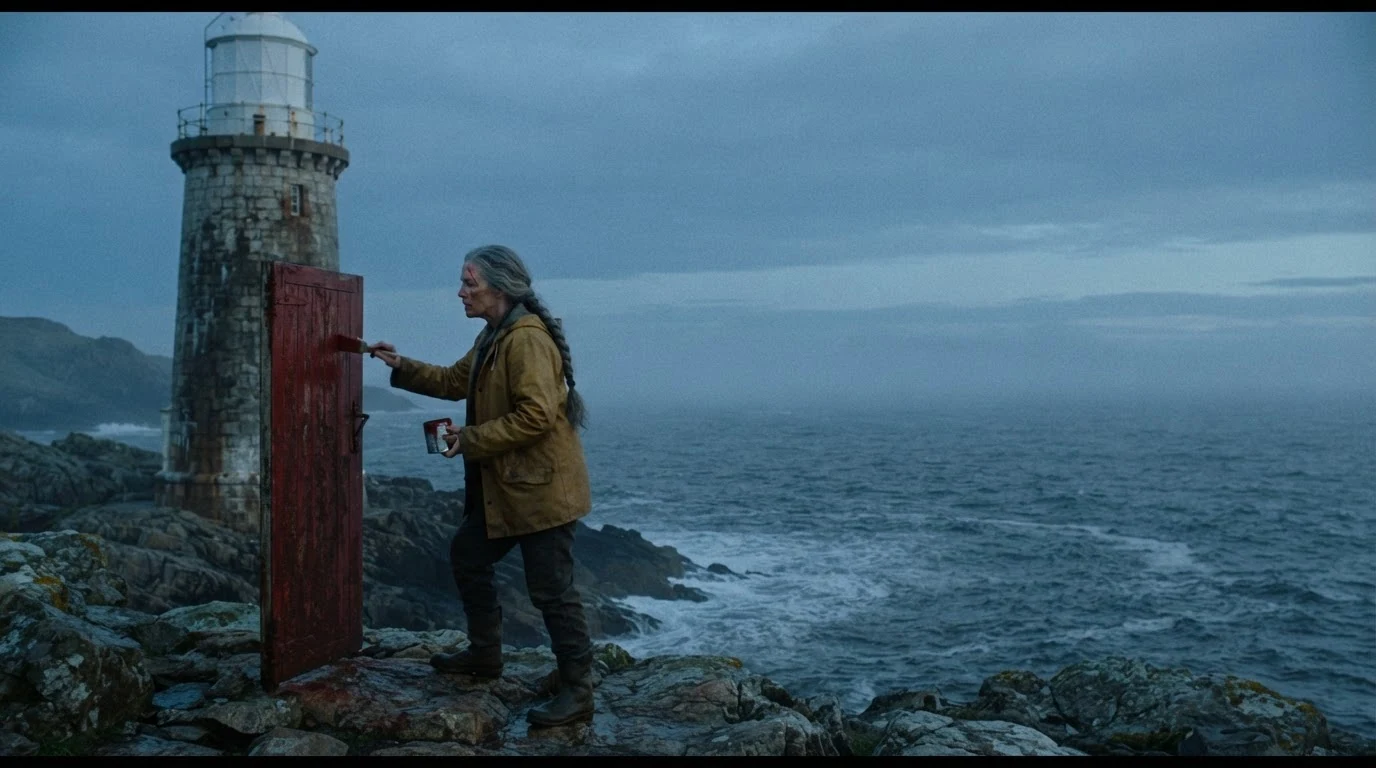
"Opening image," "alone" and "back half turned to the sea" state the setup: routine and a closed world. The empty sea leaves room for what will change. Start frame for the video.
Open FlashBoardsFinal image of a feature film, mirroring the opening. The same remote stone lighthouse on a rocky island, now at sunset. A woman in her late fifties with a long grey braid, a scar across her left eyebrow and a mustard-yellow oilskin jacket sits on the freshly painted red door's step beside a boy of about ten with curly black hair and a green knit sweater; both face the sea, where a small fishing boat heads toward the island. Wide shot, 35mm lens at chest height, lighthouse in the left third. Warm golden light, clear sky. Cinematic film still, fine grain.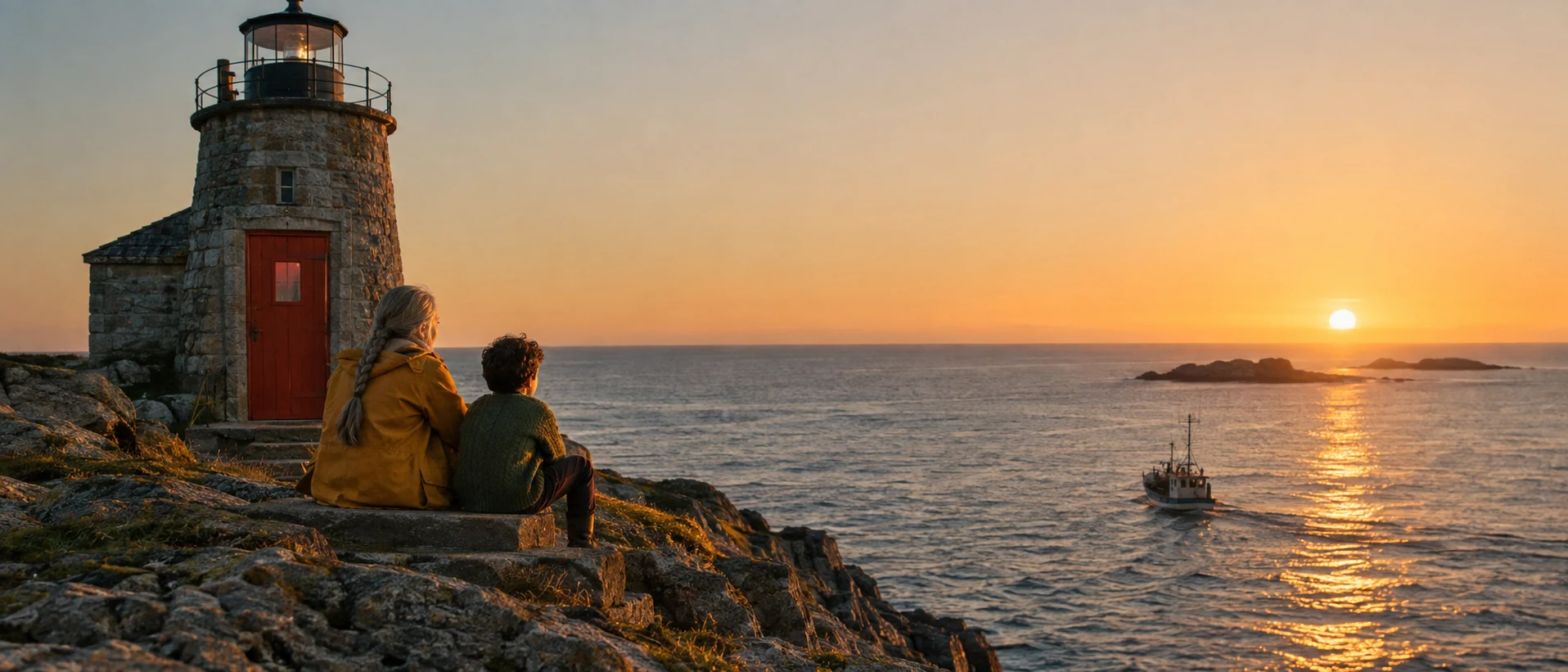
"Mirroring the opening" plus the same lens, height and composition hold the frame constant so only the story changes: dawn to sunset, alone to together, back to the sea to facing it.
Open FlashBoardsCamera: locked-off wide shot at chest height, holding steady for the whole shot. Action: from the first frame mist drifts across the rocks and the woman drags her brush in long strokes across the red door. She pauses, lowers the brush and turns her head toward the sea on the right. She looks at the empty water for a moment, then turns back to the door and keeps painting.Mist and brush strokes move from the first frame, so the shot never freezes. The look toward the sea hints at a want; the return to painting keeps her in the setup.
Open FlashBoardsCommon mistakes
- The final image drifts from the opening: a new lighthouse, a new jacket. Repeat location, costume, lens and height word for word.
- Models overstate the change. Alter two or three things (light, company, gaze) and keep the rest.
- A static routine freezes in video. Give the character a repeated action from the first frame.
Keep the reference frames, prompts and every generated take side by side — images and video in one canvas.
FAQ
4 questionsWhat is story structure?
Story structure is the order and proportion of the events that carry a story from setup to resolution: the opening, the disruption, the escalating complications, the climax and the aftermath. The three-act structure, Freytag's pyramid, the hero's journey and Save the Cat are different ways of mapping it.
What is the difference between plot and story structure?
The plot is the set of events and how they cause each other. Structure is how those events are arranged and weighted in the telling: what comes first, where the turns land and how much time each part gets. One plot told in order or from the ending gives two structures.
Is the hero's journey the same as the three-act structure?
No, but they fit together. The three-act structure divides a story by timing: setup, confrontation, resolution. The hero's journey describes the protagonist's transformation, from the call to the ordeal and the return. Crossing the threshold usually ends act one, and the ordeal sits inside act two.
Do all movies follow a story structure?
Every film has a structure, even one that ignores the popular models. Episodic, nonlinear and conflict-light films still order events deliberately and give each part a length. What changes is the shape: a mosaic, a loop or a four-part twist instead of a three-act rise and fall.
Related terms
6- Three-Act StructureStorytelling
The three-act structure splits a story into setup, confrontation and resolution, turned by plot points at roughly the quarter and three-quarter marks — the default blueprint of feature screenwriting.
- Save the Cat Beat SheetScreenwriting
The Save the Cat beat sheet is Blake Snyder's 15-beat map of a feature, from Opening Image and Catalyst to Finale and Final Image, with page targets for each beat — a ready template for planning scenes and storyboards.
- Dan Harmon Story CircleStorytelling
Dan Harmon's story circle is an eight-step, simplified hero's journey — you, need, go, search, find, take, return, change — used to structure episodes and features.
- Rising ActionStorytelling
Rising action is the chain of complications between the inciting incident and the climax, where obstacles pile up and stakes rise.
- ClimaxStorytelling
The climax is the story's decisive peak: the protagonist faces the central conflict head-on and the main dramatic question is answered.
- NarrativeStorytelling
A narrative is a chain of events connected by cause and effect and told from a chosen point of view; in film, it's the story as organized by plot, image and sound.
Further reading
Gustav Freytag, Technique of the Drama (1863). Joseph Campbell, The Hero with a Thousand Faces (1949). Syd Field, Screenplay (1979). Christopher Vogler, The Writer's Journey.