 FlashBoards Learn
- Learn
- Storytelling
- Plot Device
Storytelling · Film language
Plot Device
Also called: narrative device, story device
A plot device is any object, character or situation whose main job is to move the story forward: a MacGuffin everyone chases, a ticking clock, a lucky coincidence, a last-minute rescue. Good devices feel like part of the world; clumsy ones show the writer's hand pushing the plot along.
- What it does
- Gives the story a push: starts the chase, raises the stakes, forces a choice or delivers a reveal.
- Use it when
- The plot needs pressure or a turn that characters alone won't produce.
- Watch out
- If the audience notices the device before the drama, it reads as a shortcut, not a story.
- Try this prompt
Insert shot of a brass pressure gauge, needle creeping into the red, cold water rising past a riveted steel wall, hard flashlight beam, 16:9
What is a plot device?
A plot device is a piece of story machinery. It can be a thing (a letter, a key, a stolen ring), a person (the stranger who arrives to explain the rules), a condition (amnesia, a deadline, a storm that cuts the phone line) or an event (the coincidence that puts two enemies in the same bar). What they share is function: the device exists mainly because the plot needs it.
That is not an insult. Every story runs on devices. Memento (2000) gives its hero a condition that stops him forming new memories, so Polaroids, notes and tattoos carry the plot from scene to scene.
The term sits with the other narrative techniques, but it describes what pushes the story, not how it is told. A plot-device character is the same idea in human form: someone who exists only to deliver information, a warning or a rescue, with no arc of their own.
Types of plot devices, with examples
MacGuffin
The object everyone wants, whose nature barely matters. The glowing briefcase in Pulp Fiction (1994) is opened on screen, but its contents are never shown. More in the MacGuffin article.
Ticking clock
A deadline that turns every scene into a race. In High Noon (1952) the marshal has until the noon train arrives. Back to the Future (1985) makes the clock visible as a family photo in which Marty's siblings are fading.
Plant and payoff (Chekhov's gun)
An element shown early so a later turn feels earned. The compressed-air tanks on the boat in Jaws (1975) become the weapon of the ending. This is the strict form of foreshadowing.
Recognition token
An object or creature that reveals who someone really is. In The Third Man (1949) a cat curls against a pair of shoes in a dark Vienna doorway, and a window light reveals the face of a man the story has already buried.
Coincidence
Chance that brings people or information together. Audiences accept a coincidence that gets characters into trouble far more readily than one that gets them out.
Deus ex machina
The unearned rescue by a power or accident the story never set up. See deus ex machina.
Red herring
A false clue that points the audience at the wrong answer, as the missing-patient investigation does in Shutter Island (2010). More in red herring.
Why writers use plot devices, and when they fail
Devices solve structural problems. A ticking clock adds urgency to a slow middle act. A MacGuffin gives rivals a reason to collide. A recognition token delivers a reveal in one image instead of pages of exposition.
A device fails when it is visible as machinery:
- It arrives just in time. The rescue or clue appears the moment the plot needs it, with no plant. That is how a device turns into a plot hole.
- It replaces a choice. When a decision should have produced the turn, a coincidence steals the drama.
The Return of the King (2003) shows both sides: the One Ring carries weight in every scene, while the Eagles' rescue is still argued about as a convenient exit. Star Wars: The Rise of Skywalker (2019) drew similar criticism for a dagger that leads to a wayfinder that leads to a planet: objects that mattered only as signposts.
How to stage a plot device on screen
Plant it in the frame, not in dialogue. Show the tank, key or photo where it has a reason to be, ideally in the background of a scene about something else.
Give it a dedicated insert. A clock face, gauge or letter needs one clean close-up so its state is readable. Repeat the framing later and the change (needle in the red, a name crossed out) tells the story without a line.
Light it as a character. In The Third Man the reveal is a light switching on in a window. Motivated light landing on the device at the right moment does more than a music sting.
In FlashBoards, keep the plant and payoff frames of each device side by side on one board with a note on which scene uses them, so a missing setup is visible before it becomes a plot hole.
Plot device vs. narrative technique
- A plot device is an element inside the story: the ring, the deadline, the rescue. Characters can touch it, fear it or chase it.
- A narrative technique is a choice about telling: a flashback, reverse chronology, an unreliable narrator. Characters don't know it exists.
Memento uses both: amnesia and Polaroids are devices; the reverse-order structure is a technique. Test: retell the story in chronological order. A device survives; a technique disappears.
How to create a plot device with AI
3 promptsA plot device works on screen as one readable image, so generate the device itself: a ticking-clock gauge, a recognition token in a doorway, then a clip where the device changes state. Keep plant and payoff frames together on a FlashBoards board.
Ticking clock insert shot in a flooding ship engine room: a round brass pressure gauge in the foreground, needle just touching the red zone, cold seawater rising past a riveted steel wall, a young mechanic with a shaved head and a burn scar on his cheek out of focus behind, one hard flashlight beam, green-gray palette, 50mm lens, shallow depth of field, cinematic still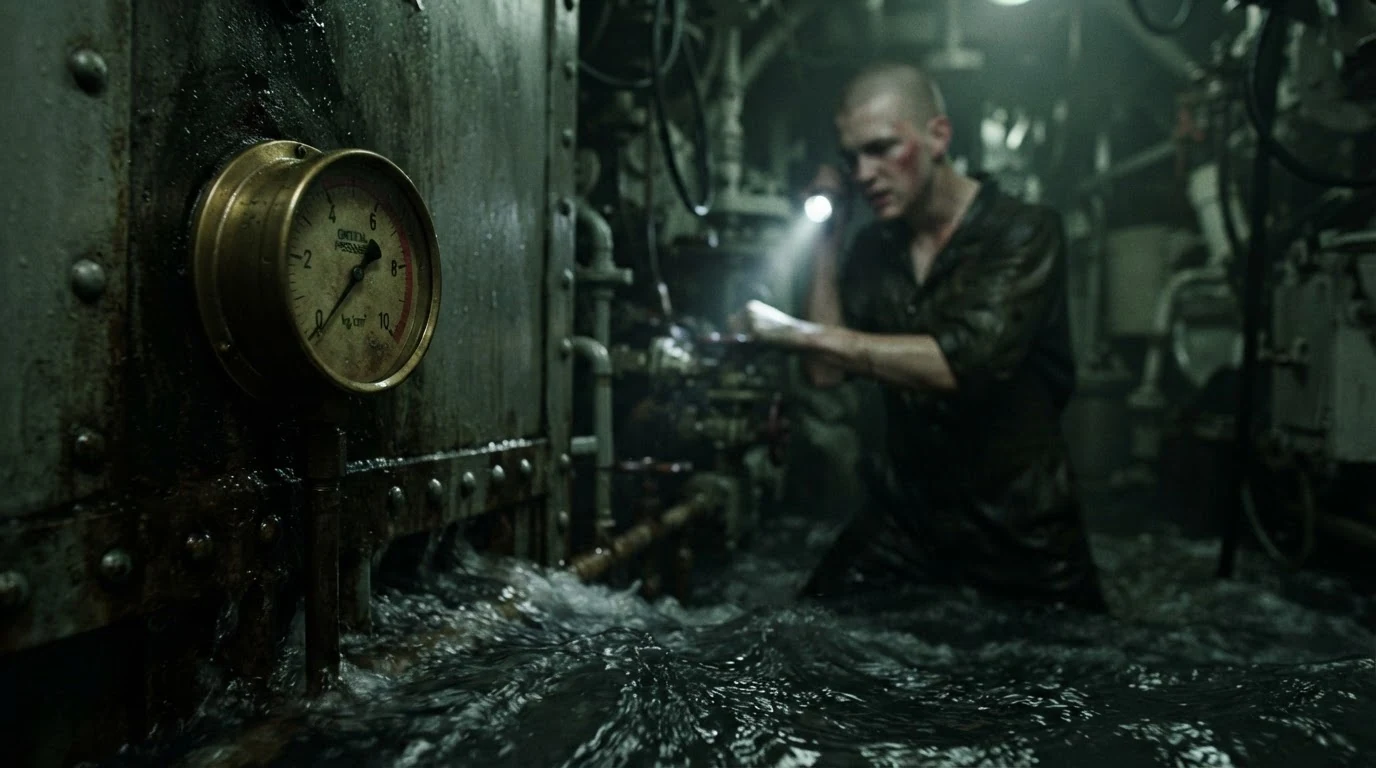
Needle just touching the red zone makes the deadline readable at a glance; rising water gives the video something to move. The mechanic stays soft so the device leads the frame.
Open FlashBoardsRecognition token reveal, old European city street at night after rain: a gray tabby cat curls against a man's polished black shoes in a stone doorway, his body in deep shadow, one upstairs window light cutting a hard rectangle across wet cobblestones and the hem of his coat, black-and-white, high contrast, wide anamorphic frame, camera at street level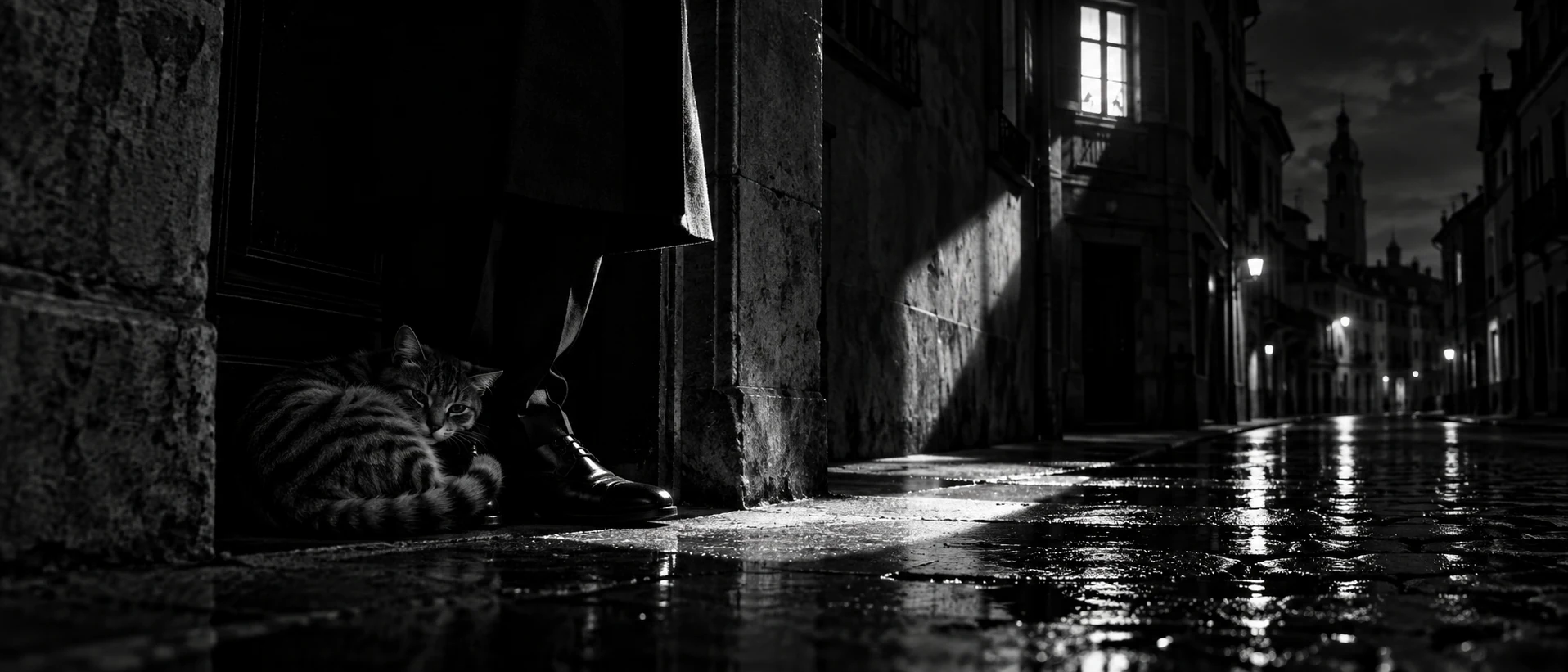
Cat against the shoes and body in deep shadow hide the identity while the light rectangle promises the reveal.
Open FlashBoardsCamera: slow push toward the gauge from the first frame, ending on a close-up of the dial. Action: from the first frame the needle sweeps clockwise across the whole dial, crosses into the red zone and keeps trembling deeper into it while water climbs the riveted wall and splashes the pipes. Behind it the mechanic wades forward and grabs a valve wheel with both hands. The shot ends on the needle pinned against the stop at the far end of the red zone, past the last number.Water and needle move from frame one, so the clip is alive at once, and the push ends on the device's new state.
Open FlashBoardsCommon mistakes
- Models blur the device into set dressing. Name it first, put it in the foreground, state its condition.
- Gauges and clocks come out unreadable. Ask for a round dial with a red zone, not numbers.
- Video models finish the action. End the prompt on the device's state, not the hero's success.
- Reveal images show the face by default. Say what is lit and what is in shadow.
Keep the reference frames, prompts and every generated take side by side — images and video in one canvas.
FAQ
4 questionsWhat is a plot device in simple terms?
A plot device is anything in a story that exists mainly to move the plot: an object everyone chases, a deadline, a coincidence, a character who arrives with key information. Used well, it feels natural to the world. Used badly, the audience senses the writer arranging events instead of the characters causing them.
What are the main types of plot devices?
The most common are the MacGuffin, the ticking clock, plant and payoff (Chekhov's gun), the red herring, coincidence, the recognition token that reveals an identity, amnesia and deus ex machina. Most films combine several: a MacGuffin starts the chase and a ticking clock sets its speed.
What are good examples of plot devices in movies?
"Rosebud" in Citizen Kane (1941) drives the whole investigation. The fading photo in Back to the Future (1985) is a visible ticking clock. The air tanks in Jaws (1975) are planted early and pay off at the end.
Is a plot device a bad thing?
No. Every story uses devices, and the best are invisible because they grow from character and setting. A device becomes a problem when it appears exactly when needed without setup, or replaces a character's decision. Those are the moments audiences call contrived.
Related terms
5- Narrative TechniquesStorytelling
Narrative techniques are the tools a storyteller uses to control what the audience knows and when — flashbacks, nonlinear order, point of view, foreshadowing, unreliable narrators, twists.
- MacGuffinStorytelling
A MacGuffin is the object everyone in the story is chasing — a briefcase, a formula, a statue — whose exact nature barely matters; it exists to set the characters in motion. Hitchcock popularized the term.
- Deus Ex MachinaStorytelling
Deus ex machina is an unearned rescue: a hopeless situation is suddenly solved by a new character, coincidence or power the story never set up.
- Red HerringStorytelling
A red herring is a false clue planted to point the audience toward the wrong suspect or explanation, so the real answer lands as a surprise.
- ForeshadowingStorytelling
Foreshadowing plants hints — an object, a line, an image — that prepare the audience for what comes later, so the payoff feels both surprising and inevitable. Chekhov's gun is its strictest form.
Further reading
Robert McKee, Story (1997). François Truffaut, Hitchcock/Truffaut (1966).