 FlashBoards Learn
- Learn
- Storytelling
- MacGuffin
Storytelling · Film language
MacGuffin
Also called: McGuffin, plot coupon
A MacGuffin is the object, secret or goal that every character in a story wants, while its actual nature barely matters to the audience. A briefcase, a microfilm, a statue or a list exists to set people in motion and put them in conflict. Alfred Hitchcock popularized the term and built many of his thrillers around one.
- What it does
- Gives every character the same thing to want, so chases, betrayals and set pieces have a reason to happen.
- Use it when
- The story is really about the people, the pursuit and the danger, not about the object they are fighting over.
- Watch out
- If the audience starts caring what the object is and you never pay that off, the ending feels like a cheat.
- Try this prompt
Insert shot, a sealed brass-cornered wooden box on a café table at night, three hands reaching for it from different sides
What is a MacGuffin?
A MacGuffin is a kind of plot device: the thing the characters chase, steal, guard or trade, whose importance to them is total and whose importance to us is close to zero. Spies want the plans, gangsters want the case, treasure hunters want the relic. What the plans say or what the case holds could be swapped for something else without changing a single scene, because the story runs on the wanting, not on the object.
The spelling varies (MacGuffin, McGuffin, sometimes Maguffin), and critics of fantasy fiction use a close cousin, the plot coupon: a set of tokens the hero must collect, like coupons mailed in to receive the ending.
Where the word comes from
Hitchcock credited the term to his friend, the screenwriter Angus MacPhail, and liked to explain it with a shaggy-dog joke. Two men share a train compartment; one asks about an odd parcel on the luggage rack. The other says it is a MacGuffin, a device for trapping lions in the Scottish Highlands. When the first man objects that there are no lions in the Highlands, the answer comes back: then that's no MacGuffin. The punchline is the definition. The object explains nothing and doesn't need to; it only needs to exist long enough to start the conversation.
Hitchcock told the story often, most famously in his long interviews with François Truffaut, published in the mid-1960s as Hitchcock/Truffaut. There he argued that the MacGuffin matters enormously to the characters on screen and hardly at all to the director or the viewer, and he held up the vague government secrets of North by Northwest (1959) as his emptiest, purest example.
Why do filmmakers use a MacGuffin?
A MacGuffin solves a structural problem: how do you get strangers with different goals into the same room, the same car and the same fight? You give them one object that all of them want.
- It starts the engine. The theft of the object, its arrival or the first mention of it often serves as the inciting incident. Marion Crane taking $40,000 from her employer in Psycho (1960) is what puts her on the road to the Bates Motel.
- It creates opposing sides. Anyone who wants the object is either an ally or an obstacle, which gives the protagonist and the antagonist a concrete reason to collide.
- It moves the story through space. A MacGuffin can be carried, hidden, handed off and lost, so it drags the plot from one location to the next. North by Northwest sends Cary Grant's ad man from a New York hotel bar to a cornfield and onto Mount Rushmore, all because of microfilm he never sees until the end.
- It keeps stakes legible. The audience doesn't need to understand the NOC list in Mission: Impossible (1996) in detail. They only need to know that if the wrong person gets it, agents die. That clarity lets the film spend its time on the heist.
- It frees attention for the real subject. Because the object is simple, the story can be complicated where it counts: in loyalty, desire, guilt and suspense.
The classic MacGuffin is also disposable. In Psycho, the stolen money sinks into the swamp with Marion's car, and the film never returns to it. The crime story was bait.
MacGuffin examples in film
- ***The 39 Steps* (1935).** A design for a silent aircraft engine, carried in the head of a music-hall memory man. Richard Hannay spends the film running across Scotland because of a secret he never needs to understand.
- ***The Maltese Falcon* (1941).** A jewel-encrusted statuette that turns out to be a lead fake when it finally arrives. The chase exposes every character's greed; the bird itself is worthless.
- ***Notorious* (1946).** Uranium ore hidden in wine bottles in a Nazi sympathizer's cellar. The real subject is the love story, and the cellar key is what the camera cares about.
- ***Kiss Me Deadly* (1955).** A locked box nicknamed "the great whatsit" that glows and burns when opened, one of the rare cases where the MacGuffin's contents become the climax.
- ***Star Wars* (1977).** The Death Star plans stored in R2-D2. They pull Luke into the war and pay off in the final attack.
- ***Raiders of the Lost Ark* (1981).** The Ark of the Covenant, pursued by Indiana Jones and his rivals across three continents.
- ***Pulp Fiction* (1994).** A briefcase with the combination 666 that throws a warm golden light onto the face of whoever opens it. We never see inside, which is exactly the point.
- ***Ronin* (1998).** A silver case that mercenaries kill and die for; nobody explains what is in it.
- ***The Big Lebowski* (1998).** A soiled rug starts the Dude's quest, and a ransom briefcase turns out to have been empty all along, a joke on the whole genre.
Notice the pattern. The strongest MacGuffins have a distinct physical form (a statue, a case, a box, a droid) even when their meaning is vague. Audiences follow objects more easily than ideas.
How to write and stage a MacGuffin
On the page, the MacGuffin needs rules more than a backstory:
- Decide what it does for each character. Money for one, revenge for another, survival for a third. The object stays the same; the motives make the scenes.
- State the stakes in one line. "If they decode the list, our agents die" is enough. Resist long exposition about how the device works.
- Track its location. Keep a simple log of who holds the object in every scene. Audiences notice when a case teleports, and a plot hole around the MacGuffin breaks the whole chase.
- Choose: reveal, withhold or subvert. Show the contents (Kiss Me Deadly), never show them (Pulp Fiction, Ronin) or reveal that they were worthless (The Maltese Falcon, The Big Lebowski). Each choice is a different ending.
On set, the MacGuffin is a movie prop with a heavy job, so design and shoot it deliberately:
- Give it a readable silhouette. It should be identifiable in a wide shot at a glance: a boxy aluminum case, an ornate box, a statuette. Matte, dark props vanish in low-key scenes; a polished edge or a bright color keeps them visible.
- Introduce it with an insert. A clean insert shot the first time the object appears, on a 50–100 mm lens with shallow focus, teaches the audience what to track. Repeat the same framing at each handoff so the object reads as the same thing.
- Light it as a character. A practical light inside the prop, or a small hard source kept only on the object, makes it the brightest thing in frame. Pulp Fiction's glowing case is the extreme version: the light lands on the faces and the reactions tell the story.
- Stage the tug-of-war. Block scenes so the object sits between characters, on the table, in the middle of the frame, with hands entering from different sides. The composition becomes the conflict.
- Cover the reactions. If the contents stay hidden, the close-up of the person looking inside does the work. Plan the reaction shot before the insert.
In FlashBoards, it helps to give the MacGuffin its own lane on the board: prop references, the first insert, every handoff frame and a note of who holds it in each scene, laid out left to right in story order. When a generated take shows the case in the wrong hand, you see it next to the scene that set up where it should be.
MacGuffin vs. red herring: what's the difference?
Both are story devices, and both can be objects, which is why they get mixed up. They do opposite jobs.
- A MacGuffin is openly important. Everyone knows the characters want it; its contents are what doesn't matter. It generates motion.
- A red herring is secretly unimportant. It is a false clue that looks meaningful and points the audience at the wrong suspect or explanation. It generates misdirection, and it only works if the viewer believes it.
In short: the MacGuffin is the thing we are told to follow, the red herring is the thing we are tricked into following. A mystery can have both, as when everyone hunts a stolen jewel (MacGuffin) while a planted glove points to an innocent butler (red herring).
Two more neighbors are worth separating:
- Chekhov's gun, the strict form of foreshadowing, demands that an object shown early must be used later. A MacGuffin reverses the emphasis: it must be wanted, but it never has to be used. The Death Star plans are both; the Pulp Fiction case is only a MacGuffin.
- A deus ex machina resolves the plot from outside at the end. A MacGuffin starts the plot from inside at the beginning.
When does a MacGuffin fail?
The device breaks in three predictable ways.
- The audience cares more than the film does. If the script teases the contents with mystery and mood, viewers will expect an answer. Withholding works in Pulp Fiction because the film treats the case lightly; it frustrates after an hour spent building a riddle.
- Nobody believes the characters want it. A MacGuffin runs on desire. If both the device and the motives are vague, nothing holds the plot together. Give at least one character a specific, personal reason.
- The object becomes a switch. A MacGuffin that suddenly solves every problem in the last act turns into a deus ex machina. If the device will be used, set up its abilities early and keep them limited.
A good test: describe the film without naming the object. If the story still sounds complete (who wants what, who stands in the way, what it costs), the MacGuffin is doing its job. Explore more devices like this in the storytelling hub.
How to create a macguffin with AI
3 promptsA MacGuffin is easy to show and hard to make matter: the image has to say everyone wants this without explaining what it is. Build the frame around one distinct object, light it as the brightest thing in the scene and put the competing hands, eyes or bodies around it. Generate the insert and the wide on one FlashBoards board, then animate the tug-of-war from the first frame.
Cinematic insert shot, high angle looking down at a small dark wooden box with brass corners and a red wax seal, placed in the exact center of a scratched marble café table at night. Three hands reach toward it from three sides: a woman's hand with chipped green nail polish and a thin silver bracelet, a man's hand in a black leather glove, an old man's hand with a heavy gold signet ring. A single warm hard light from above falls only on the box, the table edges fall off into shadow. 50mm lens, shallow depth of field, tense thriller mood, 35mm film grain.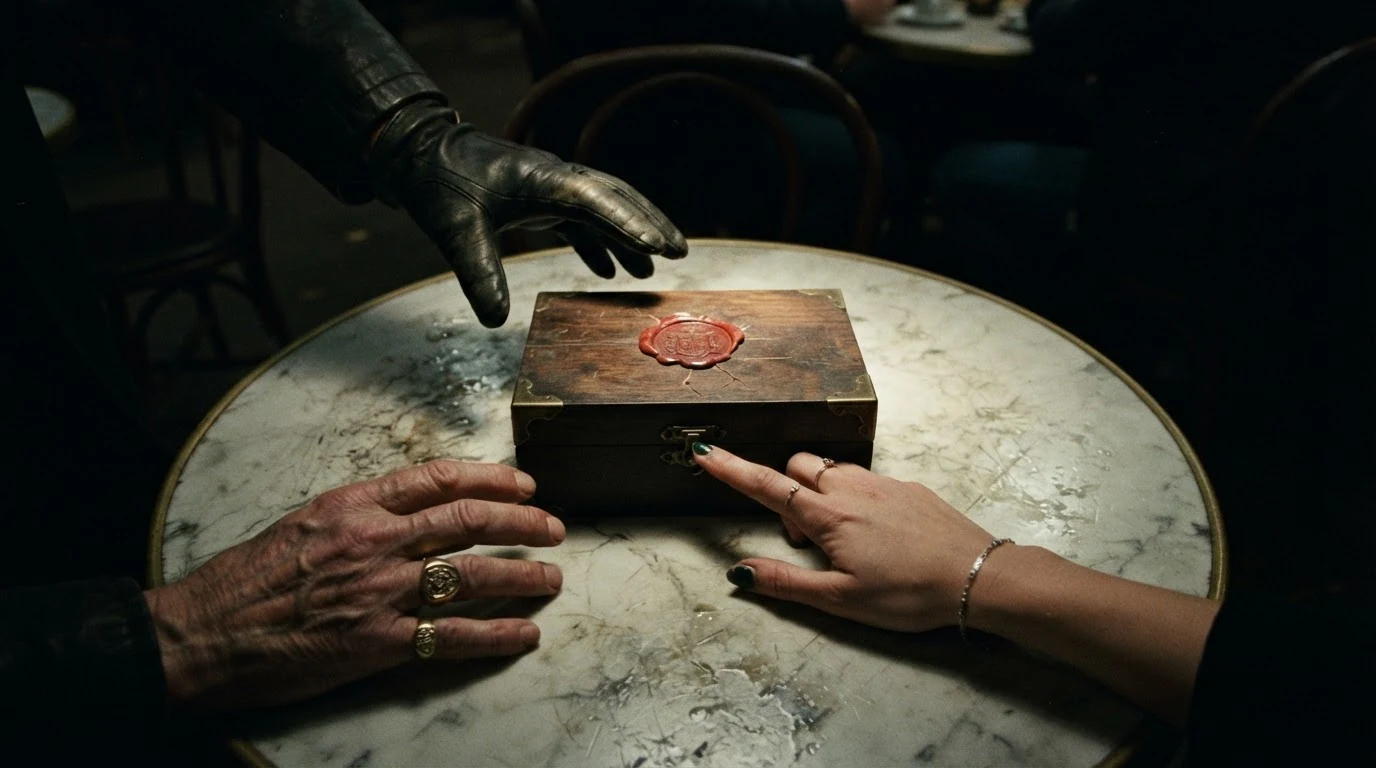
"Exact center" and "three hands reach toward it from three sides" turn the object into the thing everyone wants without a word of plot. The single hard light "only on the box" makes it the brightest element, which is how you tell the viewer what to track. Giving each hand a detail (nail polish, glove, ring) creates three distinct rivals the audience can follow in later shots.
Open FlashBoardsWide anamorphic shot of an empty night train platform in light rain. On the left, a courier in her fifties with a cropped gray undercut, a scar through her left eyebrow and a long olive raincoat stands holding a dented aluminum briefcase chained to her wrist; the case catches the light of an overhead sodium lamp and is the brightest object in the frame. Far right, under a flickering sign, two figures in dark coats watch her, half in shadow. Wet concrete reflections, deep teal shadows, warm orange practical lights, 40mm anamorphic lens, cold suspense.
The second take shows the other half of the device: the MacGuffin in a wide, with the people who want it separated by the frame. "Chained to her wrist" and "brightest object in the frame" keep the case readable even though it is small, and the watchers on the opposite side set up the pursuit. The 21:9 width gives room for the distance between rivals.
Open FlashBoardsCamera: slow steady push-in toward the wooden box from the first frame, ending closer on the box and the fingertips around it. Action: the three hands are already moving at the start. The gloved hand slides forward fast and closes on one side of the box, the woman's hand with green nail polish grabs the other side at the same moment, and both pull, sliding the box a few centimeters across the marble. The old man's hand with the gold ring slowly presses flat on the lid and holds it still. The warm light stays on the box, the edges of the table stay dark.The action starts in the first sentence ("already moving at the start"), so the clip doesn't open on a frozen still. Each hand is named by the detail from recipe 1, which keeps the model from inventing new people, and the ending (a hand pinning the lid) gives the shot a clear beat: the object is contested and nobody has won yet.
Open FlashBoardsCommon mistakes
- The object disappears. Models often render a small prop as background clutter. Put it in the center, name its material and silhouette, and state that it is the brightest thing in the frame.
- The contents get drawn. Write "closed" or "sealed" and describe the lid, lock or wax seal; a prompt about what is inside invites the model to show it.
- Nobody seems to want it. An object alone on a table is a still life. Add the rivals: hands entering from different sides, eyes on the object, a watcher across the frame.
- Extra hands in video. Describe only what is in the start frame, each hand by one visible detail.
- Glow turns into magic. For a Pulp Fiction style reveal, describe the warm light on the face of the person looking in, not light beams or sparkles from the case.
Keep the reference frames, prompts and every generated take side by side — images and video in one canvas.
FAQ
5 questionsWhat is a MacGuffin in simple terms?
A MacGuffin is the thing everybody in a story is after, such as a briefcase, a secret file, a jewel or a relic, whose exact nature doesn't matter to the audience. Its job is to give the characters a shared goal so they chase, fight and betray each other. You could swap it for a different object and the story would play almost the same way.
Why is it called a MacGuffin?
Alfred Hitchcock credited the word to screenwriter Angus MacPhail and explained it with a joke about a parcel on a train rack that supposedly traps lions in the Scottish Highlands, where there are no lions. The nonsense name fits the idea: the object's explanation is irrelevant, only its effect on the characters counts. Hitchcock's interviews made the term standard film vocabulary.
What are some famous MacGuffin examples?
Classic examples include the microfilm in North by Northwest (1959), the stolen $40,000 in Psycho (1960), the falcon statuette in The Maltese Falcon (1941), the Death Star plans in Star Wars (1977), the Ark in Raiders of the Lost Ark (1981), the glowing briefcase in Pulp Fiction (1994), the case in Ronin (1998) and the NOC list in Mission: Impossible (1996).
What is in the briefcase in Pulp Fiction?
The film never says. When the case is opened (its combination is 666), a warm golden glow lights the face of whoever looks inside, and the camera shows only the reaction. Because the contents are never revealed, the briefcase is one of the purest modern MacGuffins: it matters only because the characters want it, and fans have argued about it for decades.
What is the difference between a MacGuffin and a plot device?
A plot device is any element whose main job is to move the story forward, including coincidences, ticking clocks, prophecies and a deus ex machina. A MacGuffin is one specific type: the object or goal that the characters pursue. Every MacGuffin is a plot device, but a ticking bomb or a lucky coincidence is not a MacGuffin, because nobody is trying to get hold of it.
Related terms
4- Red HerringStorytelling
A red herring is a false clue planted to point the audience toward the wrong suspect or explanation, so the real answer lands as a surprise.
- Plot DeviceStorytelling
A plot device is any object, character or situation whose main job is to move the story forward — a MacGuffin, a ticking clock, a coincidence, a deus ex machina.
- ForeshadowingStorytelling
Foreshadowing plants hints — an object, a line, an image — that prepare the audience for what comes later, so the payoff feels both surprising and inevitable. Chekhov's gun is its strictest form.
- Insert ShotCamera Shots
An insert is a close shot of an object or small action inside the scene — a note, a phone screen, a hand turning a key — cut into the coverage so the audience notices exactly the detail the story needs.
Further reading
François Truffaut with Helen G. Scott, Hitchcock/Truffaut (Simon & Schuster). Donald Spoto, The Art of Alfred Hitchcock (Doubleday).