 FlashBoards Learn
- Learn
- Storytelling
- Red Herring
Storytelling · Film language
Red Herring
Also called: false lead, misdirection
A red herring is a false clue planted to point the audience toward the wrong suspect or explanation, so the real answer lands as a surprise. It works because filmmakers give the decoy everything a real clue gets on screen: a close-up, a suspicious glance, a music sting, while the truth sits quietly in plain sight.
- What it does
- Pulls the audience's attention and suspicion onto a wrong answer, so the real one surprises them without feeling like a cheat.
- Use it when
- Your story hides a culprit, motive or truth, and the audience would otherwise guess it too early.
- Watch out
- A decoy that is never explained, or a real answer that was never on screen, reads as a cheat, not a twist.
- Try this prompt
Drawing room at night, a scarred groundskeeper gripping garden shears in hard side light in the foreground, a smiling grandmother pouring tea soft in the background, 16:9 film still.
What is a red herring in film?
A red herring is a clue, character or event that the story deliberately presents as meaningful so the audience draws the wrong conclusion. It's a kind of plot device: its job isn't to be true, it's to occupy the viewer's attention while the real answer is being set up somewhere else.
The name comes from hunting and debate. A smoked herring turns reddish-brown and smells strongly, and the phrase is usually traced to a story the English journalist William Cobbett published in the early 1800s about dragging one across a trail to throw hounds off the scent. That image is still the best way to think about it: the red herring doesn't erase the real trail, it lays a stronger, more tempting one across it.
In screen stories a red herring has three parts:
- The plant. The false clue gets emphasis: screen time, a close shot, a line of dialogue that makes it sound important.
- The pull. Characters and audience start building theories around it. The more a detective or protagonist believes it, the more we do.
- The release. The story clears the false lead, ideally in a way that also reveals something true. A red herring that simply vanishes feels like a dropped thread.
The good ones are fair. The real answer is on screen the whole time, just given less weight. That's the difference between a red herring and a plot hole: when the truth comes out, the audience can look back and see that the film didn't lie, it only directed their eyes.
Types of red herrings, with examples
Red herrings come in a few recognizable shapes. Most mysteries use more than one.
The false suspect. The most common form: a character who looks guilty. Harry Potter and the Sorcerer's Stone (2001) points everything at Snape, cold, hostile and seen muttering during the Quidditch match, while the stammering, harmless-seeming Quirrell is the real threat. Home Alone (1990) uses the same trick in a gentler key: Old Man Marley, rumored among the neighborhood kids to be a murderer, turns out to be a lonely man who ends up saving Kevin.
The crowded suspect list. Instead of one decoy, the story gives everyone a motive. Clue (1985) gathers guests who are all being blackmailed by the same man, Mr. Boddy, so every one of them has a reason. Knives Out (2019) does it with a whole family, each member financially threatened by the patriarch before his death, and it adds a second layer by apparently showing us the culprit early on.
The decoy identity. The film tells us who the villain is, then swaps them. In Batman Begins (2005), the man introduced as Ra's al Ghul is a stand-in, and Bruce's mentor Ducard is the real one. In The Usual Suspects (1995), Agent Kujan is so sure Keaton is Keyser Söze that the audience adopts his theory, while the man telling the story is sitting in front of him.
The false resolution. The problem seems solved, and it isn't. In Jaws (1975) the fishermen catch a tiger shark and the town celebrates, until Hooper examines it and the evidence doesn't add up.
The misleading storyline. The biggest version hijacks the whole plot. Psycho (1960) spends its opening act on Marion Crane's stolen money, the car trade, the highway patrolman and her guilty conscience, and then abandons that story along with its star. The stolen money works as a MacGuffin for the first act and as a red herring for the audience's expectations about the rest of the film.
The double bluff. The story raises suspicion, clears the suspect, then proves the first instinct right. Scream (1996) arrests Billy early, lets him go, and brings him back as one of the killers.
Why do filmmakers use red herrings?
To protect the ending. Film audiences are experienced readers of structure. They know the famous actor with little to do is probably important, and they know the obvious suspect usually isn't guilty. A red herring gives them something to solve so they stop working on the real answer.
To make the reveal recolor the film. When a plot twist lands, the audience replays earlier scenes in their heads. A well-built red herring means those replays pay off: the scene they misread was actually showing them the truth. The Usual Suspects is built for that second viewing.
To build suspense and dread. A suspect in the house raises suspense in every scene they enter, whether or not they're guilty. Marley in Home Alone makes every walk down the snowy street tense for Kevin.
To say something about the characters. Who a detective suspects says who they are. Kujan's certainty about Keaton shows his pride. The family in Knives Out each blame the outsider first, and the film uses that to make its point about them.
How to write and shoot a red herring
A red herring is written in the script but sold with the camera. The cinematic grammar that says "this matters" is the same grammar that plants a false clue, so you can use it on purpose.
Emphasis on the decoy. An insert shot of the bloody letter opener, held for two or three seconds with a slow push-in, tells the audience to remember it. A reaction shot of the groundskeeper glancing at the door after someone mentions the will does the same for a character. Close framing, a longer lens, a music sting on the cut: each one adds weight.
Lighting and framing the suspect. Put the decoy in low-key lighting, hard sidelight, half of the face in shadow, or frame them in the foreground of someone else's shot, watching. Audiences read shadow and scrutiny as guilt long before any dialogue makes the case.
Understatement for the truth. Give the real clue less than it deserves: show it in a wide shot, on the edge of frame, out of focus in the background, or during a laugh or an argument that pulls attention elsewhere. A rack focus away from a detail at the exact moment it becomes relevant is a classic way to show something and hide it at once. Whatever you hide must still be readable on a second viewing. That's the fair-play rule.
Write the release. Decide in the outline how and when each red herring gets cleared, and what true information the clearing reveals. In Jaws, dismissing the tiger shark exposes the town's denial. In Home Alone, clearing Marley gives Kevin an ally. A red herring with a scene that clears it feels designed. One without feels forgotten.
Keep it proportional. One major false lead and two or three minor ones is plenty for a feature. If every scene has a decoy, the audience stops trusting any clue and stops guessing.
Plan it on the board. Red herrings live across the whole film, so it helps to see them at once. In FlashBoards you can lay out the decoy's plant, pull and release shots in one row and the real clue's quieter appearances in the row below, next to reference frames for how each should be lit and framed. When the rows sit side by side on one board, you can check that the truth really is on screen before the reveal.
Red herring vs. MacGuffin vs. foreshadowing
All three involve details the audience notices. What separates them is their job in the story.
- A red herring points the wrong way. Its purpose is misdirection, and it's eventually proven false or irrelevant to the solution.
- A MacGuffin is what the characters want: the briefcase, the microfilm, the stolen money. Its nature barely matters, but the chase for it is real. It doesn't mislead anyone about the ending, it just makes the story go. Hitchcock popularized the term.
- Foreshadowing points the right way. It plants a hint that pays off, so the ending feels earned rather than random.
The cleverest scenes use them together. The same shot can foreshadow for the attentive viewer while a louder red herring in the same scene distracts everyone else. The money in Psycho shows how one element can switch roles: it drives the first act as a MacGuffin, and once Marion is gone it has also served as a red herring for what the film is really about.
A red herring is also different from an unreliable narrator, though they often work together. The unreliable narrator is a source of false information; the red herring is the false information itself. In The Usual Suspects the narrator feeds the investigator the story, and the red herrings are what he chooses to put in it.
For more devices that control what the audience knows and when, see the storytelling hub, including dramatic irony, which works the opposite way: the audience knows more than the characters.
How to create a red herring with AI
3 promptsA red herring on screen is a matter of emphasis: who gets the hard light, the focus and the foreground, and who gets soft background. Image and video models reproduce that emphasis well if you assign it plane by plane in the prompt, instead of asking for "a suspicious scene." Build the decoy shot and the insert, then animate the decoy so the true culprit's small tell happens behind him. In FlashBoards you can keep the decoy shots and the real-clue shots on one board and compare takes side by side.
Mystery film still, drawing room of an old country house at night. Foreground, sharp focus, left third of frame: a tall gaunt groundskeeper in his fifties with a shaved head, a pale burn scar down the right side of his neck and a heavy grey wool coat, gripping a pair of rusty garden shears, staring past the camera. Hard cold sidelight from a window, half his face in deep shadow. Background, soft focus, right side of frame: a small elderly woman with a long silver braid and round gold spectacles, in a cream cardigan, pouring tea by a warm table lamp, smiling gently. 40mm lens, camera at seated eye height, low-key lighting, deep green and amber palette, cinematic film still.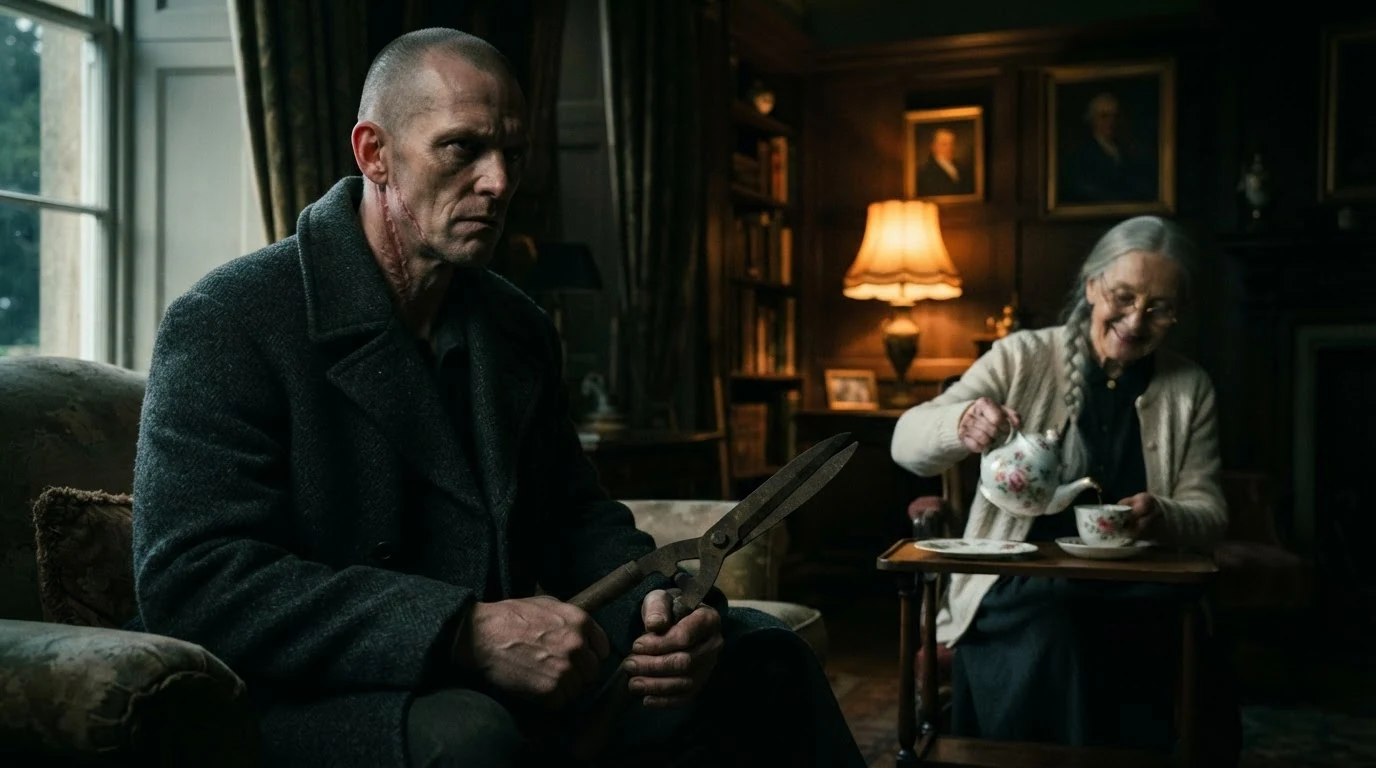
The prompt stages misdirection by planes. "Foreground, sharp focus," "hard cold sidelight" and "half his face in deep shadow" make the groundskeeper look guilty, and the shears give the audience a weapon to fixate on. "Background, soft focus," "warm table lamp" and "smiling gently" make the grandmother read as harmless, and that's exactly where a mystery would hide its culprit. The scar, braid and spectacles make both characters specific, invented people. This frame is the start frame for the video recipe.
Open FlashBoardsMystery film insert shot, anamorphic widescreen. Extreme close-up on a mahogany writing desk: an ornate silver letter opener with a dark red smear on the blade lies across an unfinished handwritten letter, lit by a narrow hard beam from a desk lamp, sharp focus, left half of frame. Right side of frame, far behind and soft out of focus: a delicate porcelain teacup with a faint pink lipstick mark on the rim, barely lit, sitting on a side table. Shallow depth of field, 100mm macro lens, dark wood tones, deep shadows, cinematic film still.
This is the object version of the same trick, as an insert. The letter opener gets everything that says "clue": "extreme close-up," "hard beam," "sharp focus" and a red smear. The real evidence, the teacup with lipstick on the rim, is still in frame, but "far behind," "soft out of focus" and "barely lit." That's the fair-play rule in one image: the truth is on screen, just underweighted. The teacup also links back to the tea-pouring grandmother in recipe 1.
Open FlashBoardsCamera: slow steady push-in toward the groundskeeper in the foreground, moving about a third of the way closer over the shot, focus staying on him the whole time. Action: from the first frame the groundskeeper is already turning his head slowly toward the camera, his grip tightening on the garden shears. In the middle he looks straight into the lens, jaw clenched, the cold window light sliding across the scar on his neck. At the end he stays still and staring, while behind him in soft focus the elderly woman with the silver braid stops pouring, sets the teapot down and glances toward him for a moment before going back to smiling.The push-in and "focus staying on him" keep all the cinematic emphasis on the decoy, the way a thriller would cut it. "Already turning his head" makes the shot alive from the first frame so it doesn't drift into a push on a still image. The woman's glance happens in soft focus in the background: that's the real tell, visible on a second viewing and easy to miss on the first. Everything named is already in recipe 1's frame, so the model has nothing new to invent.
Open FlashBoardsCommon mistakes
- Everyone looks guilty. Ask for "a suspicious scene" and models light every face moodily. Assign the mood per character: hard shadow for the decoy, warm light and a smile for the real culprit.
- Everything in focus. Image models often render the background as sharp as the foreground, which kills the hierarchy. State "foreground, sharp focus" and "background, soft focus" and give a lens (40mm or longer).
- The real clue disappears. If you describe the hidden detail too vaguely, it doesn't get drawn. Name it concretely ("a teacup with a pink lipstick mark on the rim") and then weaken it with position and light, not by leaving it out.
- The video camera wanders to the background. Say "focus staying on him the whole time," otherwise the model may rack focus to the second character and give away the reveal.
- Named negatives backfire. Writing "she is not holding a weapon" can put a weapon in her hand. Describe what she is doing instead: pouring tea, smiling.
Keep the reference frames, prompts and every generated take side by side — images and video in one canvas.
FAQ
6 questionsWhat is a red herring in a movie?
A red herring is a false clue, suspect or event that a film deliberately emphasizes so the audience reaches the wrong conclusion. It keeps viewers busy with a tempting wrong answer while the real one is set up quietly. Classic examples include Snape in Harry Potter and the Sorcerer's Stone, Old Man Marley in Home Alone and the stolen money in Psycho.
What are some famous red herring examples in film?
Psycho (1960) builds its first act around stolen money, then drops that story. Jaws (1975) has a caught tiger shark that isn't the killer. The Usual Suspects (1995) points the investigator at Keaton. Batman Begins (2005) introduces a decoy Ra's al Ghul. Knives Out (2019) and Clue (1985) give every suspect a motive, so the whole cast works as a set of red herrings.
Is a red herring the same as misdirection?
A red herring is a specific tool of misdirection. Misdirection is the broader practice of steering attention away from something, and it includes editing, framing, music and performance. A red herring is the concrete false lead the misdirection is built around: a suspect, an object, a theory. You can misdirect without a red herring, for example by cutting away early, but every red herring is misdirection.
What is the difference between a red herring and a plot twist?
A red herring is the setup and a plot twist is the payoff. The red herring holds the audience's attention on a wrong answer; the twist reveals the right one and changes how earlier scenes read. Many twists rely on red herrings, but a twist can also come without any false lead, simply by revealing information the audience had no reason to question.
Why is it called a red herring?
A smoked herring turns reddish and has a strong smell. The phrase is usually traced to a story William Cobbett published in the early 1800s about using one to drag hounds off a hare's scent. The metaphor fits storytelling well: a red herring doesn't remove the real trail, it lays a stronger, more tempting one across it.
Is using a red herring cheating the audience?
Only when the film breaks fair play. A red herring is fair if the real answer was on screen and readable, and if the false lead gets cleared in a way that makes sense. It becomes a cheat when the truth depends on information the audience never saw, or when the decoy is simply dropped. The test: on a second viewing, the clues should hold up.
Related terms
5- MacGuffinStorytelling
A MacGuffin is the object everyone in the story is chasing — a briefcase, a formula, a statue — whose exact nature barely matters; it exists to set the characters in motion. Hitchcock popularized the term.
- ForeshadowingStorytelling
Foreshadowing plants hints — an object, a line, an image — that prepare the audience for what comes later, so the payoff feels both surprising and inevitable. Chekhov's gun is its strictest form.
- Plot TwistStorytelling
A plot twist is a revelation that overturns what the audience believed about the story or a character; a good one is prepared by fair clues and recolors everything seen before.
- Unreliable NarratorStorytelling
An unreliable narrator is a storyteller — through voice-over or a point-of-view protagonist — whose account the audience can't fully trust because they lie, misremember or misread what happens.
- Plot DeviceStorytelling
A plot device is any object, character or situation whose main job is to move the story forward — a MacGuffin, a ticking clock, a coincidence, a deus ex machina.
Further reading
Alfred Hitchcock and François Truffaut, Hitchcock/Truffaut (1966) — on suspense, surprise and the MacGuffin. Michael Quinion, World Wide Words — on the origin of the phrase "red herring."