 FlashBoards Learn
- Learn
- Storytelling
- Post-Credits Scene
Storytelling · Film language
Post-Credits Scene
Also called: stinger, mid-credits scene, end-credits scene, credit cookie
A post-credits scene is a short scene placed during or after a film's end credits: a final gag, a coda for a side character, or a tease of the next installment. It rewards the viewers who stay in their seats and lets the film say one more thing after the story has officially ended.
- What it does
- Adds a last beat outside the main story: a joke, a small payoff or a hook for what comes next.
- Use it when
- The film has a loose thread, a running gag or a franchise future that does not belong inside the ending itself.
- Watch out
- Anything the story needs to make sense belongs before the credits; many viewers leave or stop the stream.
- Try this prompt
Dark museum vault after hours, a woman with cropped silver hair lifts a cracked obsidian mask from a shattered display case, red emergency light, 21:9
What is a post-credits scene?
A post-credits scene is any scene that plays after the closing titles have started. The climax and resolution are over, the credits roll, and the film comes back for one more moment. It is one of the narrative techniques that shape how a story ends.
There are two placements:
- Mid-credits scene. It interrupts the roll before the long crawl of crew names, so most of the room still sees it.
- End-credits scene. It plays after the very last card, for patient viewers only, which is why it is often a small joke or an extra tease.
Some films use both.
Stingers, credit cookies and the main types
Stinger is the industry name for a short scene tagged onto the credits; fans also say credit cookie or end-credits tag. Most stingers fall into four types.
The gag
A last joke, often a callback. Airplane! (1980) returns after the credits to the passenger left in a taxi at the start of the film, still waiting.
The fourth-wall sendoff
Ferris Bueller's Day Off (1986) has Ferris walk out after the credits, surprised the audience is still there, and tell them to go home. It is a fourth-wall break used as a goodbye, later parodied by Deadpool (2016).
The coda
A small payoff for a side thread. Pirates of the Caribbean: The Curse of the Black Pearl (2003) shows the monkey taking a coin from the chest, cursing itself again.
The tease
A hook for the next film, the most common use today. Iron Man (2008) brings Nick Fury into Tony Stark's house to mention the "Avengers Initiative", the model for franchise stingers that set up a sequel or crossover.
Why do filmmakers use post-credits scenes?
To protect the ending. A joke or tease before the credits would undercut the last emotional beat. Past the titles, the ending lands clean and the extra beat plays as a bonus.
To change the tone. The Avengers (2012) follows its battle with a near-silent scene of the exhausted heroes eating shawarma, a deadpan beat that would have deflated the climax.
To build a franchise. A tease plants a character, object or place for a future installment. It works like a cliffhanger with lower stakes: it opens a question but leaves the story complete.
The risk is dependence: when every film hides an announcement in the credits, the scene becomes an obligation, and a tease for a sequel that never gets made ages badly.
How to write, shoot and place a post-credits scene
Keep it short. Most stingers run from 20 seconds to two minutes: one location, one or two characters, one idea.
Make it optional. Nothing the story needs can live here. If the scene resolves a plot point, it belongs in the epilogue before the titles.
Give it one clear image. A tease works when the audience can name what they saw: a face, an object, a place. Stage it simply, a static wide or a slow push toward the reveal, and light the key object so it reads.
Choose the placement. A scene everyone should see goes mid-credits; the in-joke goes at the very end.
Cut in and out cleanly. Hard cut from a black card into the scene and back to black, usually without music.
In FlashBoards, keep the stinger frames next to the film's final scene and the planned opening of the next installment on one board, to check the tease points at something the next story uses.
Post-credits scene vs. epilogue
- An epilogue is part of the story. It sits before the credits, often jumps ahead in time, and shows where the characters ended up. It completes the denouement.
- A post-credits scene sits outside the story. It can be cut without breaking anything, often changes tone, and usually looks forward.
The line can blur: Pirates of the Caribbean: At World's End (2007) holds a scene set years later until after the credits. The test: if a viewer who leaves at the credits misses something the story promised, it is an epilogue in the wrong place.
How to create a post-credits scene with AI
3 promptsA post-credits tease lives on one readable image, so design it before you shoot. Generate the reveal frame, try a second take in a comic register, then animate the first frame to test the timing of the reveal. Keep the stinger frames on the same FlashBoards board as the film's final scene to judge them together.
Dark museum vault after hours, a heavyset woman in her sixties with a long silver braid over one shoulder, round wire-rimmed glasses, a thin scar along her left jaw and a charcoal wool coat stands behind a shattered glass display case, lifting a cracked black obsidian mask out of it with both gloved hands, lit only by a single red emergency light from above, medium shot at chest height through the broken glass, shallow depth of field, anamorphic widescreen look, still and ominous mood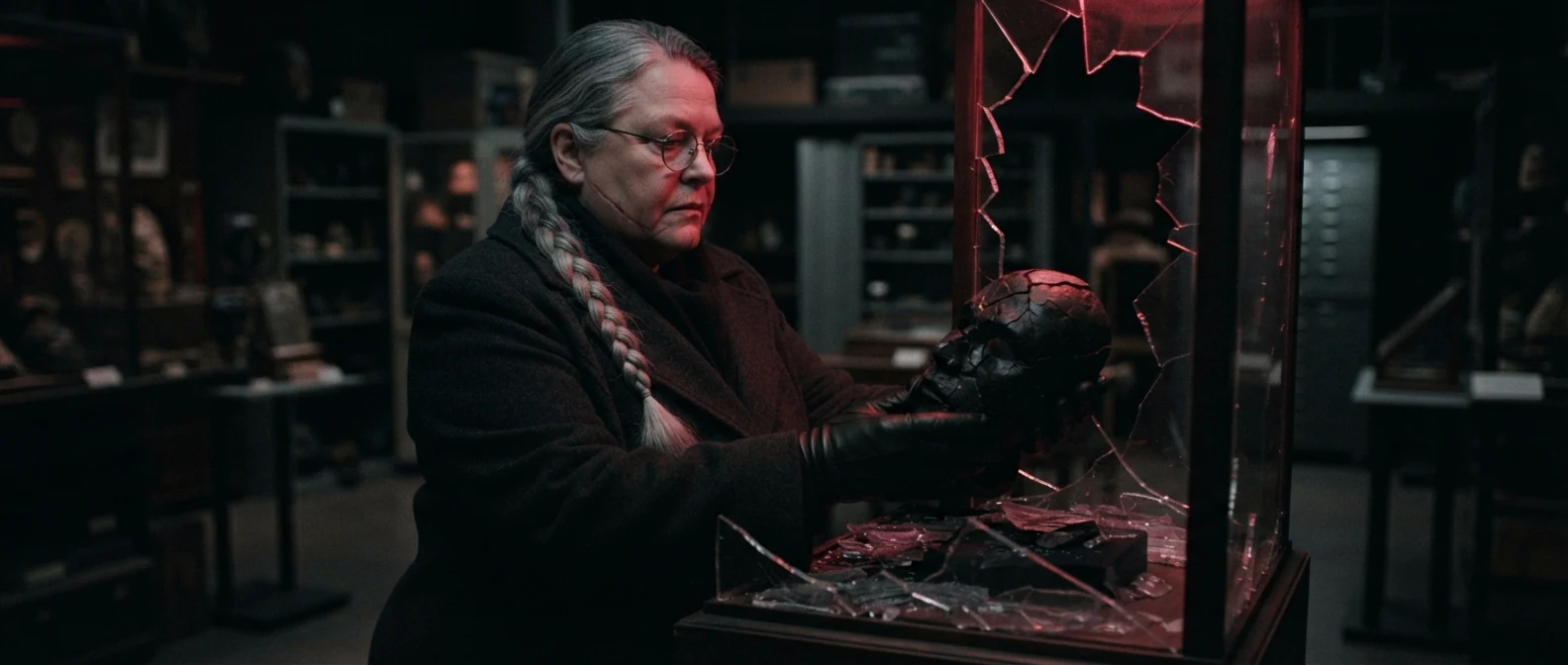
Lifting a cracked black obsidian mask gives the audience one object to name, and specific features (long silver braid, scar along her left jaw) make a character people will recognize later. The single red emergency light keeps the frame readable in seconds.
Open FlashBoardsThe ruins of a defeated villain's lair the morning after, a broad man in his forties with a ginger handlebar mustache and a dented yellow hard hat sits alone on an overturned crate among smoking rubble, eating instant noodles from a paper cup, wide static shot at eye level, centered symmetrical framing, flat daylight falling through a hole in the roof, dust hanging in the air, deadpan comedy tone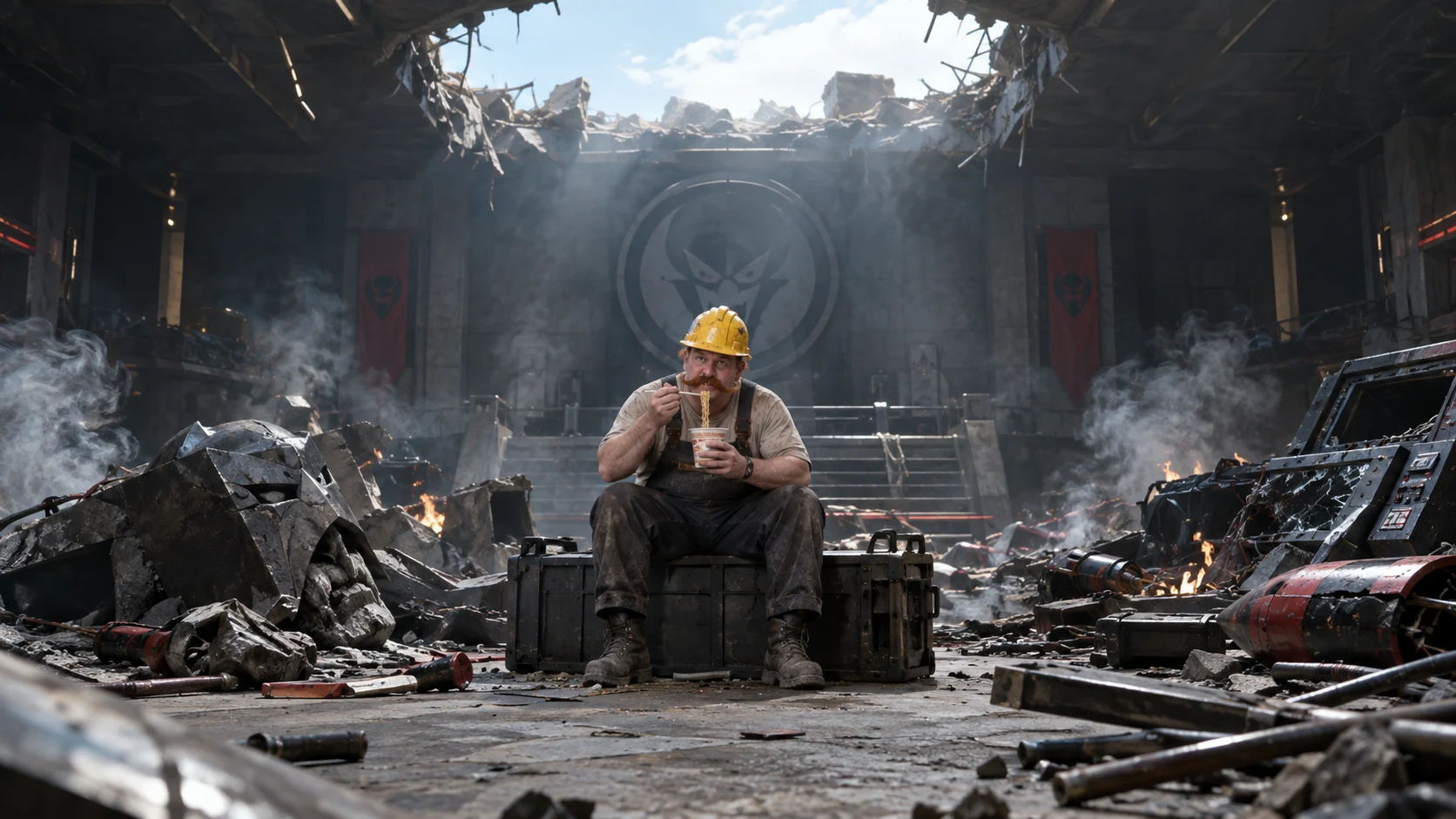
The gag stinger: a minor character left behind after the story ended. Wide static shot, centered symmetrical framing and flat daylight are deadpan comedy grammar; eating instant noodles contrasts a mundane action with the wreckage.
Open FlashBoardsCamera: a slow, steady push-in starts immediately and ends in a close-up of her face and the mask. Action: She lifts the cracked obsidian mask out of the broken case and turns it toward the red light. A thin orange glow spreads along the crack. She looks up just past the camera, and the red light flickers once.Starts immediately plus the lifting action keep the shot alive from frame one. The move ends on the reveal, the glowing crack, and her look past the lens is the last beat before the cut to black.
Open FlashBoardsCommon mistakes
- "Post-credits scene" or "end credits" in a prompt tends to add text or title cards. Describe the scene; add the credits in the edit.
- A vague "mysterious villain" turns into a generic hooded figure; give concrete features.
- Empty rooms get filled with invented props. Name only what's there.
- In the video, start the motion in the first sentence, or the model slowly zooms on a still.
Keep the reference frames, prompts and every generated take side by side — images and video in one canvas.
FAQ
4 questionsWhat is the difference between a mid-credits scene and a post-credits scene?
A mid-credits scene interrupts the credits, usually before the long crawl of crew names, so most of the audience still sees it. A post-credits or end-credits scene plays after the final card, when only patient viewers remain. Films often put the important tease mid-credits and save a smaller joke for the very end.
Why is it called a stinger?
Stinger is industry slang for a short tag at the end of a program or film, a quick last hit after the main piece is over. In movies it means the scene tagged onto the end credits. Fans also call it a credit cookie or an end-credits tag.
What was the first post-credits scene?
There is no agreed first. Short bonus bits after the end titles appear in comedies by the late 1970s and early 1980s, Airplane! (1980) among the best known. Ferris Bueller's Day Off (1986) made the fourth-wall goodbye famous, and Iron Man (2008) turned the sequel tease into a franchise habit.
Do post-credits scenes matter for the story?
They should not be required. A well-built post-credits scene is optional: the film is complete without it, and it adds a joke, a small payoff or a hook for a future installment. If a scene resolves something the plot promised, it is really an epilogue and belongs before the credits.
Related terms
3- EpilogueStorytelling
An epilogue (or coda) is a short final section after the main story is resolved, often jumping ahead in time to show where the characters ended up.
- SequelStorytelling
A sequel continues an earlier story, following the same characters or world after the events of the first film.
- CliffhangerStorytelling
A cliffhanger ends an episode, act or film at a moment of unresolved danger or revelation, so the audience has to come back to find out what happens.
Further reading
Blake Snyder, Save the Cat! (2005) on setups and payoffs; David Bordwell and Kristin Thompson, Film Art: An Introduction on narrative openings and closings.