 FlashBoards Learn
- Learn
- Storytelling
- Tragic Hero
Storytelling · Film language
Tragic Hero
Also called: Aristotelian tragic hero
A tragic hero is an admirable protagonist brought down by a flaw or an error of their own making. Because we respect them and see the fall coming, their ruin stirs pity and fear instead of contempt, and the story ends with a recognition that arrives too late to save them.
- What it does
- Makes the audience grieve for someone who caused their own ruin, and fear the same flaw in themselves.
- Use it when
- Your story is about ambition, pride or loyalty that curdles, and the ending should feel inevitable, not accidental.
- Watch out
- If the hero is unlikable from the start or the fall comes from outside bad luck, you get a cautionary tale or a melodrama, not tragedy.
- Try this prompt
Wide high-angle shot, an old man in a rumpled suit alone at the head of a banquet table set for twenty, every chair empty, candles burned low
What is a tragic hero?
The term comes from Aristotle's Poetics, which described the ideal figure of Greek tragedy: a person better than most of us, but not perfect, who falls from good fortune to misery through an error rather than villainy. Oedipus is his model: a capable king who hunts for the cause of a plague and discovers that he is the cause.
In film the tragic hero is a specific kind of protagonist. The goal and the flaw are tangled together, so every step toward winning is also a step toward the end.
What are the characteristics of a tragic hero?
Most tragic heroes share six traits:
- Stature. Power, talent or moral standing, so the fall has a height. Today: a mob heir or a tycoon.
- Hamartia. The fatal error or flaw: a blind spot, an obsession, one wrong judgment.
- Hubris. Often the flaw is overweening pride: the belief that the rules don't apply to them.
- Reversal. The action turns against the hero, what the Greeks called peripeteia.
- Recognition. The hero finally sees the truth, the moment of anagnorisis.
- Undeserved suffering. The punishment exceeds the crime, which produces pity, and it could happen to us, which produces fear. The release at the end is catharsis.
The hero must also choose. If a storm or a stranger ruins them, we pity a victim; tragedy needs the hero's own hand on the lever.
Tragic hero examples in film
- Charles Foster Kane, Citizen Kane (1941). A gifted publisher whose need to be loved on his own terms empties his life. He walks between facing mirrors that multiply him into an endless line of reflections.
- Michael Corleone, The Godfather (1972) and Part II (1974). A war hero who steps into the family business to protect the family and destroys it. Part II ends on him sitting alone.
- Macbeth, from Throne of Blood (1957) to The Tragedy of Macbeth (2021). A brave soldier whose ambition pushes him from murder to murder.
- Hidetora, Ran (1985). Kurosawa's King Lear: a warlord who misjudges his sons and watches his kingdom burn.
- Jay Gatsby, The Great Gatsby (2013). A self-made man undone by his faith that the past can be bought back.
- Blanche DuBois, A Streetcar Named Desire (1951). Her illusions are both her dignity and her ruin.
How to show a tragic hero on screen
Tragedy is a shape over time, so plan the visuals as a curve:
- Build the height first. Early scenes give the hero command of the frame: centered compositions, slightly low angles, rooms that turn toward them.
- Plant the flaw in an image. Show the trait before it costs anything, like a hand waving away advice. Viewers who spot it early feel the dread of dramatic irony.
- Shrink the world. As the fall accelerates, go wider and higher, empty the rooms, and use longer lenses that isolate the figure.
- Stage the recognition close. The anagnorisis belongs in a held close-up, lit so the face can change without a cut.
- End on solitude. Many tragedies close on the hero alone in a space that was once full.
In FlashBoards you can lay the arc out on one board: reference frames for the rise, the turn and the ending in three rows, with generated key frames beside them to check that the frames really grow emptier.
Tragic hero vs. anti-hero
Both are flawed protagonists, but they start in different places.
| | Tragic hero | Anti-hero | |---|---|---| | Starting point | Admirable, high status | Compromised from the start | | Flaw | One fatal trait or error | Many, often part of the appeal | | Arc | Fall from height | May rise, stay flat or fall | | Audience feeling | Pity and fear | Fascination, guilty sympathy |
A character can move from one to the other: Michael Corleone starts as a tragic hero and ends close to a dark anti-hero, a character arc at its most tragic. More devices like these live in storytelling.
How to create a tragic hero with AI
4 promptsYou can't generate a flaw, but you can generate its consequences. Nano Banana 2 Lite builds the final image of the fall, GPT Image 2.5 stages a recognition close-up, and MiniMax H3 Max Turbo animates the first frame into the hero's last walk. Keep all three on one FlashBoards board. The fourth prompt re-shoots a real film shot from a text description alone, and the original plays next to the result so you can compare.
Wide high-angle shot down a vast, dim banquet hall. A long table set for twenty with silver and crystal, every chair empty, candles burned down to stubs. Far away at the head of the table, small in the frame and facing the camera, stands a silver-haired man in his sixties with a hooked nose, deep-set gray eyes and a trimmed white beard, in a rumpled black three-piece suit, one hand on the back of his chair. Cold moonlight from tall windows, warm candle glow, 35mm lens, somber film still.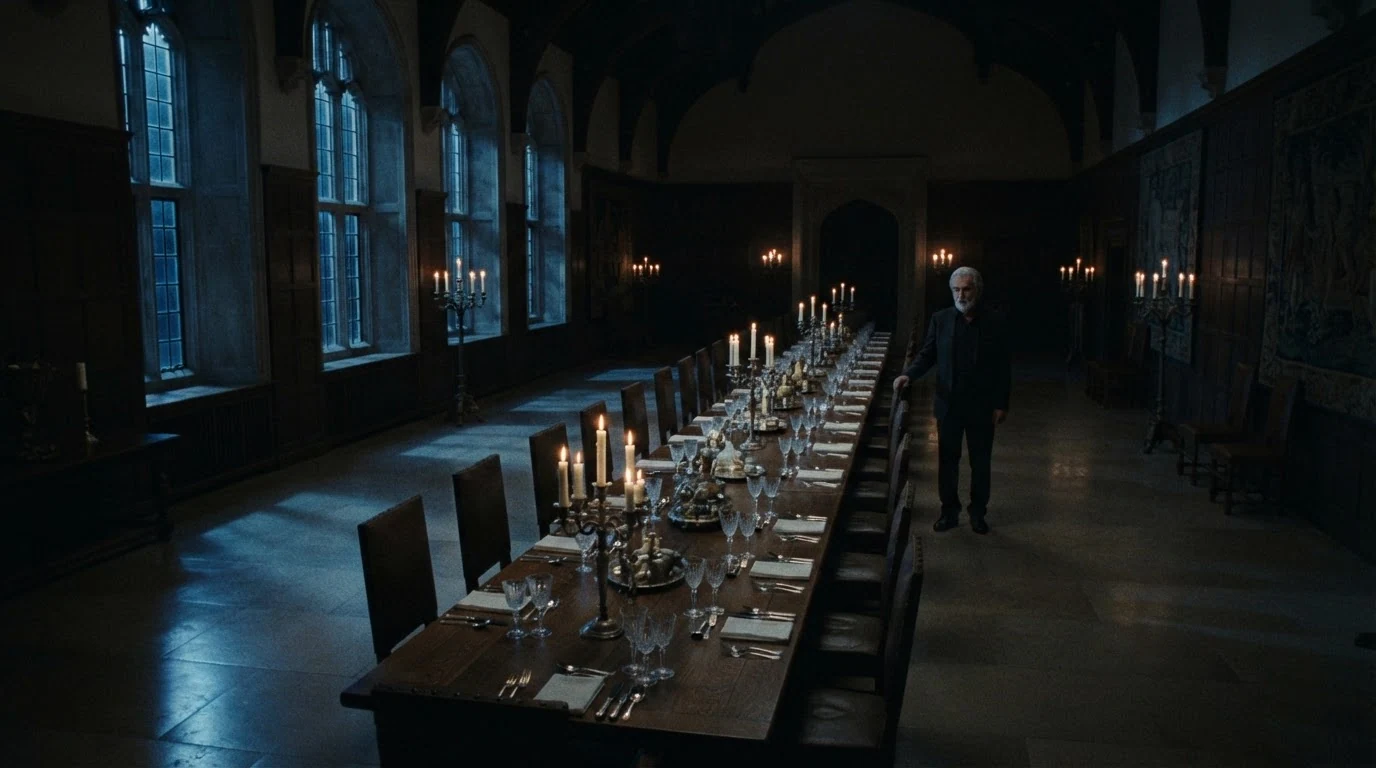
Every chair empty and candles burned down to stubs tell the fall; the high angle and placing him far away at the head of the table make him small in the frame. The rich table keeps the lost height visible.
Open FlashBoardsClose-up at eye level on a woman in her forties with close-cropped black hair, a thin white scar across her chin and dark brown eyes, in a mud-streaked officer's greatcoat, kneeling in a rain-soaked field at dawn. She stares at an unfolded letter in her gloved hands, her face frozen between disbelief and understanding. Soft gray dawn light, shallow depth of field, a blurred torn banner behind her, 85mm lens, film still.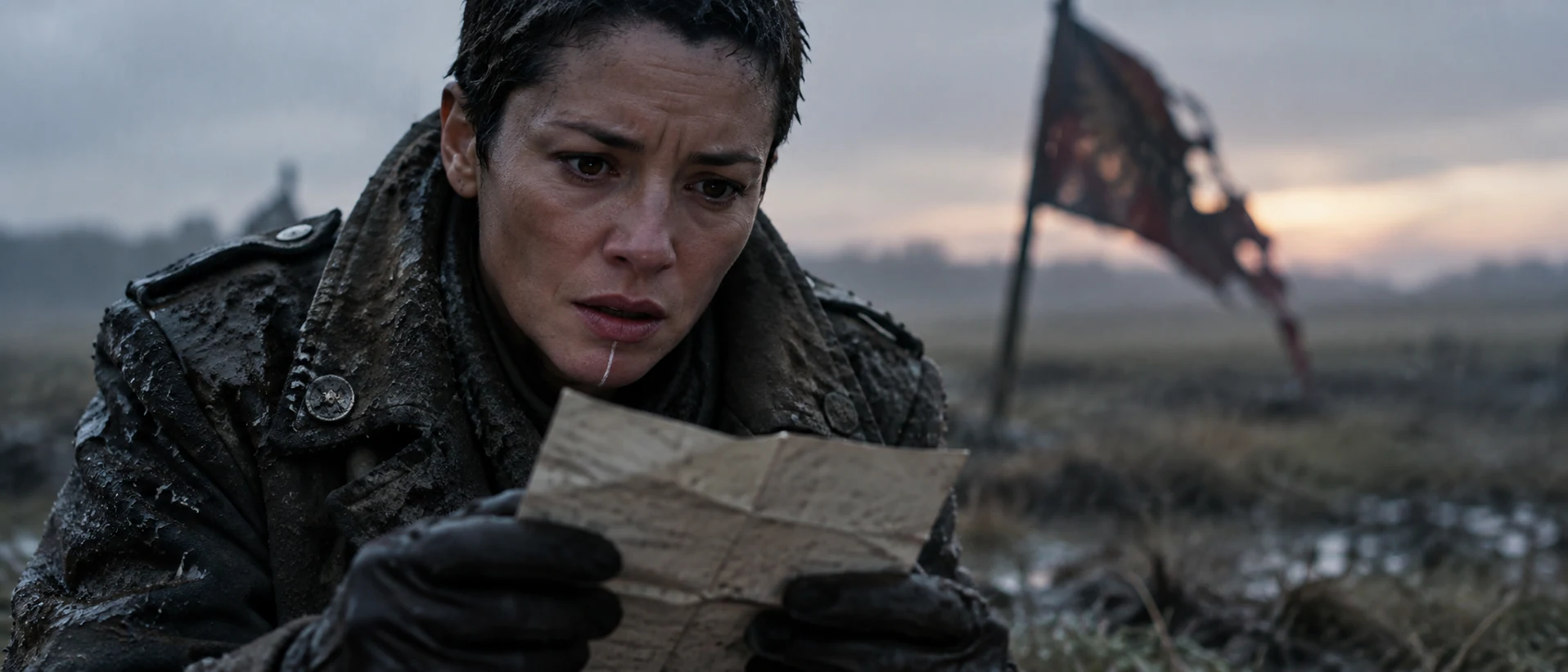
This is the recognition beat. Frozen between disbelief and understanding gives the expression a direction; the 85mm close-up and shallow depth of field remove the world, leaving only the realization.
Open FlashBoardsCamera: a very slow, steady pull-back from the far end of the table, rising slightly, so the hall grows larger and the man smaller. Action: The man is already lifting his hand from the chair. He walks slowly along the table, trailing his fingers across the empty chair backs. Halfway down he stops, looks at the empty seats, and sits in a chair at the side of the table, not the head.Already lifting his hand keeps the shot alive from the first frame. Sitting at the side, not the head shows his lost place without adding anything that isn't in recipe 1.
Open FlashBoards{
"output": "Full-screen live-action film shot from Braveheart (1995), one continuous shot from its very first frame: a condemned hero carried in a cart through a gate into a vast jeering crowd. Overcast cold daylight, desaturated blue-gray palette, drifting smoke, medieval London square, 35mm film grain, scope framing.",
"characters": {
"S1": {
"name": "William Wallace, played by Mel Gibson",
"look": "long tangled brown hair, bare arms, torn brown tunic and belted kilt, arms stretched out and roped to a wooden yoke across his shoulders",
"voice": "silent"
}
},
"shots": [
{
"shot": 1,
"camera": "starts close among guards and a horse in the foreground by a dark stone gate, then pans left while trucking right and arcing counterclockwise around the cart, widening from a medium-wide to a high wide shot of the whole square",
"action": [
"BEGINNING: alive from the first frame, helmeted guards in red-and-gold tabards and a brown horse pass close in the foreground left to right; far back at screen right Wallace stands upright in a cart under the stone gate, arms roped to the yoke",
"THEN: the foreground guards and horse clear the frame; the cart rolls forward out of the gate shadow toward camera, Wallace in the centre-right third, head held level, eyes fixed ahead over the crowd, hands still, gripping the yoke",
"THEN: the camera swings around the cart and a packed crowd fills the lower frame, faces turned up at him, fists and arms raised; gray smoke rises from fires behind them",
"END: high wide shot, Wallace small at the centre of the frame above a sea of heads, timber stands and smoke behind him, still upright and unbowed"
],
"dialogue": [],
"voice": "silence: nobody speaks in this shot, no voice at all"
}
],
"sound": {
"ambience": "cart wheels on cobbles, hooves, a roaring hostile crowd, crackling fires",
"speech": "no words in this video; the only human sounds are breaths, movement and crowd roar",
"never_spoken": "no narration and no voice-over: the descriptions, performance notes and step words of this prompt are never spoken aloud",
"music": "a film score under the scene, always below the voices: a slow mournful low-string lament with a distant drum",
"subtitles": "none"
}
}Remakes Wallace's cart ride to execution in Braveheart (1995), keeping the arcing move that shrinks the upright hero into the crowd.
The fall is staged as spectacle: roped to a wooden yoke and still upright and unbowed keep his pride visible, while the arcing camera widens until he is small at the centre of a jeering crowd. Silence plus a mournful lament lets the image carry the tragedy.
Open FlashBoardsCommon mistakes
- Models make fallen heroes theatrical, fists raised to the sky. Ask for a still, specific action.
- A lone figure at eye level just looks sad. State the high angle and how small the figure is.
- Empty rooms get filled with extras. Describe what IS there (empty chairs, burned-down candles).
Keep the reference frames, prompts and every generated take side by side — images and video in one canvas.
FAQ
5 questionsWhat is a tragic hero in simple terms?
A tragic hero is a good, often powerful main character who ruins themselves through a personal flaw or a wrong choice. The audience admires them, sees the mistake coming and feels pity when they fall. Oedipus, Macbeth and Michael Corleone are classic examples.
What are the 6 characteristics of a tragic hero?
The usual list, drawn from Aristotle: high stature, a fatal flaw or error (hamartia), often pride (hubris), a reversal of fortune (peripeteia), a moment of recognition (anagnorisis), and suffering greater than deserved, which brings the audience catharsis. The fall must come from the hero's own choice.
What is an Aristotelian tragic hero?
An Aristotelian tragic hero follows the model in Aristotle's Poetics: a person of high standing, neither perfectly virtuous nor wicked, who falls into misfortune through an error of judgment rather than vice. The fall should arouse pity and fear. Sophocles' Oedipus is Aristotle's own example.
What are some tragic hero examples in film?
Often-cited examples include Charles Foster Kane in Citizen Kane (1941), Michael Corleone in The Godfather films, Hidetora in Ran (1985), Gatsby in The Great Gatsby (2013) and Blanche DuBois in A Streetcar Named Desire (1951). Each falls from a height through a flaw of their own.
Is a tragic hero the same as an anti-hero?
No. A tragic hero starts admirable and falls through one fatal flaw, drawing pity and fear. An anti-hero lacks conventional heroic qualities from the start and wins sympathy despite them. Michael Corleone drifts from one to the other across The Godfather films.
Related terms
3- Anti-HeroStorytelling
An anti-hero is a protagonist who lacks conventional heroic qualities — selfish, cynical or morally compromised — yet still carries the story and the audience's attention.
- CatharsisStorytelling
Catharsis is the emotional release an audience feels when a story's built-up tension breaks — through tears, relief or laughter — usually at or right after the climax.
- ProtagonistStorytelling
The protagonist is the main character whose goal drives the story and whose choices the audience follows; they don't have to be good, just central.
Further reading
Aristotle, Poetics (trans. Malcolm Heath, Penguin Classics, 1996). A. C. Bradley, Shakespearean Tragedy (1904). Robert McKee, Story (1997).